Rong May Glass Bridge is a cliff-edge glass skywalk on O Quy Ho Pass, about 17 km from Sapa town, open daily from 7:00 AM to 5:30 PM with adult tickets at 500,000 VND (₹1,750) including the glass elevator. Often called Vietnam’s highest glass bridge and marketed to visitors as the Sapa Glass Bridge, it sits more than 2,000 m above sea level on the Lai Chau side of the pass.
The key facts are:
| Fact | Detail |
|---|---|
| Opening hours | 7:00 AM–5:30 PM, daily |
| Ticket (includes glass elevator both ways) | Adult (over 1.4 m): 500,000 VND (₹1,750) · Child (1–1.4 m): 300,000 VND (₹1,050) · Under 1 m: free |
| Adventure games | 150,000 VND (₹525) per game |
| Location | O Quy Ho Pass, Binh Lu Commune, Lai Chau Province |
| From Sapa town | About 17 km, 30–45 minutes by car |
| Time needed | 1.5–3 hours |
Each of these is explained below, from the ticket types to the best months for cloud views.

What Is the Rong May Glass Bridge in Sapa?
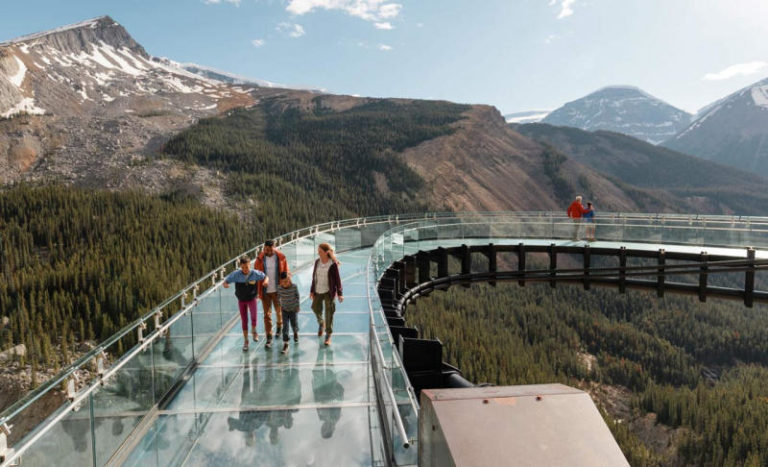
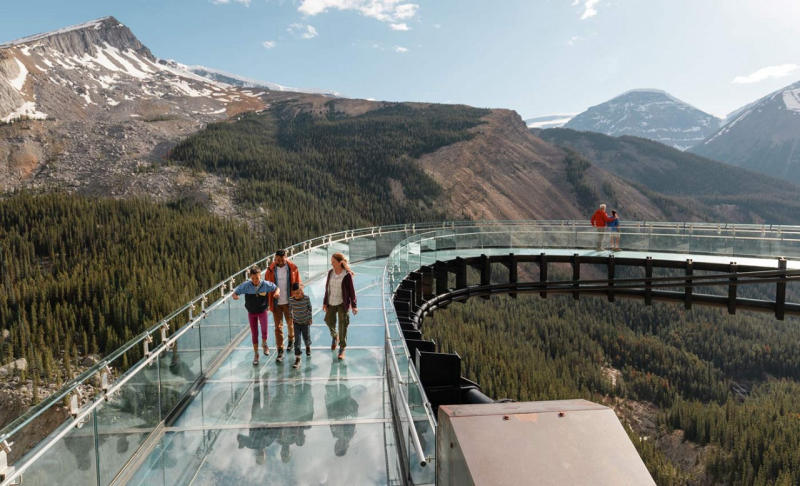
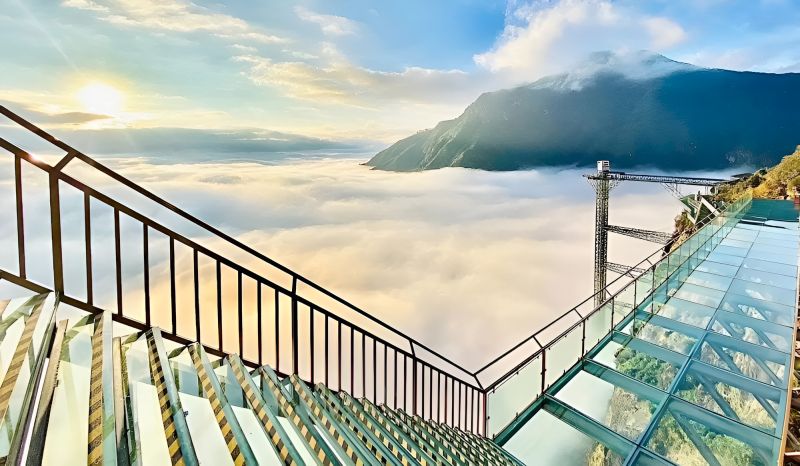
Rong May Glass Bridge is a glass skywalk and glass elevator complex built into the cliff of O Quy Ho Pass, where a 60-metre glass overhang looks out over the Hoang Lien Son range. The name “Rồng Mây” translates directly to Dragon Cloud in English: Rồng means Dragon and Mây means Cloud, a name earned from the way morning fog wraps around the structure like a dragon moving through the sky.
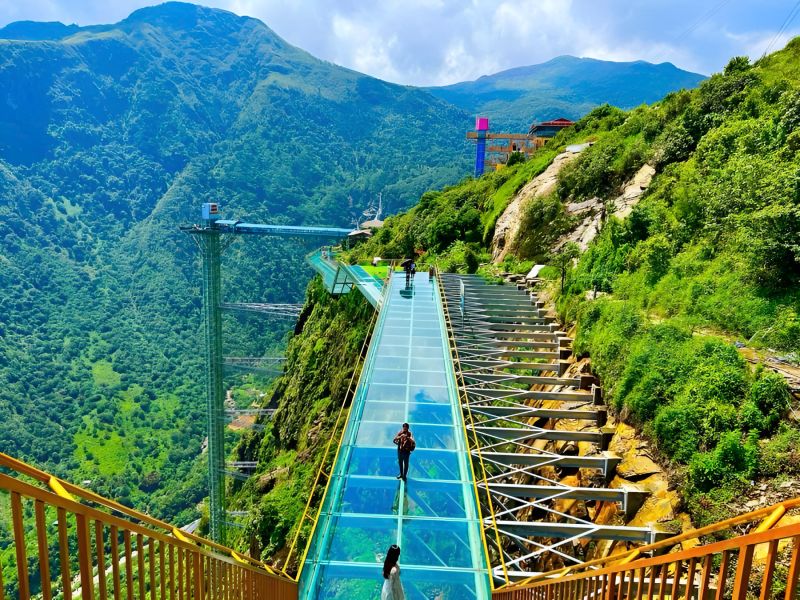
The glass elevator rises about 300 metres up the cliff, with the first 80 metres inside the mountain, before it opens onto the bridge deck. The deck extends 60 metres out from the cliff as a transparent glass overhang, with 4 walkway corridors spreading in different directions, so visitors can walk a circuit of about 300 metres. The glass panels are made of 3 layers of tempered glass, and the elevator carries about 1,200 people per hour.
When Was Rong May Glass Bridge Built?
Rong May Glass Bridge construction began in January 2018 and the bridge opened on 16 November 2019. The investor, Hoang Lien Son Group, put more than VND 1,000 billion (about ₹350 crore) into the elevator and glass bridge. The complex was developed to add a new mountain attraction near Sapa beyond Fansipan.
Are Cloud Dragon Skywalk and Rong May Glass Bridge the Same?
Yes. Cloud Dragon Skywalk and Rong May Glass Bridge refer to the same structure on O Quy Ho Pass, inside the Rong May Tourist Complex in Binh Lu Commune, Lai Chau Province. “Cloud Dragon” and “Dragon Cloud” are alternative English translations of the Vietnamese name “Rồng Mây”, and both are used interchangeably by Vietnamese and international tour operators. There is no separate “Cloud Dragon” bridge in Sapa.
Is Rong May Glass Bridge the Highest Glass Bridge in Vietnam?
Yes, Rong May is widely described as Vietnam’s highest glass bridge because it sits more than 2,000 m up on O Quy Ho Pass, while Bach Long in Moc Chau holds the Guinness record as the world’s longest glass pedestrian bridge at 632 m.
The 2 bridges are the best-known glass bridges in northern Vietnam, and they suit different priorities: Rong May for height and cloud views, Bach Long for length and a shorter drive from Hanoi. They compare as follows:
| Criterion | Rong May Glass Bridge | Bach Long Glass Bridge |
|---|---|---|
| Location | O Quy Ho Pass, Lai Chau (17 km from Sapa) | Moc Chau, Son La |
| Known for | Height on the pass | World’s longest glass pedestrian bridge (Guinness) |
| Glass length | About 300 m of corridors, 60 m overhang | 632 m |
| Height | Elevator rises about 300 m | 150 m above the ground |
| From Hanoi | About 330 km, 6–7 hours | About 4–5 hours |
| Glass elevator | Yes | No |
| Ticket | 500,000 VND (₹1,750) | — |
Indian travellers who prioritise altitude, cloud photography and adventure games choose Rong May Glass Bridge, while those who prioritise a record-length glass walk and a shorter drive from Hanoi choose Bach Long. Once the structure is clear, the next practical question is where the bridge sits on the map, because its location shapes every transport and timing decision for the visit.
Where Is Rong May Glass Bridge Located?
Rong May Glass Bridge is located on O Quy Ho Pass in Binh Lu Commune, Lai Chau Province, about 17 km from Sapa town along National Highway 4D. Since July 2025, the former Son Binh commune has been part of Binh Lu Commune, so older maps still show Tam Duong District. The bridge sits on the summit ridge of O Quy Ho Pass, 1 of Vietnam’s 4 great mountain passes, collectively known as the “tứ đại đèo”, on the Lai Chau side of the provincial border with Lao Cai.
The Google Maps coordinates for Rong May Glass Bridge are 22°19’14.6″N, 103°44’43.8″E. Travellers should save these coordinates offline before leaving Sapa town, because mobile data on O Quy Ho Pass is intermittent and GPS routing can be unreliable without a downloaded map. The distances that matter are:
| From | Distance | Time |
|---|---|---|
| Sapa town | About 17 km | 30–45 minutes by car |
| Hanoi | About 330 km | 6–7 hours by road |
| Fansipan cable car station (Sapa town) | About 17 km | 30–45 minutes |
National Highway 4D between Sapa town and the bridge is a continuous mountain switchback road: spectacular, but not suited to self-driving without mountain driving experience in Vietnam. Most visitors stay in Sapa town and come up for half a day, so the base for the trip matters, and the travel guide to Sapa Vietnam covers where to stay, the villages and the cable car.
Rong May Glass Bridge Ticket Price and Entrance Fee in 2027
The standard Rong May Glass Bridge adult ticket costs 500,000 VND (₹1,750) and includes the glass elevator in both directions, while children from 1 m to 1.4 m pay 300,000 VND (₹1,050) and children under 1 m enter free.
Ticket categories at Rong May Glass Bridge are set by height rather than age:
| Ticket | Height | Price (VND) | Price (₹) | Glass elevator |
|---|---|---|---|---|
| Adult | Above 1.4 m | 500,000 | ₹1,750 | Yes (both ways) |
| Child | 1–1.4 m | 300,000 | ₹1,050 | Yes (both ways) |
| Infant | Under 1 m | Free | Free | Yes (with parent) |
| Walking-trail ticket, adult | Above 1.4 m | 200,000 | ₹700 | No |
| Walking-trail ticket, child | 1–1.4 m | 100,000 | ₹350 | No |
Each adventure game inside the Rong May Glass Bridge complex, including the zipline, the Death Swing, the sky bike and the Invisible Bridge, costs a separate 150,000 VND (₹525) per turn. Visitors should carry cash, as card payment is not always available at the game counters.
Tickets are sold at the counter on arrival and through online agents. Queues at the counter and the elevator can reach 30 minutes or more on December weekends, so an early start helps in peak season.
Does the Rong May Glass Bridge Ticket Include the Glass Elevator?
Yes. The standard 500,000 VND adult ticket includes the glass elevator ride both up and down. The elevator is not charged separately when the standard ticket is bought. The walking-trail ticket at 200,000 VND does not include the elevator and requires a long, steep uphill climb on foot.
Rong May Glass Bridge Opening Hours
Rong May Glass Bridge is open every day from 7:00 AM to 5:30 PM, including weekends and public holidays. A visit takes 1.5–3 hours, including the elevator queue, the deck and 1 or 2 games, so arriving by 3:30 PM leaves enough time before closing. The first hour after opening, from 7:00 AM to 8:30 AM, has the shortest queues and the best chance of clouds below the deck.
The Rong May Glass Bridge deck and elevator keep running in light rain and fog. The adventure games, however, can pause for 30 minutes to 2 hours in strong wind or heavy rain, as a standard safety hold by the on-site team.
Best Time to Visit Rong May Glass Bridge
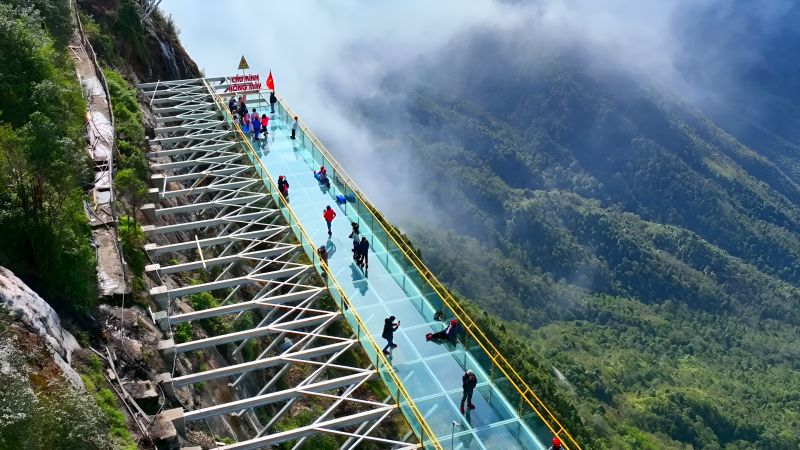
Rong May Glass Bridge is at its best from September to December, when clear mornings and cloud seas below the deck are most common.
Best Months for Clear Views and Cloud Seas
October to December gives the best mix of clear mornings and cloud seas below the Rong May Glass Bridge deck. September through November brings the clearest skies for panoramic views, with lower humidity than the summer months and Sapa hotel prices below the December peak. October to early November is the practical sweet spot for travellers who want good conditions without the year-end crowds, while December adds the most frequent cloud seas at the cost of colder mornings and longer queues.
The pass follows Sapa’s wider weather pattern, and the month-by-month rainfall and temperatures are set out in the guide to the best time to visit Sapa. Travellers tied to the Indian summer break can see what the north is like in late spring in the guide to Vietnam in May, when the pass is green and less crowded.
Is Rong May Glass Bridge Cold?
Yes. The pass at Rong May Glass Bridge runs 3–5°C colder than Sapa town at the same hour. Even in the summer months, a light jacket helps, because the wind on the 60-metre overhang makes the air feel colder still. Timing defines when to visit, and the next question is how to get from Hanoi or Sapa to the complex entrance on National Highway 4D.
How to Reach Rong May Glass Bridge from Hanoi and Sapa
Travellers reach Rong May Glass Bridge in 2 stages: first from Hanoi to Sapa town, then 17 km from Sapa town to the complex entrance on National Highway 4D. All the options for the first stage, from limousine vans to the night train, are compared in the guide on how to get from Hanoi to Sapa.
Stage 1 — Hanoi to Sapa Town
Limousine van is the most common way from Hanoi to Sapa, taking 5.5–6 hours for 320,000–450,000 VND (₹1,125–₹1,580) per person one way. The options compare as follows:
| Option | Time | Cost per person |
|---|---|---|
| Limousine van | 5.5–6 hours | 320,000–450,000 VND (₹1,125–₹1,580) |
| Overnight sleeper bus | 6–7 hours | 270,000–370,000 VND (₹945–₹1,300) |
| Overnight train to Lao Cai + shuttle | 8–9 hours | Hard seat 290,000 VND (₹1,020) to 4-berth soft sleeper 790,000 VND (₹2,770), plus a 40,000–50,000 VND shuttle up to Sapa |
| Private car (4 seats) | 5–5.5 hours | 3,200,000–4,400,000 VND (₹11,230–₹15,440) per car, one way |
The train runs only as far as Lao Cai, not to Sapa itself, so the last 35 km is always by road. The private car suits families of 3–4 or groups with older members who prefer not to manage transfers. Prices are approximate and change by season.
Stage 2 — Sapa Town to Rong May Glass Bridge
A taxi or Grab from Sapa town to Rong May Glass Bridge costs about 350,000–400,000 VND (₹1,230–₹1,405) one way, or about 700,000 VND (₹2,455) return with the driver waiting.
From Sapa town, the road follows National Highway 4D towards O Quy Ho Heaven’s Gate for 17 km to the complex entrance. A return fare agreed before leaving town is the safer choice, because empty taxis rarely pass the complex for the trip back. A free shuttle runs between the main road and the glass elevator base inside the complex.
Is There Direct Transport from Hanoi to Rong May Glass Bridge?
No. No direct bus or train runs from Hanoi to Rong May Glass Bridge, and every route requires a change in Sapa town. Travellers who prefer not to coordinate 2 transport bookings, a return taxi and game tickets separately can book a Vietnam Sapa tour package that brings all of these into 1 confirmed booking.
Adventure Games at Rong May Glass Bridge
Beyond the glass skywalk included in the ticket, Rong May has several adventure games at 150,000 VND (₹525) per turn: the Death Swing, a high-speed zipline, a sky bike, a single-plank bridge and the Invisible Bridge. The games compare as follows:
| Activity | Price (VND / ₹) | Duration | Suitable for |
|---|---|---|---|
| Glass skywalk | Included in 500,000 / ₹1,750 | — | All ages |
| Death Swing | 150,000 / ₹525 | — | Not for heart conditions |
| High-speed zipline | 150,000 / ₹525 | About 45 min | Height and weight limits apply |
| Sky bike (rope bike) | 150,000 / ₹525 | About 20 min | Easiest paid game |
| Single-plank bridge | 150,000 / ₹525 | — | Steady nerves |
| Invisible Bridge (Cloud Walk bridge) | 150,000 / ₹525 | — | Families with children aged 8+ |
Glass skywalk — included in the 500,000 VND ticket: The 60-metre glass overhang is the experience that most visitors travel to O Quy Ho Pass for, and it suits all ages and fitness levels.
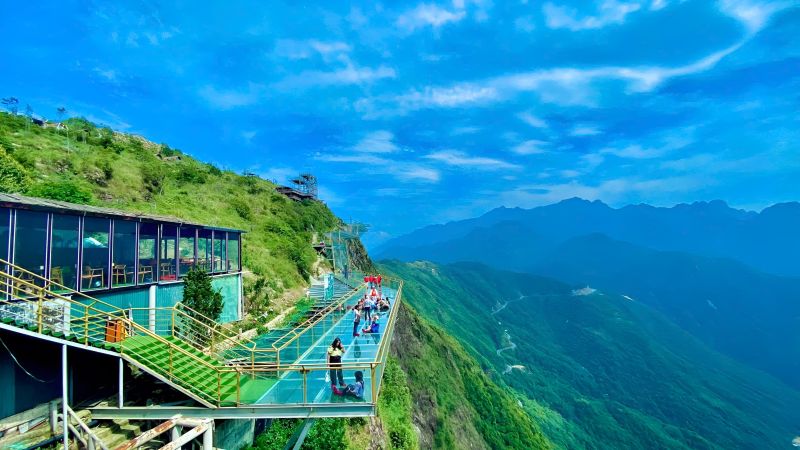
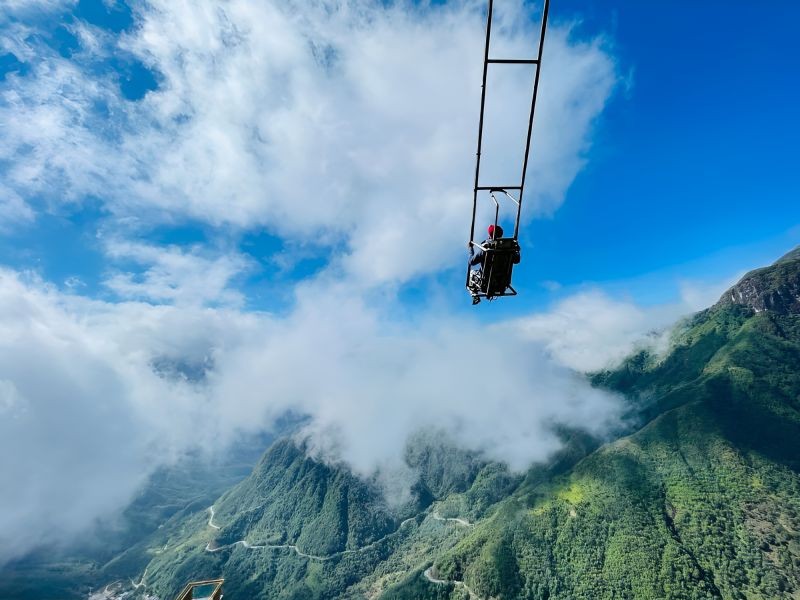
Death Swing — 150,000 VND (₹525) per turn: The Death Swing launches from the cliff face and swings the rider out over the open valley. It is not suitable for visitors with heart conditions, high blood pressure or severe vertigo.
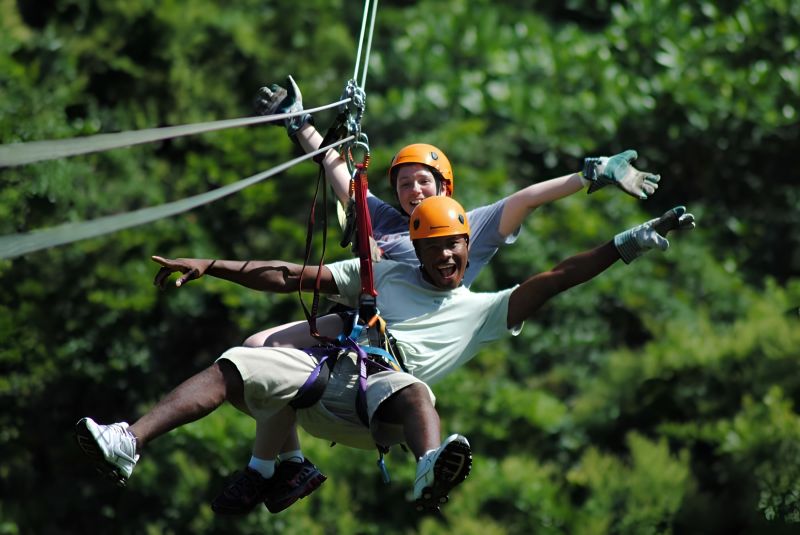
High-speed zipline — 150,000 VND (₹525) per run: The zipline takes about 45 minutes, including the safety briefing and harness fitting, and gives a view of the valley that the deck alone does not. Height and weight limits are confirmed at the counter.
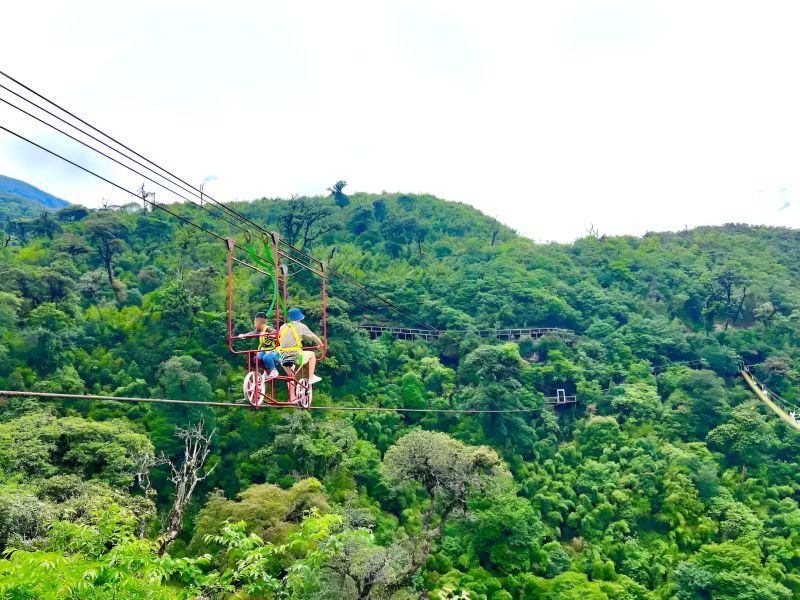
Sky bike (rope bike) — 150,000 VND (₹525): The sky bike is a cable-suspended bicycle ridden above the valley on a circuit of about 20 minutes, and it is the gentlest step up from the glass skywalk for travellers unsure about the swing or the zipline.
What Is the Invisible Bridge at Rong May?
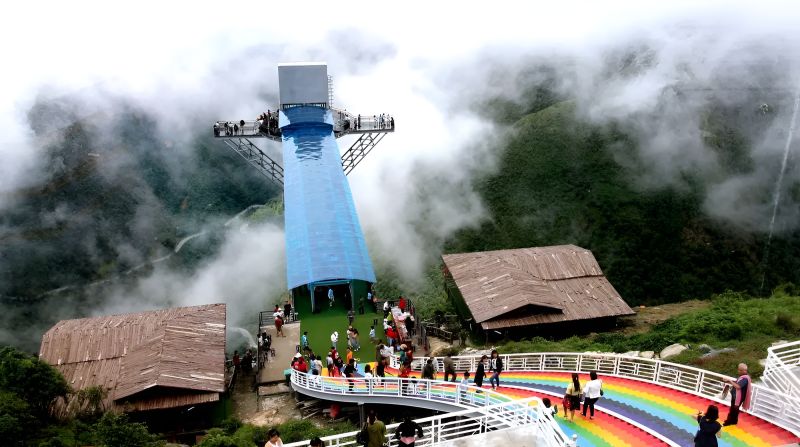
The Invisible Bridge, also signposted as the Cloud Walk bridge, is a narrow wooden suspension bridge strung across the cliff beside the glass deck, costing 150,000 VND (₹525) per turn with a harness and helmet provided.
When fog rolls in, the planks seem to disappear into the cloud, which gives the Invisible Bridge its name and the feeling of stepping between clouds. The swaying motion is gentler than the Death Swing or zipline, making the Invisible Bridge the most family-friendly paid game for children aged 8 and above. The best photos of this wooden bridge in Sapa are taken from the glass deck, looking across at the bridge against the valley.
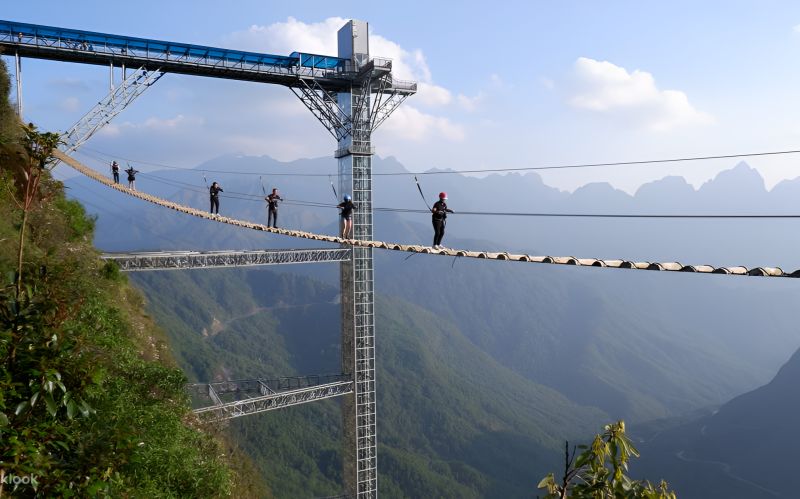
Rong May Glass Bridge Photos: 4 Best Spots for Instagram-Worthy Shots
The 4 best photo spots in Rong May are the glass elevator, the bridge’s central junction, the Death Swing launch point and the roadside viewpoint near the entrance. The spots are:
- Glass elevator ascent: The glass walls give a straight-down view of the valley, and the best moment is when the elevator passes through the cloud layer. Holding the phone flat against the glass removes reflections. Best in the first hour after opening, 7:00–8:30 AM.
- Bridge centre (corridor junction): The junction of the corridors gives a wide view of the Hoang Lien Son range, and Fansipan (3,143 m) is visible on clear days. Best on clear days between 9:00 and 11:00 AM.
- Death Swing launch point: The viewing platform beside the launch point captures the full arc of the swing against the valley.
- O Quy Ho Pass viewpoint near the entrance: The roadside angle shows the whole structure, the corridors, the elevator shaft and the cliff face in 1 frame, and it is free to access. Best between 7:00 and 8:30 AM.
Fog days and clear days produce equally striking photos: fog makes the bridge appear suspended in white, while clear days show its full scale against the mountains.
Is Rong May Glass Bridge Worth It for Indian Travellers?
Yes, Rong May is worth it on a clear morning for Indian travellers already staying in Sapa, but on foggy days the view disappears, so it is best kept flexible in the itinerary.
The 500,000 VND (₹1,750) ticket includes the glass elevator in both directions and access to the 60-metre overhang. Many travellers pair the bridge with Fansipan and Silver Waterfall on a single Sapa day, so the drive up the pass covers several stops.
Rong May is not worth a dedicated trip for travellers based only in Hanoi without a night in Sapa, because the return drive from Hanoi takes more than 12 hours, while Bach Long Glass Bridge sits about 4–5 hours away in Moc Chau. Glass bridges are only 1 part of the story, and the country’s other famous crossings are compared in the guide to Vietnam bridges.
Is Rong May Glass Bridge Safe?
Yes, Rong May Glass Bridge is safe for visitors: the glass deck is made of 3 layers of tempered glass, visitors wear shoe covers on the glass, and every adventure game comes with a harness, helmet and staff supervision.
Staff manage the number of people on the deck during busy periods, and the games are paused in strong wind or heavy rain. Parents should keep hold of young children on the open overhang sections, where the valley is visible directly below the glass, and the adventure games carry minimum age, height and weight limits that are confirmed at each counter before payment.
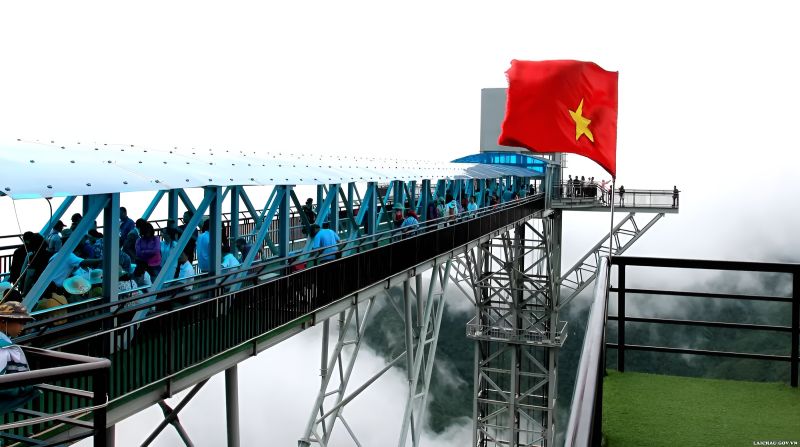
Rong May Glass Bridge Travel Tips: 7 Things to Know Before Going
The 7 points below cover the preparation gaps most often reported after a visit to Rong May Glass Bridge. They are:
- Tip 1 — Carry VND cash for the games. Card terminals at the game counters are not always working, and 600,000 VND (₹2,100) covers 4 games at 150,000 VND each.
- Tip 2 — Wear comfortable shoes with good grip. Shoe covers are handed out for the glass deck, so the main need is footwear that grips well on the pass and the walkways.
- Tip 3 — Buy tickets at the counter or through an online agent. On December weekends, an early arrival is the best way to avoid the queue.
- Tip 4 — Pack a warm layer. The pass is 3–5°C colder than Sapa town, and the wind on the overhang adds to the chill.
- Tip 5 — Check O Quy Ho Pass weather, not the Sapa town forecast. The pass often has different weather from town on overcast days. Travellers who find thick fog on arrival can visit Silver Waterfall first and return to the bridge between 10:00 and 11:00 AM, when the fog most often clears on days without rain.
- Tip 6 — Take motion sickness medication before leaving Sapa town. National Highway 4D is 17 km of continuous switchbacks, and travellers used to flat city roads often feel car sick on it even at moderate speed.
- Tip 7 — Agree a return taxi fare before departure. A return fare of about 700,000 VND (₹2,455), with the driver waiting 2–3 hours, avoids the problem of finding a taxi back from the pass, where ride-hailing apps work poorly.
Most of these points matter most in the busy months from October to December.
3 Attractions to Combine with Rong May Glass Bridge on the Same Day
Silver Waterfall, O Quy Ho Heaven’s Gate and Love Waterfall all sit on National Highway 4D near Rong May, so the 3 fit into the same day as the bridge.
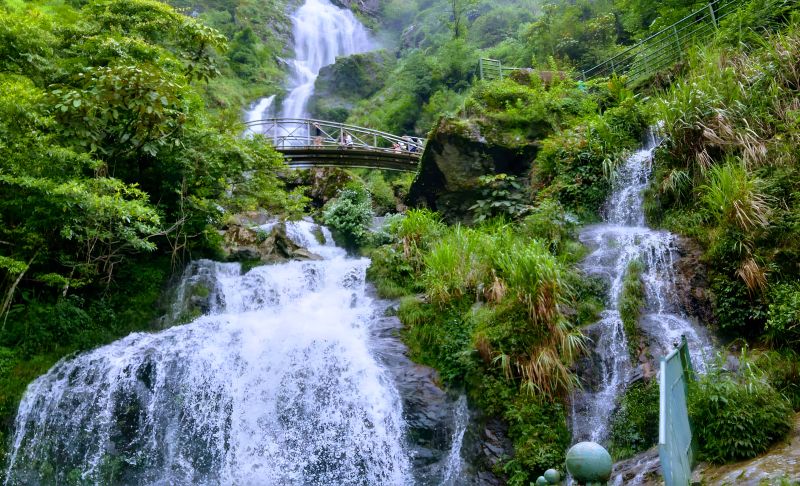
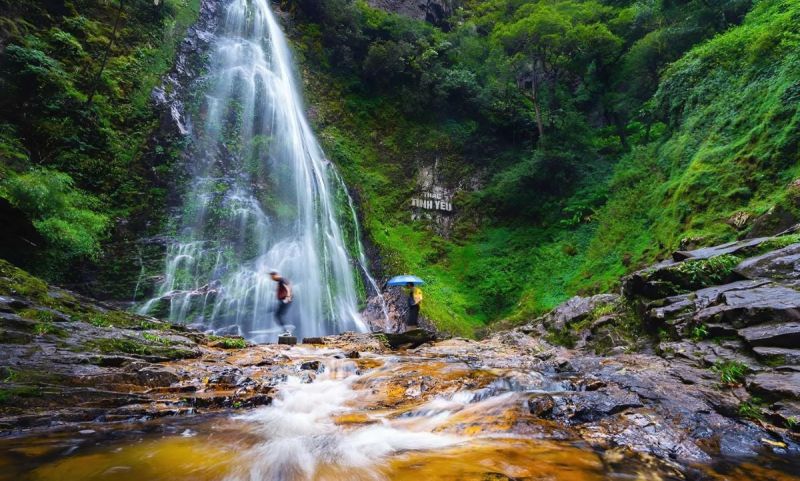
Silver Waterfall (Thac Bac) — 5 minutes from Rong May Glass Bridge. Silver Waterfall falls down the O Quy Ho cliff a short walk from the roadside car park, and the entrance fee is 20,000 VND (₹70) per adult. On heavily fogged mornings, visiting the waterfall first and returning to Rong May later often brings clearer bridge conditions. The trail, viewpoints and best photo angle are covered in the guide to Silver Waterfall.
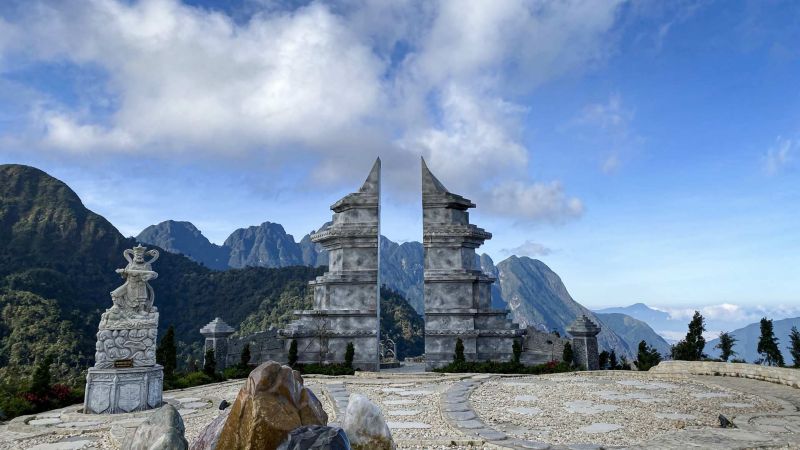
O Quy Ho Heaven’s Gate — 3 minutes from Rong May Glass Bridge. Heaven’s Gate is a free roadside viewpoint looking across both the Lao Cai and Lai Chau sides of the pass, though some private photo spots on the pass charge a small fee.
Love Waterfall (Thac Tinh Yeu) — about 14 km from Sapa town. Love Waterfall sits in pine forest about 3 km before the pass, making it a natural stop on the way up or back. The entrance fee is 70,000 VND (₹245) for adults and 30,000 VND (₹105) for children.
For travellers also visiting Cat Cat Village in the same Sapa stay, a 2-day plan works best: Cat Cat on the first morning, and Rong May on the second morning, when the pass conditions can be checked the evening before. Travellers with more time can choose further Sapa attractions, from Cat Cat Village to the Muong Hoa Valley, all ranked in the guide to the places to visit in Sapa.
FAQs about Rong May Glass Bridge
Travellers asking about Rong May Glass Bridge most often want to know if it suits seniors and children, about bungee jumping, card payment, its province and whether it is open.
Is Rong May Glass Bridge suitable for seniors and young children?
Yes: the glass elevator removes the climb and the deck is a flat circuit with handrails, so most seniors and children manage it, and children under 1 m enter free. “Senior travellers in their late 60s and early 70s have completed the skywalk by elevator without physical difficulty; the challenge is psychological, not physical,” says Anthony Ngo, Co-founder of Vietnamtour.in. People with a severe fear of heights, heart conditions or high blood pressure, and pregnant women, should think carefully before going onto the glass.
Is there bungee jumping at Rong May?
No, not on the current game list: bungee jumping has been advertised at Rong May in the past, but it does not appear on the 2026 list of games. Availability is worth checking at the counter on the day.
Can you pay by card at Rong May Glass Bridge?
No, not reliably: card payment often does not work at the ticket and game counters, so cash in VND is the safer option. ATMs are easier to find in Sapa town than on the pass.
Is Rong May Glass Bridge in Sapa or Lai Chau?
Rong May Glass Bridge is in Lai Chau Province, just across the provincial border from Sapa in Lao Cai Province, which is why it is marketed as the Sapa Glass Bridge. The bridge is about 17 km from Sapa town, and nearly all visitors reach it from there.
Is Rong May Glass Bridge open now?
Yes. The operator planned a pause from 1 October 2026 but confirmed on 26 September that the site would keep operating as normal until further notice from the authorities. The latest status is worth checking with a local operator or hotel before driving up the pass.
Planning a Visit to Rong May Glass Bridge
Rong May Glass Bridge rewards an early start on a clear day: the elevator, the glass overhang and the cloud views over O Quy Ho Pass are at their best in the first hours after opening. Most visitors fit it into a half day from Sapa town alongside Silver Waterfall and Heaven’s Gate.
Vietnamtour.in’s Sapa trips can include the glass bridge as a half-day stop, with a private car and driver from Sapa town, and each Sapa tour package shows how it fits into a wider northern Vietnam route. Travellers adding central Vietnam can pair it with the Golden Bridge at Bana Hills, and every Vietnam tours from India route can be built around both.
- Hanoi HQ: Floor 4, Bao Anh Building, 62 Tran Thai Tong, Cau Giay, Hanoi
- Delhi: A 10/1 Gujrawala Town Part 1, Main G T Karnal Road, Delhi 110009
- India hotline: +91 88502 95722
- Vietnam / WhatsApp: +84 948 333 087
- Email: [email protected]
Share the travel dates, group size and departure city in the form below to plan Sapa and Rong May.