

Hoi An is a UNESCO-listed old trading town in central Vietnam, on the Thu Bon River about 30 km south of Da Nang Airport, known for its lantern-lit Ancient Town, its tailors, its beaches at An Bang and Cua Dai, and the Cham temples of My Son 40 km inland; since 1 July 2025 it has been a ward of Da Nang city. The Ancient Town was a busy port from the 16th to the 18th century, and its wooden houses, assembly halls and the Japanese Covered Bridge mix Vietnamese, Chinese, Japanese and French styles.
Hoi An, Vietnam works 2 ways: a 2–3 night stop on a central Vietnam route with Da Nang and Hue, and a slower base for beaches, craft villages and cooking classes. Indian travellers fly into Da Nang, which has direct flights from Delhi, Mumbai, Kolkata, Ahmedabad and Hyderabad, and reach Hoi An by road in 45–60 minutes. This Hoi An Vietnam travel guide from Vietnamtour.in covers where the town is, what it is known for, when to go, how to reach Hoi An and get around, where to stay, what to eat and buy, how many days to plan and what a trip costs.
| Fact | Detail |
|---|---|
| Country | Vietnam |
| Status | Ward of Da Nang city since 1 July 2025 (formerly Hoi An city, Quang Nam province) |
| Location | Central Vietnam, on the Thu Bon River near the coast |
| UNESCO listing | Hoi An Ancient Town, 1999; My Son Sanctuary, 1999 |
| Nearest airport | Da Nang (DAD), about 30 km, 45–60 min by road |
| Flights from India | Direct to Da Nang from Delhi, Mumbai, Kolkata, Ahmedabad and Hyderabad |
| Ancient Town ticket | 120,000 VND (₹440) for foreign visitors, 5 heritage sites, valid 24 hours |
| Best months | February to August |
| Known for | Lanterns, tailors, cao lau noodles, beaches, craft villages |
| Visa | Vietnam e-Visa (US$25, ₹2,375) for Indian passport holders |
| Currency | Vietnamese dong (VND); prices shown as VND (₹) |
Each of these facts is expanded in the sections that follow, from the exact location to a 3-night budget.
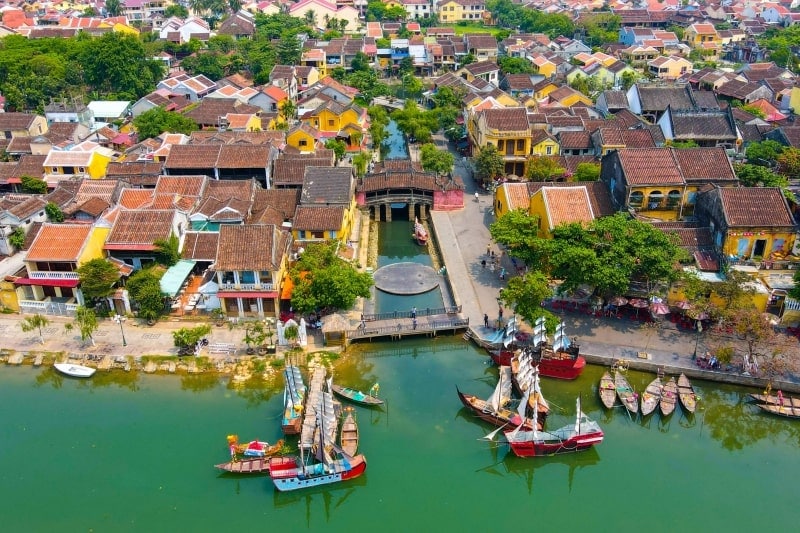


Where Is Hoi An?
Hoi An is in central Vietnam, about 30 km south of Da Nang city and its international airport, on the north bank of the Thu Bon River 5 km from the sea, and it has been a ward of Da Nang city since 1 July 2025. The distances that matter for a Hoi An trip are:
| From | Distance | How |
|---|---|---|
| Da Nang Airport | About 30 km | 45–60 min by car |
| An Bang Beach | About 4 km | 10 min by car or 20 min by bicycle |
| My Son Sanctuary | About 40 km | 1 hr by car |
| Hue | About 125 km | 3 hr by car over the Hai Van Pass |
| Hanoi / Ho Chi Minh City | About 800 km / 900 km | About 1 hr 20 min by air to Da Nang |
Older maps and booking sites still show “Hoi An city, Quang Nam province”, the names used before the 2025 merger of Quang Nam into Da Nang. Hoi An has no airport or railway station of its own, so every arrival runs through Da Nang, and most travellers combine the 2 on the same trip.
What Hoi An Is Known For
Hoi An is known for 5 things: the UNESCO-listed Ancient Town with its lanterns and Japanese Covered Bridge, made-to-measure tailoring, food such as cao lau and banh mi, the beaches at An Bang and Cua Dai, and the craft and farming villages around the town. The main highlights and where they sit are:
| Highlight | Where | Best for |
|---|---|---|
| Ancient Town and Japanese Covered Bridge | Town centre | Heritage, lanterns at night |
| Fujian Assembly Hall, Tan Ky Old House | Ancient Town | Architecture, history |
| An Bang and Cua Dai beaches | 4–5 km east | Swimming, beach cafés |
| Cam Thanh Coconut Village | 3 km south-east | Basket-boat rides |
| Tra Que and Thanh Ha villages | 3 km from town | Farming and pottery classes |
| My Son Sanctuary | 40 km inland | Champa temples, half day |
| Cham Islands | 20 km offshore | Snorkelling, March to September |
The Ancient Town is closed to cars and lit by silk lanterns every evening, and the town switches off its electric lights on the 14th night of each lunar month for the Full Moon Lantern Night.
The Ancient Town, the beaches and the villages fit into 2–3 days, and the day trips to My Son and the Cham Islands add a third or fourth day.
When to Go to Hoi An
February to August is the best time to visit Hoi An, with dry days, calm seas on the beaches and clear evenings for the lanterns, while September to January is the rainy season, when the Ancient Town floods in some years in October and November. The 4 seasons compare as follows:
| Season | Months | Weather | Verdict |
|---|---|---|---|
| Spring | February–April | Mild, 20–30°C, little rain | Best for walking the town and cycling |
| Summer | May–August | Hot, 30–35°C, mostly dry | Best for the beaches; busiest with domestic travellers |
| Autumn | September–November | Heavy rain, storms, river floods | Least reliable; October is the riskiest month |
| Winter | December–January | Cool, 18–25°C, drizzle | Quiet and cheaper; rough seas |
The rains move from the north to the centre in autumn, and the guide to Vietnam October weather shows why the centre is wettest just when the north dries out. Lantern nights, Tet and the Mid-Autumn Festival fall on lunar dates, which are listed for the year in the guide to festivals in Hoi An.
How to Reach Hoi An from India
Travellers from India reach Hoi An by flying direct to Da Nang from Delhi, Mumbai, Kolkata, Ahmedabad or Hyderabad, or via Hanoi or Ho Chi Minh City, and then driving 45–60 minutes south to Hoi An, since the town has no airport. The routes compare as follows:
| Route | Time | Notes |
|---|---|---|
| Delhi / Mumbai / Kolkata / Ahmedabad / Hyderabad → Da Nang | About 4–5.5 hr | Direct flights on VietJet Air |
| India → Hanoi or Ho Chi Minh City → Da Nang | Plus 1 hr 20 min domestic flight | When combining the north or the south |
| Da Nang Airport → Hoi An, Grab car | 45–60 min | About 387,000 VND (₹1,420) for a 4-seat car |
| Da Nang Airport → Hoi An, private car | 45–60 min | Families and groups, meet-and-greet at arrivals |
Indian passport holders need a Vietnam e-Visa before departure. Travellers who start in the south use the routes compared in the guide on Ho Chi Minh to Hoi An, and those starting in the north use the guide on Hanoi to Hoi An. The airport transfer itself is covered in the guide on Danang to Hoi An.
Getting Around Hoi An
Hoi An’s Ancient Town is car-free and small enough to walk, while the beaches, villages and My Son are reached by bicycle, Grab car, taxi or a car with driver. The options compare as follows:
| Option | Cost | Best for |
|---|---|---|
| Walking | Free | Ancient Town, riverside, night market |
| Bicycle rental | About 30,000–50,000 VND (₹110–₹185) per day; free at many hotels | Tra Que, An Bang Beach, rice fields |
| Grab car or taxi | App fare, fixed before the ride | Beaches, Thanh Ha, Cam Thanh |
| Cyclo | Agreed before the ride | A short tour of the old town edge |
| Car with driver | Half or full day | My Son, Da Nang, Hue via the Hai Van Pass |
Bicycles are the most pleasant way between the old town and the beaches, since the roads to An Bang and Cua Dai are flat and run through rice fields, and the same ride south-east reaches the basket boats of Cam Thanh Coconut Village in 15 minutes. Cyclos wait outside the Ancient Town, and their fares are best agreed before the ride.
Where to Stay in Hoi An: Old Town, Riverside or Beach
The Ancient Town edge suits a first visit, the riverside and rice-field areas hold quieter villas and homestays, and An Bang and Cua Dai beaches hold the resorts. The 4 areas compare as follows:
| Area | Vibe | Best for | Price band |
|---|---|---|---|
| Ancient Town edge | Walkable, lanterns, restaurants | First visit | Budget–High |
| Riverside and Cam Thanh | Quiet villas, pools, rice fields | Couples, families | Mid |
| An Bang Beach | Beach cafés, homestays | Beach and nightlife | Budget–Mid |
| Cua Dai and Ha My coast | Large resorts, private beach | Luxury, honeymoon | High |
Summer is the busiest season for hotels, so June to August stays are best booked early. Beach resorts with pools and private sand are compared in the guide to Hoi An beach resorts, and the differences between the 3 beaches are set out in the guide to the beaches in Hoi An.
Food and Shopping in Hoi An
Hoi An’s food runs from cao lau noodles and banh mi to Indian and vegetarian kitchens in the old town, while its shops sell lanterns, silk, tailored clothes and crafts from the surrounding villages.
What to Eat in Hoi An
Cao lau, mi Quang, white rose dumplings and banh mi are the dishes most visitors try first in Hoi An, and Indian and vegetarian meals are easy to find in the old town. Street desserts cost about 10,000–20,000 VND (₹35–₹75) and a bowl of cao lau or mi Quang about 30,000–50,000 VND (₹110–₹185). Vegetarian versions of mi Quang and banh mi are served at the central market and at vegetarian kitchens near the river. Indian restaurants cluster within a 10-minute walk of the Japanese Covered Bridge, and they are compared in the guide to Indian restaurants in Hoi An.
Tailors and Shopping in Hoi An
Hoi An has hundreds of tailors who make suits, dresses and kurtas to measure within 24–48 hours, and its shops sell silk lanterns, scarves, bronze and wooden crafts at fixed or lightly negotiable prices. Tailors can copy a garment from a sample or a photo, and Indian travellers often bring a favourite kurta or a saree blouse to be copied in local silk or linen. Allowing 2–3 days for fittings gives the best result.
Lanterns, silk scarves, Kim Bong wood carvings and Thanh Ha pottery are the most common things to take home, and where to buy each one is explained in the guide to things to buy in Hoi An. Coffee, cashews and lacquerware are better value elsewhere in the country, as set out in the guide to what is famous in Vietnam to buy.
How Many Days Do You Need in Hoi An?
2 nights cover the Ancient Town, a beach and 1 craft village, 3 nights add My Son Sanctuary or the Cham Islands, and 4 nights add a slow day of tailoring and cooking classes. A Hoi An itinerary by length of stay looks like this:
| Stay | What fits | Best for |
|---|---|---|
| 2 nights | Ancient Town, lanterns, An Bang Beach, Cam Thanh | Short central stop |
| 3 nights | Adds My Son Sanctuary or the Cham Islands | History, first visit |
| 4 nights | Adds tailoring fittings, a cooking class and Tra Que | Families, slow travel |
| 6+ nights | Combines with Da Nang, Ba Na Hills and Hue | Full central route |
The full ranked list of sights is in the guide to the places to visit in Hoi An, while the third and fourth days usually go to the Champa temples of My Son Sanctuary or a snorkelling trip to the Cham Islands. Most central routes pair Hoi An with Da Nang and Hue, and the scenic road north over the Hai Van Pass is set out in the guide on Hoi An to Hue. A 9 days Vietnam tour package is the usual length for a route that adds Hanoi or Ho Chi Minh City to 3 nights in the centre, and the guide to the Vietnam city name list helps choose the other stops.

Hanoi · Halong Bay · Da Nang · Hoi An · Phu Quoc

Hanoi · Halong Bay · Sapa · Da Nang · Hoi An · Phu Quoc · Ho Chi Minh City · Mekong Delta

Hanoi · Ninh Binh · Halong Bay · Da Nang · Hoi An · Ho Chi Minh City · Mekong Delta

Ho Chi Minh City · Mekong Delta · Da Nang · Hoi An · Hanoi · Sapa · Halong Bay
Siem Reap · Ho Chi Minh City · Mekong Delta · Da Nang · Hoi An · Hanoi · Ninh Binh · Halong Bay · Luang Prabang

Ho Chi Minh City · Mekong Delta · Da Nang · Hoi An · Hanoi · Halong Bay

Siem Reap · Da Nang · Hoi An · Hanoi · Halong Bay

Ho Chi Minh City · Mekong Delta · Da Nang · Hoi An · Hanoi · Halong Bay · Ninh Binh

Ho Chi Minh City · Mekong Delta · Da Nang · Hoi An · Hanoi · Sapa · Halong Bay

Hanoi · Halong Bay · Da Nang · Hoi An · Phu Quoc

Hanoi · Halong Bay · Sapa · Da Nang · Hoi An · Phu Quoc · Ho Chi Minh City · Mekong Delta

Hanoi · Ninh Binh · Sapa · Halong Bay · Da Nang · Hoi An
How Much Does a Hoi An Trip Cost?
A 3-night Hoi An trip from India costs about ₹35,000–48,000 per person on a budget, ₹52,000–75,000 mid-range and ₹95,000–1,40,000 for luxury, including return flights to Da Nang, the e-Visa, airport transfers, hotels, the Ancient Town ticket and food. Prices below are per person for 3 nights and 4 days, based on 2 people sharing a room and flying from Delhi or Mumbai.
| Cost item | Budget | Mid-range | Luxury |
|---|---|---|---|
| Return flight India – Da Nang | ₹22,000–30,000 | ₹30,000–42,000 | ₹42,000–60,000 |
| Vietnam e-Visa | US$25 (₹2,375) | US$25 (₹2,375) | US$25 (₹2,375) |
| Da Nang Airport – Hoi An return | Grab, shared by 2, about 387,000 VND (₹1,420) | Private car, shared by 2 | Private car with guide |
| Hotel per room per night | 400,000–900,000 VND (₹1,465–3,295) | 1,200,000–2,500,000 VND (₹4,395–9,160) | 4,000,000–8,000,000 VND (₹14,650–29,305) |
| Ancient Town ticket | 120,000 VND (₹440) | 120,000 VND (₹440) | 120,000 VND (₹440) |
| Food per day | ₹750–1,100 | ₹1,800–2,900 | ₹4,400–9,000 |
| Total per person | ₹35,000–48,000 | ₹52,000–75,000 | ₹95,000–1,40,000 |
The Ancient Town ticket is the published 2026 rate for foreign visitors; flight, hotel and food figures are estimates. ₹1 ≈ 273 VND and US$1 ≈ ₹95. Prices checked October 2026. Not included: My Son and Cham Islands tours, tailoring, shopping and travel insurance.
Flights and hotels make up most of a Hoi An budget, and both rise in the June to August holidays. The same cost model applied to the rest of the country appears in the guide to a Vietnam trip from India budget.
FAQs about Hoi An
Indian travellers planning Hoi An most often ask how to reach the town, when to avoid it, whether the tailors make Indian clothes, and which sights matter most.
How to reach Hoi An from India?
Fly direct to Da Nang from Delhi, Mumbai, Kolkata, Ahmedabad or Hyderabad, then drive 45–60 minutes south to Hoi An by Grab car or private car. Travellers from other Indian cities connect through Hanoi, Ho Chi Minh City or a regional hub to Da Nang.
When should I avoid visiting Hoi An?
October and November are the months to avoid, because heavy rain and storms can flood the Ancient Town’s riverside streets. December and January are cool and quiet but the sea is rough, so February to August is the safer window for a first visit.
Can Hoi An tailors make Indian clothes?
Yes, Hoi An tailors can make kurtas, saree blouses and other Indian garments by copying a sample or a photo, usually within 24–48 hours. Bringing a well-fitting piece to copy and allowing 2–3 days for fittings gives the best result.
What are the must-visit places in Hoi An?
The Ancient Town with the Japanese Covered Bridge, the Fujian Assembly Hall, An Bang Beach, Cam Thanh Coconut Village and My Son Sanctuary are the must-visit places in and around Hoi An. The Marble Mountains are often listed too, but they sit in Da Nang, about 20 km north, and fit best on the way from the airport.
Is Hoi An worth visiting?
Yes, Hoi An is worth visiting for its preserved old town, lantern evenings, tailors, beaches and day trips to My Son, all within an hour of Da Nang Airport. It suits travellers who enjoy slow walks and food more than nightlife or theme parks.
Plan a Hoi An Trip
Hoi An rewards travellers who match the dates to the weather and the lunar calendar: February to August for dry days, the 14th of the lunar month for the lantern night, and early mornings for the Ancient Town before the crowds. The harder part is the route, since every trip from India runs through Da Nang and most combine Hoi An with Hue, Ba Na Hills or another region.
Building a central Vietnam trip around Hoi An means getting the flight into Da Nang, the transfer, the lantern night and the tailoring time to line up at once. Vietnamtour.in, part of Seni World Travel, has arranged that for more than 428,000 travellers from India since 2015, with local experts in Vietnam and a team in Delhi, and every Vietnam trip from India can carry a Hoi An leg with vegetarian and Jain meals on request. Beach-first travellers can also pair Hoi An with Phu Quoc packages from India for a second coast. Share the travel dates, group size and departure city in the form below for a customizable Hoi An, Vietnam itinerary built around the lanterns and the beaches.