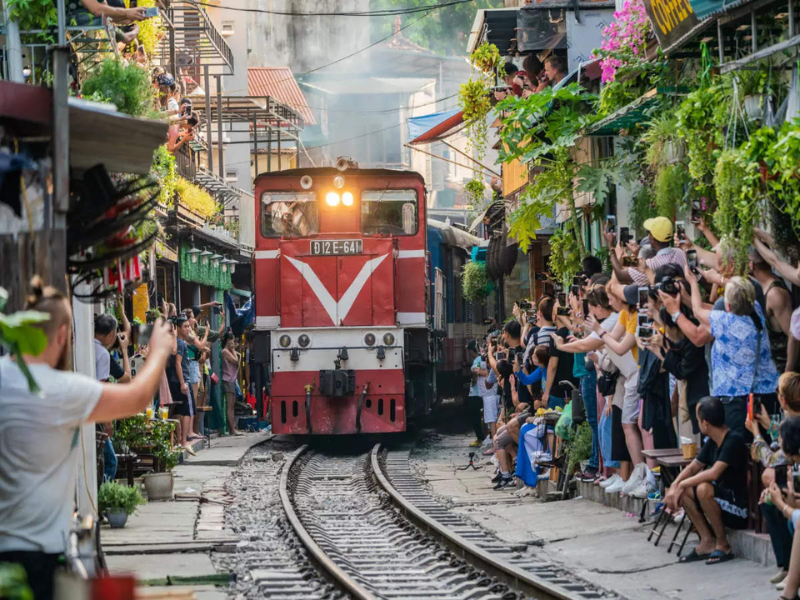
Hanoi Train Street is a 400-metre section of active railway running through a narrow residential lane in Hanoi’s Old Quarter, where trains pass within 80 centimetres of building facades at 15–20 km/h. Built by the French in 1902, the Phung Hung Street section became an international viral destination after 2017 and remains one of the most access-controlled visitor experiences in Hanoi as of 2026.
This guide covers access rules, train timings with IST conversion, the 5 operational cafes with INR pricing and vegetarian options, safety protocols, and photography positions — structured for Indian tourists.
What Is Hanoi Train Street in the Old Quarter?
Hanoi Train Street is a narrow residential alley along Phung Hung Street and Tran Phu Street in Hoan Kiem District, where an operational railway line passes through daily. Hanoi Train Street is not a tourist attraction built for visitors — it is a functioning residential street where families live, businesses operate, and the national railway runs multiple times per day through a lane so narrow that residents press against their doorways as each train passes.
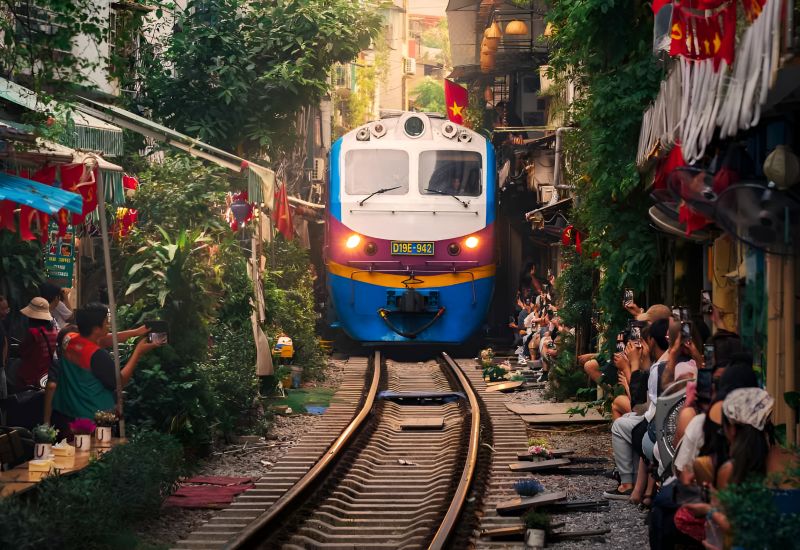
Hanoi Train Street went viral internationally after 2017, triggering a wave of tourists that led to the street’s first closure in October 2019 after a tourist was struck by a train. Hanoi Train Street reopened in January 2023 with stricter cafe-managed access. In March 2025, the Hanoi Department of Tourism banned all organised group tours from visiting the street — as of 2026, Hanoi Train Street remains accessible only through individual visits arranged via licensed cafes along the lane.
Indian tourists familiar with the Nilgiri Mountain Railway or the Darjeeling Toy Train will recognise the same level of proximity between a working train and daily civilian life — Hanoi Train Street delivers that same physical closeness, compressed into a dense urban alley where residents step back into doorways as each train passes.
The Phung Hung section and the Le Duan section sit 1.7 km apart from each other — Indian tourists visiting for the first time should know which section to target and how to reach it from the Old Quarter.
Where Is Hanoi Train Street Located?
The main tourist-accessible section of Hanoi Train Street runs along Phung Hung Street, Cua Dong Ward, Hoan Kiem District, Hanoi. Hanoi Train Street has 2 distinct sections that Indian tourists should understand before visiting.
| Section | Characteristics | Best For |
|---|---|---|
| Phung Hung Street (North) | Multiple cafes, murals, most popular with tourists | First-time visitors, full experience |
| Le Duan Street (South) | Fewer cafes, more residential, near Ga Ha Noi station | Photography, avoiding crowds |
The Phung Hung section has 4 confirmed entrances: No. 8D Dien Bien Phu Street at the intersection with Ton That Thiep Street; No. 3 Tran Phu Street at the intersection with Phung Hung Street (the most visited section); No. 62 Phung Hung Street at Nguyen Van To Street; and No. 141 Phung Hung Street from Nguyen Quang Bich Street.
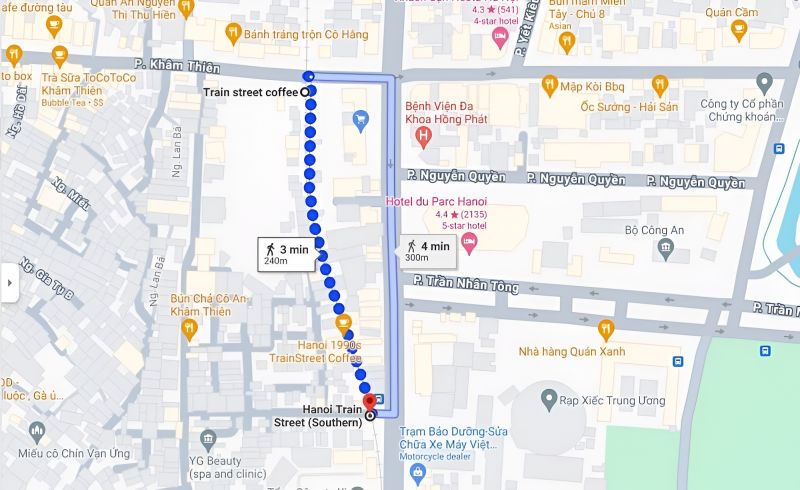
Hanoi Train Street sits approximately 1.5–2 km walking distance west of Hoan Kiem Lake. The Le Duan section near Ga Ha Noi station is further from the Old Quarter but fully open with no barriers or guards — a fully open alternative on days when the Phung Hung section faces stricter enforcement.
From the Phung Hung section, Indian tourists staying in Old Quarter hotels can reach Hanoi Train Street on foot in 20–25 minutes from Hoan Kiem Lake, or 8–10 minutes from St. Joseph’s Cathedral, which is the nearest major landmark. The walking route and Grab fare breakdown are covered below.
How to Get to Hanoi Train Street from Hoan Kiem
Walk northwest from Hoan Kiem Lake to Hanoi Train Street in 20–25 minutes, or take a Grab for 40,000 to 60,000 VND (₹140–₹210) in under 10 minutes.
The 6-step walking route from Hoan Kiem Lake to Hanoi Train Street:
- Start at Hoan Kiem Lake (Bờ Hồ) at the northern lakeside
- Walk west along Hang Trong Street for 300 metres
- Turn left onto Ly Quoc Su Street and continue 150 metres south
- Cross Dien Bien Phu Street at the railway track crossing — the tracks are visible at street level
- Follow Phung Hung Street north 100 metres to the cafe zone
- Look for licensed cafe signboards or ask locals for “đường tàu” (train street)
For Indian tourists taking Grab, show the driver the address “3 Tran Phu, Hoan Kiem” or type “Hanoi Train Street” directly in the Grab app — the Grab app recognises the location by name.
Most Indian tourists staying near Hang Bac Street in the Old Quarter are only 600 metres from Hanoi Train Street — closer than Hoan Kiem Lake itself.
Scam alert: Motorbike drivers who approach tourists near the Old Quarter, claiming Hanoi Train Street is closed and offering alternative transport, are running a common tourist scam. Proceed directly to a pre-booked cafe and let cafe staff handle access.
Arriving at the lane without knowing the train schedule is the most common mistake — trains do not run at fixed hourly intervals, and the difference between a weekday and weekend visit determines whether Indian tourists see 1 train or 10.
Hanoi Train Street Schedule and Train Times in 2026
Hanoi Train Street has no fixed daily train schedule. Train times vary by day, enforcement level, and maintenance conditions — always confirm the current day’s schedule directly with your booked cafe on arrival.
The times below are estimates sourced from cafe staff and on-ground traveller reports collected in early 2026 by Vietnamtour.in’s Hanoi-based local team, who monitor real-time train movements across frequently visited sections of the street. Trains vary by ±15–20 minutes from these estimates on most days.
| Day | Estimated Train Times (Hanoi Time, UTC+7) |
|---|---|
| Monday–Friday | ~7:00 PM, ~7:45 PM, ~8:45 PM, ~9:30 PM |
| Saturday–Sunday | ~6:00 AM, ~9:15 AM, ~11:20 AM, ~3:20 PM, ~5:30 PM, ~6:00 PM, ~7:00 PM, ~7:45 PM, ~8:30 PM, ~9:00 PM |
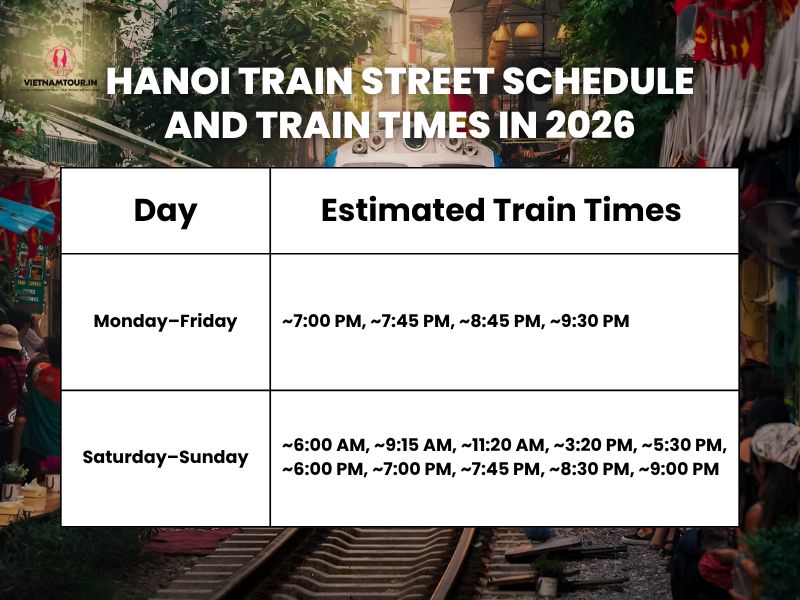
Important weekday disclaimer: Weekday train times at Hanoi Train Street are not fixed and vary significantly. Some weekday trains run throughout the day; other weekday trains pass only in the evening from 7:00 PM onward. Cafe staff track train movements in real time and are the most reliable source for the current day’s schedule — check with your booked cafe on arrival rather than relying on any published timetable, including this one.
Freight trains run additionally outside these times without a scheduled announcement. On approximately 5–10% of visit days, scheduled trains do not pass through due to maintenance; cafe staff confirm whether trains will run on a given day.
For Indian Standard Time conversion: Hanoi time (UTC+7) is 1 hour and 30 minutes ahead of IST. The 3:20 PM weekend afternoon train in Hanoi = 1:50 PM IST. The 7:00 PM evening train in Hanoi = 5:30 PM IST.
For the national rail schedule, consult dsvn.vn. Times listed on dsvn.vn are departure times from Hanoi Station — trains reach the Phung Hung section approximately 10–15 minutes after departure.
Weekend evening trains between 7:00 PM and 9:00 PM concentrate 3–4 trains into a 2-hour window — but temperature, humidity, and natural light vary sharply between October and June, making the month of visit as important as the time of day.
Best Time to Visit Hanoi Train Street
October to March is the best time to visit Hanoi Train Street — Hanoi’s dry season temperatures of 16°C–26°C (61°F–79°F) make both the afternoon and evening train windows comfortable, and the natural light in October and November produces the best photography conditions.
Time of day recommendations:
- Afternoon trains (~3:20 PM on weekends): Better natural light for photography; fewer crowds than evening; recommended October–April when daylight extends past 5 PM.
- Evening trains (~7:00 PM–7:45 PM): The most visually dramatic window — the lane is lit by lantern lights from cafe facades, cooler temperatures make waiting comfortable, and the confined alley creates a high-contrast visual effect between warm lantern light and the dark lane. Optimal October–March.
- Weekend mornings (~9:00–9:30 AM): Least crowded; 1–2 trains; best for Indian families travelling with young children who should not be on the street during the crowded evening window.
Indian holiday alignment:
| Indian Holiday | Vietnam Timing | Crowd Level at Train Street |
|---|---|---|
| Diwali (Oct–Nov) | Best dry season | High — book cafe 1–2 days ahead |
| Christmas–New Year | Best weather | Very high — book 2–3 days ahead |
| Holi (Mar) | Late dry season | Moderate–high |
| Summer holidays (May–Jun) | Hot, humid | Moderate — evening trains only |
Tet warning: Hanoi Train Street cafes may close 3–7 days during Tet (January–February). Confirm operating dates with the specific cafe directly before planning a Tet-period visit.
Under 2025–2026 regulations, the cafe booking is not optional — it is the only method of entering the lane past the access barriers.
The Best Cafes on Hanoi Train Street
Hanoi Train Street has multiple operational cafes along the Phung Hung and Le Duan sections as of 2026. The cafes below are selected based on confirmed address, viewing angle, and consistent feedback from Indian travellers visiting Hanoi Train Street through Vietnamtour.in-curated itineraries.
| Cafe | Address | Vegetarian | Min. Order (INR) |
|---|---|---|---|
| MER Café | 48 Phung Hung St, Cua Dong | Yes | ₹108–₹288 |
| Coffee Waitrans 74 | 74 Phung Hung St, Cua Dong | Yes | ₹108–₹180 |
| Hảo Hảo Coffee | 80 Phung Hung St, Cua Dong | Limited | ₹108–₹180 |
| Railway Cafe | 5 Tran Phu St, Hoan Kiem | Yes | ₹180–₹288 |
| Café Ga Đông Dương | 5A Tran Phu St, Hoan Kiem | Yes | ₹180–₹288 |
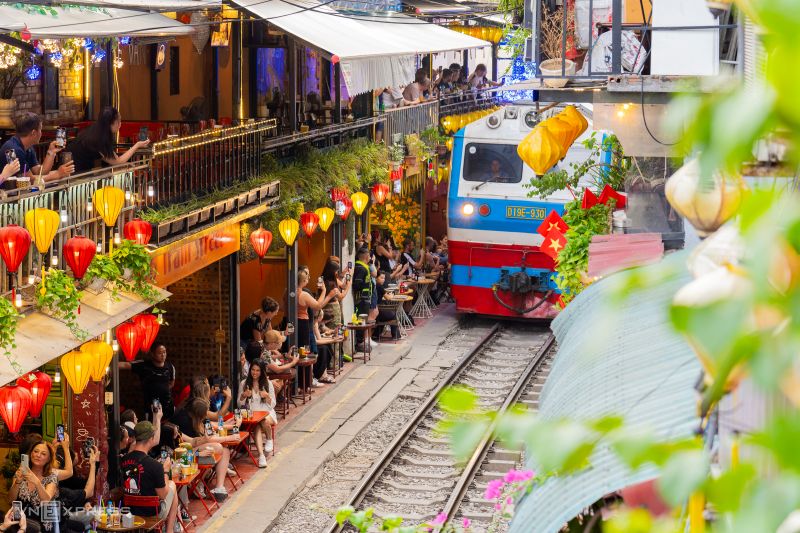
Contact the chosen cafe via Instagram, Facebook, or WhatsApp before arriving — cafe staff meet visitors at the access barrier and escort visitors to their seats. Most cafes respond within a few hours.
4 of the 5 listed cafes serve Vietnamese herbal teas, fresh fruit, and non-meat items suitable for vegetarian Indian travellers. Jain travellers should confirm with cafe staff that fruit platters and herbal teas exclude root vegetables and egg-based items — egg coffee (cà phê trứng) contains whipped egg yolk and is not Jain-compliant. Egg coffee and iced brown coffee (cà phê nâu đá) are the 2 signature drinks to order while waiting for the train — both are available at all 5 cafes listed above.
Hanoi Train Street cafes accept cash (VND) only — UPI, PhonePe, and Google Pay are not accepted at any Phung Hung or Tran Phu cafe as of 2026. Exchange INR to VND before arriving.
From cafe arrival to departure, the full Hanoi Train Street visit follows the same sequence on every visit day.
What Does the Hanoi Train Street Experience Include?
A single train visit at Hanoi Train Street takes approximately 60–90 minutes from cafe arrival to departure. The full sequence runs as follows:
Arrive at the cafe 20–30 minutes before the estimated train time — cafe staff confirm the current day’s schedule on arrival and assign seating. Order your drink and secure a viewing seat facing the tracks.
Cafe staff signal 3–5 minutes before the train — all visitors return to cafe premises or press against the wall. The warning signal is a whistle from cafe staff or a bell from the direction of Hanoi Station.
The train passes taking 30–45 seconds to clear the fully visible section of Phung Hung Street. The air displacement from the passing train is physically felt by anyone seated in the front row.
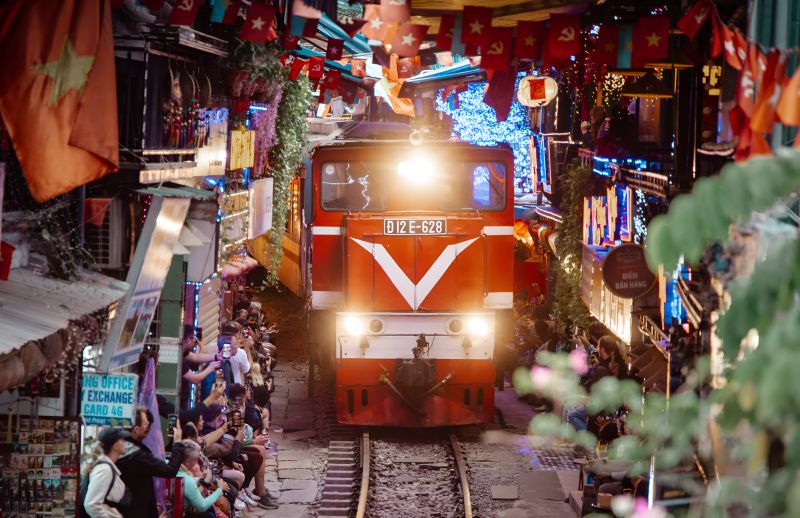
A 5–10 minute photography window opens after the train clears the Phung Hung Street section. On weekend evenings, 2–3 trains pass within a 90-minute window between 7:00 PM and 9:00 PM — visitors who arrive at 6:30 PM on a Saturday see 2–3 trains before 9:00 PM on most weekend evenings.
Bottle cap tradition: Place a small coin or beer bottle cap on the rails before the train arrives. The passing train’s weight flattens the bottle cap into a unique souvenir to take home. Cafe staff at several Phung Hung cafes facilitate this for visitors who ask.
Each train passage brings the full weight of a locomotive within arm’s reach of seated visitors — 6 safety rules determine where and how Indian tourists position themselves before, during, and after each pass.
Hanoi Train Street Safety Tips for Indian Tourists
Hanoi Train Street is safe for Indian tourists when 6 mandatory safety rules are followed.
- Book a licensed cafe seat before arriving — required both for safety and for access through the barriers
- Return to the cafe seat when staff blow the warning whistle — all visitors must be behind the cafe threshold before the train enters the visible section
- Keep all bags, camera straps, scarves, and clothing clear of the track — clearance is less than 80 cm at the narrowest points; loose items extending beyond the building line are a genuine hazard
- Do not stand on or cross the railway track at any point, including between trains — the track is an active national railway, not a pedestrian path
- Follow cafe staff instructions immediately — local police are present at barrier points during train passages; cafe owners have signed formal agreements with authorities and have been fined when visitors violated safety rules inside their section
- Do not pay any entrance fee to individuals at the barriers — no official entrance ticket exists; access is through licensed cafes only; any individual requesting a direct payment is not an official representative
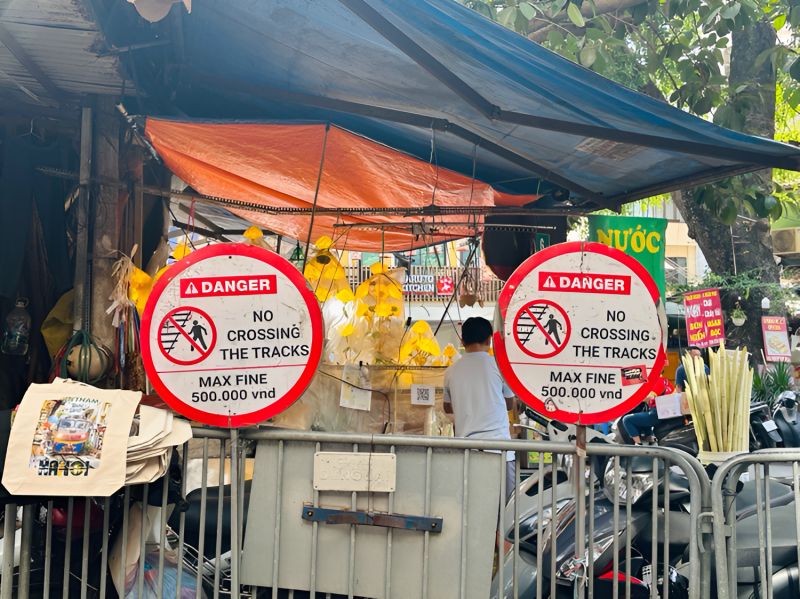
Children under 12 must remain seated inside the cafe during all train passages — the cafe interior, not the doorway or the front row of outdoor seating.
Indian tour groups visiting during Diwali, Christmas–New Year, or Holi should contact cafes at least 1–2 days in advance. Total seating capacity across the Phung Hung section is approximately 120–150 seats — the section fills to capacity within 30 minutes of peak evening trains on weekends.
The window after each train clears the lane is the primary photography opportunity — and the camera position chosen before the train arrives determines the type of image captured.
Hanoi Train Street Photography Spots and Best Camera Positions
3 distinct photography positions along Hanoi Train Street each produce a different type of image of the train passage.
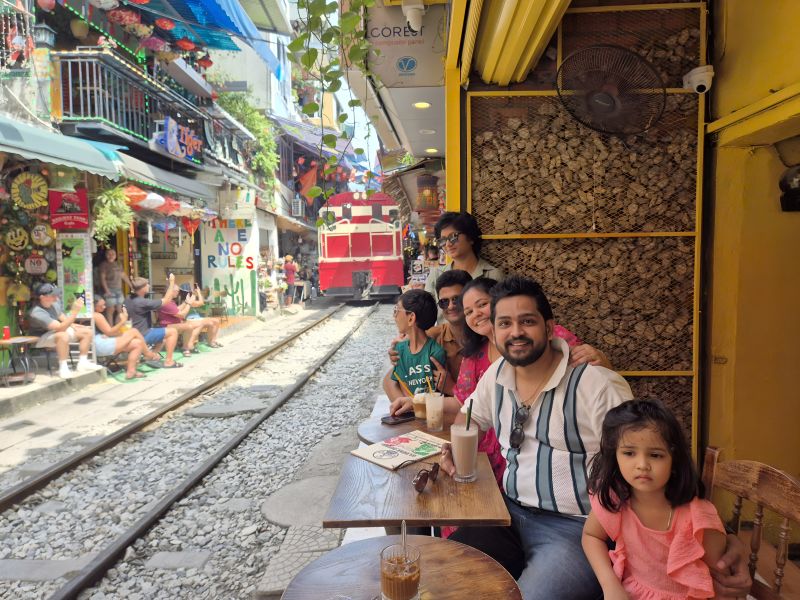
Position 1 — Cafe terrace elevated angle: The upper floors of Railway Cafe (5 Tran Phu) and Café Ga Đông Dương (5A Tran Phu) provide elevated angles showing the train moving between opposing cafe walls. Wide-angle shots from the second or third floor compress the lane into a narrow corridor — one of the most common compositions shared from Hanoi Train Street. Book a second-floor seat at Railway Cafe or Café Ga Đông Dương specifically to access the elevated, wide-angle composition.
Position 2 — Street-level lane position (pre-train window only): The street-level lane position is accessible 20–30 minutes before the warning signal. Shoot at 24mm with the camera at hip or shoulder height, framing the train approach with residential buildings on both sides. Perspective compression at 24mm — with the 2.5-metre lane width — captures both the train and the opposing facade in the same frame. Return to the cafe at the warning signal.
Position 3 — End-of-lane position near Dien Bien Phu Street: The longest visible train approach of approximately 80 metres is available from the Dien Bien Phu Street end of the lane. The end-of-lane position near Dien Bien Phu Street is best for tracking shots following the full length of the train’s passage through the Phung Hung Street section.
Technical settings: Use a shutter speed of 1/500s or faster to freeze the train at 15–20 km/h. Evening trains between 7:00 PM and 7:45 PM in October–March offer the best lantern-lit conditions — the warm ambient light from cafe facades is sufficient for clear photography without flash.
Smartphone note: Indian tourists with iPhone 15/16 Pro or Samsung S24/S25 use Cinematic Mode for tracking shots during the train passage or Night Mode for the lantern-lit evening window at Hanoi Train Street. Do not use flash photography during train passage — flash disorients both train operators and other visitors in the confined lane.
Frequently Asked Questions About Hanoi Train Street
Is Hanoi Train Street Free to Enter?
Entry to Hanoi Train Street is not entirely free. Access requires booking a seat at a licensed cafe with a minimum order of ₹108–₹288 per person, depending on the cafe. No official entrance ticket or government fee exists. Any individual at the barriers requesting a direct entry payment is not an official representative — decline and proceed to a pre-booked cafe instead.
How Many Trains Pass Through Hanoi Train Street Per Day?
The number of daily trains varies by day and season. On weekdays, trains pass primarily in the evening from 7:00 PM onward. On weekends, approximately 10 trains pass through the Phung Hung Street section between 6:00 AM and 11:00 PM, with the highest concentration between 5:30 PM and 9:00 PM. Freight trains run additionally outside scheduled times without prior announcement.
Is Hanoi Train Street Safe for Indian Families with Children?
The street is safe for Indian families with children when 3 conditions are met: a cafe seat is pre-booked before arrival, children under 12 remain seated inside the cafe during all train passages, and all family members follow cafe staff instructions immediately upon the warning whistle. Weekend morning trains between 9:00–9:30 AM offer the safest and least crowded family visit window.
Can Indian Vegetarians Find Food at Hanoi Train Street Cafes?
Yes — at least 4 of the 5 operational cafes along Phung Hung Street offer vegetarian items, including fresh fruit, vegetarian spring rolls, and Vietnamese herbal teas as of 2026. Confirm vegetarian availability when contacting the cafe to book a seat.
What Happens If the Train Is Delayed at Hanoi Train Street?
Delays of 15–20 minutes from estimated times occur regularly. Cafe staff receive advance notice from the rail network and update seated visitors on the revised time. On rare maintenance days when trains do not run, cafe staff confirm the situation — visitors who have pre-booked can ask via WhatsApp before travelling to the street.
Is Group Tour Access to Hanoi Train Street Allowed in 2026?
As of March 2025, the Hanoi Department of Tourism has banned licensed tour operators from organising group tours to Hanoi Train Street. Individual and small-group self-arranged visits through licensed cafe bookings remain possible. Indian travellers on Vietnam tour packages should confirm with their tour operator whether access is arranged via individual cafe booking rather than a group tour format.
What Are the Limitations of Visiting Hanoi Train Street?
There are 3 main limitations to visiting Hanoi Train Street that Indian travellers need to know before arriving:
- The active train experience lasts 30–45 seconds per train passage — Indian tourists expecting a prolonged attraction should position the visit as a 90-minute stop within a broader Old Quarter walking route rather than a standalone half-day destination.
- The street is not wheelchair accessible due to railway tracks, uneven paving, and the 2.5-metre lane width.
- Organised group tours have been banned since March 2025 — only self-arranged individual visits through licensed cafes remain possible.
The Phung Hung section is surrounded by Hoan Kiem Lake, the Imperial Citadel of Thang Long, and the Temple of Literature — all ranked among the top places to visit in Hanoi for Indian tourists. Phung Hung Mural Street (50 metres adjacent) and Dong Xuan Market (600 metres north) are the 2 nearest stops for extending the visit.
To plan the complete time in Hanoi — covering Hoan Kiem Lake, the Temple of Literature, Tran Quoc Pagoda, and the West Lake circuit — the Hanoi travel guide provides a full day-by-day framework for Indian tourists spending 2–4 days in Hanoi. For multi-city itineraries combining Hanoi with Ha Long Bay, Hoi An, or Ho Chi Minh City, Vietnam tour packages cover 5–14 day routes with flights and hotels included.