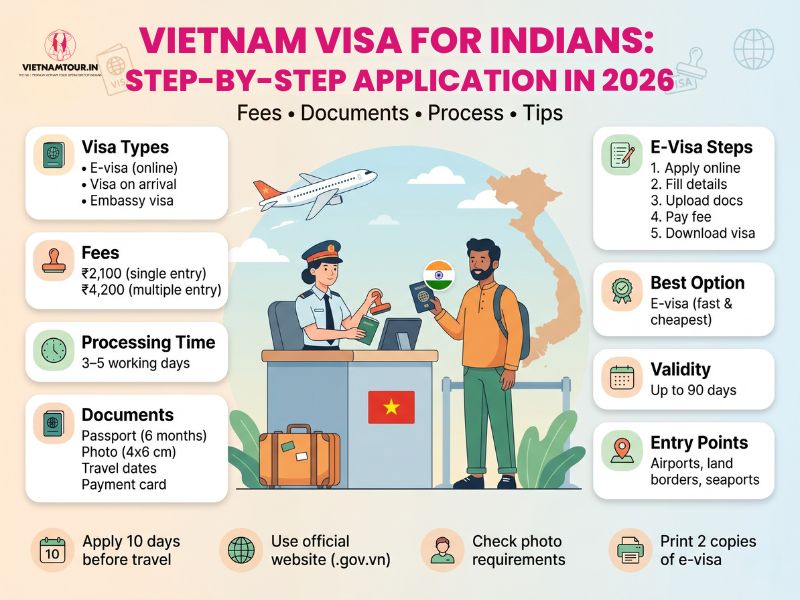
Indian passport holders need a visa for Vietnam: the tourist e-visa costs US$25 (₹2,375) for a single entry or US$50 (₹4,750) for multiple entries, allows stays of up to 90 days and is processed in about 3 working days. The 1 exception is Phu Quoc Island, where travellers flying in directly from abroad can stay 30 days without a visa.
This guide to the Vietnam visa for Indians is prepared by Vietnamtour.in, the No.1 premium Vietnam tour operator for Indian travellers, having served 428,000+ Indian travellers since 2015. It explains the fees in rupees, the documents Indian citizens need, how to apply for the tourist e-visa from India, the Digital Arrival Card and when visa on arrival applies.
Vietnam Tourist Visa Fee for Indian Nationals in INR
The Vietnam e-visa fee is fixed by the government at US$25 (₹2,375) for a single entry and US$50 (₹4,750) for multiple entries, paid online at evisa.gov.vn and valid for up to 90 days.
The official Vietnam tourist visa fee is set in USD under Circular 28/2026/TT-BTC, in force since 1 April 2026. INR amounts are converted at approximately ₹95 per US$1 and may vary slightly with daily exchange rates. The government fee for each visa type is set out below:
| Visa type | Government fee (USD) | Fee in INR (approx.) | Entries | Where it is paid |
|---|---|---|---|---|
| E-visa, single entry | US$25 | ₹2,375 | Single | Online at evisa.gov.vn |
| E-visa, multiple entry | US$50 | ₹4,750 | Multiple | Online at evisa.gov.vn |
| Embassy visa | Set by visa type, stay and entries | Confirmed by the Embassy | Single or multiple | Embassy of Vietnam, New Delhi, or Consulate, Mumbai |
| Visa on arrival (stamping fee) | US$25 single entry | ₹2,375 | Single | Cash at the airport, plus an approval letter arranged in advance |
All tourist visa types allow stays of up to 90 days. The e-visa has no hidden fees beyond US$25 or US$50 charged at evisa.gov.vn.
Vietnam Visa Requirements for Indian Passport Holders
Indian passport holders need 4 documents to apply for a Vietnam e-visa: a valid passport (minimum 6 months validity), a digital passport photo (4×6 cm, white background), confirmed travel dates, and an international credit or debit card for payment. The 4 requirements are:
- Passport: biodata page scan in JPG or PDF format, minimum 6 months validity from the intended date of entry, with at least 2 blank pages for the visa stamp.
- Passport photo: 4×6 cm, white background, no glasses (including prescription glasses), no hat, taken within the last 6 months, uploaded as a JPG/JPEG file within the size limit shown on evisa.gov.vn.
- Travel dates: intended entry and exit dates, the entry and exit border gates and an address in Vietnam.
- Payment card: Visa or Mastercard debit or credit card with international transactions enabled.
The e-visa portal asks for only 2 uploads, the passport data page and a portrait photo; flight and hotel bookings are not uploaded but are worth carrying to immigration.
The Vietnam embassy visa requires additional documents beyond the 4 listed above: the application form, a confirmed return flight ticket, a hotel booking confirmation and 2 physical photos (4×6 cm). The full embassy visa document checklist for Indian applicants is covered in the Embassy Visa section below.
Indian applicants who do not hold a Visa or Mastercard with international transactions enabled should contact their bank to activate the feature before starting the e-visa application.
What Is the Vietnam E-Visa for Indian Passport Holders?
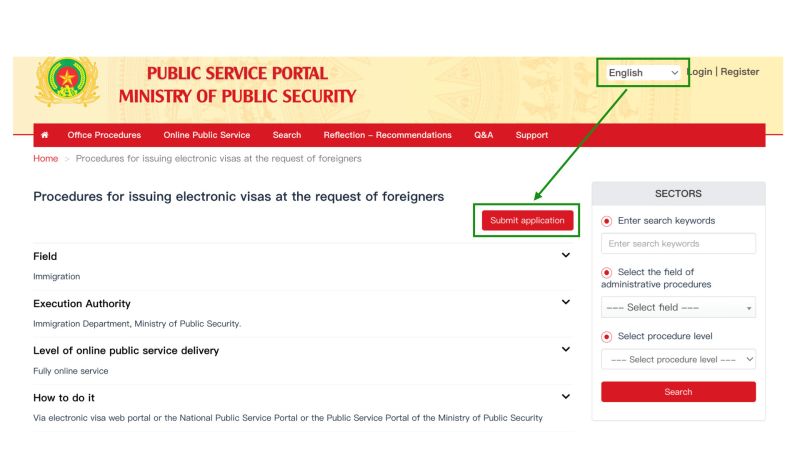
The Vietnam e-visa is an electronic visa that Indian passport holders apply for entirely online at evisa.gov.vn or thithucdientu.gov.vn, with no embassy visit required.
The Vietnam e-visa is valid for up to 90 days, single or multiple entry, and is accepted at 83 international border gates under Resolution 389/NQ-CP of 2 December 2025, including 15 airports in operation such as Noi Bai (Hanoi), Tan Son Nhat (Ho Chi Minh City), Da Nang, Cam Ranh (Nha Trang) and Phu Quoc. Long Thanh airport near Ho Chi Minh City joins the list once it opens for commercial flights, scheduled for December 2026; under the current plan, long-haul routes, including South Asia, move to Long Thanh from the summer 2027 schedule. The airports Indian flights use are compared in the guide to international airports in Vietnam.
The Vietnam e-visa portal has operated on evisa.gov.vn and thithucdientu.gov.vn since 8:00 AM on 11 November 2024 (Vietnam time). Approval is delivered by email as a PDF document, which Indian applicants print and present alongside the passport at the Vietnam border gate. No sticker or stamp is added to the passport before arrival.
How to Apply for Vietnam E-Visa from India: 7 Steps
Indian passport holders apply for the Vietnam e-visa in 7 steps, entirely online at evisa.gov.vn. The steps are:
- Step 1 — Visit the official portal. Indian applicants open evisa.gov.vn or thithucdientu.gov.vn and save the registration code shown after submission. Third-party agent sites often rank above the official portal on Google, so always verify the URL ends in .gov.vn before entering any personal details. The full checklist for identifying the official Vietnam visa website is covered in the section below.
- Step 2 — Select “Apply for E-Visa”. Click the e-visa application button on the homepage, choose “Foreigner”, and select India as the nationality from the dropdown menu.
- Step 3 — Fill in personal details. Enter passport number, full name exactly as printed in the passport with no abbreviations, date of birth, gender, place of birth and nationality. Double-check every field against the passport biodata page before proceeding, as mismatches are the most common rejection reason for Indian e-visa applicants.
- Step 4 — Enter travel details. Input the intended entry date, exit date and an address in Vietnam, and choose the airport or border gate where the traveller will enter Vietnam.
- Step 5 — Upload documents. Upload the scanned passport biodata page (JPG or PDF, maximum 2 MB) and the digital passport photo (4×6 cm, white background, JPG/JPEG within the portal’s size limit).
- Step 6 — Pay the fee. Pay US$25 for a single entry or US$50 for multiple entries using an international Visa or Mastercard. The fee is non-refundable, including in the event of rejection.
- Step 7 — Download and print the e-visa. Applicants download the approved e-visa from the search page on evisa.gov.vn using the registration code, email address and date of birth, then print 2 copies to carry with the passport.
The form is filed in 1 session, so it helps to have the passport scan and photo ready before starting.
Vietnam Digital Arrival Card
Indian travellers also complete Vietnam’s free Digital Arrival Card at prearrival.immigration.gov.vn within 72 hours before landing at Vietnam’s main international airports, including Tan Son Nhat, Noi Bai, Da Nang and Phu Quoc. The card does not replace the e-visa. Travellers receive a QR code to show at passport control, and travellers connecting to a domestic flight submit 1 card for the first airport of arrival. More airports are being added, so travellers should check the portal before departure.
The 2 most common technical failure points for Indian e-visa applicants occur before the submission reaches the Vietnamese government:
- A passport photo rejected for a non-white background, glasses or a blurry image.
- A payment declined because the card does not have international online transactions enabled.
Both failures result in a wasted application session with no refund on a paid fee. Vietnamtour.in, which has served 428,000+ Indian travellers since 2015, can check passport scans and photos before submission so that applications reach the Vietnamese government without avoidable errors.
Vietnam E-Visa Processing Time for Indian Applicants
Vietnamese law sets the e-visa processing time at 3 working days, although the Embassy of Vietnam in India advises allowing more time in busy periods, and evisa.gov.vn has no paid express track.
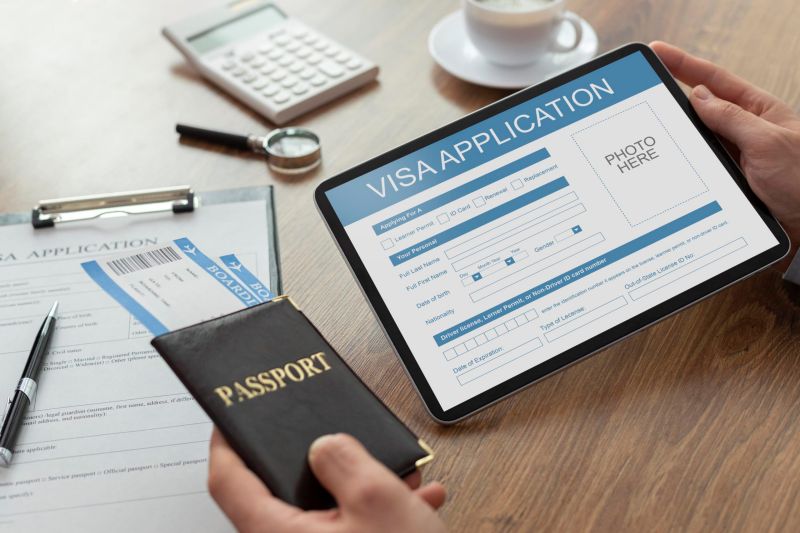
Business days exclude weekends and Vietnamese public holidays. The 3 ways to file the application, and what each costs, are compared below:
| Filing option | Cost | Processing time | Best for |
|---|---|---|---|
| Apply directly on evisa.gov.vn | US$25 (₹2,375) single / US$50 (₹4,750) multiple | About 3 working days; no express option | Travellers comfortable filing the form themselves |
| Vietnamtour.in e-visa service | US$35 (₹3,325): US$25 government fee + US$10 service fee | About 3 working days, with passport and photo checks first | First-time applicants who want the form checked |
| Vietnamtour.in urgent service | Fee depends on how quickly the visa is needed | Faster than standard | Travellers departing within a few days |
Peak application periods for Indian applicants include Diwali week (October – November), Christmas to New Year (December 20 – January 5) and Holi week (March). Indian travellers flying in these periods should apply earlier than usual, because any correction leaves less time before departure.
What Is Vietnam Visa on Arrival for Indians?
Visa on arrival is available only in specific cases set by Vietnamese law, and the case that applies to most travellers is a tour organised by a licensed Vietnamese international tour operator. Under Clause 1, Article 18 of Law 47/2014, a visa can be issued at an international border gate in 6 cases:
- Departing from a country with no Vietnamese visa-issuing office.
- Travelling through several countries before Vietnam.
- Visiting on a tour run by a Vietnamese international tour operator.
- Foreign crew leaving through another border gate.
- Attending a relative’s funeral or visiting a seriously ill relative.
- Emergency or rescue work, or another special reason requested by a Vietnamese authority.
Most visa on arrival letters are arranged by tour operators for groups travelling on a fixed itinerary.
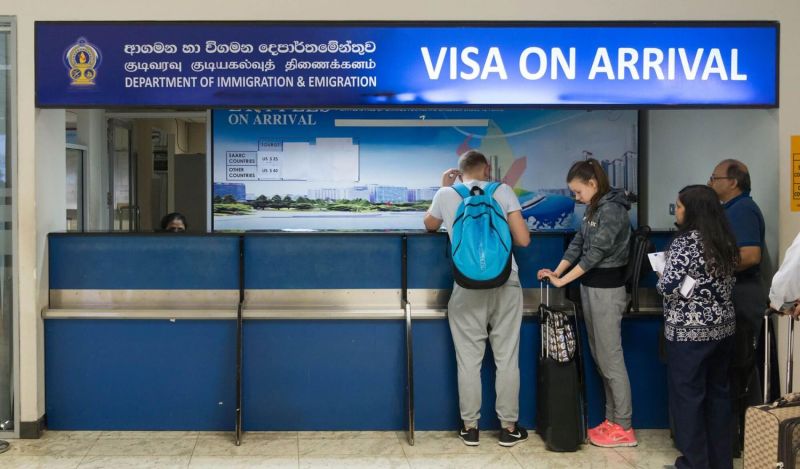
For Indian citizens, Vietnamtour.in arranges the e-visa rather than a visa on arrival letter, because the e-visa is processed fully online. The visa on arrival letter service is mainly used by travellers of other nationalities and costs US$35 (₹3,325) for processing plus a US$25 (₹2,375) stamping fee at the airport.
Independent Indian travellers apply for the e-visa, while travellers who book a Vietnam trip package from India can have Vietnamtour.in arrange the e-visa as part of the trip planning.
Vietnam Embassy Visa for Indian Passport Holders
The Vietnam embassy visa is a sticker visa stamped into the Indian passport, applied for in person or by post at the Embassy of Vietnam in New Delhi or the Consulate General in Mumbai.
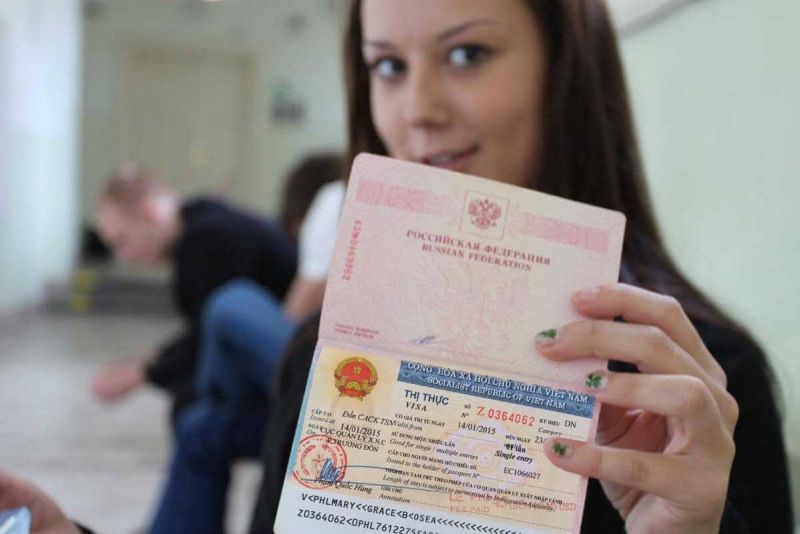
Embassy visa fees depend on the visa type, length of stay and number of entries, are confirmed by the Embassy when applying and are not refunded. The Embassy offers same-day processing for an extra fee, depending on the documents. The embassy visa is the preferred option for Indian applicants requiring multiple-entry business visas, journalist or investor visa categories, or in cases where a previous e-visa application has been rejected and requires in-person clarification.
The Embassy of Vietnam in New Delhi is located at EP-7A, Chandragupta Marg, Chanakyapuri, New Delhi-110021. The consular section accepts applications on Monday from 10:30 AM to 11:30 AM and from Tuesday to Friday from 9:30 AM to 11:30 AM, returns passports from 4:00 PM to 5:30 PM, and answers calls on +91 70 4203 5588 from 2:30 PM to 6:00 PM on working days. The Consulate General of Vietnam in Mumbai is at Unit 805, 8th Floor, Powai Plaza, Hiranandani Gardens, Central Avenue, Powai, Mumbai 400076.
Documents required for the Vietnam embassy visa include a valid passport with a minimum of 2 blank pages, 2 physical photos (4×6 cm, white background), a completed application form, a confirmed flight itinerary, a hotel booking confirmation, and the application fee paid in cash or demand draft. Indian applicants outside Delhi applying by post or courier should allow an additional 3 to 5 days for document transit, and the e-visa remains the fastest option for most standard tourist trips from India.
How to Identify the Official Vietnam Visa Website for Indian Applicants
The only 2 official Vietnam e-visa websites are evisa.gov.vn and thithucdientu.gov.vn, both run by the Vietnam Immigration Department. The older address evisa.xuatnhapcanh.gov.vn now only shows information and a notice pointing to the 2 new domains, and all other sites claiming to offer Vietnam e-visa services are third-party agents or unauthorised intermediaries.
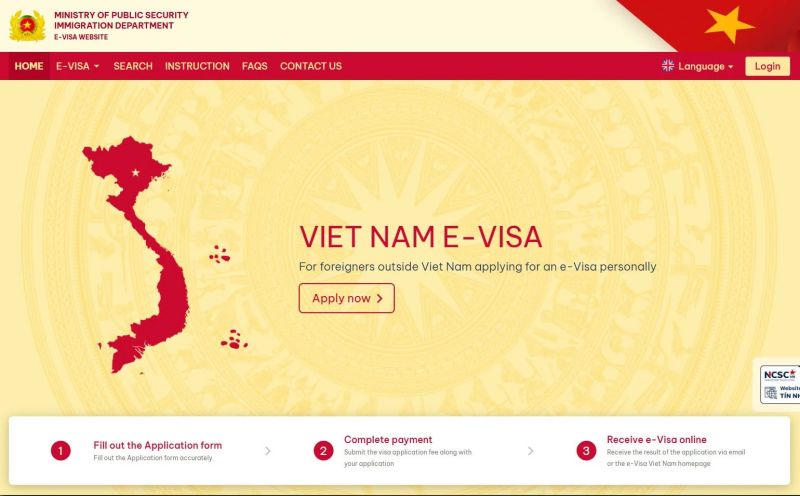
Indian applicants identify fake Vietnam visa websites through 4 clear signals:
- The URL does not end in .gov.vn.
- The site charges a fee higher than US$25 for a single entry or US$50 for multiple entries.
- The site requests additional information not required by the Vietnamese government, such as bank statements or income proof.
- The site does not display the Vietnam Ministry of Public Security logo in the header or footer.
Google search results for “Vietnam visa” frequently display paid advertisements and agent sites above the official government portal, so applicants should scroll past sponsored results and verify the URL begins with evisa.gov.vn before entering any passport details or payment information. Vietnamtour.in’s e-visa service is a paid assistance service, not a government website, and the government fee stays US$25 (₹2,375) whichever way the application is filed.
Phu Quoc Visa for Indians: 30-Day Visa-Free Entry Rules
Indian travellers flying directly to Phu Quoc from abroad can stay on the island for up to 30 days without a visa, but they need an e-visa to continue to mainland Vietnam. The exemption, set out in Law 47/2014 as amended in 2019, applies to the island only, and whether a visa is needed depends on how the trip reaches Phu Quoc, as the 4 scenarios below show:
| How the trip reaches Phu Quoc | Visa needed? |
|---|---|
| International flight straight to Phu Quoc (such as the Ahmedabad–Phu Quoc flight from December 2026), staying on the island only | No, up to 30 days visa-free |
| International flight straight to Phu Quoc, then on to Hanoi, Da Nang or Ho Chi Minh City | Yes, an e-visa covering the mainland part of the trip |
| Landing in Hanoi or Ho Chi Minh City first, then a domestic flight to Phu Quoc | Yes, an e-visa from the first arrival |
| Mainland Vietnam, then Phu Quoc, then back to the mainland | Yes, an e-visa for the whole stay |
The 30-day Phu Quoc stay cannot be extended, and visa-free arrivals at Phu Quoc still complete the Digital Arrival Card.
Can Indians with a US Visa Enter Vietnam Without a Separate Visa?
A valid US visa does not exempt Indian passport holders from Vietnam’s visa requirement. Indian nationals must obtain a separate Vietnam visa regardless of any third-country visas held in their passports.
A US visa, UK visa, Schengen visa, Australian visa and Canadian visa do not create a visa exemption for Vietnam for Indian passport holders. The confusion arises because some Southeast Asian countries, such as the Philippines, offer visa-free entry or reduced requirements for Indians holding a US visa, but Vietnam does not apply any such third-country visa exemption policy.
Can Indians Extend a Vietnam E-Visa?
Indian travellers cannot extend a Vietnam e-visa on their own; an e-visa holder already in Vietnam can receive a new visa only when a Vietnamese agency, organisation or individual sponsors the application.
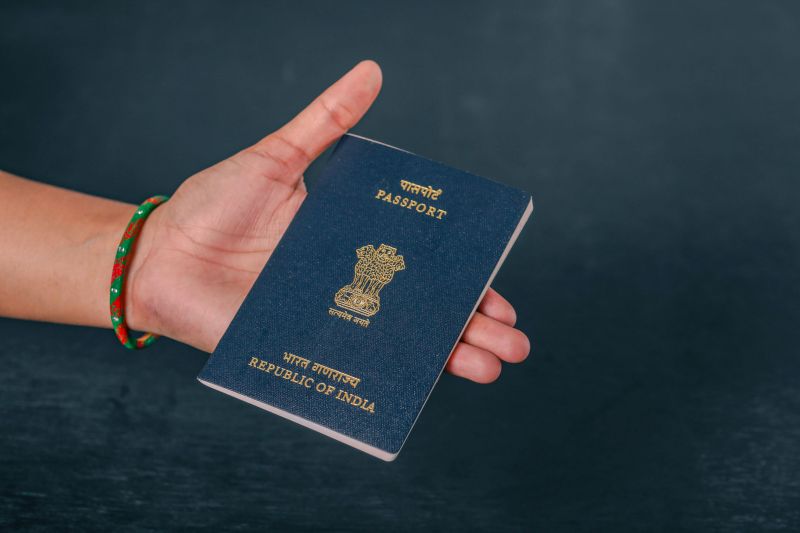
Indian travellers without a sponsor who want to stay longer exit Vietnam before the e-visa expires, usually to Cambodia or Laos, and re-enter on a new e-visa; Phnom Penh is about 6–7 hours from Ho Chi Minh City by bus. Travellers expecting to leave and re-enter Vietnam should choose the multiple-entry e-visa (US$50, ₹4,750) from the start, and can turn the border crossing into a holiday with the Vietnam and Cambodia tour packages, covering Angkor Wat and Phnom Penh.
Common Reasons Vietnam Visa Is Rejected for Indian Applicants
Vietnam e-visa applications from Indian nationals are rejected for 5 specific reasons, all of which are preventable before submission. The 5 reasons are:
- Passport data mismatch. The name, date of birth or passport number on the form does not match the passport biodata page exactly; this is the single most common rejection reason for Indian applicants.
- Passport validity under 6 months. The passport must hold at least 6 months validity from the intended date of entry, and passports expiring sooner are rejected automatically.
- Non-compliant passport photo. The uploaded photo is blurry, has a non-white background, shows glasses or a hat, or is older than 6 months.
- Invalid or inconsistent travel dates. The entry date falls in the past, the entry date is after the exit date, or the intended stay exceeds 90 days.
- Payment card without international transactions. The card used does not have international online transactions enabled.
Each of these errors can be fixed and the application filed again the same day.
Rejected Indian applicants can submit a new application as soon as the error is corrected, but the fee for the rejected application is not refunded. Depending on how close the rejection falls to the departure date, it can cascade into missed flights and forfeited hotel bookings if the resubmission processing window is not factored in.
Best Time to Apply for a Vietnam Visa from India
Indian travellers should apply for the Vietnam e-visa at least 2 weeks before departure, and about 1 month ahead in peak season, because the Embassy of Vietnam in India advises allowing extra time in busy periods. The timing by travel scenario is:
- Standard travel (planned 30+ days in advance): apply 10 to 14 days before departure, allowing 3 working days plus a 5 to 7-day buffer for corrections or resubmissions.
- Peak Indian holiday season (October to January, March, April to May): apply about 1 month in advance.
- Last-minute travel: evisa.gov.vn has no same-day option, so Vietnamtour.in’s urgent processing helps travellers short on time, with the fee depending on the turnaround.
Earlier is always safer, since the fee is lost if a rejected application has to be filed again.
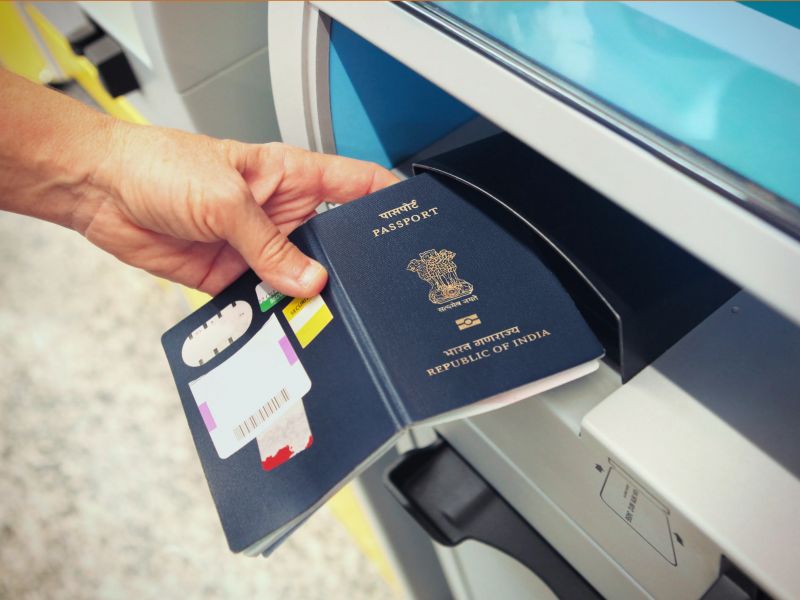
Indian applicants should avoid submitting applications on Vietnamese public holidays: National Day (September 2), Reunification Day (April 30) and Tet Lunar New Year (January to February, dates vary). The evisa.gov.vn portal remains open during these holidays, but processing pauses until working days resume. Once the visa is approved, the next step is staying connected on arrival, and the guide to the free Mobifone eSIM in Vietnam explains how to get online from the airport.
Vietnam Visa for Indian Passport Holders — Key Facts
The 4 ways an Indian passport holder can enter Vietnam compare side by side as follows:
| Detail | E-visa | Visa on arrival | Embassy visa | Phu Quoc visa-free |
|---|---|---|---|---|
| Fee | US$25 (₹2,375) single / US$50 (₹4,750) multiple | Approval letter + US$25 (₹2,375) stamping fee | Set by the Embassy | Free |
| Stay | Up to 90 days | Per approval letter | Per visa issued | Up to 30 days, island only |
| Processing | About 3 working days | Letter before flying, stamp on arrival | Set by the Embassy; same-day for a fee | None |
| Where to apply | evisa.gov.vn or thithucdientu.gov.vn | Through a licensed Vietnamese tour operator | Embassy, New Delhi, or Consulate, Mumbai | No application; fly directly to Phu Quoc |
| Best for | Almost all Indian tourists | Specific cases under Vietnamese law | Business, journalist or investor visas | Island-only beach holidays |
The Vietnam e-visa at US$25 (₹2,375) is the simplest option for most Indian passport holders, and the full holiday budget, with flights, hotels and food alongside the visa fee, is set out in the guide to planning a Vietnam budget trip from India.
FAQs About Vietnam Visa for Indians
Indian travellers asking about the Vietnam visa most often want to know about children, transit, Cambodia trips, refunds, tickets, insurance and business visas.
Does Each Child Need a Separate Vietnam E-Visa?
Yes, each child with a passport needs a separate application, photo and full fee. evisa.gov.vn has no family or group application.
Do Indians Need a Vietnam Visa for a Transit Flight?
No, travellers who stay inside the international transit area do not need a visa. A visa is needed when the connection requires clearing immigration, including a domestic Vietnam leg.
Should Indian Travellers Choose a Multiple-Entry E-Visa for a Vietnam–Cambodia Trip?
Yes, the multiple-entry e-visa (US$50, ₹4,750) suits trips that leave Vietnam and return within 90 days. Land crossings from Cambodia on the e-visa list include Moc Bai and, since December 2025, Binh Hiep.
Is the Vietnam Visa Fee Refunded If the Application Is Rejected?
No, the e-visa fee is not refunded when an application is refused. Indian applicants can file a new application once the error is corrected.
Do Indians Need a Flight Ticket to Apply for the Vietnam E-Visa?
No, the e-visa form asks only for travel dates, entry gate and an address in Vietnam. A return ticket and hotel booking are still worth carrying at immigration.
Is Travel Insurance Required for Vietnam?
No, travel insurance is not required to enter Vietnam as of October 2026. A 2026 Politburo resolution sets a direction for compulsory insurance for international visitors, but no implementing rule has been issued, so travellers should check again before travelling.
Do Travellers Need a Health Declaration to Enter Vietnam?
No, Vietnam has no general health declaration for arriving travellers as of October 2026. The Ministry of Health activates declarations only when a disease situation requires it.
Which Visa Do Indians Need for Business or Work in Vietnam?
The tourist e-visa does not allow work: business visits use a DN visa, and paid work needs an LĐ visa plus a work permit. Both are arranged through a sponsoring company in Vietnam, and Indian travel companies sending groups can work with a Vietnam DMC in India.
Do Indian Diplomatic or Official Passport Holders Need a Vietnam Visa?
No, holders of Indian diplomatic and official (service) passports are exempt for stays of up to 90 days under a bilateral agreement in force since 23 March 1995. Ordinary passport holders follow the rules in this guide.
Ready to Apply for Your Vietnam E-Visa?
The Vietnam e-visa application takes under 15 minutes to complete, with approval delivered by email within about 3 working days. Indian travellers can apply directly at evisa.gov.vn, or ask Vietnamtour.in, a travel agent in Vietnam working only with Indian travellers, to handle the e-visa for US$35 (₹3,325), with passport and photo checks before submission.
With the visa sorted, the trip itself can be planned by length or by departure city. Fixed routes include the Vietnam tour package for 7 days, the Vietnam tour package 7 nights 8 days and the 10 day trip to Vietnam cost guide, and island holidays are covered by the Phu Quoc travel packages.
Packages are also listed by city, with the best flight for each: the Vietnam tour package from Delhi, the Vietnam tour package from Mumbai, the Vietnam tour package from Kolkata, the Vietnam package from Bangalore, the Vietnam tour package from Hyderabad, the Vietnam tour package from Ahmedabad, the Vietnam tour package from Chennai, the Vietnam tour package from Kerala, the Vietnam tour package from Jaipur and the Vietnam tour packages from Pune.
- Hanoi HQ: Floor 4, Bao Anh Building, 62 Tran Thai Tong, Cau Giay, Hanoi
- Delhi: A 10/1 Gujrawala Town Part 1, Main G T Karnal Road, Delhi 110009
- India hotline: +91 88502 95722
- Vietnam / WhatsApp: +84 948 333 087
- Email: [email protected]
Share the travel dates and departure city in the form below for help with the visa and the trip.