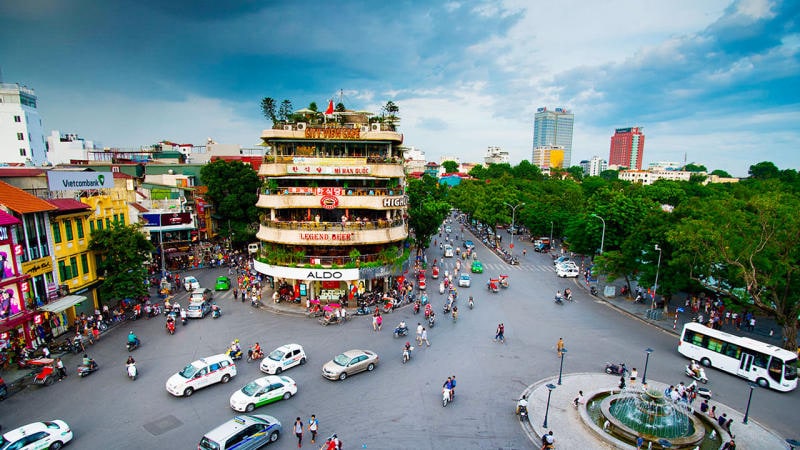
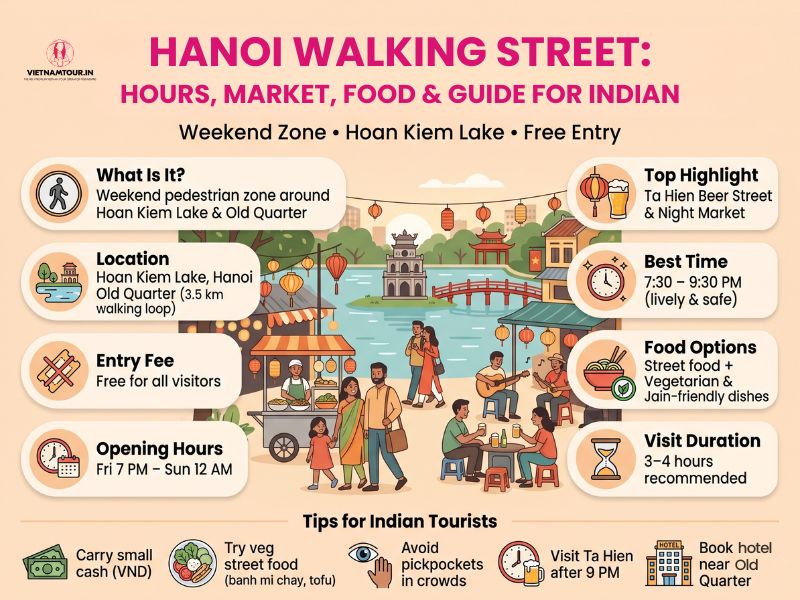
Hanoi Walking Street is the weekend pedestrian-only zone around Hoan Kiem Lake and Hanoi Old Quarter, operating from 7:00 PM Friday through midnight Sunday across every weekend of the year, with a single annual closure during Tết (Vietnamese Lunar New Year holiday). Hanoi Walking Street transforms a 3.5 km (2.2 miles) circuit in central Hanoi into a car-free network of night markets, street food lanes, live music clusters, and the iconic Ta Hien Beer Street — creating Hanoi’s largest continuous weekend outdoor entertainment zone.
This Hanoi Walking Street guide for Indian tourists in 2026 covers Hanoi Walking Street across 4 practical planning layers: the weekend schedule and zones (Hoan Kiem Lake pedestrian perimeter, Ta Hien Beer Street, Hàng Đào Night Market), the food and shopping experience with vegetarian and Jain-friendly options, safety and transport routes from major Hanoi hotels to the Walking Street perimeter, and how to schedule the Walking Street weekend inside a wider Vietnam tour package from India.
Hanoi Walking Street feels immediately familiar to Indian tourists — the weekend car-free energy matches Janpath and Connaught Place Inner Circle in Delhi on a Sunday evening, the market density mirrors Sarojini Nagar, and the Ta Hien Beer Street bar crowd runs the same open-air communal vibe as Hauz Khas Village in Delhi. Indian tourist budgets at Hanoi Walking Street range from 115,000–230,000 VND (₹400–₹800) per person for a street-food-and-bia-hơi evening, up to 385,000–570,000 VND (₹1,350–₹2,000) per person, including souvenirs, dinner, and a rooftop bar drink.
Hanoi Walking Street Definition — Boundaries, Zones & Hoan Kiem Anchor
Hanoi Walking Street is the weekend pedestrian-only zone covering the streets around Hoan Kiem Lake and extending into the Old Quarter, closed to all motor vehicles from 7:00 PM Friday until midnight Sunday, and activated with street performers, vendor stalls, food carts, and open-air markets. Hanoi Walking Street (locally called Phố đi bộ Hồ Gươm — Hoan Kiem Walking Street) runs a 3.5 km (2.2 miles) perimeter loop around Hoan Kiem Lake, with 16 directly-closed Old Quarter streets — including the Hàng Đào night-market corridor and Ta Hien Beer Street — restricted to traffic during the same weekend window. Counting the 10 partially-restricted feeder lanes covered by the same weekend pedestrian protocol, Hanoi Walking Street spans the 26-street perimeter referenced in some Hanoi guides.
Hanoi Walking Street covers 4 distinct zones for Indian tourists: the Hoan Kiem Lake perimeter promenade, the Hàng Đào–Đồng Xuân Night Market corridor, Ta Hien Beer Street, and 14 Old Quarter connecting lanes. The 4 Hanoi Walking Street zones operate as a single integrated pedestrian network across the weekend closure hours:
- Hoan Kiem Lake Perimeter runs 1.7 km (1.05 miles) as a lake-edge promenade, featuring the illuminated Ngoc Son Temple, the red Huc Bridge, and 5–8 live music clusters on Saturday evenings.
- Hàng Đào–Đồng Xuân Night Market Corridor stretches 600 metres through the Old Quarter, hosting vendor stalls that sell clothing, souvenirs, and Vietnamese street food at 50,000–300,000 VND (₹175–1,050) per item.
- Ta Hien Beer Street operates as the Old Quarter bar lane, serving bia hơi draft beer at 10,000–20,000 VND (₹35–70) per glass with plastic-stool sidewalk seating and live acoustic music from 8:00 PM onward.
- Old Quarter Connecting Lanes total 14 additional streets closed to traffic, hosting food stalls, street performances by local musicians and acrobats, and children’s games — including traditional ô ăn quan and shuttlecock kicking.
Hanoi Walking Street exists as a municipal initiative by the Hanoi People’s Committee, launched in September 2016 for the Hoan Kiem Lake zone and extended into the Old Quarter streets in December 2020. The Hanoi People’s Committee activated Hanoi Walking Street to reanimate the historic downtown for domestic tourism, foreign visitors, and local weekend recreation — with the zone now drawing an estimated 15,000–25,000 visitors per weekend evening during peak season (Vietnamtour.in operations data, 2023–2025).
Hanoi Walking Street differs from a fixed night market or a single bar street as a time-bound urban transformation. Hanoi Walking Street converts streets that carry cars Monday through Friday into a continuous pedestrian experience across Friday night, Saturday, and Sunday, covering a 3.5 km lake loop plus 16 Old Quarter lanes for Indian tourists.
Hanoi Walking Street Schedule — Opening Days And Hours
Hanoi Walking Street opens every Friday at 7:00 PM and closes Sunday at midnight, operating across 17 total hours spread over 3 weekend evenings. Hanoi Walking Street runs 3 distinct activity phases across the weekend for Indian tourists — Friday evening launch crowds, Saturday peak density, and Sunday family and cultural programming — all within the same Hoan Kiem Lake and Old Quarter pedestrian zone boundaries.
Hanoi Walking Street weekend operating hours:
- Friday evening — 7:00 PM to 12:00 AM (5 hours, opening-night crowd density building through the evening)
- Saturday evening — 6:00 PM to 12:00 AM (6 hours, peak density between 8:00 PM and 10:00 PM)
- Sunday evening — 6:00 PM to 12:00 AM (6 hours, family-oriented crowd with children’s performances scheduled earlier in the evening)
The Hàng Đào Night Market within the Hanoi Walking Street zone runs shorter hours from 6:00 PM to 11:00 PM on Friday, Saturday, and Sunday, closing 1 hour before the broader Walking Street pedestrian zone shuts down each night.
Hanoi Walking Street operates on all Vietnamese public holidays with one annual exception: Hanoi Walking Street closes for 5 days during Tết (Vietnamese Lunar New Year, falling mid-February to late February in 2026), when Hanoi businesses shut across the national holiday window. Hanoi Walking Street stays open during Vietnamese Independence Day (2 September), International Labour Day (1 May), and every weekend across the Indian Diwali (October–November), Dussehra (September–October), and Christmas–New Year (December–January) travel peaks. During the Indian holiday travel windows, Hanoi Walking Street runs its normal weekend schedule with higher Indian tourist density — Indian tourists should book accommodation near Hoan Kiem Lake 2 weeks in advance to secure availability during Diwali and Christmas peak periods.
Vietnamtour.in weekend-arrival data shows Indian travellers landing in Hanoi on Friday morning maximise the Walking Street experience, with 2-night Friday–Sunday stays delivering access to all three activity phases. Vietnamtour.in itinerary planners recommend booking Old Quarter hotels within 500 metres of Hoan Kiem Lake, reducing post-midnight transport needs and improving safety for Indian families and solo Indian travellers.
Hoan Kiem Lake Walking Street — What Can You See and Do?
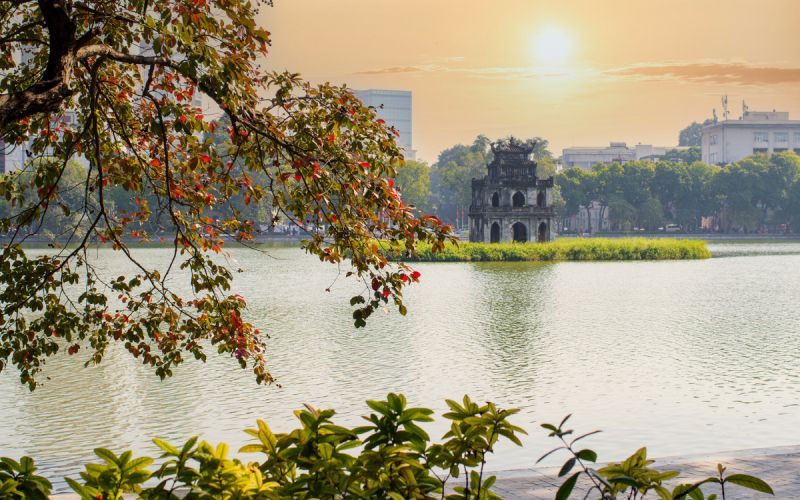
The Hoan Kiem Lake Walking Street is a 1.7 km (1.05 miles) pedestrian promenade circling Hoan Kiem Lake, featuring the illuminated Ngoc Son Temple on Jade Island, the red-painted Huc Bridge, 6–8 live music clusters spaced roughly 200 metres apart, and open-air group activities including traditional dance, Vietnamese folk games, and children’s performances. Hoan Kiem Lake sits at the geographic centre of Hanoi Walking Street, with the lake itself forming the visual anchor and the surrounding streets closed to all motor vehicles throughout the weekend closure window.
Indian tourists spend 60–90 minutes on the Hoan Kiem Lake Walking Street perimeter completing 4 main activities: a Ngoc Son Temple visit, live music stops, Vietnamese folk game participation, and dessert-and-coffee stalls at the north lake end. The 4 Hoan Kiem Lake Walking Street activities run as a natural circuit around the 1.7 km lake perimeter:
- Ngoc Son Temple Visit runs as a 19th-century temple completed in 1841 on Jade Island, with the Jade Island site itself recorded in Hanoi history dating back to the Tran dynasty (13th–14th century), accessed via the red Huc Bridge, operating until 9:00 PM Friday through Sunday with evening illumination and an entry fee of 30,000 VND (₹100) per adult.
- Live Music Spots total 6–8 locations spaced roughly 200 metres apart around the lake perimeter, hosting traditional Vietnamese music ensembles, jazz duos, and student street performers from 7:30 PM to 10:30 PM.
- Vietnamese Folk Games include ô ăn quan (a traditional mancala variant), kéo co (tug of war), and jump rope, set up free of charge in open pedestrian zones at 3–4 designated spots around the lake.
- Ice Cream and Egg Coffee Stalls cluster at the north end of Hoan Kiem Lake at Thuy Ta Cafe and Hapro Coffee, serving egg coffee at 35,000–55,000 VND (₹125–195) per cup and Trang Tien ice cream at 15,000–25,000 VND (₹55–90) per scoop.
Indian tourists can preview the Hanoi Walking Street layout on Google Maps by searching Pho di bo Ho Guom for the Hoan Kiem Lake perimeter and Ta Hien Street for the Old Quarter bar lane.
The Hoan Kiem Lake pedestrian zone and Ta Hien Beer Street form 2 distinct sections of the same Hanoi Walking Street weekend, with contrasting crowd profiles and evening character. The 2 zones sit 400 metres apart and draw different Indian tourist segments depending on evening priority.
Hoan Kiem Lake Walking Street runs family-friendly and culture-focused, drawing children, couples, elderly locals, and mixed international tourists into an open-air public-park atmosphere after dark. Hoan Kiem Lake Walking Street stays alcohol-free across the pedestrian zone, with vendors selling non-alcoholic drinks, street snacks, and traditional sweets rather than beer or cocktails.
Ta Hien Beer Street sits 400 metres north of Hoan Kiem Lake inside the Old Quarter, running adult-focused and alcohol-centred with bar patrons on plastic stools, live bar music, and a crowd weighted toward tourists aged 20–40. Ta Hien Beer Street serves as the late-evening continuation point for Indian tourists transitioning from the cultural Hoan Kiem Lake zone into the Old Quarter bar scene.
Indian tourists visiting both zones in a single evening follow a standard 3-stop route across 3 hours. Indian tourists start at Hoan Kiem Lake at 7:00 PM, walk the 1.7 km perimeter for 60 minutes while visiting Ngoc Son Temple and the live music clusters, then move 400 metres north to Ta Hien Beer Street for drinks from 9:00 PM onward.
Ta Hien Beer Street Old Quarter — Complete Guide For Indian Visitors
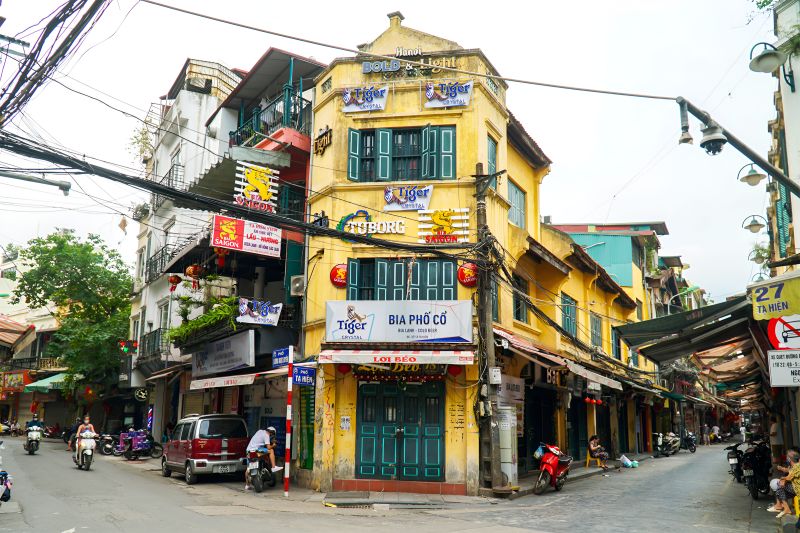
Ta Hien Beer Street is the 200-metre bar lane in Hanoi Old Quarter running northeast of Hoan Kiem Lake, where hundreds of tourists and Vietnamese locals drink fresh-brewed bia hơi on plastic stools from 7:00 PM until 1:00 AM — the most iconic nightlife address in Hanoi. Ta Hien Beer Street (Tạ Hiện) holds 15+ open-front bars, 3 top-rated cocktail venues, and a dense street-food vendor cluster, and Ta Hien Beer Street sits inside the broader Hanoi Walking Street pedestrian zone every Friday, Saturday, and Sunday evening.
Ta Hien Beer Street pricing for Indian tourists in 2026:
- Bia hơi (fresh draft beer) — 10,000–20,000 VND (₹35–70) per glass, brewed daily in Hanoi and consumed the same day
- Bottled beer (Tiger, Saigon Special, Hà Nội) — 30,000–45,000 VND (₹105–160) per bottle
- Street snacks — fresh spring rolls (gỏi cuốn), grilled corn (ngô nướng), and grilled skewers (xiên nướng) at 15,000–30,000 VND (₹50–105) per item
- Cocktails at top-rated bars — 115,000–340,000 VND (₹400–1,200) per cocktail at Hanoi Blues Bar and Secret Bar & Pub
3 named venues anchor Ta Hien Beer Street:
- 1900 Le Théâtre (8B Tạ Hiện) — 4.2⭐ rating from 3,200 Google reviews, opens 9:00 PM, nightclub with live music and happy hour drinks
- Hanoi Blues Bar (2B Tạ Hiện) — 4.8⭐ rating from 1,300 Google reviews, opens 6:00 PM, cocktail bar with dine-in food service
- Secret Bar & Pub (1 Tạ Hiện) — 5.0⭐ rating from 2,200 Google reviews, opens 8:00 PM, craft cocktails and small-plate food
Is Ta Hien Street Safe for Indian Solo Female Travelers?
Yes, Ta Hien Beer Street is safe for Indian solo female travelers from 7:00 PM until midnight, with pickpocketing as the primary concern rather than harassment or violent crime. Ta Hien Beer Street maintains consistent foot traffic of 2,000–3,500 visitors per weekend evening (Vietnamtour.in tour-guide field counts, 2024 peak season), visible Hanoi Police presence at both street entrances with 15-minute patrol intervals, and a mixed gender crowd of domestic tourists, international tourists, and Hanoi locals. Ta Hien Beer Street delivers a safety profile comparable to the bar streets Indian solo female travelers navigate in Hauz Khas Village, Bandra, or Koregaon Park at weekend peak hours.
The 4 safety points that follow cover peak hours, post-midnight transitions, street-level solicitation awareness, and drink-handling protocols for Indian solo female travelers on Ta Hien Beer Street:
- Peak Safe Hours run from 7:00 PM to midnight with continuous foot traffic at all times, delivering the baseline safety condition of high-density pedestrian activity across the full Ta Hien Beer Street stretch.
- Post-Midnight Transition Window opens at 1:00 AM last-call when crowd density drops 70–80% within 20 minutes. Indian solo female travelers should book a Grab car 20 minutes before leaving the bar, not after, because the post-midnight driver shortage at 1:15–1:30 AM means 15–25 minutes waiting on a street that empties faster than Grab supply recovers. Anthony Nguyen, Co-founder and CMO of Vietnamtour.in (10+ years operating Indian-exclusive Vietnam tours, 428,000+ Indian tourists handled since 2015), flags this timing gap in all Ta Hien briefings for Indian tour groups.
- Street-Level Solicitation Awareness covers “boom boom” solicitors (slang for informal sex-trade approaches) operating on side lanes adjacent to Ta Hien Beer Street, with a firm verbal decline and continued walking pace resolving the interaction for Indian solo female travelers within seconds.
- Drink-Handling Protocol keeps Indian solo female travelers’ drinks in visual line of sight at all times, with unsolicited “free drink” offers from strangers declined as standard practice — matching the drink-safety norm familiar with Goa beach bars and Mumbai club circuits.
Indian solo female traveler safety on Ta Hien Beer Street aligns with the baseline precautions Indian solo female travelers apply in Hauz Khas Village, Bandra, and Koregaon Park at night. Indian solo female traveler safety on Ta Hien Beer Street rests on 2 layers: the high-foot-traffic environment supplying the structural safety baseline, and standard personal vigilance covering the residual risk that remains at any night-economy venue worldwide.
What Non-Alcoholic Drinks Are Available At Ta Hien For Indian Tourists?
Ta Hien Beer Street serves 5 non-alcoholic drink categories for Indian tourists who do not drink alcohol: fresh fruit juices, Vietnamese egg coffee, bottled water and soft drinks, fresh sugarcane juice, and Vietnamese iced tea. Ta Hien Beer Street non-alcoholic drink pricing matches the bia hơi street-vendor price tier, making a Ta Hien Beer Street visit fully accessible for Indian tourists on a non-alcoholic Hanoi itinerary.
- Fresh fruit juices — mango (xoài), watermelon (dưa hấu), and passion fruit (chanh dây) at 30,000–60,000 VND (₹105–210) per glass
- Vietnamese egg coffee (cà phê trứng) — 35,000–55,000 VND (₹120–195) per cup, lacto-ovo vegetarian Hanoi specialty prepared with whisked egg yolk and condensed milk
- Bottled water and soft drinks — 15,000–25,000 VND (₹50–90) per 500ml bottle or 330ml can across Coca-Cola, Sprite, and Pepsi brands
- Fresh sugarcane juice (nước mía) — 15,000–20,000 VND (₹50–70) per cup at street vendors along the Ta Hien Beer Street lane
- Vietnamese iced tea (trà đá) — 5,000–10,000 VND (₹20–35) per glass, served free or at no additional cost with food orders at street-food stalls
Indian tourists ordering non-alcoholic drinks at Ta Hien Beer Street bars face no venue pressure to consume alcohol, and Indian families travelling with children use Ta Hien Beer Street as a walkthrough cultural experience during the Hanoi Walking Street weekend rather than a drinking destination.
Hanoi Walking Street Night Market — Shopping, Prices & What to Buy
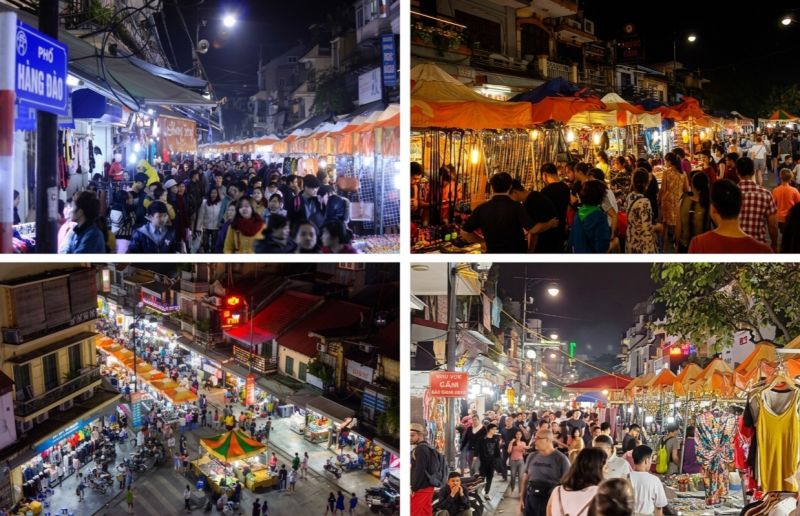
The Hanoi Walking Street Night Market runs 600 metres from Hàng Đào Street through Hàng Ngang to Đồng Xuân Market, operates Friday, Saturday, and Sunday from 6:00 PM to 11:00 PM, and holds 200–250 vendor stalls selling clothing, souvenirs, and street food with bargaining expected at every non-food stall. The Hanoi Walking Street Night Market sits entirely within the Walking Street pedestrian zone and forms the primary shopping destination for Indian tourists during a weekend Hanoi visit. The 5 Hanoi Night Market product categories, bargaining protocols, restricted items, and payment options for Indian tourists follow in the sections below.
Hanoi Night Market product categories for 2026 cover 5 shopping verticals with rupee-equivalent pricing across clothing, souvenirs, embroidery, packaged consumables, and on-site street food:
- Clothing covers T-shirts, áo dài (traditional Vietnamese dress), and scarves at 60,000–240,000 VND (₹210–840) per item.
- Souvenirs cover lacquerware boxes, silk scarves, wooden crafts, and conical bamboo hats (nón lá) at 30,000–450,000 VND (₹105–1,580) per item.
- Embroidery and Fabric cover hand-embroidered tablecloths and cushion covers at 150,000–750,000 VND (₹525–2,630) per item.
- Vietnamese Coffee and Tea Packaging cover Trung Nguyen ground coffee, Highlands coffee beans, and lotus tea at 100,000–300,000 VND (₹350–1,055) per pack.
- Street Food at the Market covers bánh tráng nướng (grilled rice paper), chè (sweet soup), and fresh sugarcane juice at 20,000–35,000 VND (₹70–125) per item.
Hanoi Night Market bargaining operates at every clothing, souvenir, and embroidery stall, with Indian tourists opening offers at 50% of the asking price and settling transactions at 60–70% of the original quote. Hanoi Night Market bargaining dynamics match Sarojini Nagar in Delhi, Janpath in Delhi, and Colaba Causeway in Mumbai — Indian tourists familiar with haggling at these Indian markets navigate the Hanoi Night Market rhythm without adjustment. Hanoi Night Market food stalls and packaged-goods stalls (coffee, tea, branded snacks) operate on fixed prices with no bargaining accepted.
Indian tourists should avoid 2 product categories at Hanoi Night Market: pirated branded goods (fake Nike, Adidas, and Louis Vuitton items) and fake luxury watches. Pirated branded goods and fake luxury watches from Hanoi Night Market carry seizure risk at Indian airport customs on return, with Indian Customs conducting secondary baggage checks on approximately 15–25% of flights arriving from Vietnam routes at Delhi, Mumbai, and Bengaluru airports.
Hanoi Night Market stalls accept Vietnamese dong (VND) cash only, with no card or UPI payment options available at any vendor stall. Hanoi Night Market bargaining rounds move faster when Indian tourists carry small-denomination VND notes — specifically 10,000, 20,000, 50,000, and 100,000 VND notes — which avoid the change-making delays that stall negotiations. ATMs at the Đồng Xuân Market entrance and along Hàng Đào Street provide VND withdrawal access during market operating hours, dispensing 50,000 VND, 100,000 VND, 200,000 VND, and 500,000 VND denominations.
Hanoi Walking Street Food Tour — Best Street Food For Indian Tourists

Hanoi Walking Street food spans 3 main food zones with vegetarian and Jain-friendly options available across every zone: the Hoan Kiem Lake perimeter for light snacks and Vietnamese egg coffee, the Hàng Đào Night Market corridor for grilled and sweet street foods, and the Ta Hien Beer Street food stalls for late-night substantial meals. A Hanoi Walking Street food tour combines street-vendor pricing of 15,000–80,000 VND (₹50–280) per item with 5–10 minute walking distances between zones, allowing Indian tourists to complete a full food tour of 5–6 Vietnamese street dishes in 90 minutes of walking time.
The highest-density Hanoi night food streets within the Hanoi Walking Street weekend zone are Cấm Chỉ alley (Cam Chi) for midnight phở bowls, Tong Duy Tan Street corner for grilled skewers and bánh mì, Ta Hien Beer Street for fresh spring rolls (gỏi cuốn) and grilled seafood, and the Đồng Xuân Market perimeter for dried snacks, fresh tropical fruit, and traditional sweets.
What Vegetarian Street Food Is Available at Hanoi Walking Street?
Hanoi Walking Street offers 8 reliably vegetarian street food dishes for Indian tourists, priced at 15,000–50,000 VND (₹55–175) per item across hot dishes, snacks, desserts, and fresh fruit options. Hanoi Walking Street vegetarian vendors in the Old Quarter tourist zone recognize the Vietnamese phrase “Tôi ăn chay” (I am vegetarian, pronounced “toy an chai”) and adjust dishes on request during the Friday-through-Sunday evening operating window.
The 8 Hanoi Walking Street vegetarian street food dishes for Indian tourists follow in the list below:
- Rau Muống Xào Tỏi covers morning glory stir-fried with garlic at sit-down street food stalls, priced at 30,000–45,000 VND (₹105–160) per plate.
- Đậu Phụ Chiên covers fried tofu with lemongrass at street food stalls and bánh mì carts, priced at 25,000–40,000 VND (₹90–140) per portion.
- Bánh Mì Chay covers vegetarian Vietnamese baguettes filled with tofu, cucumber, carrot pickles, and fresh herbs, priced at 20,000–35,000 VND (₹70–125) per baguette.
- Grilled Corn (Ngô Nướng) covers charcoal-grilled corn cobs with scallion oil, sold at mobile street carts at 15,000–25,000 VND (₹55–90) per cob.
- Grilled Sweet Potato (Khoai Lang Nướng) covers charcoal-roasted sweet potatoes from the same mobile carts, priced at 15,000–25,000 VND (₹55–90) per piece.
- Nem Cuốn Chay covers fresh vegetarian spring rolls with tofu, rice noodles, and herbs, priced at 30,000–50,000 VND (₹105–175) per plate of 4 rolls.
- Chè covers Vietnamese sweet dessert soup with mung beans, coconut milk, and seasonal fruit, priced at 20,000–35,000 VND (₹70–125) per cup.
- Fresh Fruit Cups cover cut mango, pineapple, and watermelon served with chili salt, priced at 20,000–30,000 VND (₹70–105) per cup.
Jain Indian travelers at Hanoi Walking Street communicate dietary restrictions using the Vietnamese phrase “không hành, không tỏi” (no onion, no garlic, pronounced “khong han, khong toy”), which Old Quarter tourist-zone vendors understand with 70–80% reliability during peak evening hours. Jain Indian travelers at Hanoi Walking Street find fresh fruit cups and grilled corn as the 2 safest Jain-compatible options, since both dishes contain zero onion, zero garlic, and no cross-contamination risk from shared cooking surfaces used for meat dishes.
Which Street Foods At Hanoi Walking Street Are Safe For Indian Stomachs?
Indian tourists concerned about stomach sensitivity at Hanoi Walking Street follow 4 specific street food safety rules: choose busy stalls with high customer turnover, avoid raw herb and salad garnishes during the first travel days, drink sealed bottled water only, and select cooked-to-order grilled or stir-fried dishes over pre-prepared items sitting under heat lamps. Hanoi Walking Street food is safe for Indian tourists who follow basic street food hygiene protocols standard across Southeast Asia destinations.
4 Hanoi Walking Street food safety rules for Indian tourists:
- High-turnover stall rule — Hanoi street food stalls with 5+ customers waiting or eating indicate fresh preparation and rapid ingredient turnover, reducing stomach-upset risk for sensitive Indian travelers.
- Cooked-to-order preference — grilled items (chicken skewers, sweet corn, sweet potato fritters), stir-fries (morning glory, fried noodles, tofu dishes), and hot-bowl dishes (phở, bún chả, bún riêu) cook at high temperature immediately before serving at Hanoi Walking Street stalls.
- Raw garnish caution — Indian tourists with sensitive stomachs skip raw herbs and salad garnishes served alongside phở and bún chả for the first 2 days of the Hanoi trip, reintroducing fresh herbs gradually from day 3 onwards.
- Sealed bottled water only — Indian tourists buy sealed bottled water at 10,000–15,000 VND (₹35–55) per 500ml bottle and avoid ice in street drinks at smaller vendor stalls during the first 2 travel days in Hanoi.
Indian tourists should carry standard Southeast Asia traveler medication for the first 48 hours of a Hanoi street food tour: ORS (Oral Rehydration Salts) sachets, loperamide tablets, and a basic antacid — matching the standard precaution kit for first-time Indian trips to Bangkok or Bali street food zones.
How to Reach Hanoi Walking Street from Major Hotels
Indian tourists can travel to Hanoi Walking Street from major Hanoi hotels through 3 transport options: walking (5–15 minutes from Old Quarter hotels), Grab ride-hailing (60,000–150,000 VND (₹210–525) from hotels outside the Old Quarter), or hotel shuttle service available at 4-star and 5-star Hanoi properties. Hanoi Walking Street accessibility is high from every major Hanoi hotel zone, with Old Quarter hotels sitting directly inside the Walking Street pedestrian boundary.
Hanoi Walking Street access from 4 major Hanoi hotel zones for Indian tourists:
- Old Quarter hotels (Hang Be, Ma May, Hang Bac streets) — direct walk into the Walking Street zone in 0–5 minutes on foot, at zero transport cost
- French Quarter hotels (Ly Thuong Kiet, Hai Ba Trung area) — 10–15 minute walk north to Hoan Kiem Lake, or Grab Car at 60,000–100,000 VND (₹210–350) per trip
- West Lake hotels (Xuan Dieu, Quang An in Tay Ho district) — Grab Car at 60,000–100,000 VND (₹210–350) per trip or Grab Bike at 30,000–50,000 VND (₹105–175) per trip, 15–20 minute travel time
- Hotel districts near Hanoi Railway Station — 20–25 minute walk or 15-minute Grab Car at 80,000–130,000 VND (₹280–455) per trip
The Grab ride-hailing app serves as the standard transport method for Indian tourists in Hanoi, replacing street-hailed taxis and xe ôm (motorbike taxis). Grab fares in Hanoi run at 40% of the equivalent Uber or Ola fares in Indian metros, and Indian tourists spend 200,000–400,000 VND (₹700–1,405) per day on total Grab transport across a standard Hanoi trip.
Indian tourists staying outside the Old Quarter drop off at the north end of Hoan Kiem Lake on Đinh Tiên Hoàng Street pickup/dropoff zone rather than attempting to enter the Walking Street pedestrian zone — Grab drivers cannot enter the closed streets, and Grab rides end at the zone perimeter.
Is Hanoi Walking Street Safe for Indian Tourists?
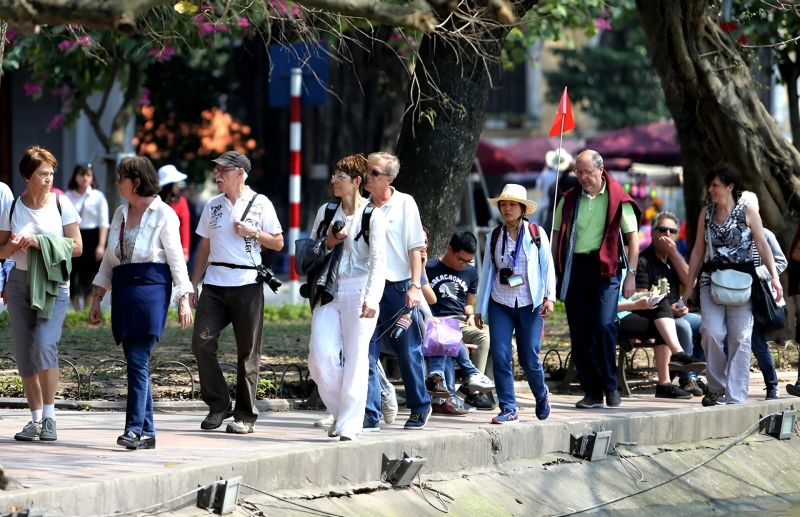
Yes, Hanoi Walking Street is safe for Indian tourists across every visitor category — families, couples, solo travelers, and senior travelers — with the Hoan Kiem Lake zone ranking among the safest urban evening environments accessible to Indian tourists in Southeast Asia. Hanoi Walking Street safety rests on 3 structural factors: consistent dense foot traffic of 15,000–25,000 weekend evening visitors from 7:00 PM to midnight, visible Hanoi Police presence with 20-minute patrol intervals at all 5 major intersections, and full LED street lighting coverage across the 3.5 km pedestrian loop and 16 connected Old Quarter lanes.
Hanoi Walking Street safety risk for Indian tourists centres on pickpocketing in crowded zones as the single primary concern, with violent crime risk measuring near-zero and registering 85–95% lower than in equivalent Indian urban nightlife zones such as Paharganj in Delhi, Colaba Causeway in Mumbai, or MG Road in Bengaluru. Hanoi Walking Street records no violent-crime incidents against Indian tourists reported to Vietnamtour.in’s Hanoi operations team across the 2023–2025 period (covering 12,400+ Indian tourist nights handled by Vietnamtour.in in central Hanoi), with the Hanoi Police maintaining a dedicated tourist-assistance desk at the Hoan Kiem Lake north end and the Đồng Xuân Market south end throughout all 3 operating nights per week. Indian tourists planning a Hanoi trip can also cross-check the latest India in Vietnam embassy advisory at indembassyhanoi.gov.in for any updated safety notices.
Is Hanoi Walking Street Safe For Indian Families With Children?
Yes, Hanoi Walking Street is safe for Indian families travelling with children from 7:00 PM to 10:00 PM across all 3 zones, with the Hoan Kiem Lake pedestrian perimeter operating as the highest-recommended family-friendly zone in Hanoi.
Hanoi Walking Street runs family-oriented weekend programming every Friday, Saturday, and Sunday evening: traditional Vietnamese folk games on the Hoan Kiem Lake promenade, children’s street music and puppet performances, ice cream and sweet snack stalls, and traditional toy vendors throughout the Hàng Đào Night Market corridor.
Hanoi Walking Street family-visit rules for Indian tourists with children:
- Best family hours — 7:00 PM to 9:30 PM on Saturday and Sunday evenings, scheduled before Ta Hien Beer Street reaches peak adult crowd density
- Recommended family zones — Hoan Kiem Lake perimeter and Hàng Đào Night Market corridor, both fully stroller-accessible with paved walking surfaces
- Zones to avoid with children after 10:00 PM — Ta Hien Beer Street shifts to adult-focused and alcohol-centered programming past 10:00 PM
- Child-safe food and drink options — Vietnamese egg coffee (prepared with sweetened condensed milk), fresh tropical fruit cups, grilled corn on the cob, and traditional Vietnamese ice cream at Thủy Tạ Cafe on the Hoan Kiem Lake shore
Indian families with children aged 4–12 find Hanoi Walking Street comparable to India Gate lawns in Delhi on a weekend evening — pedestrian-only walking zones, family-oriented programming, well-lit public spaces, and continuous high foot traffic throughout the evening hours.
Safety Rules for Indian Women Visiting Hanoi Walking Street Alone
Indian women visiting Hanoi Walking Street alone follow 5 practical safety rules: core zone boundaries, post-midnight Grab transport, firm solicitation decline, a zipped crossbody bag, and high-foot-traffic bar selection on Ta Hien Beer Street. Indian women solo travelers on Hanoi Walking Street operate in an evening environment safer than comparable tourist zones in Thailand, Indonesia, or the Philippines.
The 5 Hanoi Walking Street safety rules for Indian women solo travelers follow in the list below:
- Core Zones run along the Hoan Kiem Lake perimeter, Hàng Đào Night Market corridor, and central Ta Hien Beer Street block, with all 3 maintaining consistent foot traffic.
- Post-Midnight Transport runs through the Grab app for rides leaving Hanoi Walking Street after midnight. Indian women solo travelers should book a Grab car instead of walking back through the Old Quarter alleys.
- Solicitation Response covers boom boom approaches on Ta Hien side lanes, with a firm “No, thank you” and immediate walk-away resolving the interaction.
- Valuable Storage keeps phones and cash in a zipped crossbody bag worn in front, critical during Night Market peak density from 8:00 PM to 10:00 PM on Saturday.
- Bar Selection covers Google-rated high-traffic Ta Hien venues — 1900 Le Théâtre (4.2⭐, 3,200 reviews), Hanoi Blues Bar (4.8⭐, 1,300 reviews), and Secret Bar & Pub (5.0⭐, 2,200 reviews) — with Indian women solo travelers avoiding quieter side-alley venues that record fewer than 100 Google reviews.
Indian women solo travelers on Hanoi Walking Street dress in the same smart-casual attire standard across Southeast Asian capitals, with closed shoes for Ta Hien rooftop venues and no specific modesty requirement beyond standard tourist dress codes.
Best Time to Visit Hanoi Walking Street — Weather & Indian Holiday Calendar
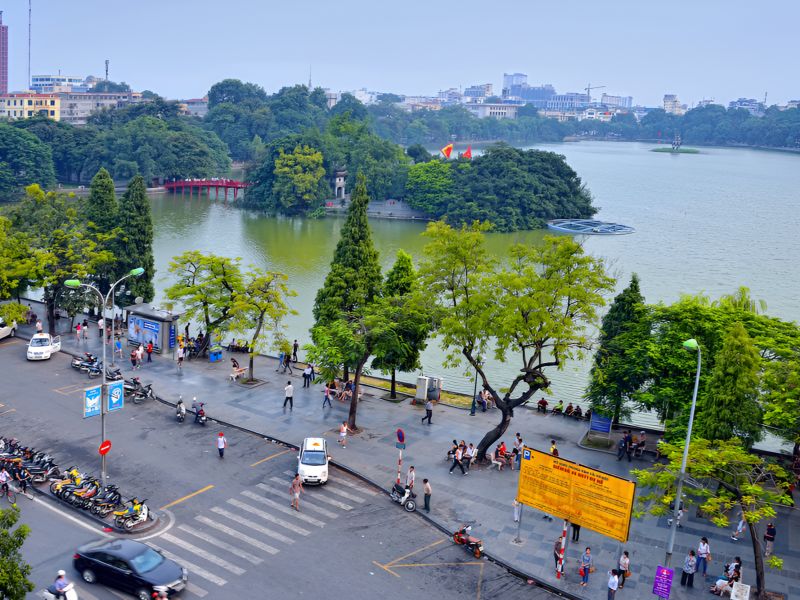
The best time for Indian tourists to visit Hanoi Walking Street runs from October to April, with dry weather and evening temperatures of 18–28°C (64–82°F) across Walking Street hours, and the 3 peak months of October, November, and March delivering the most comfortable evening conditions and minimal rainfall. Hanoi Walking Street weather varies across 4 seasons, and Indian tourist trip planning aligns Hanoi Walking Street visits with both the Hanoi climate and major Indian travel holidays.
Hanoi Walking Street weather by season for 2026 Indian tourists covers 4 distinct windows across autumn, winter, spring, and summer monsoon:
- October–November (Late Autumn Dry Window) runs 22–28°C (72–82°F) evenings with 65–75% humidity and minimal rainfall — delivering the single best Hanoi Walking Street window of the year for Indian tourists.
- December–February (Winter) runs 13–20°C (55–68°F) evenings with occasional light rain and low humidity, requiring a light jacket for Indian tourists but delivering dry and pleasant Walking Street conditions.
- March–April (Spring) runs 20–27°C (68–81°F) evenings with 70–85% humidity and occasional spring showers — delivering comfortable Walking Street conditions for Indian tourists with rising mugginess toward late April.
- May–September (Summer and Monsoon) runs 26–34°C (79–93°F) evenings with 80–90% humidity and frequent afternoon and evening thunderstorms; Hanoi Walking Street stays open but Indian tourists experience rain disruption across 40–60% of operating hours.
Hanoi Walking Street overlaps with 4 major Indian travel windows across the 2026 calendar year:
- Diwali Window (October–November) aligns with Hanoi’s best weather and draws the heaviest Indian tourist density — Indian tourists should book accommodation 3–4 weeks ahead.
- Christmas and New Year (Late December) run mild Hanoi winter conditions, with Hanoi Walking Street displaying holiday-themed decorations and drawing high international tourist crowds.
- Holi Window (March) delivers excellent Hanoi weather with moderate Indian tourist presence — Indian tourists find better accommodation value than Diwali peak.
- Summer School Holidays (May–June) overlap Hanoi monsoon season, with Hanoi Walking Street operating but indoor-fallback activities covering rain-disrupted evenings for Indian families.
Indian tourists avoid the Tết Lunar New Year window (February 15–21, 2026), with Hanoi Walking Street closing for the 3 core Tết days and most Old Quarter restaurants and shops shutting across the full week-long Vietnamese Lunar New Year period.
Hanoi Walking Street alone justifies a Hanoi weekend, but most Indian tourists package the Walking Street weekend inside a 7–14 day Vietnam itinerary covering Halong Bay, Sapa, Hoi An, and Ho Chi Minh City. The next section maps how Hanoi Walking Street fits into 3 standard Indian tourist Vietnam itineraries.
How To Plan A Hanoi Walking Street Visit As Part Of Your Vietnam Tour From India

Indian tourists plan a Hanoi Walking Street visit as a 2-night weekend segment within a 7–10 day Vietnam tour from India, arriving Hanoi on Friday morning and departing Sunday night or Monday morning to capture the full Friday-through-Sunday Hanoi Walking Street operating window.
The Hanoi Walking Street fit within a wider Vietnam tour from India depends on trip length and city combination across 3 common itinerary patterns:
- 7-day Hanoi and Halong Bay itinerary — Friday arrival in Hanoi + Saturday Walking Street evening, Sunday Halong Bay day trip with Sunday evening Walking Street return, Monday onward travel to southern Vietnam destinations
- 10-day Hanoi, Sapa, and Halong Bay itinerary — Wednesday or Thursday arrival in Hanoi, Sapa 2-night trekking segment, Friday return for full Walking Street weekend, Halong Bay Monday through Tuesday cruise segment
- 14-day full Vietnam itinerary (Hanoi, Halong Bay, Hue, Hoi An, Ho Chi Minh City) — Friday arrival in Hanoi with Walking Street weekend, domestic flight south to Hue on Monday Day 4, continuing south to Ho Chi Minh City by Day 10, Mekong Delta and Phu Quoc Days 11 through 14
Hanoi Walking Street serves as one evening anchor within a broader Hanoi sightseeing experience for Indian tourists, with the Old Quarter pedestrian zone operating alongside Hanoi’s temples, lakes, museums, French colonial landmarks, and day-trip destinations. Indian tourists planning a complete Hanoi itinerary can reference the daytime sightseeing list covering Hoan Kiem Lake activities, the Temple of Literature, the Ho Chi Minh Mausoleum, West Lake, and Tran Quoc Pagoda in the places to visit in Hanoi guide.
Indian tourists spend a minimum of 3 nights in Hanoi to cover the Walking Street weekend plus 1–2 full daytime sightseeing days, pairing the Hanoi segment with Halong Bay (2.5–3 hours east by road) and optionally Ninh Binh (2 hours south by road) to complete the Northern Vietnam circuit before flying south to Hoi An, Da Nang, or Ho Chi Minh City for the Central and Southern Vietnam portion of the tour.
Hanoi Walking Street vs. Other Vietnam Night Markets — Which Is Best for Indian Tourists?
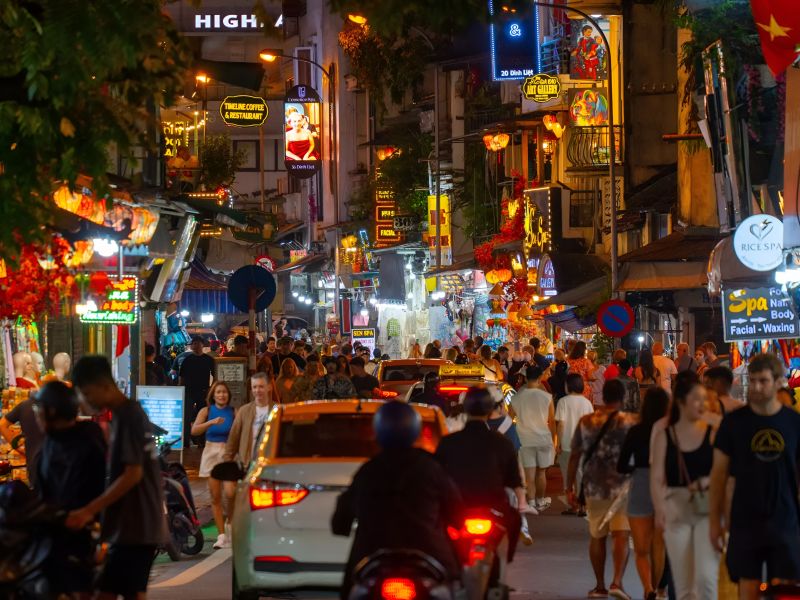
Hanoi Walking Street ranks as the best overall night market experience for Indian tourists in Vietnam, combining a pedestrian zone, Night Market, street food, live music, and bar streets in one walkable weekend — while Ho Chi Minh City’s Ben Thanh Market runs daily but is smaller, and Hoi An’s Night Market delivers lantern-lit charm on a much smaller scale.
Hanoi Walking Street, Ben Thanh Night Market, and Hoi An Night Market serve 3 distinct Indian tourist profiles, with the best choice depending on the broader Vietnam itinerary:
| Night Market | Operating Hours | Best For Indian Tourists | Price Range Per Evening |
|---|---|---|---|
| Hanoi Walking Street | Fri–Sun, 7:00 PM – 12:00 AM | Weekend evening, food + shopping + bars combo | 200,000–500,000 VND (₹700–1,755) |
| Ben Thanh Night Market (HCMC) | Daily, 7:00 PM – 11:00 PM | Daily access, smaller scale, central HCMC | 150,000–400,000 VND (₹525–1,405) |
| Hoi An Night Market | Daily, 5:00 PM – 11:00 PM | Lantern aesthetic, family + couples, quieter scale | 100,000–300,000 VND (₹350–1,055) |
Indian tourists extending the Hanoi visit beyond Walking Street’s midnight closing find the city’s bar and live music scene staying active until 2:00 AM at 5+ established late-night venues — Skyline Hanoi (rooftop, 19th floor), Binh Minh Jazz Club (live jazz nightly), Polite & Co Speakeasy, The Lighthouse Sky Bar, and 1900 Le Théâtre — across the Old Quarter and French Quarter, curated by Vietnamtour.in (the No.1 Premium Vietnam Tour Operator for Indians, having served 428,000+ Indian tourists across 46,000+ tours since 2015). The dedicated Hanoi nightlife guide covers rooftop bar listings, jazz club schedules, late-night transport protocols, and after-midnight safety rules for Indian tourists across the Old Quarter and French Quarter zones.
Hanoi Old Quarter Walking Tour vs. Walking Street — What Is the Difference?
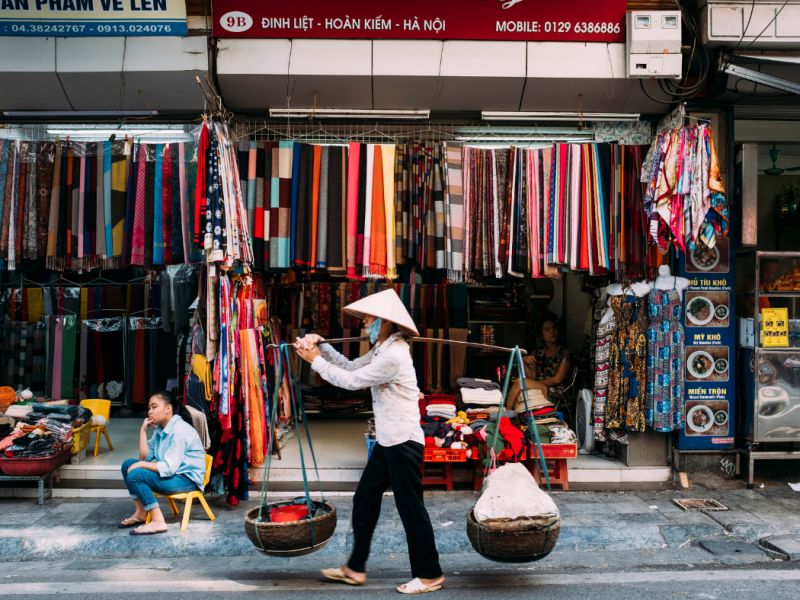
A Hanoi Old Quarter walking tour is a guided daytime cultural experience covering the district’s 36 guild streets and French colonial architecture, while Hanoi Walking Street is a weekend pedestrian-only zone that activates the same Old Quarter streets for evening markets, food, and entertainment. The 2 experiences cover identical Old Quarter geography but operate at different times for different purposes, and Indian tourists confuse the terms because both experience names contain “walking” in the Old Quarter.
Hanoi Old Quarter walking tour operates as a paid daytime guided cultural product, Hanoi Walking Street operates as a free weekend evening pedestrian zone, and both experiences share the same 36-guild-street geography across the historic Old Quarter core:
- Hanoi Old Quarter Walking Tour runs as a 2–3 hour guided cultural tour during daytime hours of 9:00 AM to 4:00 PM, covering historic guild streets, French colonial buildings, Bach Ma Temple, and Đồng Xuân Market — operating every day of the week at guide fees of 350,000–800,000 VND (₹1,230–2,810) per person.
- Hanoi Walking Street runs as a free municipal weekend pedestrian zone from 7:00 PM Friday through Sunday midnight, requiring no guide and charging no entry fee, with a focus on evening entertainment rather than historical interpretation.
- Shared 36-Guild-Street Geography runs across both Hanoi Old Quarter walking tour routes and Hanoi Walking Street zones — carrying car traffic Monday through Friday during walking-tour hours and closing to cars every weekend for Hanoi Walking Street operation.
Indian tourists planning a 3-night minimum Hanoi stay can combine the daytime Hanoi Old Quarter walking tour with the weekend Hanoi Walking Street evening visit, covering both the guild-street historical context and the weekend entertainment transformation. The broader Hanoi destination catalogue — including temples, museums, lakes, and the Old Quarter itself — runs across dozens of landmarks beyond these 2 Walking experiences, with the full places to visit in Hanoi guide covering the complete Hanoi attractions list for Indian tourists.
This Hanoi Walking Street guide for Indian tourists covers the full weekend pedestrian-zone experience — schedule, zones, food, shopping, safety, and itinerary fit. The Frequently Asked Questions below cover the residual planning details Indian tourists check before the Hanoi trip.
Frequently Asked Questions — Hanoi Walking Street for Indian Tourists
What Is the Entry Fee for Hanoi Walking Street?
Hanoi Walking Street has no entry fee, with the pedestrian zone, Night Market access, live music performances, and folk game areas all running free of charge for Indian tourists. Hanoi Walking Street visitors pay only for food, drinks, shopping purchases, and optional paid attractions such as Ngoc Son Temple entry at 30,000 VND (₹100) per adult.
Can Indian Tourists Use Credit Cards on Hanoi Walking Street?
Hanoi Walking Street stalls accept Vietnamese dong (VND) cash only, with card payments limited to rooftop bars, sit-down restaurants, and larger shops inside Đồng Xuân Market that accept Visa and Mastercard. Hanoi Walking Street spending patterns show Indian tourists using 500,000–1,000,000 VND (₹1,755–3,510) in small-denomination cash per weekend evening for food, drinks, and Night Market shopping.
Are There Any Operational Restrictions or Capacity Caps at Hanoi Walking Street?
Hanoi Walking Street operates at full capacity in 2026 with no operational restrictions remaining from the COVID era. Hanoi Walking Street runs normal Friday through Sunday operating hours across all zones — no capacity caps, no mask mandates, and no vendor limits in effect.
How Long Do Indian Tourists Spend at Hanoi Walking Street?
Indian tourists spend a minimum of 3–4 hours at Hanoi Walking Street for a complete experience across the 4 core zones. Hanoi Walking Street time allocation for Indian tourists runs 60 minutes at the Hoan Kiem Lake perimeter, 45 minutes at the Night Market, 60 minutes at Ta Hien Beer Street, and 30–45 minutes for food stops across 2–3 stalls.
Is Parking Available Near Hanoi Walking Street?
Hanoi Walking Street has no car parking within the pedestrian zone itself, with Grab drop-off available at the zone perimeter at the north end (Hang Dau Street) and the south end (Dinh Tien Hoang Street). Hanoi Walking Street motorbike parking runs at hotel lots and public parking bays around the perimeter at 10,000–30,000 VND (₹35–105) for a full evening.
Does Hanoi Walking Street Have Indian Restaurants Nearby?
Yes, 4 Indian restaurants operate within 500 metres of the Hanoi Walking Street zone: Namaste Hanoi on Hang Hanh Street, Tandoor Hanoi on Hang Trong Street, Khazaana Indian Restaurant on Bao Khanh Street, and Dakshin Indian Restaurant on Ma May Street. Hanoi Walking Street-area Indian restaurants price full meals at 250,000–450,000 VND (₹880–1,580) per person, covering North Indian, South Indian, and vegetarian thali options.
What Languages Do Vendors at Hanoi Walking Street Speak?
Hanoi Walking Street vendors speak Vietnamese as the primary language, with basic English at Old Quarter tourist-facing stalls covering numbers, product names, and bargaining phrases. Indian tourists using English complete shopping transactions, food orders, and directional queries without significant difficulty, with the Google Translate app loaded with a Vietnamese offline download covering complex bargaining conversations that exceed basic English range.