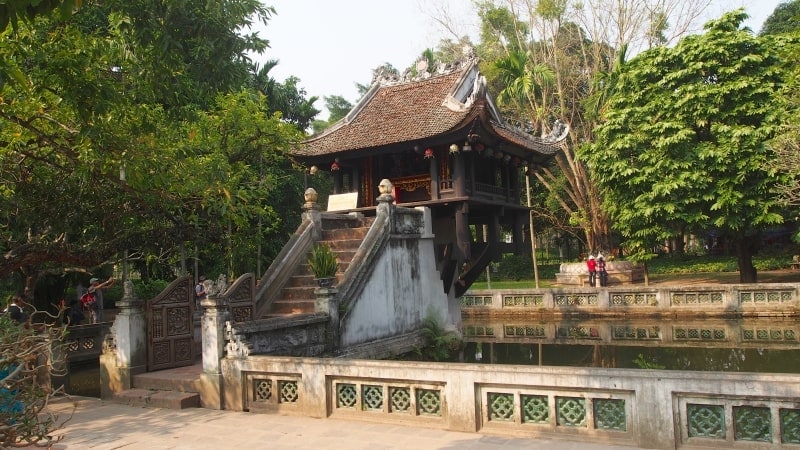

One Pillar Pagoda — known in Vietnamese as Chùa Một Cột, formally named Diên Hựu Tự (Pagoda of Extended Blessings) — is a historic Buddhist temple located in Ba Dinh District, Hanoi, built in 1049 AD under the reign of King Lý Thái Tông. One Pillar Pagoda sits within Hanoi’s most historically dense district — the outer compound of Dien Huu Pagoda (Chùa Diên Hựu) is free to enter, while a 25,000 VND entry fee applies specifically to the shrine itself.
One Pillar Pagoda opens at 7:00 AM and closes at 6:00 PM daily, with an entry fee of ₹90 (25,000 VND) for foreign tourists; the best photography window is 7:00–8:30 AM on weekdays. Built in 1049 AD under King Lý Thái Tông after a dream vision of the Goddess of Mercy, the current structure is a 1955 reconstruction built to identical dimensions — a single stone pillar of 1.2 metres diameter supporting a 3m × 3m wooden pavilion above a lotus pond. This guide covers One Pillar Pagoda’s founding legend, single-pillar lotus architecture, Buddhist cosmological symbolism, practical entry information, and the Ba Dinh District morning circuit that Indian tourists combine with One Pillar Pagoda in a single visit.
The Legend and History Behind One Pillar Pagoda
One Pillar Pagoda was built in 1049 by King Lý Thái Tông after the king dreamed of the Goddess of Mercy (Quan Âm Bồ Tát) presenting him a son while seated on a lotus flower. King Lý Thái Tông, who had long been without an heir, consulted his court and ordered construction of a wooden shrine in the exact form of the lotus from the dream — a pavilion rising from water on a single stone pillar, replicating the lotus throne of the goddess.
After the completion of the One Pillar Pagoda, King Lý Thái Tông received an heir. He named the shrine Liên Hoa Đài (Lotus Flower Platform). The surrounding temple complex was named Diên Hựu Tự — Pagoda of Extended Blessings — reflects the king’s wish for lasting divine favour.
The lotus (padma), as the seat of divine beings — Goddess Lakshmi, Lord Brahma, and the Buddha — is one of the most deeply shared symbols across Hindu and Buddhist traditions originating in the Indian subcontinent. One Pillar Pagoda’s single-pillar lotus architecture embodies this same symbolic principle: the lotus rising from water as a representation of purity and divine grace — a construction logic immediately recognisable to Indian visitors familiar with lotus iconography in Hindu temple art and Buddhist sculpture.
One Pillar Pagoda was maintained and restored across multiple Vietnamese dynasties after 1049. Withdrawing French forces destroyed the original One Pillar Pagoda structure in 1954. The Vietnamese government rebuilt the One Pillar Pagoda in 1955 to the same dimensions and design as recorded in Nguyễn Dynasty historical documents.
Why One Pillar Pagoda Is Considered Vietnam’s Most Iconic Buddhist Temple
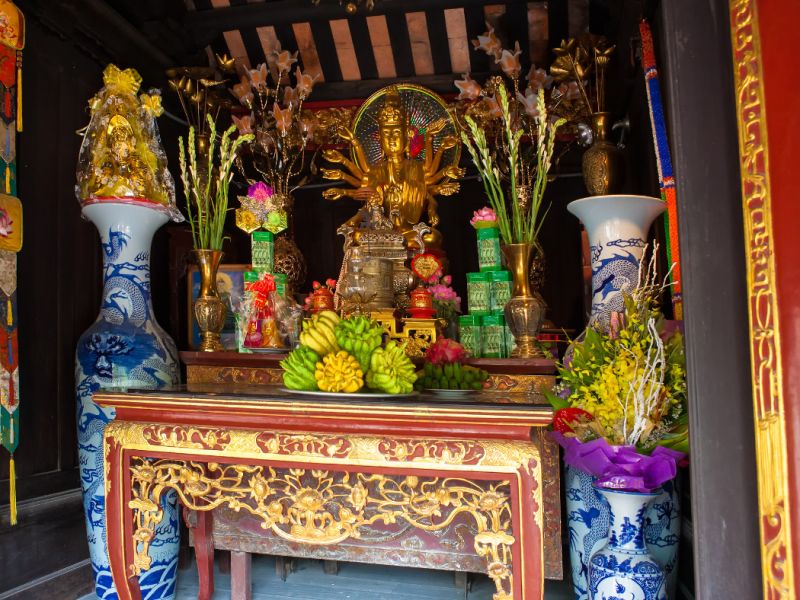
One Pillar Pagoda is Vietnam’s most architecturally unique Buddhist temple — the only Buddhist structure in Vietnam built on a single pillar rising from a lotus pond, a design with no equivalent among the 500+ Buddhist pagodas registered in Hanoi. Alongside Perfume Pagoda (Chùa Hương), One Pillar Pagoda is listed by the Vietnamese Ministry of Culture as one of Vietnam’s two most nationally significant Buddhist heritage sites. One Pillar Pagoda sits within the buffer zone of the Thăng Long Imperial Citadel — a UNESCO World Heritage Site inscribed in 2010 — placing One Pillar Pagoda within a protected heritage corridor of 1,300 years of continuous occupation.
The Ba Dinh District heritage corridor, anchored by One Pillar Pagoda, receives over 2 million domestic and international visitors annually — making it the most visited heritage precinct in Hanoi. One Pillar Pagoda’s 1049 founding date predates all other heritage structures within the 500-metre Ba Dinh radius by at least 21 years, establishing it as the oldest active religious site in the district.
The 1955 Reconstruction and What Was Preserved
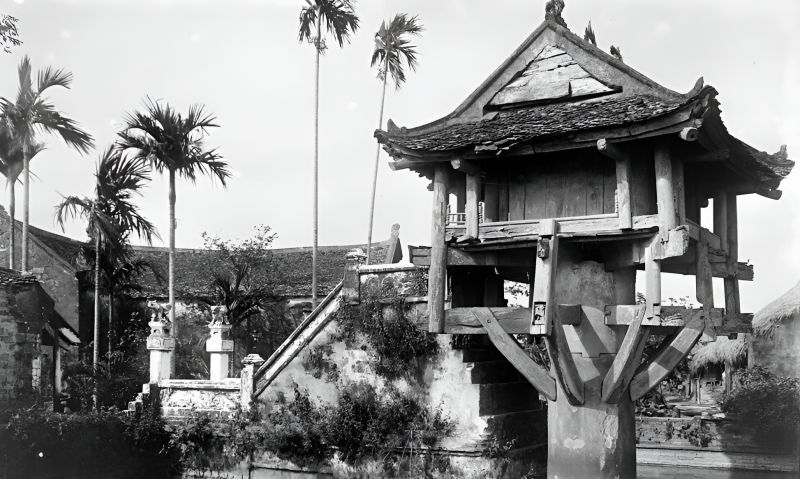
The current One Pillar Pagoda is a 1955 reconstruction of the 11th-century original, built to identical single-pillar dimensions and proportions recorded in historical documents. French forces destroyed the original 1049 One Pillar Pagoda structure in 1954 during the French withdrawal from Hanoi. The 1955 reconstruction retained One Pillar Pagoda’s defining architectural element — the single stone pillar of 1.2 metres diameter supporting the wooden shrine pavilion above the lotus pond — producing a structure identical in design concept to the 1049 original despite using new physical materials.
The Architecture and Design of One Pillar Pagoda
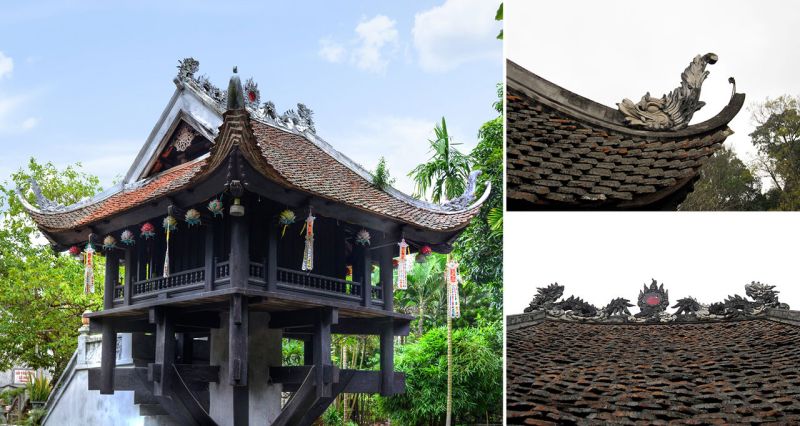
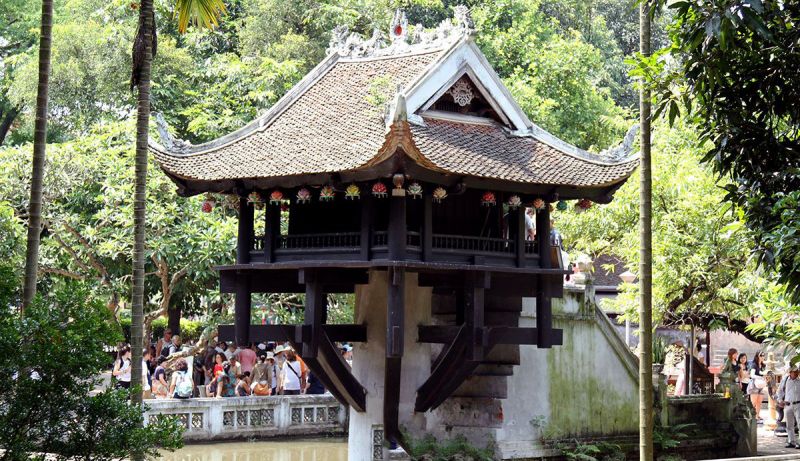
One Pillar Pagoda stands on a single cylindrical stone pillar approximately 1.2 metres in diameter, rising from a square pond to support a wooden shrine pavilion measuring 3 metres by 3 metres — eight curved roof edges sweep upward at each corner in classical Vietnamese Buddhist architectural style, and the entire wooden pavilion structure uses traditional joinery with no iron nails.
Each structural element of One Pillar Pagoda corresponds to a specific layer of Buddhist symbolism: the stone pillar represents the lotus stem, the wooden pavilion represents the lotus flower in full bloom, and the square pond represents bể khổ — the sea of sorrow — from which the lotus rises unblemished. The 3-element structure of One Pillar Pagoda encodes the Buddhist principle of purity emerging from suffering through divine grace in physical architectural form.
One Pillar Pagoda (Liên Hoa Đài), built in 1049 AD, predates the Bahá’í Lotus Temple in New Delhi by 926 years — both One Pillar Pagoda and the Bahá’í Lotus Temple place the lotus as the central architectural symbol of purity, making One Pillar Pagoda the oldest of the two lotus-architectural religious structures by over 9 centuries.
One Pillar Pagoda is the primary shrine within the larger Dien Huu Pagoda complex (Chùa Diên Hựu), which includes the surrounding courtyard, entrance gate, and auxiliary structures. The Dien Huu Pagoda compound courtyard, entrance gate, and auxiliary structures are all accessible free of charge — only the One Pillar Pagoda shrine interior charges an entry fee of ₹90 (25,000 VND).
The Symbolism of the Single Pillar in Vietnamese Buddhist Art
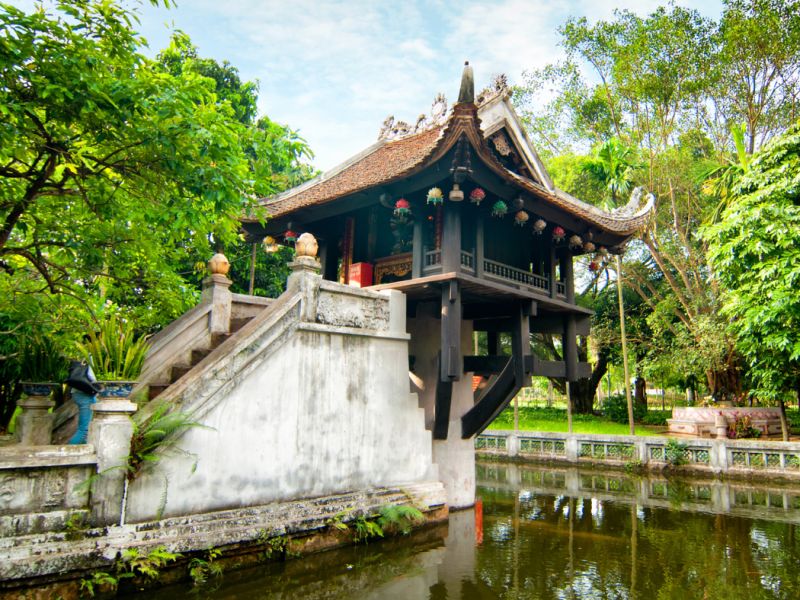
The single pillar of One Pillar Pagoda represents the axis of the universe (Mount Meru, núi Tu Di in Vietnamese) in Buddhist cosmology — the same cosmic axis principle expressed by the central post (yasti) of the Great Stupa at Sanchi, Madhya Pradesh, and by the Dhamek Stupa at Sarnath, Uttar Pradesh, both built to anchor the Buddhist cosmic world-axis in physical architectural form. The Mount Meru cosmic axis concept holds that a central pillar connects the realms of the universe and anchors existence at its centre. One Pillar Pagoda’s single stone pillar of 1.2 metres in diameter is the physical construction of this principle, making One Pillar Pagoda a cosmological model rather than a conventional shrine building. One Pillar Pagoda’s single-pillar cosmic axis architecture and the yasti post of the Sanchi Great Stupa express identical Buddhist cosmological logic across two separate national traditions — separated by approximately 1,300 years of construction history.
How One Pillar Pagoda Compares to Other Hanoi Temples
One Pillar Pagoda is the only Buddhist temple in Hanoi built on a single pillar rising from a lotus pond — a design with no equivalent among the 500+ Buddhist pagodas registered in Hanoi. The table below compares One Pillar Pagoda with three other major Hanoi temples by architecture, entry fee, and visit duration.
| Temple | Architecture | Entry Fee | Visit Duration | Distance from Old Quarter |
|---|---|---|---|---|
| One Pillar Pagoda (Chùa Một Cột) | Single-pillar lotus pavilion, 1049 AD | ₹90 (25,000 VND) | 20–30 minutes | 2.5 km |
| Temple of Literature (Văn Miếu) | Confucian courtyard complex, 1070 AD | ₹250 (70,000 VND) | 45–60 minutes | 1.5 km |
| Tran Quoc Pagoda (Chùa Trấn Quốc) | 11-storey stupa on West Lake peninsula, 6th century AD | ₹90 (25,000 VND) | 20–30 minutes | 3.5 km |
| Ngoc Son Temple (Đền Ngọc Sơn) | Taoist-Buddhist shrine on Hoan Kiem Lake island | ₹140 (40,000 VND) | 20–30 minutes | 0 km (Old Quarter) |
One Pillar Pagoda is the most historically significant of the four — the only structure among them built to encode Buddhist cosmological principles (lotus stem = pillar, lotus flower = pavilion, sea of sorrow = pond) in architectural form. Tran Quoc Pagoda is the oldest active Buddhist temple in Hanoi; Ngoc Son Temple is the most accessible from the Old Quarter at 0 km walking distance.
One Pillar Pagoda Timings, Entry Fee, and Visitor Rules
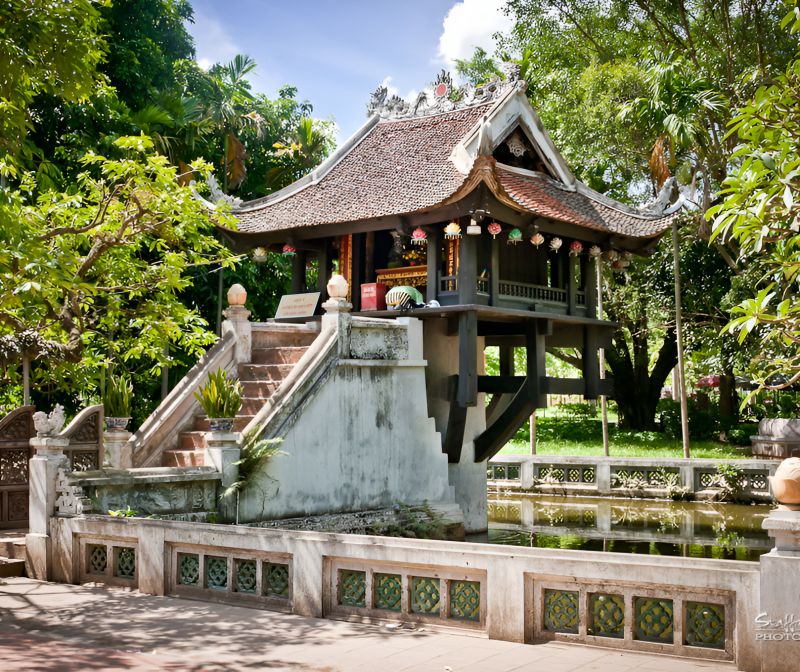
One Pillar Pagoda opens at 7:00 AM and closes at 6:00 PM daily, including weekends and public holidays, with an entry fee of ₹90 (25,000 VND) per person for foreign tourists — Vietnamese citizens enter free of charge. The ₹90 (25,000 VND) entry fee applies specifically to crossing the wooden bridge over the lotus pond and entering the One Pillar Pagoda shrine. The outer Dien Huu Pagoda courtyard compound is free to enter during One Pillar Pagoda’s operating hours of 7:00 AM to 6:00 PM.
One Pillar Pagoda dress code requires shoulders and knees to be covered before entering the shrine — sleeveless clothing requires a dupatta or scarf cover at the One Pillar Pagoda entrance. Footwear is removed before stepping onto the wooden bridge leading to the One Pillar Pagoda shrine. Photography is permitted throughout the Dien Huu Pagoda compound; flash photography is not permitted inside the One Pillar Pagoda shrine itself.
A One Pillar Pagoda shrine visit takes 20–30 minutes. The full Dien Huu Pagoda compound, combined with the adjacent Ba Dinh District landmarks — Ho Chi Minh Mausoleum, Presidential Palace, and Vietnam Museum of Ethnology — requires 1–1.5 hours for a complete visit.
How to Get to One Pillar Pagoda from Hanoi Old Quarter

One Pillar Pagoda is located on Ong Ich Khiem Street, Ngoc Ha Ward, Ba Dinh District — 2.5 km from Hanoi Old Quarter and reachable in 10–15 minutes by Grab or taxi.
4 transport options from Hanoi Old Quarter to One Pillar Pagoda:
- Grab or taxi: ₹70–₹105 (20,000–30,000 VND), 10–15 minutes — suits families and groups; Grab app operates identically to Ola and Uber, with in-app payment accepted by Grab drivers across Hanoi
- Xe ôm (motorbike taxi): ₹42–₹63 (12,000–18,000 VND), 8–12 minutes — suits solo travellers and couples; negotiate fares before departure as xe ôm drivers do not use meters
- Walking: free, 30–35 minutes — passes Hoan Kiem Lake and the French Quarter along the route
- Bus Route 45: ₹14 (4,000 VND), 20–25 minutes — departs from Dinh Tien Hoang Street stop adjacent to Hoan Kiem Lake
One Pillar Pagoda, Ho Chi Minh Mausoleum, and the Vietnam Museum of Ethnology are located within 1.2 km of each other in Ba Dinh District. Indian tourists combining all 3 sites in a single morning visit can find walking distances, entry timings, and recommended visit orders in the Hanoi attractions guide.
Best Time to Visit One Pillar Pagoda for Photography and Avoiding Crowds
The best time to visit One Pillar Pagoda is between 7:00 AM and 8:30 AM on a Tuesday, Wednesday, or Thursday — weekday mornings in this window have the lowest visitor density of the week and the best natural light conditions for lotus pond photography.
Crowd levels at One Pillar Pagoda by time slot:
- Weekday 7:00–8:00 AM: lowest visitor density of the week — optimal photography and shrine access window
- Weekday 9:00–11:00 AM: visitor numbers increase significantly; shrine access remains comfortable but photography positions at the wooden bridge become occupied
- Friday 10:00–11:00 AM: peak crowd density for weekdays — school and tour groups arrive simultaneously; shrine access requires queuing
- Saturday–Sunday 1:00–3:00 PM: peak weekend density — photography at the wooden bridge and lotus pond positions is obstructed by visitor volume
Morning light falls directly on the eastern face of the One Pillar Pagoda shrine between 7:00 AM and 9:00 AM, producing a golden reflection on the lotus pond. The optimal photography position is from the wooden bridge at the shrine entrance — from this position, the full stone pillar, wooden pavilion, and lotus pond reflection appear within a single frame.
During the rainy season (July–September), the lotus pond water level in the One Pillar Pagoda rises by 20–30 cm, producing a wider pond reflection in photographs. October and November deliver the clearest morning lights and temperatures of 18–24°C in Hanoi — the most comfortable conditions for a Ba Dinh District morning visit.
October and November coincide with the Diwali holiday window, producing the best combination of Hanoi weather conditions and low weekday crowd levels at One Pillar Pagoda for Indian tourists planning a Hanoi trip around Indian public holidays.
Avoid the One Pillar Pagoda in January and February — Tết Nguyên Đán draws the highest annual visitor volume to Hanoi pagodas, with One Pillar Pagoda receiving 3–5× its average daily visitor count during the Tet period.
Avoid July and August — monsoon rainfall averages 250–300 mm per month in Hanoi, and humidity above 85% makes outdoor sightseeing in Ba Dinh District uncomfortable by 10:00 AM.
One Pillar Pagoda Entrance
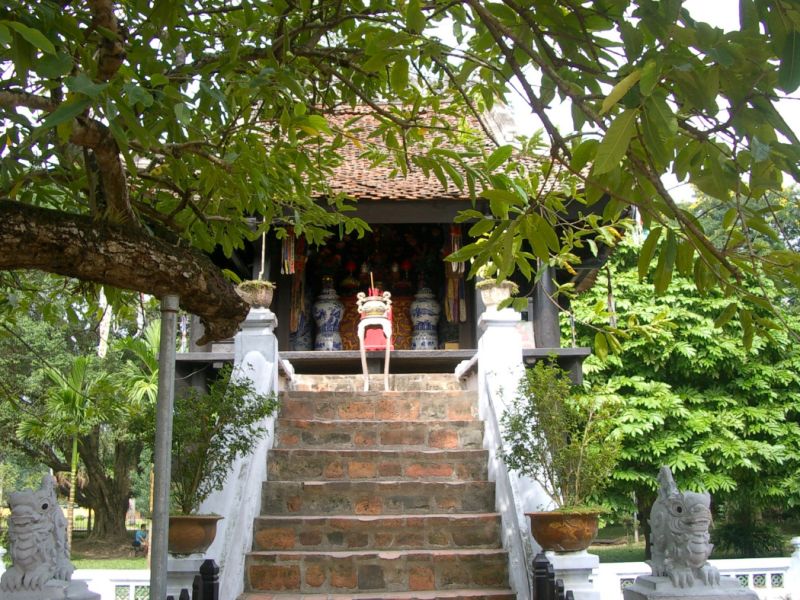
The only entrance to the One Pillar Pagoda shrine is a narrow wooden bridge accessed through the Bach Tuynh stone tower (Tháp Bạch Tùng — the white stone archway) on the right side of Dien Huu Pagoda’s courtyard. The route from the street to the One Pillar Pagoda shrine follows 5 steps: enter through the main gate of Dien Huu Pagoda → cross the courtyard → locate the Bach Tuynh stone tower on the right → pass through the Bach Tuynh tower → cross the narrow wooden bridge → arrive at the shrine entrance where the ₹90 (25,000 VND) entry fee is collected.
One Pillar Pagoda shrine holds 4–5 visitors at a time. Visitors pay ₹90 (25,000 VND) at the shrine gate and wait outside the wooden bridge when the One Pillar Pagoda shrine is at capacity — waiting time at the wooden bridge during off-peak weekday hours (7:00–9:00 AM) is 2–3 minutes. The One Pillar Pagoda shrine has no formal queuing barrier; visitors enter as the previous group exits.
One Pillar Pagoda Tour from Hanoi for Indian Tourists
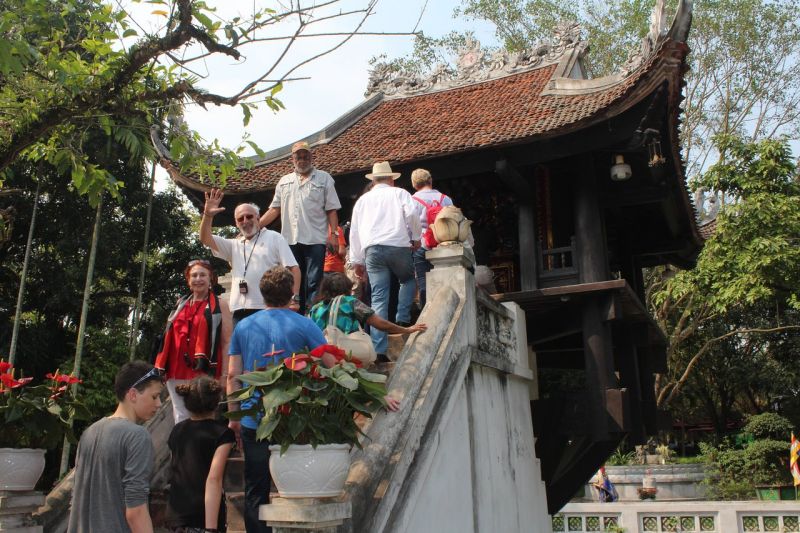
Indian tourists visiting One Pillar Pagoda combine One Pillar Pagoda with the Ba Dinh Square half-day circuit — One Pillar Pagoda, Ho Chi Minh Mausoleum, Ho Chi Minh Museum, and Ba Dinh Square sit within 500 metres of each other and require no transport between stops.
The recommended Ba Dinh half-day sequence departing at 7:00 AM:
- One Pillar Pagoda (7:00–7:30 AM): ₹90 (25,000 VND) entry — visit first for lowest crowd density and optimal morning light on the lotus pond
- Ho Chi Minh Mausoleum (8:00–9:00 AM): free entry — Ho Chi Minh Mausoleum opens at 8:00 AM on Tuesday, Wednesday, Thursday, Saturday, and Sunday; Ho Chi Minh Mausoleum is closed Monday and Friday
- Ho Chi Minh Museum (9:00–10:30 AM): ₹42 (12,000 VND) entry — located directly adjacent to Ho Chi Minh Mausoleum
- Ba Dinh Square (10:30–11:00 AM): free entry at all hours — open-air site requiring no ticket
A full-day Hanoi heritage tour — Ba Dinh circuit in the morning, followed by Hoan Kiem Lake, Temple of Literature, and the Old Quarter in the afternoon — costs ₹1,800–₹2,500 per person for a private guided tour. A private Hanoi day tour for a family of 4 costs ₹6,000–₹8,000 for the group — ₹1,500–₹2,000 per person, 20–30% below individual per-person pricing.
October, November, March, and April deliver Hanoi’s lowest rainfall months and temperatures of 18–28°C — the most comfortable weather window for Ba Dinh District outdoor sightseeing for Indian tourists.
What Else to See Near One Pillar Pagoda in Hanoi
One Pillar Pagoda sits within a 500-metre radius of 4 major Hanoi landmarks, all accessible on foot with no transport required — making One Pillar Pagoda the most efficient starting point for a Ba Dinh District morning circuit.
4 landmarks within 500 metres of One Pillar Pagoda:
- Ho Chi Minh Mausoleum: 200 metres from One Pillar Pagoda, 3 minutes on foot, free entry — open Tuesday, Wednesday, Thursday, Saturday, and Sunday; closed Monday and Friday
- Ho Chi Minh Museum: 300 metres from One Pillar Pagoda, 4 minutes on foot, ₹42 (12,000 VND) entry fee for foreign tourists
- Ba Dinh Square: 300 metres from One Pillar Pagoda, 4 minutes on foot, free entry and open 24 hours
- Dien Huu Pagoda main compound: directly adjacent to One Pillar Pagoda, 0 minutes walking, free entry
Ho Chi Minh Mausoleum enforces the same dress code as the One Pillar Pagoda — shoulders and knees covered — allowing Indian tourists dressed for One Pillar Pagoda to enter Ho Chi Minh Mausoleum without adding or changing clothing between the two sites.
The Temple of Literature is 1.5 km from One Pillar Pagoda — reachable by Grab in 5 minutes or on foot in 18–20 minutes — with an entry fee of ₹250 (70,000 VND) for foreign tourists. Hoan Kiem Lake and Hanoi Old Quarter are 2.5 km from One Pillar Pagoda, reachable by Grab in 8–10 minutes, and form the afternoon extension of the Ba Dinh morning circuit for Indian tourists covering Hanoi’s historical core in a single day. For a complete overview of Hanoi’s landmarks, historical context, and practical travel tips for Indian tourists — from Ba Dinh Square to the Hoan Kiem Lake area — the Hanoi travel guide covers the full city in a single reference.
The Ba Dinh District concentration of 4+ national heritage landmarks within 500 metres of each other is unique among Southeast Asian capital cities — One Pillar Pagoda’s 1049 founding predates all other heritage structures in this corridor by at least 21 years, establishing it as the oldest active religious site in the district and the most historically grounded starting point for any Hanoi heritage visit.