Hanoi, Vietnam’s 1,000-year-old capital, has 15 distinct places to visit that Indian tourists consistently rank among the best in Southeast Asia. The city sits on the banks of the Red River (Song Hong), covers 3,359 square kilometres, and is home to 8 million residents — making it one of the most historically layered capitals in Asia. Hanoi’s Noi Bai International Airport receives direct flights from Delhi, Mumbai, Kolkata, Chennai, and Bangalore, with flight times ranging from 3.5 to 5 hours depending on the originating city.
The 15 places to visit in Hanoi covered in this guide are organised into three primary clusters. The first cluster covers free and iconic landmarks that require no entry fee and anchor every first-time itinerary. The second cluster covers historical and political sites in Ba Dinh District, including two UNESCO World Heritage Sites and Vietnam’s most significant colonial-era prison. The third cluster covers unique Hanoi experiences — a 1,000-year-old water puppet art form, a railway street cutting through a residential neighbourhood, and a single-origin egg coffee invented in 1946. The guide then covers museums, spiritual sites, and West Lake before moving into planning, day trips, and audience-specific recommendations.
Indian tourists visiting Hanoi in 2026 spend between ₹800 and ₹3,000 per attraction, with the majority of iconic landmarks available free of charge. A well-paced itinerary covering all 15 places requires 3 to 4 days in the city. Hanoi holds a specific advantage for Indian travellers that no other Southeast Asian capital matches: the city contains more active Buddhist pagodas than Bangkok, Kuala Lumpur, or Singapore, and its street food scene includes a broader range of vegetarian options rooted in Vietnamese Buddhist culinary tradition.
Hoan Kiem Lake and Ngoc Son Temple
Hoan Kiem Lake is the geographic and cultural centre of Hanoi — a 12-hectare freshwater lake rated 4.7 stars across 12,000 Google reviews, making it the highest-rated lake landmark in Hanoi. The lake’s name translates as “Lake of the Restored Sword,” drawn from the legend of King Le Loi, who returned a divine sword to a sacred turtle in 1428 after using it to defeat Chinese invaders. Hoan Kiem Lake sits at the heart of Hoan Kiem District, surrounded by French-colonial buildings, tree-lined pavements, and the city’s oldest commercial streets.
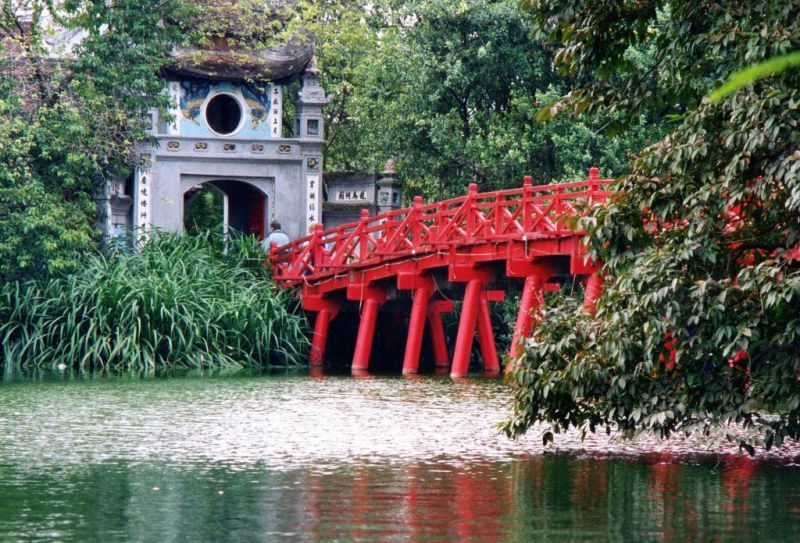
Ngoc Son Temple stands on a small island at the northern end of Hoan Kiem Lake, connected to the shore by the Huc Bridge — a curved, red-painted wooden bridge constructed in 1862. The temple was built in 1865 and is dedicated to two figures: Van Xuong, the god of literature, and Tran Hung Dao, the 13th-century general who repelled three Mongol invasions. Inside the Ngoc Son Temple complex, visitors find bronze statues, incense altars, and a preserved specimen of the Hoan Kiem turtle (Rafetus swinhoei) — one of the rarest freshwater turtle species on earth — mounted in a glass case.
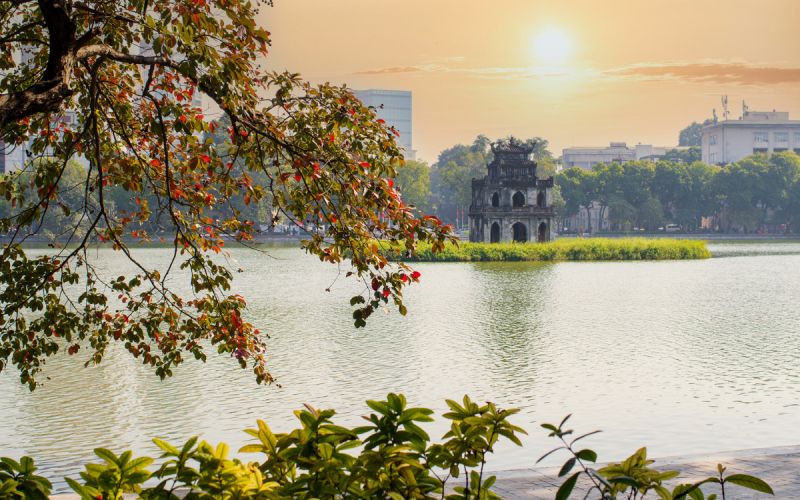
The last living Hoan Kiem turtle died in 2016. Turtle Tower (Thap Rua), a small stone tower rising from a mid-lake island, remains as a monument to the species and to the founding legend of the lake.
Walking the 1.8-kilometre perimeter of Hoan Kiem Lake is free at all hours. Entry to Ngoc Son Temple costs VND 30,000 (₹107), and the temple opens daily from 8:00 AM to 6:00 PM with no advance booking required.
Indian tourists familiar with Fateh Sagar Lake in Udaipur — which also features a small island structure at its centre — find Hoan Kiem a comparable visual experience. The key difference is location: Hoan Kiem Lake sits directly inside the city centre, not on the outskirts, and requires no vehicle to reach from the Old Quarter.
Is Hoan Kiem Lake Free for Indian Tourists?
Yes, walking around Hoan Kiem Lake in Hanoi is completely free for Indian tourists and requires no ticket or registration. The 1.8-kilometre lakeside pavement surrounding Hoan Kiem Lake is accessible 24 hours a day, seven days a week, with no ticket counter, no registration booth, and no time restriction. Only entry to Ngoc Son Temple on the island carries an admission fee of VND 30,000 (₹107).
Every Saturday and Sunday morning from 7:00 AM to 9:00 AM, Dinh Tien Hoang Street and Le Thai To Street — the two main roads bordering the lake — close to all motor vehicles and become pedestrian-only zones, offering the widest and most relaxed walking experience of the week.
What Is the Best Time to Visit Hoan Kiem Lake to Avoid Crowds?
The best time to visit Hoan Kiem Lake in Hanoi to avoid crowds is between 6:00 AM and 8:00 AM on weekdays, when local residents practise Tai Chi on the lakeside paths and morning light reflects off the water without tourist crowds. Weekend mornings between 6:00 AM and 9:00 AM are also photogenic but draw heavier foot traffic, as the car-free zone attracts Hanoi residents alongside tourists.
The period between 11:00 AM and 3:00 PM brings both peak heat and peak visitor numbers — the least comfortable window for a lakeside walk. The second-best time to visit is 6:00 PM to 9:00 PM daily, when the lake perimeter is lit by street lamps, the temperature drops, and local families fill the paths.
Indian tourists visiting Hoan Kiem Lake in October, November, or December experience temperatures between 18°C and 24°C and the clearest skies of the year — the optimal conditions for photography at the lake. October at Hoan Kiem Lake coincides with Hanoi’s peak season and the Diwali travel window simultaneously — flights from Delhi, Mumbai, and Bengaluru to Hanoi, Old Quarter hotels, and Thang Long Water Puppet Theatre weekend seats all reach full capacity during the same 2–3 week period. Vietnamtour.in — winner of TripAdvisor Best of the Best 2023 and trusted by 428,000+ Indian tourists since 2015 — recommends booking Hanoi accommodation, Water Puppet Theatre seats, and Ha Long Bay cruises as a single coordinated reservation 3–4 months before Diwali departure, before individual components close to availability independently.
Hanoi Old Quarter
Hanoi Old Quarter is a 100-hectare commercial district of 36 guild streets, each historically named after the trade practised on that street since the 13th century. The district’s boundaries run from Hang Dau Street in the north to Hang Bong Street in the south, from the Red River bank in the east to Phung Hung Street in the west. Each of the 36 streets — Hang Gai (silk), Hang Ma (paper goods), Hang Bac (silver), and Hang Tre (bamboo), among others — originally housed a single trade guild, with families of the same profession living and working in adjacent tube houses along a single block.
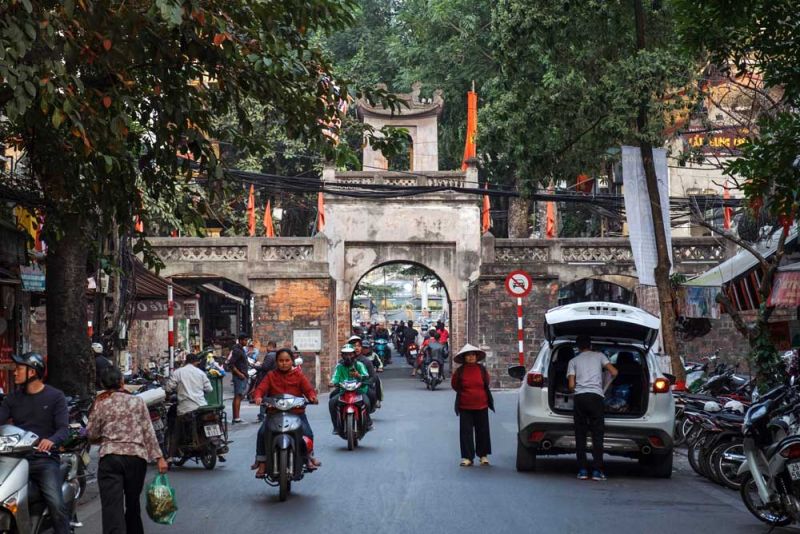
3 streets in Hanoi Old Quarter deliver the highest concentration of shopping, cultural, and evening food experiences. Hang Gai (Silk Street) concentrates Hanoi’s highest-quality silk fabric shops, custom Ao Dai tailors, and hand-embroidered goods, with silk scarves starting at ₹535 (150,000 VND). Hang Ma specialises in paper craft goods, lanterns, and decorative items — during Tet and the Mid-Autumn Festival, Hang Ma’s 200-metre block fills with red and gold paper decorations at stall density 3–4× above normal trading days. Ta Hien Street (Beer Street) operates as Hanoi’s most concentrated evening food zone from 6:00 PM daily, with draught Hanoi bia hoi at ₹32 (9,000 VND) per glass and street food from ₹82 (23,000 VND) per dish.
Walking Hanoi Old Quarter costs nothing. A complete street food meal costs ₹150–₹410 (43,000–115,000 VND) per person. The entry point from Hoan Kiem Lake is the northern shore — walking north from Ngoc Son Temple puts a visitor inside the Old Quarter in 3 minutes on foot. Hanoi Old Quarter’s tube houses share the same commercial density as Chandni Chowk in Delhi — 3 to 4-storey French-colonial buildings with 3–5 metre street frontages built deliberately shallow to minimise feudal tax liability, with some houses extending 60 metres deep from front to back.
What Are the Best Streets in Hanoi Old Quarter for Indian Tourists?
The 5 most rewarding streets in Hanoi Old Quarter for Indian tourists are Hang Gai, Hang Ma, Ta Hien, Hang Be, and Ma May — each offering a distinct experience across shopping, craft culture, food, and living heritage.
Hang Gai Street is Hanoi’s primary destination for silk, custom ao dai, and hand-embroidered textiles, with prices ranging from VND 150,000 to VND 900,000 (₹535 to ₹3,215). Hang Ma Street is most spectacular during Tet and the Mid-Autumn Festival, when the entire street becomes a lantern and decoration market visible from neighbouring blocks. Ta Hien Street operates as the Old Quarter’s evening social centre, with bia hoi priced at VND 9,000 (₹32) per glass and plastic stools filling every pavement from 6:00 PM onward.
Hang Be Market runs from early morning and concentrates fresh produce, cooked breakfasts, and rice dishes at VND 24,000 to VND 45,000 (₹85 to ₹160) per serving. Ma May Street contains the best-preserved original tube house interior in Hanoi Old Quarter at number 87 — the house retains its original three-section layout, courtyard well, and ancestral altar. Entry to the Ma May tube house costs VND 20,000 (₹71).
Is the Hanoi Old Quarter Safe to Walk at Night?
Yes, the Hanoi Old Quarter is safe to walk at night until 11:00 PM, with continuous foot traffic, bright commercial lighting on major streets, and a regular police presence on Ta Hien, Hang Bac, and Dinh Liet streets. The safest and highest-density sections after 6:00 PM are Ta Hien, Hang Bac, and the intersection at Dinh Liet — all remain crowded with tourists and local residents through 10:30 PM.
Pickpocketing occurs in dense crowds at major junctions; keeping a phone and wallet in a zipped interior pocket eliminates most risk. Women travelling in groups of two or more are advised to use Grab — the regional equivalent of Ola or Uber — after 10:00 PM rather than walking to more distant hotels. Grab operates 24 hours a day across Hanoi with fare estimates shown before booking.
Temple of Literature
The Temple of Literature (Van Mieu — Quoc Tu Giam) is Vietnam’s oldest surviving university complex, constructed in 1070 under King Ly Thanh Tong and rated 4.6 stars across 23,000 Google reviews. The complex was built to honour Confucius and his 72 disciples. In 1076, King Ly Nhan Tong established the Quoc Tu Giam (Imperial Academy) within the same grounds, making it Vietnam’s first national university. The institution operated continuously for 700 years until 1779, producing 1,307 doctoral graduates whose names are inscribed on 82 stone steles still standing within the complex today.
The Temple of Literature is structured around 5 consecutive walled courtyards that progress from the outer ceremonial gate to the inner sanctuary of Confucius. The first courtyard begins at Van Mieu Gate, the main entrance on Quoc Tu Giam Street. The second courtyard leads to Dai Trung Mon (Great Middle Gate). The third courtyard contains Khue Van Cac — the Pavilion of the Constellation of Literature, built in 1805 — a two-storey wooden structure with four circular windows reproduced on Vietnam’s 100,000 VND banknote.
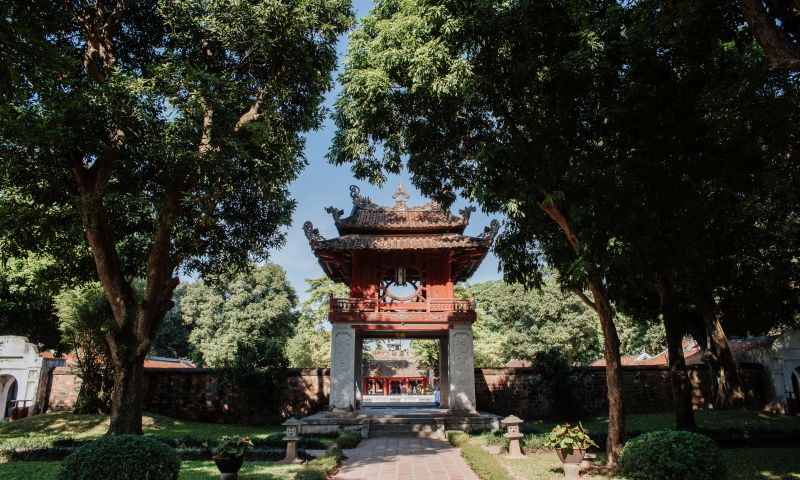
The fourth courtyard holds Thien Quang Well and the 82 doctoral steles mounted on stone tortoise bases, a collection that received UNESCO Memory of the World recognition in 2010 for its documentary significance. Vietnamese university students visit the fourth courtyard before examinations to rub the tortoise heads for good luck — a practice that continues today. The fifth courtyard contains Dai Thanh Sanctuary, the main hall of Confucian worship.
Entry to the Temple of Literature costs VND 70,000 (₹250) for general visitors; students pay VND 35,000 (₹125) with valid ID. The complex opens daily from 8:00 AM to 5:00 PM. A complete visit through all five courtyards takes 1.5 to 2 hours.
Indian visitors with an interest in ancient universities find a direct parallel with Nalanda University ruins in Bihar — both represent the oldest formal educational institutions in their respective regions. The key distinction is structural: the Temple of Literature remains intact and fully navigable, while Nalanda survives primarily as excavated ruins.
Is the Temple of Literature Worth Visiting for Non-History Buffs?
Yes, the Temple of Literature in Hanoi is worth visiting without historical interest. The five tranquil courtyards, bonsai gardens, lotus ponds, and the architectural detail of Khue Van Cac provide a visually distinct experience from every other Hanoi attraction.
Khue Van Cac is one of the most photographed wooden structures in Hanoi — recognisable from the 100,000 VND banknote and immediately striking at the entrance to the third courtyard without any prior historical context. The bonsai gardens and stone-paved courtyards are quiet before 10:00 AM, offering the best conditions for photography without crowds.
Indian tourists with a Buddhist or Confucian cultural background consistently describe the Temple of Literature’s atmosphere as spiritually familiar despite the Vietnamese architectural idiom. The combination of incense, courtyard gardens, and stone inscription carries resonances across both traditions.
The Temple of Literature and Hoa Lo Prison Museum are 10 minutes apart by Grab and combinable within a single afternoon block — but Indian tourists planning independently often allocate each site a separate half-day, wasting one full Grab trip and compressing the rest of the Hanoi itinerary unnecessarily. Vietnamtour.in, which has designed Hanoi itineraries for 428,000+ Indian tourists since 2015, sequences Temple of Literature (2:00 PM) and Hoa Lo Prison Museum (4:00 PM) as a standard paired afternoon block in all Hanoi private day tours, leaving the morning free for Hoan Kiem Lake and the Old Quarter without overlap.
What Are the 5 Courtyards Inside the Temple of Literature?
The Temple of Literature in Hanoi contains 5 sequential courtyards, each serving a distinct ceremonial or educational purpose, designed to guide visitors from the outer gate to the inner Confucian sanctuary.
The first courtyard is a transitional entry space between the city and the sacred compound, bordered by Van Mieu Gate. The second courtyard leads to Dai Trung Mon and contains mature trees lining a central path. The third courtyard is the most architecturally significant — Khue Van Cac, the Pavilion of the Constellation of Literature, stands at its centre, reflected in a small rectangular pond below its southern face.
The fourth courtyard holds the greatest historical density: 82 stone doctoral steles inscribed with the names and home villages of 1,307 graduates from 1442 to 1779, each stele mounted on a stone tortoise base. This section holds UNESCO Memory of the World recognition and is the most historically irreplaceable part of the complex. The fifth courtyard contains Dai Thanh Sanctuary, the main worship hall, where statues of Confucius and his four principal disciples are displayed.
Allow at least 20 minutes in the fourth courtyard to read the stele inscriptions — many record graduates from provinces now known by different names, offering a direct window into Vietnam’s administrative geography across six centuries.
Ho Chi Minh Mausoleum and Presidential Palace
The Ho Chi Minh Mausoleum complex in Ba Dinh District is the single most significant political site in Vietnam — a cluster of five interconnected landmarks on the square where Ho Chi Minh declared Vietnamese independence on 2 September 1945. The mausoleum building opened in 1975 and houses the preserved body of Ho Chi Minh, viewable by visitors who queue in silence along a prescribed route through the granite building. Entry to the mausoleum building is free for all visitors, foreign and domestic.
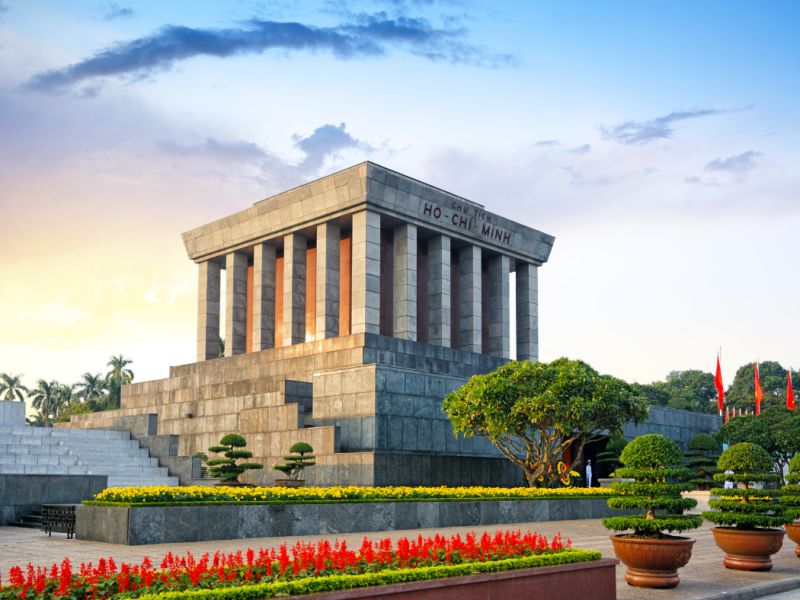
The complex includes five sites across the western side of Ba Dinh Square: the mausoleum building itself; the Presidential Palace (Phu Chu Tich, built 1906, a French colonial yellow building); the Ho Chi Minh Stilt House (built 1958, where Ho Chi Minh lived in deliberate simplicity); Ho Chi Minh’s fish pond; and One Pillar Pagoda (Chua Mot Cot). Entry to the Khu Di tich tai Phu Chu Tich — covering the Stilt House, fish pond, and Presidential Palace grounds — costs VND 40,000 (₹143) per person.
The dress code at the Ho Chi Minh Mausoleum is strictly enforced. Visitors must cover shoulders and knees — shorts, short skirts, and sleeveless tops are not permitted inside the complex. Photography inside the mausoleum building is absolutely prohibited; phones must be stored before entering and must not be raised or held in hand at any point inside. Silence is required throughout the interior.
Visitors queue in two parallel lines and walk at a fixed pace through the building — stopping, gesturing, or speaking loudly results in immediate removal by guards.
Indian tourists familiar with Raj Ghat in Delhi find the atmosphere carries a similar solemnity: a national leader commemorated in a quiet, landscaped setting with a dress code and reverential conduct expected. The key difference is that Ho Chi Minh’s body is physically present inside the mausoleum building — unlike Raj Ghat, which marks the cremation site with a black marble platform.
Is the Ho Chi Minh Mausoleum Open Every Day?
No, the Ho Chi Minh Mausoleum in Hanoi is not open every day. The mausoleum opens only from 8:00 AM to 11:00 AM on Tuesday, Wednesday, Thursday, Saturday, and Sunday — and closes on Monday and Friday every week.
The mausoleum also closes for approximately two months each year — typically September and October — for body preservation maintenance. The exact dates of the annual closure vary and are announced by Vietnamese state media. Checking the official schedule before travelling to Hanoi in September or October is strongly recommended.
Arriving before 9:00 AM on any open day minimises queue time. Saturday mornings draw the longest queues of the week, as domestic tourists from other provinces and foreign visitors converge at the same time.
What Is the One Pillar Pagoda and Is It Inside the Mausoleum Complex?
Yes, the One Pillar Pagoda (Chua Mot Cot) sits approximately 200 metres from the Ho Chi Minh Mausoleum entrance within the same Ba Dinh complex and is accessible on the same visit at no additional charge. One Pillar Pagoda was originally built in 1049 under King Ly Thai Tong — a single wooden lotus-shaped shrine elevated on a stone pillar 1.25 metres in diameter, rising from a square pond.
The structure replicates the image of a lotus blossom emerging from still water — the Buddhist symbol of enlightenment arising from impermanence. Entry to One Pillar Pagoda costs VND 25,000 (₹89).
Indian visitors with a background in Tibetan or Mahayana Buddhism recognise the lotus-on-water iconography as a visual echo of Padmasambhava imagery. The pagoda’s lotus-on-pillar design reads as immediately familiar to anyone acquainted with the lotus motif across South and Southeast Asian Buddhist traditions.
Imperial Citadel of Thang Long
The Imperial Citadel of Thang Long is Hanoi’s oldest royal site, built in 1010 by King Ly Thai To when he moved the capital from Hoa Lu to Thang Long (present-day Hanoi) and designated a UNESCO World Heritage Site in 2010. The citadel served as the political and military centre of 13 Vietnamese dynasties across 1,300 years, making it the longest-continuously-occupied royal site in mainland Southeast Asia.
Entry to the Imperial Citadel of Thang Long costs VND 100,000 (₹357). The citadel opens daily from 8:00 AM to 5:00 PM and closes on Mondays. A complete visit takes 1.5 to 2 hours.
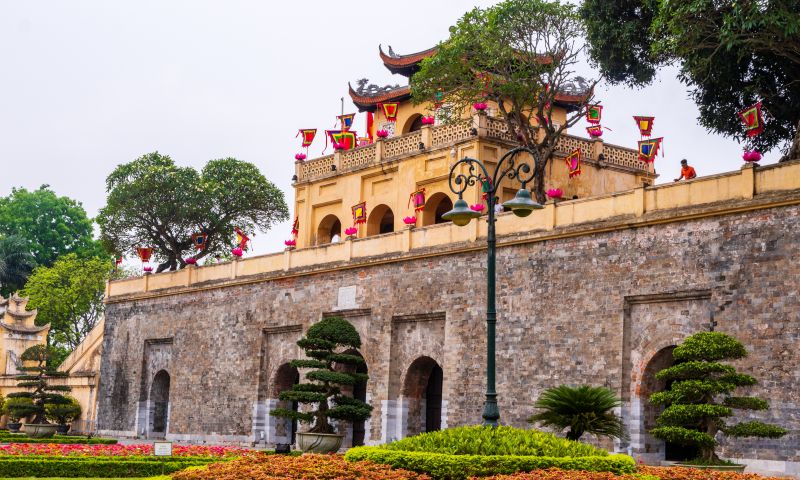
The Imperial Citadel of Thang Long contains four sections, each representing a distinct historical layer of Hanoi’s 1,000-year royal history. Doan Mon Gate is a 15th-century triple-arched ceremonial entrance — the central arch was reserved exclusively for the emperor during imperial ceremonies. Kinh Thien Palace survives as a Le Dynasty stone platform with elaborately carved dragon staircases; the palace structure itself was destroyed in the colonial period, but the foundation and steps remain intact.
The D67 Underground Bunker is a Cold War command centre with original equipment intact — phones, tactical maps, and chair arrangements remain exactly as left, making it one of the few preserved military command interiors in the world that has not been reconstructed. The 18 Hoang Dieu Archaeological Site is a below-ground excavation discovered in 2002, revealing 13 stacked civilisational layers from the Tang Dynasty period through the French colonial era, visible simultaneously in a single pit.
Indian tourists familiar with Red Fort (Lal Qila) in Delhi find a direct structural parallel — both are UNESCO-listed royal citadels at the historical centre of a national capital. The Imperial Citadel of Thang Long predates Red Fort by 628 years (1010 versus 1638). The additional dimension that distinguishes Thang Long from Lal Qila is its Cold War military infrastructure — a layer of 20th-century history that no Mughal-era fort contains.
Is the Imperial Citadel of Thang Long Worth Visiting for Indian Tourists?
Yes, the Imperial Citadel of Thang Long in Hanoi is worth visiting for Indian tourists. The combination of 11th-century royal foundations and a Cold War-era underground bunker makes it the most historically layered single site in Hanoi.
The 18 Hoang Dieu Archaeological Site, located below the northern grounds, is the most intellectually distinctive section of the citadel. Standing at the edge of the excavation pit, visitors see ceramic fragments from the Tang, Ly, Tran, Le, and French colonial periods stacked in visible geological layers — a direct visual record of 1,300 years of urban continuity on a single site.
Indian tourists with two days in Hanoi can deprioritise the citadel in favour of the Ho Chi Minh Mausoleum and Temple of Literature. Indian tourists with three or more days in Hanoi should include the Imperial Citadel of Thang Long as a clear addition to the itinerary.
What Are the 3 Most Important Sections Inside the Imperial Citadel of Thang Long?
The 3 sections Indian tourists should prioritise inside the Imperial Citadel of Thang Long are Doan Mon Gate, the D67 Underground Bunker, and the 18 Hoang Dieu Archaeological Site — each representing a different era of Hanoi’s 1,000-year history.
Doan Mon Gate is the defining visual landmark of the Imperial Citadel of Thang Long — a triple-vaulted 15th-century brick entrance with original stone carvings. The gate is best photographed from the interior courtyard looking back toward the entrance facade.
The D67 Underground Bunker is a fully preserved Cold War command centre located 9 metres below ground, where General Vo Nguyen Giap coordinated the Vietnamese military response during the 1972 Linebacker II campaign. The original phones, maps, and chair arrangements remain in place — one of the few preserved military command sites in the world where the interior has not been reconstructed or relocated.
The 18 Hoang Dieu Archaeological Site, at the northern end of the complex, presents 13 archaeological layers from multiple dynasties visible simultaneously in a single excavation pit. Visitors trace the physical evolution of Hanoi’s royal centre from the 7th century to the present within a 50-metre walk along the pit perimeter.
Hoa Lo Prison Museum
Hoa Lo Prison Museum is the only site in Hanoi where French colonial and American War history are presented simultaneously within the same building, rated 4.5 stars across 21,000 Google reviews. The French colonial administration built Hoa Lo Prison in 1896 under its original name Maison Centrale to hold Vietnamese independence activists. At its peak, the prison designed for 460 inmates held over 2,000 prisoners.
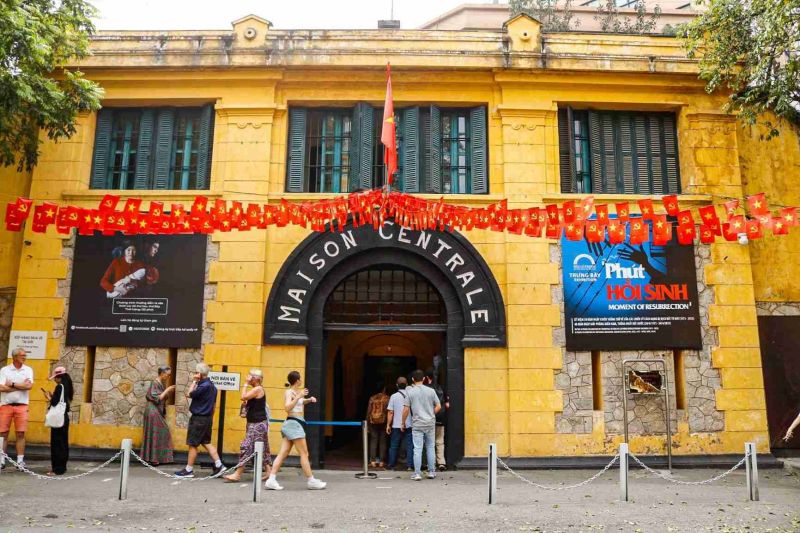
After 1954, the North Vietnamese government used the same facility to hold American pilots shot down over Hanoi during the Vietnam War. American pilots gave the prison the ironic nickname “Hanoi Hilton” — a name that entered global awareness when Senator John McCain, held at Hoa Lo from 1967 to 1973, discussed his captivity publicly.
Entry to Hoa Lo Prison Museum costs VND 50,000 (₹179). The museum opens daily from 8:00 AM to 5:00 PM, including Mondays. Hoa Lo Prison Museum is the only major historical site in Hanoi with no Monday closure.
Hoa Lo Prison Museum is structured around two distinct sections, each covering a different period of the building’s history.
The French colonial section occupies the older part of the complex and contains the original mass detention cells, individual isolation chambers, a death row block with guillotine display, and leg iron exhibits. The narrow corridors, low ceilings, and original fixtures document the physical conditions of colonial imprisonment without mediation.
The American War section presents a contrasting curatorial tone — the Vietnamese framing emphasises humanitarian treatment of American prisoners, while photographs, personal effects of captured pilots, and aircraft wreckage are displayed in well-lit gallery-style rooms. The juxtaposition between the two sections is itself a document of how two governments narrate the same physical space across different historical periods.
Indian tourists who have visited Cellular Jail in the Andaman Islands find a direct parallel in the French colonial section of Hoa Lo — both sites document the imprisonment of independence fighters under colonial law using instruments of physical coercion preserved for public education. The key difference is scale: Hoa Lo adds a second historical narrative layer — the American War period — that Cellular Jail does not contain.
What Is the History of Hoa Lo Prison and Why Do Indian Tourists Visit It?
Hoa Lo Prison in Hanoi was built in 1896 by French colonialists to imprison Vietnamese independence fighters. Indian tourists visit Hoa Lo Prison because its story of colonial resistance directly parallels India’s own freedom struggle against British rule.
The French colonial section of Hoa Lo Prison documents arrests, trials, and executions of Vietnamese nationalists under a judicial and penal system imported from metropolitan France — the same dynamic of colonial law applied against indigenous resistance that Indian visitors recognise from their own national history. The American War section adds a second layer of captivity history to the same building: the prison that held Vietnamese independence fighters was subsequently used to hold American military personnel, placing two opposing narratives of captivity and resistance within the same walls.
This dual historical identity — colonial prison and wartime detention centre — makes Hoa Lo Prison historically unique among Southeast Asia’s war memorial sites.
How Much Time Do You Need to Visit Hoa Lo Prison Museum?
Indian tourists need 45 to 75 minutes to visit Hoa Lo Prison Museum in Hanoi — approximately 20 minutes for the French colonial section and 25 to 40 minutes for the American War section, depending on how closely exhibits are read.
An English-language audio guide is available for hire at the Hoa Lo Prison Museum entrance at approximately VND 30,000 (₹107) above the entry fee. The audio guide provides full historical context for each room and is recommended for visitors without prior knowledge of the French Indochina period.
Hoa Lo Prison Museum is located 10 minutes on foot from the southern shore of Hoan Kiem Lake. Combining the museum with a morning walk around Hoan Kiem Lake and a visit to Hanoi Old Quarter makes a logistically efficient half-day itinerary.
Thang Long Water Puppet Theatre
Thang Long Water Puppet Theatre stages the most widely attended water puppet performances in Vietnam — a 50-minute show of 17 traditional acts performed daily, rooted in a rice paddy performance tradition that originated in the Red River Delta in the 11th century. Water puppetry (mua roi nuoc) began in flooded rice fields after harvest, when villagers staged performances on the water’s surface using figures carved from fig wood (go sung) — a timber dense enough to resist waterlogging.
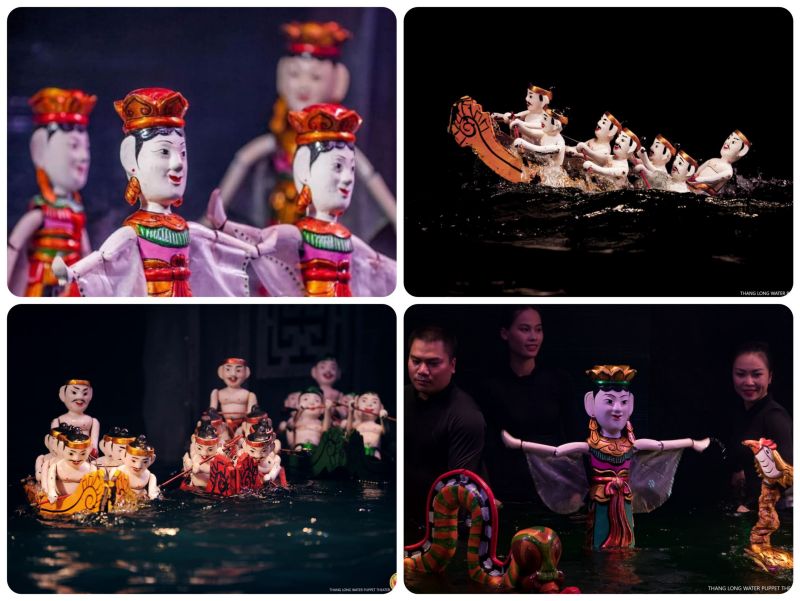
The puppets are lacquered and painted; a troupe of eight puppeteers operates each figure from behind a bamboo curtain screen (buong tro), standing submerged to waist depth and controlling each figure through a concealed system of rods and strings whose mechanisms have been kept within performing families for generations. Thang Long Water Puppet Theatre is located at 57B Dinh Tien Hoang Street, Hoan Kiem — 100 metres from the northern bank of Hoan Kiem Lake.
A standard Thang Long Water Puppet performance runs 17 acts over 50 minutes, accompanied by a live orchestra of traditional Vietnamese instruments: trong (drum), dan bau (monochord), trong com (barrel drum), and trong chau (gong). Acts include rice farming sequences, fishing, a phoenix dance, a unicorn dance, a dragon fire-breathing sequence, and a re-enactment of the Hoan Kiem Lake founding legend with the sacred turtle returning the sword.
Thang Long Water Puppet Theatre operates five shows daily at 3:00 PM, 4:00 PM, 5:00 PM, 6:15 PM, and 8:00 PM. Ticket prices vary by seating section: Standard seats (Rows P–Q) cost VND 100,000 (₹357); Deluxe seats (Rows G–O) cost VND 150,000 (₹535); VIP seats (Rows A–E) cost VND 200,000 (₹714). Advance booking 1 to 2 days ahead is recommended during October to December and April to May.
Indian tourists familiar with Rajasthani Kathputli string puppetry find a clear lineage of intent — both traditions use carved figures to narrate mythology and rural life. The defining difference is that the water surface itself functions as the stage at Thang Long, giving the figures an illusion of autonomous movement that string puppets performed on a flat platform cannot replicate.
Do Hanoi Water Puppet Shows Have English Narration?
Yes, all performances at Thang Long Water Puppet Theatre in Hanoi include a printed English programme booklet distributed at the entrance, with brief English narration before select acts. The booklet describes all 17 acts and their cultural context in English. Even without verbal narration, each scene is visually self-explanatory — agricultural sequences, dragon and phoenix dances, and the turtle legend read clearly without language.
Standard seating (Rows P–Q) at VND 100,000 (₹357) provides full stage visibility and the lowest risk of water spray. Deluxe seating (Rows G–O) at VND 150,000 (₹535) places viewers mid-stalls with a closer angle on puppet detail and minimal water mist. VIP seating (Rows A–E) at VND 200,000 (₹714) offers the closest view of puppet craft and live musicians — photography from VIP rows produces the most detailed shots of puppet expression, but carries a light water mist during dragon fire-breathing sequences.
Which Hanoi Water Puppet Theatre Is Best for Indian Tourists?
Thang Long Water Puppet Theatre is the best water puppet venue for Indian tourists visiting Hanoi. It is the longest-established venue (founded 1969), the closest to Hoan Kiem Lake at 100 metres, operates the largest performance pool in the city, and offers 5 daily show slots compared to 2 or 3 at competing venues.
Two alternative water puppet theatres exist for travellers who find Thang Long fully booked. Vietnam National Puppetry Theatre at 361 Truong Chinh Street is approximately 20% cheaper per ticket but requires a 20-minute taxi ride from the Old Quarter. Golden Bell Theatre at 72 Dinh Tien Hoang Street operates a smaller 80-seat auditorium with a closer audience-to-stage distance — suitable for travellers who prefer an intimate setting over a larger production.
For first-time visitors, Thang Long Water Puppet Theatre remains the strongest choice on quality, location, and ticket availability.
Hanoi Train Street and Egg Coffee
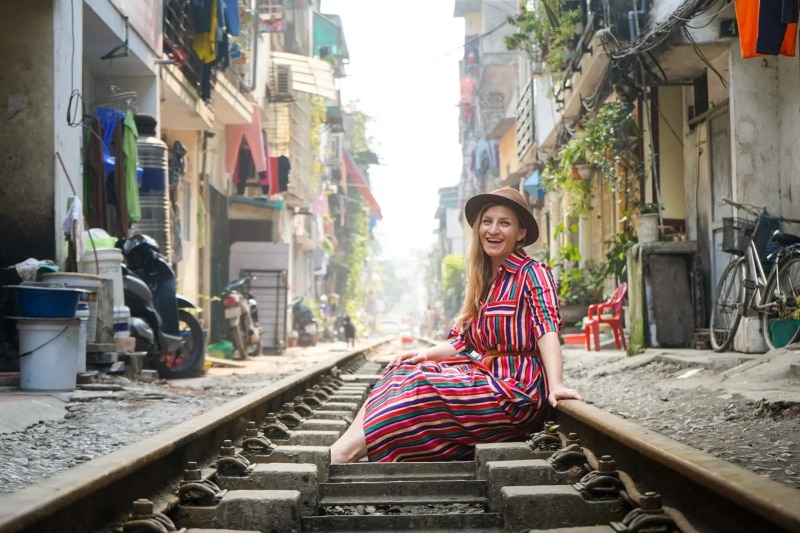
Hanoi Train Street is a 150-metre residential railway corridor on Phung Hung Street where an active train line passes within centimetres of house walls, café tables, and parked motorbikes twice daily. The section between Le Duan Station and Long Bien Bridge runs directly through a dense residential neighbourhood, with homes, small shops, and café tables lining both sides of the track at clearances of 30 to 50 centimetres from passing train carriages.
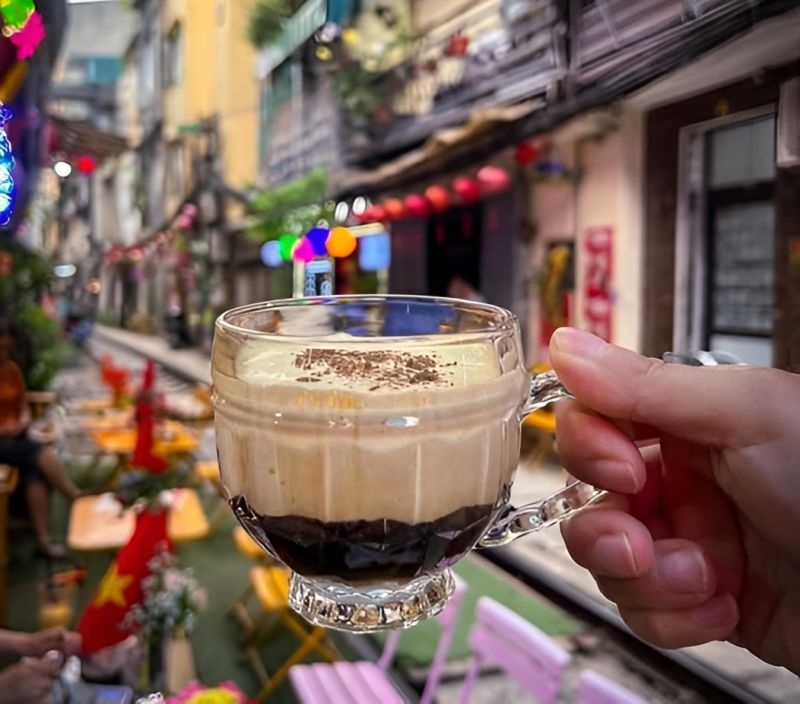
Trains pass through Hanoi Train Street approximately at 3:30 PM and 7:30 PM daily. Exact timings vary with the national rail schedule and should be confirmed locally on the day of the visit.
Egg coffee (ca phe trung) is Hanoi’s most culturally specific drink — a preparation invented by Nguyen Van Giang at Cafe Giang in 1946 when condensed milk was unavailable during wartime rationing. The original recipe whisks egg yolk with condensed milk and sugar into a thick foam, poured over a shot of strong Vietnamese drip coffee in a ceramic cup, producing a layer of dense cream the consistency of warm zabaglione sitting atop dark coffee beneath.
The drink carries no raw egg taste — the yolk is fully emulsified by beating — and the flavour profile is sweet, rich, and malty, comparable to a liquid tiramisu. Egg coffee contains no alcohol and suits Indian tourists who do not drink.
Cafe Giang, where egg coffee was invented in 1946, is located at 39 Nguyen Huu Huan Street, Hoan Kiem — a narrow alley entrance marked by a handwritten sign at street level. Egg coffee at Cafe Giang costs VND 15,000 to VND 25,000 (₹54 to ₹89) per cup. The café opens daily from 7:00 AM to 10:00 PM.
Two alternative venues serve egg coffee in central Hanoi. Cafe Dinh at 13 Dinh Tien Hoang Street serves the same preparation with a window view directly onto Hoan Kiem Lake. Giang Cafe at 39 Hang Gai Street operates inside the Old Quarter for travellers already walking the heritage streets.
Visitors who avoid caffeine entirely can order hot egg milk (trung sua nong) — the same whisked egg and condensed milk preparation without coffee — available at all three cafés.
Is Hanoi Train Street Still Open in 2026?
Yes, Hanoi Train Street remains open to visitors in 2026, with local residents managing access through café seating along the tracks. A small seating fee of VND 9,000 to VND 18,000 (₹32 to ₹64) applies at café tables closest to the rails.
The Hanoi city authority has issued multiple closure orders for the railway corridor — most recently in 2023 — citing pedestrian safety concerns. Hanoi Train Street has reopened each time under modified management. Visitors planning a trip to Hanoi Train Street in 2026 should confirm current access status locally on arrival.
Visitors should arrive at least 30 minutes before the approximate train times of 3:30 PM or 7:30 PM to secure a seated position at a café table. The safest viewing position is a café table set back from the rail edge — café operators issue a warning approximately 60 seconds before the train enters the corridor, at which point all customers step back from the track.
What Is Egg Coffee and Where Do Indian Tourists Find It in Hanoi?
Egg coffee (ca phe trung) is Hanoi’s signature drink — a thick, creamy blend of whisked egg yolk, condensed milk, and sugar poured over strong Vietnamese drip coffee, invented at Cafe Giang in 1946 during wartime condensed milk rationing. The drink carries no raw egg flavour — the yolk is fully emulsified during beating, producing a foam with the consistency of warm custard. The overall taste is sweet and malty with strong coffee beneath, comparable to a warm liquid tiramisu.
The three most reliable addresses for egg coffee in Hanoi are Cafe Giang, Cafe Dinh, and Giang Cafe. Cafe Giang at 39 Nguyen Huu Huan Street is the original location established in 1946. Cafe Dinh at 13 Dinh Tien Hoang Street serves the same recipe with a direct window view onto Hoan Kiem Lake. Giang Cafe at 39 Hang Gai Street operates inside the Old Quarter, convenient for visitors already walking Silk Street.
Egg coffee suits Indian vegetarian tourists — the drink contains no meat and no alcohol. Visitors who avoid caffeine entirely can order hot egg milk (trung sua nong) — the same whisked egg and condensed milk preparation without coffee — available at all three locations on request.
Vietnam Museum of Ethnology
The Vietnam Museum of Ethnology in Hanoi is the most comprehensive presentation of Vietnam’s ethnic diversity in the country — 4,000 artefacts, 15,000 documentary photographs, and 10 full-scale traditional houses representing 54 recognised ethnic groups, rated 4.6 stars across 15,000 Google reviews. The museum opened in 1997 in Cau Giay District and documents the material culture, clothing, tools, musical instruments, and domestic architecture of all 54 officially recognised Vietnamese ethnic groups — the Kinh majority (86% of the population) alongside 53 minority groups including H’Mong, Dao, Tay, Nung, Cham, Bahnar, and Jarai peoples.
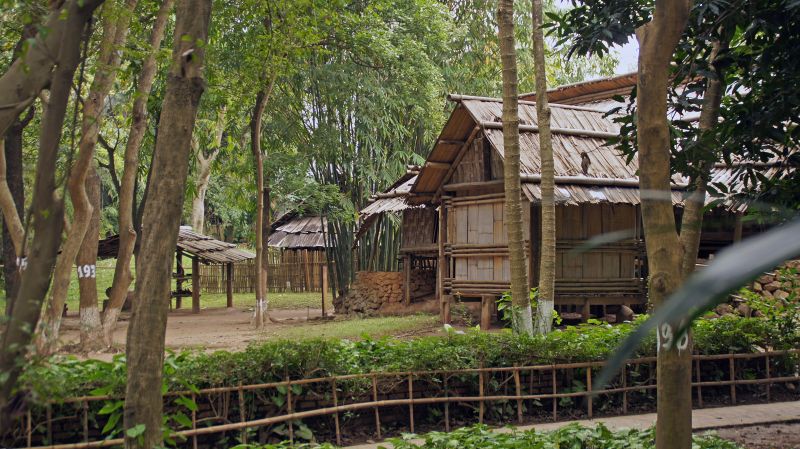
Entry to the Vietnam Museum of Ethnology costs VND 40,000 (₹143). The museum opens Tuesday to Sunday from 8:30 AM to 5:30 PM and closes on Mondays.
The Vietnam Museum of Ethnology is structured around three physically distinct sections. The main indoor building (Building D) organises artefacts geographically — from lowland Kinh culture through the Central Highlands to the northern mountain minorities — with particular depth in textile, ceramic, and musical instrument collections. Building T focuses on northern mountain minorities including H’Mong, Dao, Tay, and Nung groups, with reconstructed domestic interiors and ceremonial costume displays.
The outdoor Traditional House Garden presents 10 full-scale vernacular structures built using traditional materials and methods by artisans from the relevant communities — including a Bahnar communal house (nha rong), a Tay stilt house, a Cham floating dwelling, and an Ede longhouse. Visitors can enter the houses, touch surfaces, sit on floor platforms, and examine construction techniques at close range — a level of physical access rarely permitted in museum contexts.
Indian tourists familiar with Dilli Haat in Delhi find a comparable breadth-of-ethnic-cultures experience at the Vietnam Museum of Ethnology. The key distinction is institutional: the Vietnam Museum of Ethnology is a research and documentation institution, not a commercial marketplace — the presentations are academically grounded, and the physical objects are primary-source artefacts rather than reproductions.
Is the Vietnam Museum of Ethnology Worth Visiting for Families with Children?
Yes, the Vietnam Museum of Ethnology in Hanoi is one of the city’s best attractions for families with children. The outdoor Traditional House Garden allows children to walk inside full-scale vernacular dwellings, climb staircases, and examine construction details — a level of physical access that most museums do not permit.
The garden’s 10 full-scale structures are spread across an open landscaped area with wide paths and shaded rest areas, giving children room to move freely between houses without congestion. The museum also contains a small cafeteria and covered seating for rest breaks.
Families travelling from the Old Quarter reach the Vietnam Museum of Ethnology by Grab in approximately 20 minutes at a cost of VND 24,000 to VND 35,000 (₹86 to ₹125). Morning visits between 8:30 AM and 11:00 AM allow families to complete the outdoor garden before midday heat.
What Are the 3 Main Sections at the Vietnam Museum of Ethnology?
The Vietnam Museum of Ethnology in Hanoi is divided into 3 distinct sections: the indoor Main Building, the indoor Annex Building, and the outdoor Traditional House Garden.
The Main Building requires 45 to 60 minutes and prioritises visitors with an interest in textiles, ceramics, musical instruments, and the material culture of lowland and Central Highland groups. The Annex Building requires 20 to 30 minutes and offers the most concentrated presentation of northern mountain minority groups — the H’Mong and Dao costume collections are particularly detailed.
The outdoor Traditional House Garden requires 30 to 45 minutes and delivers the highest educational return for the least prior knowledge. The Bahnar communal house (nha rong) rises to a 15-metre conical thatched roof; the Tay stilt house stands 2 metres above ground on timber posts; the Ede longhouse spans 40 metres and is designed to house an entire extended family. All three structures are accessible internally.
Visitors with only one hour available should prioritise the Traditional House Garden and the second floor of the Main Building — the Central Highland cultures section contains the most visually distinctive displays in the complex.
West Lake (Ho Tay)
West Lake (Ho Tay) is Hanoi’s largest body of freshwater — 500 hectares in area with a 17-kilometre perimeter — and the spiritual centre of Tay Ho District, hosting Tran Quoc Pagoda, the oldest active pagoda in Hanoi at 1,485 years old. The lake sits 3 kilometres northwest of the Old Quarter in Tay Ho District — Hanoi’s most upscale residential area, containing embassies, boutique hotels, and lakeside restaurants. The lake’s western shore offers the clearest sunset views in the city between 5:30 PM and 7:00 PM.
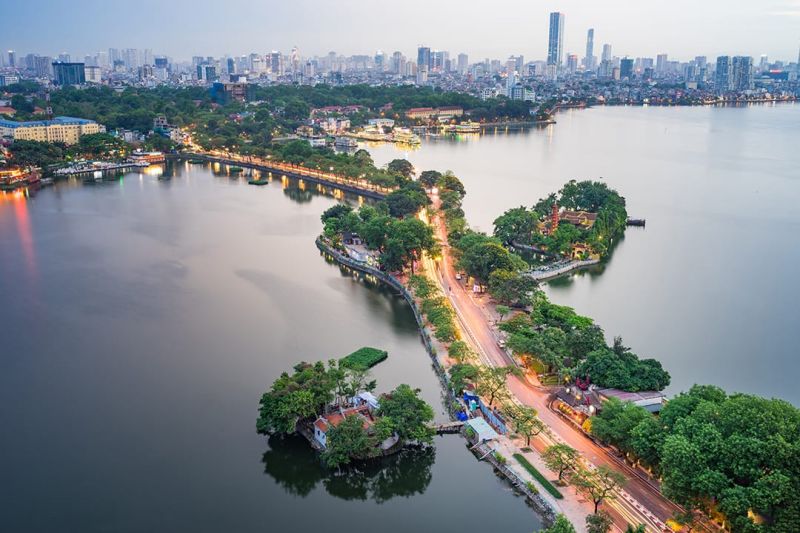
Tran Quoc Pagoda is the oldest active pagoda in Hanoi, first built in 541 AD under the Earlier Ly Dynasty — predating the Imperial Citadel of Thang Long by 469 years — on the banks of the Red River, then relocated to its current island position in the 17th century. A 60-metre causeway connects the pagoda island to the Thanh Nien Road shoreline. The pagoda’s 11-storey red-brown brick tower rises from the island’s southern end and reflects in West Lake at dusk — the most widely reproduced single image of Hanoi in international travel photography.
Entry to Tran Quoc Pagoda is free; donations are accepted at the altar inside. The pagoda opens daily from 8:00 AM to 5:00 PM. A dress code applies: shoulders and knees must be covered — wrap-around sarongs are available to borrow at the gate.
The most significant connection between Tran Quoc Pagoda and India is a Bodhi tree within the compound, propagated from the tree at Bodh Gaya, Bihar — the site of the Buddha’s enlightenment — and presented to Vietnam by the Indian government in 1959. Tran Quoc Pagoda is the only site in Hanoi with a direct botanical link to India’s most sacred Buddhist location.
Lotus flowers, incense sticks, and marigold garlands are sold at the causeway entrance for VND 6,000 to VND 12,000 (₹21 to ₹43) — the same offering materials used at Buddhist temples across South Asia.
Five temple and pagoda complexes sit within a 2-kilometre radius of West Lake’s northern and eastern shores. Quan Thanh Temple on the eastern shore dates to the 11th century and houses a 4-tonne bronze statue of the Taoist deity Huyen Thien Tran Vu — one of the largest pre-modern bronze castings in northern Vietnam. Phu Tay Ho (Tay Ho Palace), on the western peninsula, is the most actively worshipped site at West Lake — dedicated to the Mother Goddess Lieu Hanh and drawing the largest crowds on the 1st and 15th days of the lunar month, when the atmosphere of incense smoke, flower offerings, and chanting carries a strong resemblance to major temple festivals across India.
Cycling the full 17-kilometre perimeter of West Lake takes 2 to 3 hours at a comfortable pace. Bicycle hire costs VND 50,000 to VND 74,000 (₹179 to ₹264) per hour.
Is Tran Quoc Pagoda Free to Enter?
Yes, Tran Quoc Pagoda in Hanoi is free to enter — no ticket counter, no entry fee, and no advance registration is required at any point on the 60-metre causeway or within the pagoda compound. Donations are accepted at the wooden donation box inside the main altar hall.
A dress code applies at Tran Quoc Pagoda: shoulders and knees must be covered. This is a religious requirement of the active Buddhist congregation, distinct from the state-mandated dress code at the Ho Chi Minh Mausoleum. Wrap-around sarongs are available to borrow at the causeway entrance at no charge.
Indian tourists who place lotus flowers or incense sticks on the altar at Tran Quoc Pagoda follow the same offering practice common at Buddhist temples across India, Sri Lanka, and Thailand. Lotus flowers and incense sticks are sold at the causeway entrance for VND 6,000 to VND 12,000 (₹21 to ₹43). The gesture is recognised and welcomed by temple staff.
Which West Lake Temples Are Most Visited by Indian Tourists?
Tran Quoc Pagoda and Quan Thanh Temple are the 2 West Lake sites most visited by Indian tourists in Hanoi. Tran Quoc Pagoda draws visitors for its 1,485-year Buddhist history and direct Bodh Gaya botanical connection. Quan Thanh Temple draws visitors for its 4-tonne bronze statue and 11th-century Taoist architecture.
Phu Tay Ho (Tay Ho Palace), on the western lake peninsula, draws a significant secondary audience among Indian visitors on lunar calendar worship days — the 1st and 15th of each lunar month — when the intensity of offerings and communal prayer creates an atmosphere comparable to major temple festivals in Varanasi or Tirupati.
All three West Lake temples sit within a 2-kilometre arc along the northern and eastern shores of West Lake and can be covered together within 2 hours by bicycle or two short Grab journeys.
How Indian Tourists Plan the Best 2 to 3 Days in Hanoi
Indian tourists with 2 to 3 days in Hanoi can comfortably visit all 15 places in this guide by grouping them into 3 geographical clusters: Hoan Kiem District attractions on Day 1, Ba Dinh District political and royal sites on Day 2, and a day trip to either Ha Long Bay or Ninh Binh on Day 3.
Day 1 in Hanoi — Hoan Kiem District: Lake, Old Quarter, Temple of Literature, and Water Puppet Show
Day 1 in Hanoi concentrates all Hoan Kiem District landmarks into a single walkable itinerary. The day runs across five time blocks, each within walking distance or a short taxi ride of the next.
8:00 AM to 10:00 AM — Hoan Kiem Lake and Ngoc Son Temple. The 1.8-kilometre Hoan Kiem Lake perimeter walk is free and quietest before 9:00 AM. Entry to Ngoc Son Temple costs VND 30,000 (₹107) and the temple is least crowded before 9:30 AM.
10:00 AM to 1:00 PM — Hanoi Old Quarter on foot. Hang Gai covers silk and custom ao dai; Hang Ma covers decorative goods; Dinh Liet and Ta Hien cover street food browsing. Lunch at street-level restaurants in the Old Quarter costs VND 45,000 to VND 74,000 (₹160 to ₹265) per person.
2:00 PM to 4:00 PM — Temple of Literature. Entry costs VND 70,000 (₹250). The Temple of Literature and Hoa Lo Prison Museum are 10 minutes apart by taxi at VND 18,000 (₹64), allowing both to be visited within a single afternoon block.
4:00 PM to 5:30 PM — Hoa Lo Prison Museum. Entry costs VND 50,000 (₹179). The museum is the only major Hanoi historical site with no Monday closure.
Evening — Water Puppet Show at Thang Long Water Puppet Theatre. The 6:15 PM or 8:00 PM slot suits Day 1 timing. Ticket prices by section: Standard seats (Rows P–Q) VND 100,000 (₹357); Deluxe seats (Rows G–O) VND 150,000 (₹535); VIP seats (Rows A–E) VND 200,000 (₹714).
After the show: Old Quarter Night Market operates on Friday, Saturday, and Sunday evenings from 7:00 PM to 11:00 PM. On other evenings, Ta Hien Beer Street followed by egg coffee at Cafe Giang or Cafe Dinh completes the day.
For hotel recommendations, transport logistics, and weather guidance during a Hanoi stay, the complete Hanoi travel guide covers accommodation zones, airport transfer options, and month-by-month conditions.
Day 2 in Hanoi — Ba Dinh District: Mausoleum, Imperial Citadel, Train Street, and West Lake
Day 2 in Hanoi covers Ba Dinh District and requires an early start — the Ho Chi Minh Mausoleum closes at 11:00 AM and does not reopen in the afternoon.
8:00 AM to 9:00 AM — Ho Chi Minh Mausoleum. Entry to the mausoleum building is free. Arriving at 8:00 AM avoids the longest queues of the day. The mausoleum opens at 8:00 AM on Tuesday, Wednesday, Thursday, Saturday, and Sunday — confirm the day is not a Monday or Friday before planning this block.
9:00 AM to 10:30 AM — One Pillar Pagoda and Presidential Palace grounds. One Pillar Pagoda entry costs VND 25,000 (₹89). Both sites sit within 200 metres of the mausoleum exit and require no additional transport. The Khu Di tich tai Phu Chu Tich — covering the Stilt House, fish pond, and Presidential Palace grounds — costs VND 40,000 (₹143) per person.
Lunch in the Truc Bach area costs VND 45,000 to VND 89,000 (₹160 to ₹318) per person at restaurants within walking distance of the Ba Dinh complex.
1:00 PM to 3:00 PM — Imperial Citadel of Thang Long. Entry costs VND 100,000 (₹357). Prioritise Doan Mon Gate, the D67 Underground Bunker, and the 18 Hoang Dieu Archaeological Site to cover the three most historically significant sections within the 2-hour window.
3:00 PM — Hanoi Train Street on Phung Hung Street. Arrive at least 30 minutes before the afternoon train passage at approximately 3:30 PM. Café seating along the track costs VND 9,000 to VND 18,000 (₹32 to ₹64) at tables closest to the rails.
5:30 PM to 7:00 PM — West Lake and Tran Quoc Pagoda. Entry to Tran Quoc Pagoda is free. The pagoda reflects in West Lake at its most photogenic between 5:45 PM and 6:30 PM from October to March. Evening dining is available at lakeside restaurants along Tay Ho’s western shore.
Day 3 from Hanoi — Ha Long Bay or Ninh Binh Day Trip (Your Choice)
Day 3 from Hanoi has two recommended options: Ha Long Bay (east, ₹2,500–₹4,000 day trip, seascape and limestone karst) or Ninh Binh (south, ₹1,200–₹2,000 day trip, river karst plus Bai Dinh Pagoda). Indian first-time visitors prioritise Ha Long Bay; budget-conscious or repeat visitors prioritise Ninh Binh. Both are UNESCO-listed natural landscapes reachable within 3 hours of Hanoi by organised coach from hotels in the Old Quarter.
Ha Long Bay suits first-time visitors to Vietnam who prioritise seascape scenery and limestone island formations. Ninh Binh suits travellers seeking lower tourist density, a 50% cost saving, and access to Asia’s largest Buddhist pagoda complex at Bai Dinh Pagoda.
Both day trip options are covered in full detail in the Day Trips section below. The choice between Ha Long Bay and Ninh Binh depends on two factors: available budget and whether an overnight cruise is feasible.
5 More Places to Visit in Hanoi Worth Adding to Your Itinerary
Hanoi contains 5 additional attractions that reward visitors with extra time in the city, beyond the primary 15-site itinerary covered above.
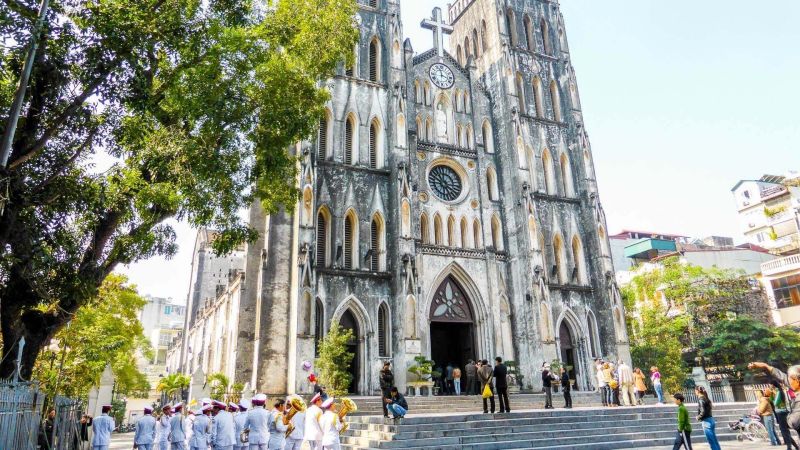
St. Joseph’s Cathedral (Nha Tho Lon Ha Noi) is a Neo-Gothic church built in 1886, modelled on Notre-Dame de Paris, with two symmetrical bell towers rising above the Hoan Kiem District roofline. Entry to St. Joseph’s Cathedral is free. The square in front of the cathedral draws the densest evening crowd of any public space in the Old Quarter, making it one of the city’s most active people-watching locations after 6:00 PM.
Hanoi Opera House (Nha Hat Lon Ha Noi) is a French colonial building completed in 1911, modelled on the Palais Garnier in Paris, and the architectural centrepiece of the Hoan Kiem District eastern edge. The exterior of Hanoi Opera House is photographable at no cost from the adjacent roundabout. Interior access requires a performance ticket costing VND 148,000 to VND 1,475,000 (₹529 to ₹5,268) depending on the event.
Vietnam National Fine Arts Museum (Bao Tang My Thuat) holds the most significant collection of lacquer painting (son mai) and silk painting (tranh lua) in Vietnam — both techniques specific to Vietnamese artistic tradition, covering Vietnamese art from the Stone Age to the contemporary period. Entry to the Vietnam National Fine Arts Museum costs VND 40,000 (₹143). The museum opens Tuesday to Sunday from 8:00 AM to 5:00 PM and closes on Mondays.
Bat Trang Pottery Village (Lang Gom Bat Trang) is a 700-year-old ceramic production village located 14 kilometres from Hanoi’s Old Quarter — approximately 30 minutes by taxi at a return cost of VND 74,000 (₹264). Visitors observe active kiln production, browse finished goods from hundreds of family workshops, and participate in hand-throwing sessions costing VND 59,000 to VND 118,000 (₹211 to ₹421) per person.
Indian tourists familiar with the pottery traditions of Khurja in Uttar Pradesh recognise the village production model — individual families operating kilns and glazing workshops in residential buildings. The Vietnamese ceramic aesthetic in blue-and-white porcelain and celadon glaze differs distinctly from North Indian ceramic traditions. Indian tourists interested in Hanoi’s traditional craft scene beyond Bat Trang will find a complete overview of craft villages — including Van Phuc Silk Village and La Phu Rattan — in the traditional craft villages in Hanoi guide.
Quang Ba Flower Market (Cho Hoa Quang Ba) operates from 2:00 AM to 6:00 AM daily, with peak activity between 3:00 AM and 5:00 AM, when wholesale flower trucks from surrounding rural provinces unload directly onto the market floor. Entry to Quang Ba Flower Market is free. The market stocks chrysanthemums, lotus, marigolds, and orchids in wholesale quantities under fluorescent lighting — conditions that produce strong low-light photography. Quang Ba Flower Market suits early risers or travellers comfortable with a pre-dawn visit.
2 Best Day Trips from Hanoi for Indian Tourists
The 2 best day trips from Hanoi for Indian tourists are Ha Long Bay and Ninh Binh — both UNESCO-listed natural landscapes reachable within 3 hours of the city by organised coach from hotels in Hanoi’s Old Quarter.
Is Ha Long Bay Worth a Day Trip from Hanoi, or Do You Need an Overnight Cruise?
A Ha Long Bay day trip from Hanoi is worth it for Indian tourists with limited time. The day trip format delivers 4 to 5 hours on the bay, a seafood lunch on board, and kayaking access — all-inclusive at VND 700,000 to VND 1,120,000 (₹2,500 to ₹4,000) per person. The day trip covers the visual highlights of Ha Long Bay — sailing through limestone karst formations, entering sea caves, and kayaking in sheltered lagoons — without requiring an overnight stay.
An overnight Ha Long Bay cruise (2 days, 1 night) adds sunset and sunrise on the bay, kayaking after dark in illuminated cave channels, and swimming at private beaches. Overnight cruise prices start at VND 2,240,000 (₹8,000) per person for standard cabin boats and reach VND 5,040,000 (₹18,000) per person for premium junk-style vessels.
Most Ha Long Bay day trip coaches depart from Hanoi Old Quarter hotels between 7:30 AM and 8:00 AM and return by 7:00 PM to 8:00 PM. Coach transfer, boat, guide, and lunch are included in the quoted per-person price.
Ha Long Bay overnight cruise operators require vegetarian and Jain meal pre-arrangements 24–48 hours before embarkation — most Indian tourists discover this requirement only on the boat, when the buffet is already set and no substitution is possible for the 2-day journey. Vietnamtour.in — operating exclusively for Indian travellers for over 10 years and recognised as TripAdvisor Best of the Best 2023 — coordinates vegetarian and Jain meal arrangements with Ha Long Bay cruise operators before departure from Hanoi, confirming dietary requirements vessel-side before the group boards at the harbour.
What Makes Ninh Binh Different from Ha Long Bay for Indian Tourists?
Ninh Binh delivers the same limestone karst formations as Ha Long Bay but in a river and land setting — Indian tourists choose Ninh Binh for significantly lower crowds, a 50% cost reduction, and access to Bai Dinh Pagoda, Asia’s largest Buddhist temple complex. A full Ninh Binh day trip costs VND 336,000 to VND 560,000 (₹1,200 to ₹2,000) per person — approximately half the cost of a Ha Long Bay day trip.
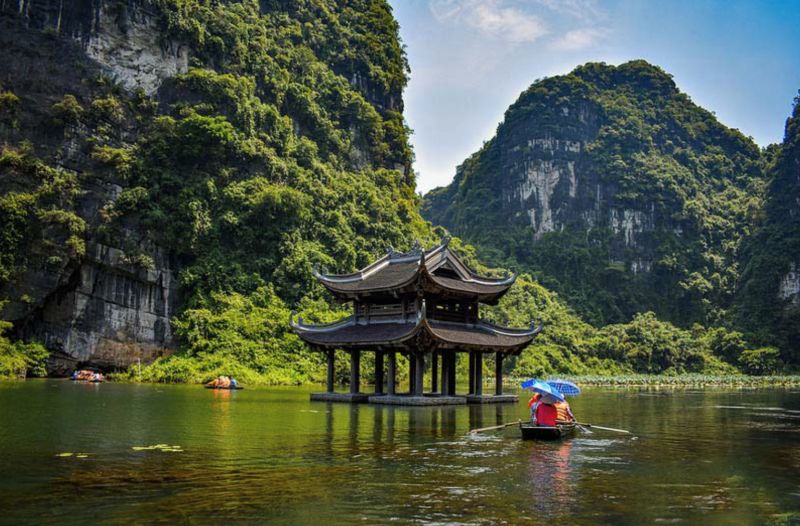
Tam Coc is Ninh Binh’s most visited river section, offering a 2-hour rowing boat journey through 3 limestone caves with rice paddies lining both banks. The combination of karst geology and agricultural landscape produces a visual environment that Ha Long Bay — entirely maritime — cannot replicate. Trang An UNESCO Geopark, located 10 kilometres from Tam Coc, extends the cave-and-river experience across a larger and less commercialised waterway network.
Bai Dinh Pagoda is Asia’s largest Buddhist temple complex, constructed between 2003 and 2014 across 539 hectares. The complex contains 500 stone arhat statues, a 10-metre gold-plated seated Buddha, and the longest corridor of Buddha statues in Asia. Bai Dinh Pagoda sits 45 minutes by road from Tam Coc, making it combinable within a single Ninh Binh day trip.
Indian Buddhist tourists consistently describe Bai Dinh Pagoda as the most architecturally impressive Buddhist site they have visited outside India. The scale of the complex, set against forested karst hills, has no equivalent in South Asia.
Best Places to Visit in Hanoi for Couples
Hanoi offers 6 distinctly romantic experiences for Indian couples — from lakeside evenings and candlelit traditional performances to French-colonial café culture and flower market visits at dawn.
Hoan Kiem Lake evening walk between 6:00 PM and 9:00 PM is free — the car-free lakeside paths, fairy lights on the Huc Bridge, and local couples walking the same route create an atmosphere consistently cited by Indian honeymooners as Hanoi’s most spontaneously romantic moment.
Thang Long Water Puppet Theatre’s 8:00 PM show places couples at the closest viewing distance for the dragon and phoenix sequences — the most visually spectacular acts of the performance. VIP seating (Rows A–E) costs VND 200,000 (₹714) and provides side-by-side seats at the front of the auditorium.
Egg coffee at Cafe Dinh (13 Dinh Tien Hoang Street) combines Hanoi’s signature drink with a direct window view onto Hoan Kiem Lake at dusk. The combination of warm café lighting, egg foam coffee, and the illuminated lake surface makes Cafe Dinh one of Hanoi’s most photographed couple experiences. Egg coffee at Cafe Dinh costs VND 29,000 to VND 44,000 (₹104 to ₹157) per cup.
West Lake sunset viewing from a lakeside restaurant between 5:30 PM and 7:00 PM provides a 500-hectare open water panorama as the sun drops behind the Tay Ho hills — the widest unobstructed skyline view available in Hanoi.
Quang Ba Flower Market, between 3:00 AM and 5:00 AM, rewards adventurous couples with a wholesale flower environment unavailable at any other hour — truck deliveries of lotus, orchid, and marigold fill the market floor under fluorescent lighting. Entry to the Quang Ba Flower Market is free.
Lotte Observation Deck SkyWalk on floor 65 of Lotte Centre provides a 360-degree aerial view of Hanoi, with West Lake, Hoan Kiem Lake, Long Bien Bridge, and the Ba Dinh government district all visible simultaneously. Entry costs VND 120,000 (₹429). The view is best between 6:00 PM and 8:00 PM as city lights activate while residual sky colour remains.
Which Hanoi Attractions Are Best for a Romantic Evening?
The 3 best Hanoi attractions for a romantic evening are Hoan Kiem Lake after 6:00 PM (free), Thang Long Water Puppet Theatre at the 8:00 PM show (₹357 to ₹714), and Lotte Observation Deck SkyWalk at dusk (₹429). Hoan Kiem Lake delivers the widest audience of romantic atmosphere at zero cost — no booking, no timing constraint, and the lake is photogenic from any point on its perimeter after dark. The Water Puppet Theatre provides a structured 50-minute shared experience with live music and a visually memorable finale. The Lotte SkyWalk closes the evening with the best citywide panorama available in Hanoi, with lift access to floor 65 taking under 2 minutes.
Is Hanoi a Good Destination for Indian Couples on Honeymoon?
Yes, Hanoi is an excellent destination for Indian couples on their honeymoon. Hanoi combines direct flight access from 5 Indian metros, a socially open culture where couples receive no unwanted attention, vegetarian-friendly street food at every price point, and accommodation ranging from boutique heritage hotels in the Old Quarter to lake-view resorts on West Lake.
Accommodation in Hanoi for Indian honeymooners costs VND 700,000 to VND 7,000,000 (₹2,500 to ₹25,000) per night across all categories.
Hanoi’s cultural norms around public spaces are more relaxed than Bangkok, Kuala Lumpur, or any Indian metro — couples walking together, sitting in cafés, or visiting temples encounter no social friction.
The Indian e-visa for Vietnam is processed online, costs approximately VND 504,000 (₹1,800), and is typically approved within 3 business days.
Vegetarian options are available from street vendors in every neighbourhood of Hanoi, including pho chay (vegetarian noodle soup), com chay (vegetarian rice dishes), and banh mi chay (vegetarian baguette).
Best Places to Visit in Hanoi at Night
The 5 best evening experiences for Indian tourists in Hanoi are Thang Long Water Puppet Theatre, Old Quarter Night Market, Ta Hien Beer Street, Hoan Kiem Lake evening walk, and Lotte Observation Deck SkyWalk — all accessible within 30 minutes of the Old Quarter.
Thang Long Water Puppet Theatre’s 8:00 PM show is the most popular and the last available slot each evening. Ticket prices range from VND 100,000 (₹357) for Standard seats to VND 200,000 (₹714) for VIP seats. Advance booking 1 to 2 days ahead is recommended during peak season.
Old Quarter Night Market on Hang Dao and Dong Xuan Streets operates on Friday, Saturday, and Sunday from 7:00 PM to 11:00 PM. Entry is free. The market concentrates clothing, souvenirs, handicrafts, and printed textiles, with individual items priced from VND 59,000 (₹211) upwards.
Ta Hien Beer Street runs every evening from 6:00 PM to midnight, with bia hoi (draught lager) at VND 9,000 (₹32) per glass and street food dishes from VND 24,000 (₹86). The street reaches full occupancy from 7:30 PM through 10:30 PM on weekdays and remains active later on weekends.
Hoan Kiem Lake evening walk is free daily from 6:00 PM onwards. The lakeside lighting activates at dusk and the lake perimeter remains comfortable for walking through to 10:00 PM. No booking, ticket, or time restriction applies.
Lotte Observation Deck SkyWalk is open until 10:00 PM and provides the best citywide panorama available in Hanoi at night. Entry costs VND 120,000 (₹429). Arriving before 9:00 PM captures the full combination of residual sky colour and active city lights.
Is Hanoi Safe at Night for Indian Tourists?
Yes, Hanoi is safe at night for Indian tourists in the central districts. The Old Quarter, Hoan Kiem lakeside, and Ba Dinh Square area maintain regular police presence and consistent pedestrian activity through 11:00 PM.
The highest-risk scenario in central Hanoi at night is opportunistic bag snatching from motorbikes on quieter side streets after 11:00 PM. Keeping bags worn across the body rather than on the shoulder eliminates most of this risk.
Grab is available 24 hours a day across Hanoi, provides upfront fare quotes, and is the recommended transport option after 11:00 PM from any location in the city. Grab operates as the regional equivalent of Ola and removes the overcharging risk that street-hailed taxis from tourist areas consistently carry for new arrivals.
What Time Does the Hanoi Old Quarter Night Market Open and Close?
The Hanoi Old Quarter Night Market opens at 7:00 PM and closes at 11:00 PM every Friday, Saturday, and Sunday on the Hang Dao to Dong Xuan Street corridor. The market covers approximately 800 metres of street length and focuses on clothing, printed textiles, souvenirs, handicrafts, and decorative items. The Old Quarter Night Market is not a food market.
For evening food near the Night Market, Ta Hien Street and Hang Be Street provide the most concentrated street food options in the same area. Ta Hien Street sits 2 minutes’ walk from Dong Xuan Market’s southern end.
Combining the Old Quarter Night Market for shopping, Ta Hien Street for food, and Hoan Kiem Lake for the walk back covers the full Old Quarter evening experience within 3 to 4 hours.
Hanoi Attraction Entry Fees in Indian Rupees (2026)
Beyond the West Lake temples and surrounding districts, every Hanoi attraction listed in this guide carries either a fixed entry fee in Vietnamese Dong or operates as a free public space. The complete fee schedule below converts each ticket price to Indian Rupees at the current exchange rate (₹1 = 280 VND), helping Indian tourists pre-budget the full Hanoi itinerary in a single view. Every major Hanoi attraction accepts cash in Vietnamese Dong; Indian Rupees are not directly accepted at ticket counters.
| Attraction | Entry Fee (VND) | Entry Fee (INR) | Notes |
|---|---|---|---|
| Hoan Kiem Lake walk | Free | Free | Open 24/7 |
| Ngoc Son Temple | 30,000 | ₹107 | 8 AM – 6 PM daily |
| Hanoi Old Quarter | Free | Free | Walking, all hours |
| Ma May tube house (no. 87) | 20,000 | ₹71 | Inside Old Quarter |
| Temple of Literature | 70,000 | ₹250 | Student ₹125 with ID |
| Ho Chi Minh Mausoleum | Free | Free | Tue/Wed/Thu/Sat/Sun, 8–11 AM |
| One Pillar Pagoda | 25,000 | ₹89 | Same complex, walkable |
| Phu Chu Tich grounds | 40,000 | ₹143 | Stilt House + fish pond |
| Imperial Citadel of Thang Long | 100,000 | ₹357 | Closed Mondays |
| Hoa Lo Prison Museum | 50,000 | ₹179 | Open every day |
| Hoa Lo audio guide | +30,000 | +₹107 | Optional, English |
| Thang Long Water Puppet (Standard) | 100,000 | ₹357 | Rows P–Q |
| Thang Long Water Puppet (Deluxe) | 150,000 | ₹535 | Rows G–O |
| Thang Long Water Puppet (VIP) | 200,000 | ₹714 | Rows A–E |
| Vietnam Museum of Ethnology | 40,000 | ₹143 | Closed Mondays |
| Tran Quoc Pagoda | Free | Free | Donation accepted |
| St. Joseph’s Cathedral | Free | Free | Outside viewing |
| Hanoi Opera House (performance) | 148,000–1,475,000 | ₹529–₹5,268 | Varies by event |
| Vietnam National Fine Arts Museum | 40,000 | ₹143 | Closed Mondays |
| Bat Trang hand-throwing | 59,000–118,000 | ₹211–₹421 | Per session |
| Quang Ba Flower Market | Free | Free | 2 AM – 6 AM only |
| Lotte Observation Deck SkyWalk | 120,000 | ₹429 | Best 6–8 PM |
| Hanoi Train Street café seat | 9,000–18,000 | ₹32–₹64 | Closest to track |
| Ha Long Bay day trip | 700,000–1,120,000 | ₹2,500–₹4,000 | All-inclusive |
| Ha Long Bay overnight cruise | 2,240,000–5,040,000 | ₹8,000–₹18,000 | Per person |
| Ninh Binh day trip | 336,000–560,000 | ₹1,200–₹2,000 | All-inclusive |
To explore all Hanoi activities as part of a pre-planned package with transport, entrance fees, and a guide included, the things to do in Hanoi page covers curated activity options by interest category and group size.
Best Time to Visit Hanoi Attractions
October to December is the best period for Indian tourists to visit Hanoi — temperatures range from 18°C to 25°C, rainfall is minimal, and sky clarity produces the best photography conditions of the year at every outdoor attraction. Indian tourists travelling during Diwali and Dussehra in October and November will find Hanoi in its most comfortable seasonal state. Flights and hotels to Hanoi for October to December should be booked 3 to 4 months in advance, as this period coincides with peak European and Australian tourist season.
January to March is an acceptable period for Indian tourists to visit Hanoi, with temperatures between 15°C and 20°C. January and February in Hanoi bring occasional drizzle and morning mist — conditions that affect outdoor attractions such as West Lake, Hoan Kiem Lake, and Train Street but do not impact indoor sites such as the Vietnam Museum of Ethnology, Hoa Lo Prison Museum, or Temple of Literature.
Tet (Vietnamese Lunar New Year), falling in January or February depending on the year, transforms Hanoi with flower markets, lantern decorations, and fireworks. Most Hanoi attractions close for 3 to 7 days during the Tet break — confirm exact closure dates before booking travel in this window. Holi in March falls within Hanoi’s acceptable visiting season, with lighter crowds at major attractions than the October to December peak.
April and May deliver temperatures from 22°C to 30°C with limited rainfall in Hanoi, making them suitable for Indian summer holiday travel and May school holidays. Indian tourists visiting Hanoi’s outdoor attractions in April and May should schedule visits before 10:00 AM or after 4:00 PM to avoid midday heat.
June to September is Hanoi’s monsoon season, with temperatures reaching 30°C to 38°C and heavy afternoon rainfall occurring regularly. Hanoi’s outdoor attractions — West Lake cycling, Hoan Kiem lakeside walks, and Train Street — are best visited before 10:00 AM or after 4:00 PM during the monsoon months.
Hanoi’s indoor attractions are unaffected by monsoon rainfall and suit full morning visits throughout June to September — the Vietnam Museum of Ethnology, Hoa Lo Prison Museum, Temple of Literature, and Thang Long Water Puppet Theatre all operate normally regardless of weather.
Indian tourists planning to travel around Hanoi during Eid should verify the monthly conditions in the best time to visit Hanoi guide, as Eid dates shift annually across the calendar.
Which Hanoi Attractions Are Overcrowded and Best Visited on Weekdays?
5 Hanoi attractions carry a consistent overcrowding risk on specific days and times — visiting each on a weekday or at an off-peak hour reduces waiting time and improves the experience at no additional cost.
Hoan Kiem Lake on Sunday mornings between 8:00 AM and 10:00 AM draws the highest single-day crowd of the week — the car-free zone on Dinh Tien Hoang and Le Thai To Streets attracts both Hanoi residents and tourists simultaneously. Arriving at Hoan Kiem Lake before 7:00 AM or switching to an evening visit eliminates congestion.
The Ho Chi Minh Mausoleum on Saturday mornings produces the longest queue of the weekly schedule — domestic tourists travelling from other Vietnamese provinces converge with international visitors at the same Saturday morning window. Visiting the Ho Chi Minh Mausoleum on Tuesday, Wednesday, or Thursday cuts queue time by 60 to 70% under equivalent weather conditions.
The Old Quarter Night Market on Saturday evenings is the most congested of the three weekly market nights — the 800-metre Hang Dao to Dong Xuan corridor becomes shoulder-to-shoulder between 8:00 PM and 10:00 PM. Friday evening delivers the same full Old Quarter Night Market operation with noticeably lower crowd density.
Ha Long Bay, in July and August, reaches peak occupancy across all boat operators — vessels operate at full capacity, and prices rise 20 to 30% above shoulder-season rates. Booking Ha Long Bay 4 to 6 weeks in advance at peak season, or switching to Ninh Binh, resolves both the crowding and the cost issue.
Hanoi Train Street on Saturday and Sunday afternoons draws the densest crowds of the week — the combination of the 3:30 PM train passage and weekend visitor volume creates conditions where the safety margin between spectators and the track is narrowest. Visiting Hanoi Train Street on Monday to Friday afternoons reduces crowd density and allows better positioning along the track, eliminating the additional hazard of weekend crowds stepping toward the rails as the train approaches.