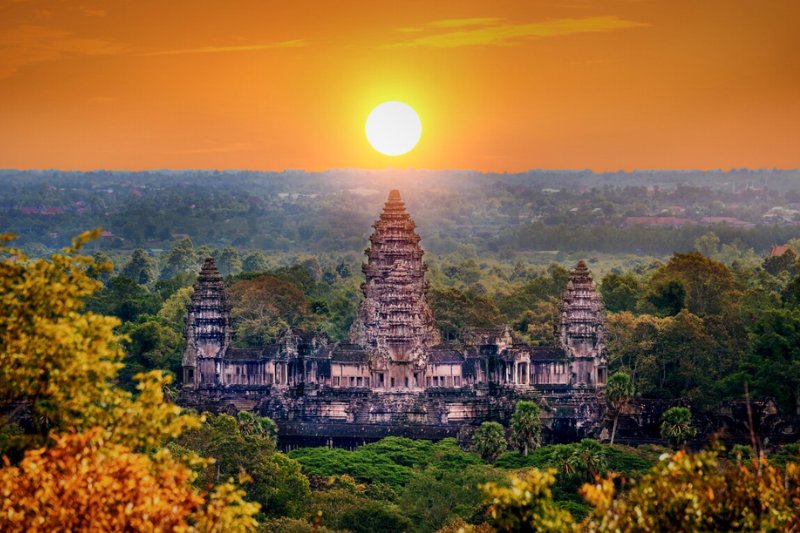
A Cambodia temple is a Hindu or Buddhist sanctuary built by the Khmer kings between the 7th and 13th centuries, and the most famous is Angkor Wat, the largest religious monument in the world. Most of the famous temples in Cambodia stand in the Angkor Archaeological Park near Siem Reap, where one Angkor Pass of US$37 (₹3,515) a day covers more than 50 temples.
This guide covers the 11 most famous Cambodia temples, from Angkor Wat, Bayon and Ta Prohm to Koh Ker and Sambor Prei Kuk, with 2026 ticket prices, the Hindu links that matter to visitors from India and a 3-day temple itinerary.
The table below sums up the temples in Cambodia covered in this guide, with the ticket each one needs as of November 2026.
| Temple | Built | Religion | Distance from Siem Reap | Ticket |
|---|---|---|---|---|
| Angkor Wat | 12th century | Hindu (Vishnu), later Buddhist | 6 km | Angkor Pass |
| Bayon (Angkor Thom) | Late 12th century | Buddhist | 8 km | Angkor Pass |
| Ta Prohm | Late 12th century | Buddhist | 10 km | Angkor Pass |
| Banteay Srei | 10th century | Hindu (Shiva) | About 35 km | Angkor Pass |
| Phnom Bakheng | Late 9th century | Hindu (Shiva) | 7 km | Angkor Pass |
| Preah Khan | 12th century | Buddhist | 9 km | Angkor Pass |
| Beng Mealea | 12th century | Hindu | About 65 km | Angkor Pass, or US$10 (₹950) alone |
| Koh Ker | 10th century | Hindu (Shiva) | About 120 km | US$15 (₹1,425) |
| Sambor Prei Kuk | 7th century | Hindu | About 150 km | US$10 (₹950) |
| Preah Vihear | 9th to 12th centuries | Hindu (Shiva) | About 200 km | Closed to visitors in 2026 |
| Wat Banan | 11th century | Hindu, later Buddhist | In Battambang, about 3 hours away | Small fee at the site |
Rupee figures are converted at US$1 = ₹95 and rounded. Distances from Siem Reap are approximate road distances.
Angkor Wat: The Greatest Cambodia Temple
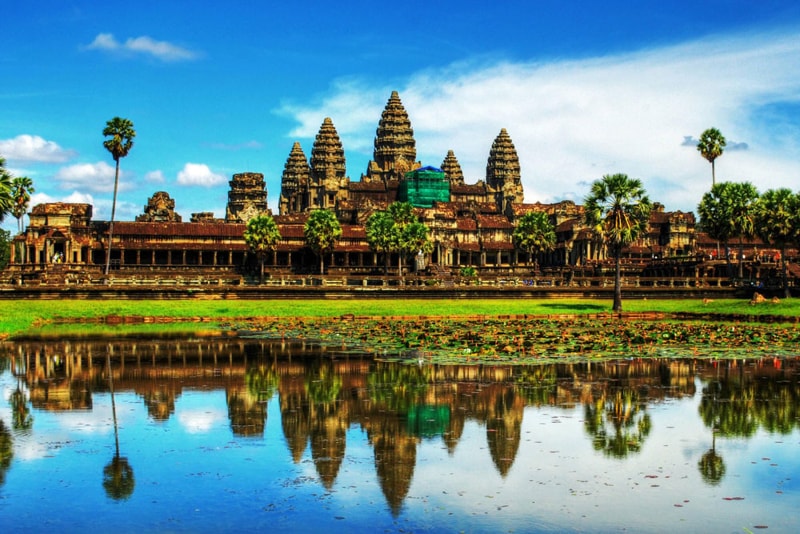
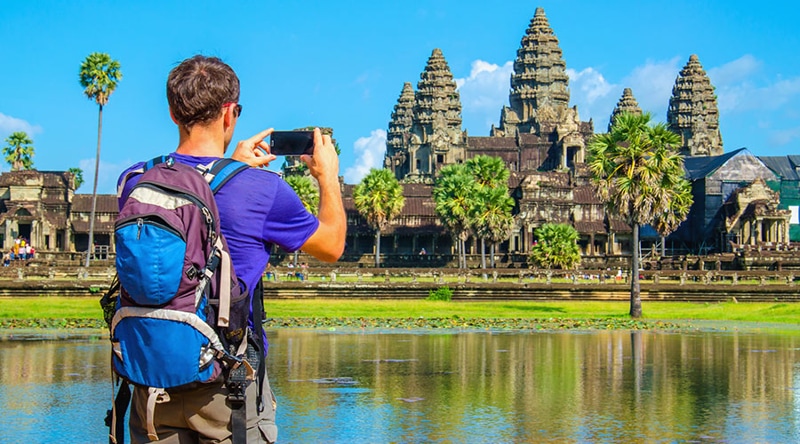
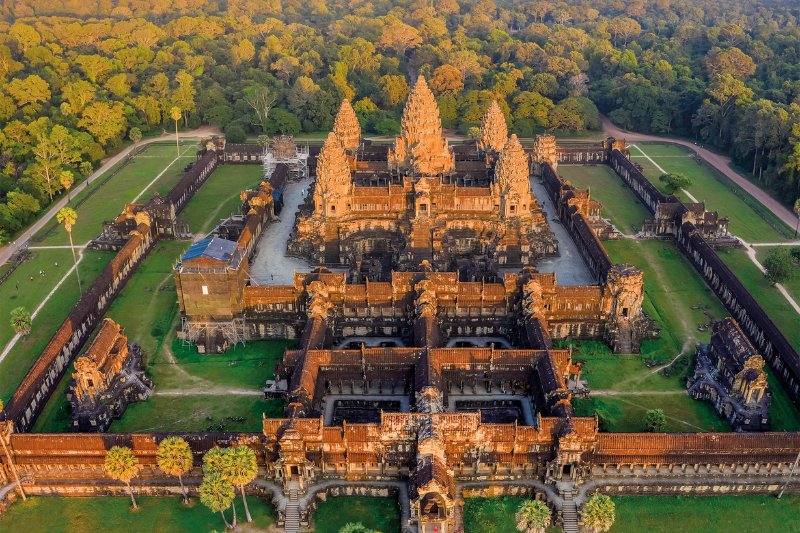
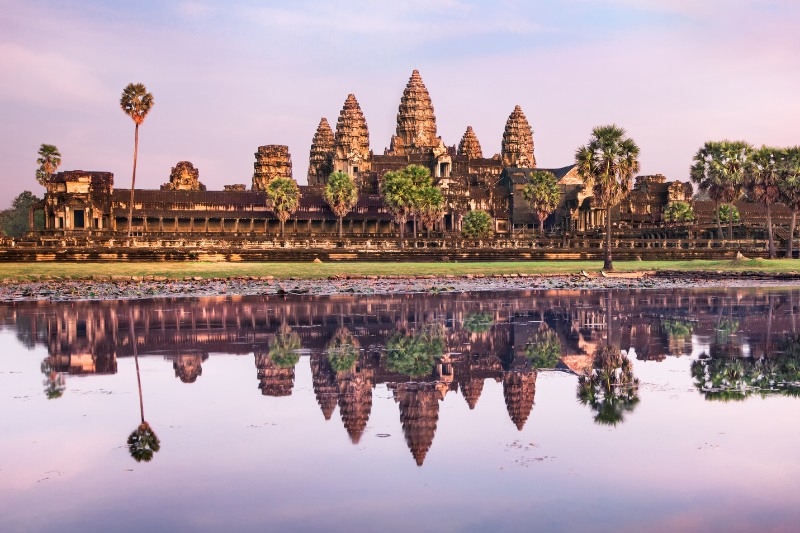
Angkor Wat is the most famous temple in Cambodia and the largest religious monument in the world, built in the early 12th century by King Suryavarman II and dedicated to the Hindu god Vishnu. The temple later became a Buddhist site and, like many temples in Cambodia, is still used for worship today.
The five towers of Angkor Wat represent the five peaks of Mount Meru, the home of the gods in Hindu cosmology, and a 190 m wide moat surrounds the temple. UNESCO listed Angkor, including Angkor Wat, as a World Heritage Site in 1992, and the temple appears on the national flag of Cambodia.
For visitors from India, the outer galleries of Angkor Wat are the highlight. The bas-reliefs show scenes from the Ramayana and the Mahabharata, the Battle of Kurukshetra and the Churning of the Ocean of Milk (Samudra Manthan), in which devas and asuras pull the serpent Vasuki to make amrita.
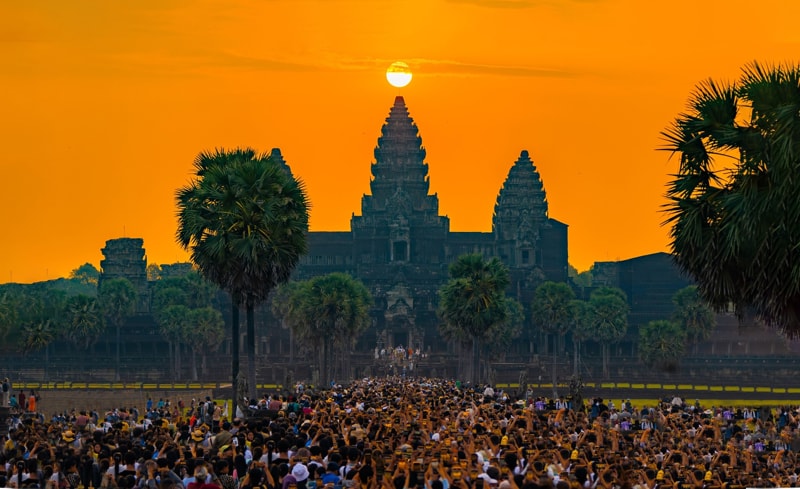
Sunrise is the best time to visit Angkor Wat. The temple opens at 5:00 AM, and the sun rises behind the central towers, seen from the ponds in front of the main gate. Arrive by 5:15 AM for a place at the front, and visit the inner galleries after 8:00 AM when the sunrise crowd leaves for breakfast.
- Opening hours: 5:00 AM to 5:30 PM.
- Ticket: Angkor Pass, US$37 (₹3,515) for 1 day.
- Time needed: 2 to 3 hours, plus sunrise.
Angkor Thom and Bayon Temple: Faces of The Khmer Empire
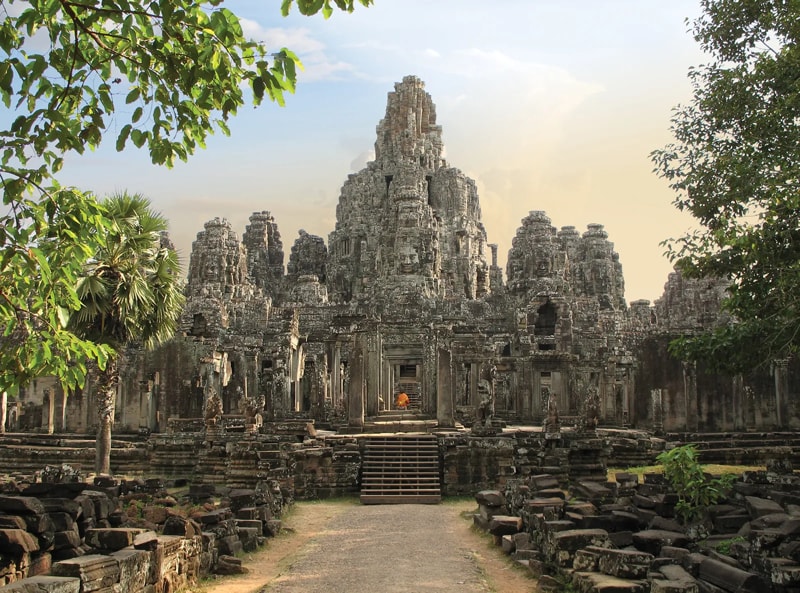
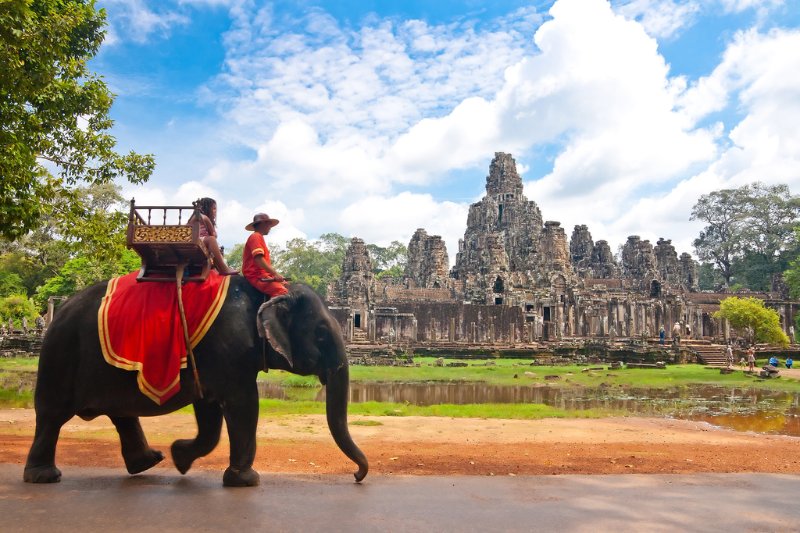
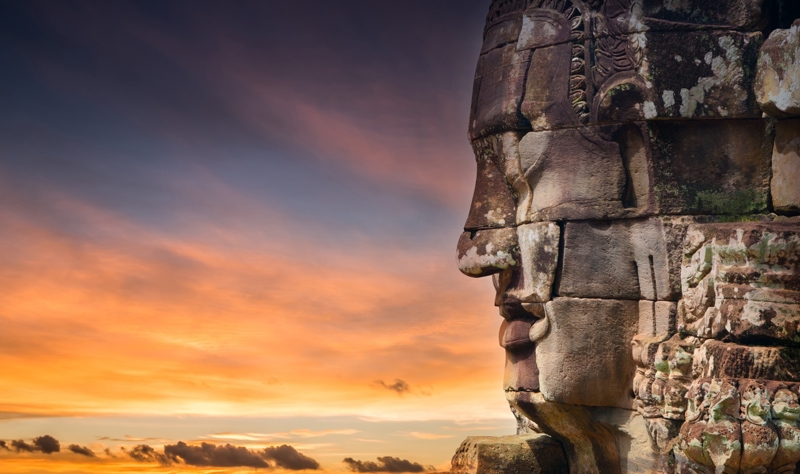
Bayon is the temple of the smiling faces at the centre of Angkor Thom, the last great capital of the Khmer Empire, built by King Jayavarman VII in the late 12th century. More than 200 stone faces look out from the towers of the Bayon, and many scholars believe they portray the bodhisattva Avalokiteshvara or the king himself.
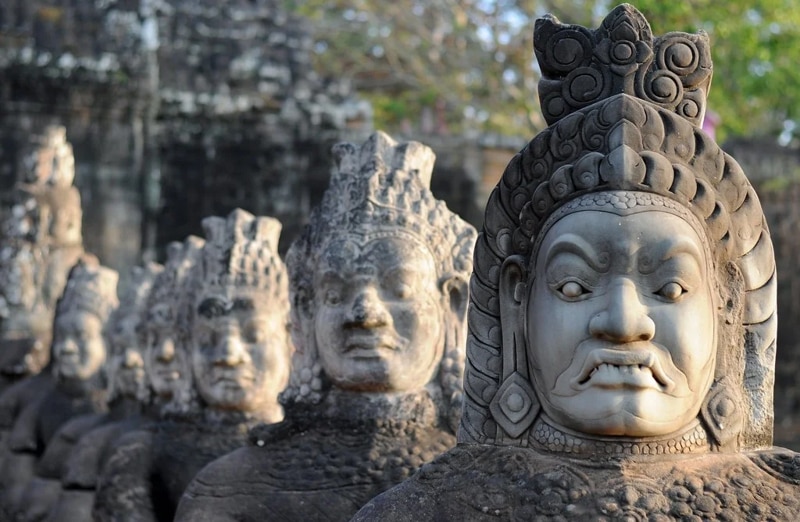
Angkor Thom is a walled royal city of about 9 square kilometres, entered through five gates with giant faces above the doorways. Along the causeway to the South Gate, rows of stone devas and asuras pull a serpent, the same Samudra Manthan story seen at Angkor Wat.
North of the Bayon, the Terrace of the Elephants and the Terrace of the Leper King were viewing platforms where the king watched parades and ceremonies. The Baphuon temple and the royal enclosure of Phimeanakas stand between them.
- Opening hours: 7:30 AM to 5:30 PM.
- Ticket: included in the Angkor Pass.
- Time needed: 2 to 3 hours for the Bayon, the terraces and the Baphuon.
Ta Prohm: The Jungle Temple
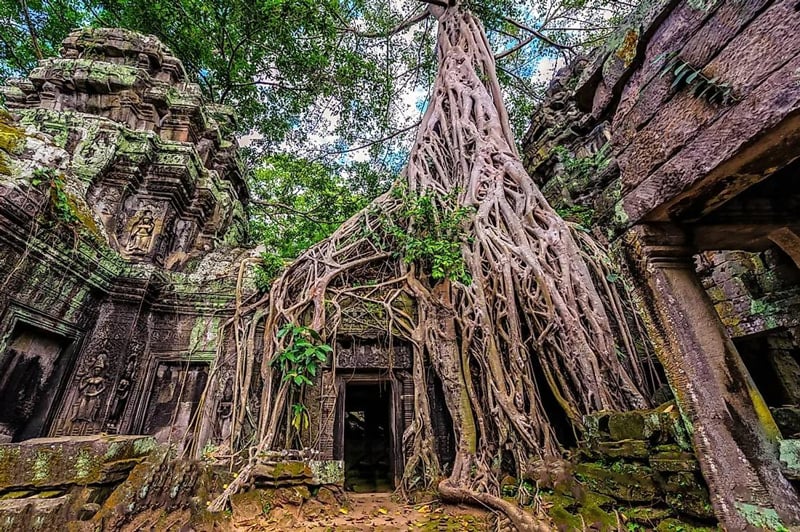
Ta Prohm is the jungle temple of Angkor, a late 12th-century Buddhist monastery where giant silk-cotton and strangler fig trees grow out of the walls and towers. King Jayavarman VII built Ta Prohm in honour of his mother.
Conservators left the trees in place to show how the jungle covered Angkor before the restoration work began, and the temple became world famous after the 2001 film Lara Croft: Tomb Raider was shot here. Wooden walkways now guide visitors past the most photographed roots, and our full guide to Ta Prohm maps the best photo spots.
Ta Prohm has a direct link to India. The Archaeological Survey of India has helped restore Ta Prohm since the early 2000s, and in 2026 the ASI and Cambodia’s APSARA National Authority were rebuilding the temple’s South Gate, with completion expected by the end of the year.
- Opening hours: 7:30 AM to 5:30 PM.
- Ticket: included in the Angkor Pass.
- Best time: 7:30 to 9:00 AM, before the tour groups.
Banteay Srei: The Pink Sandstone Temple
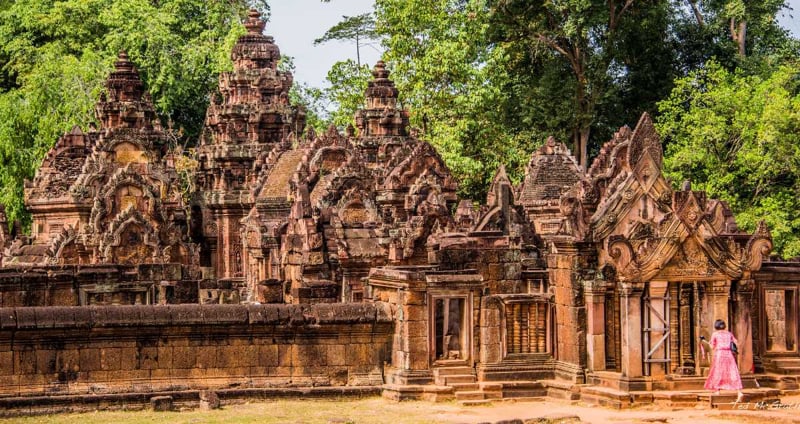
Banteay Srei is a small 10th-century Hindu temple dedicated to Shiva, built of pink sandstone and known for the finest carvings of any temple in Cambodia. The name means “citadel of women”, from the belief that only women could carve such delicate work.
The lintels and pediments show Hindu stories in deep relief, including Ravana shaking Mount Kailash and Shiva burning Kama with his third eye. Banteay Srei lies about 35 km north-east of Siem Reap, a drive of about 1 hour, and the colours of the stone glow best in the early morning or late afternoon.
- Ticket: included in the Angkor Pass.
- Time needed: 1 hour, plus the drive.
Phnom Bakheng: Sunset Temple with A View
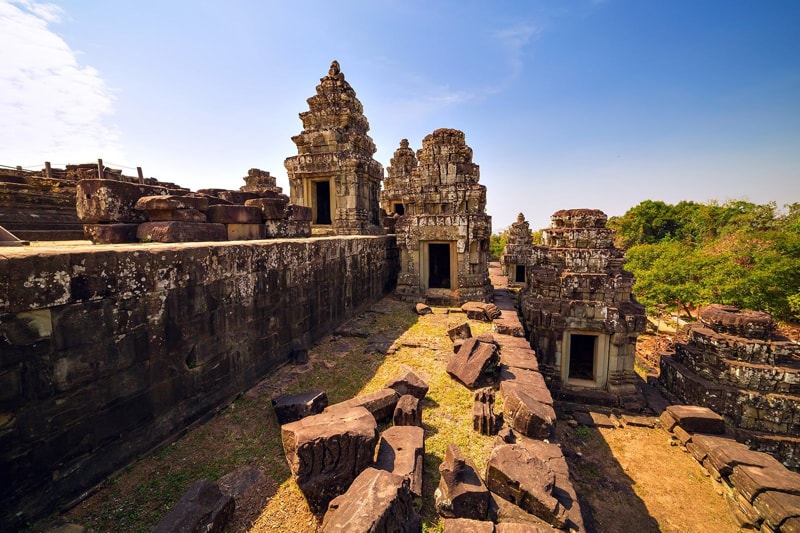
Phnom Bakheng is a late 9th-century Hindu temple dedicated to Shiva, built on a 65 m hill and the best-known sunset viewpoint in the Angkor park. It was the state temple of Yasodharapura, the first capital at Angkor.
From the top terrace, the view stretches over the jungle to the towers of Angkor Wat. The climb takes about 15 minutes on a winding path, and the number of visitors on the top terrace at sunset is limited, so arrive by 4:30 PM to be sure of a place.
- Opening hours: 5:00 AM to 7:00 PM.
- Ticket: included in the Angkor Pass.
Preah Khan: The Sacred Sword Temple
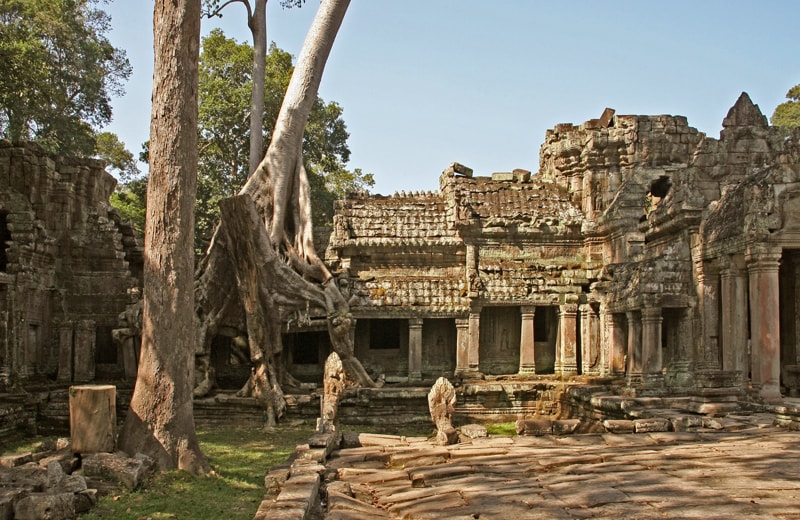
Preah Khan is a 12th-century Buddhist monastery north of Angkor Thom, built by Jayavarman VII in honour of his father, with long corridors, layered gates and trees growing over the ruins. The name means “sacred sword”.
Among the temples in Cambodia, Preah Khan feels like Ta Prohm without the crowds. A rare two-storey building with round columns stands in the outer courtyard, and the corridors run straight through four concentric enclosures. Pair Preah Khan with nearby Neak Pean and Ta Som on the Grand Circuit route.
- Ticket: included in the Angkor Pass.
- Time needed: 1 to 1.5 hours.
Beng Mealea: The Lost Temple of Cambodia
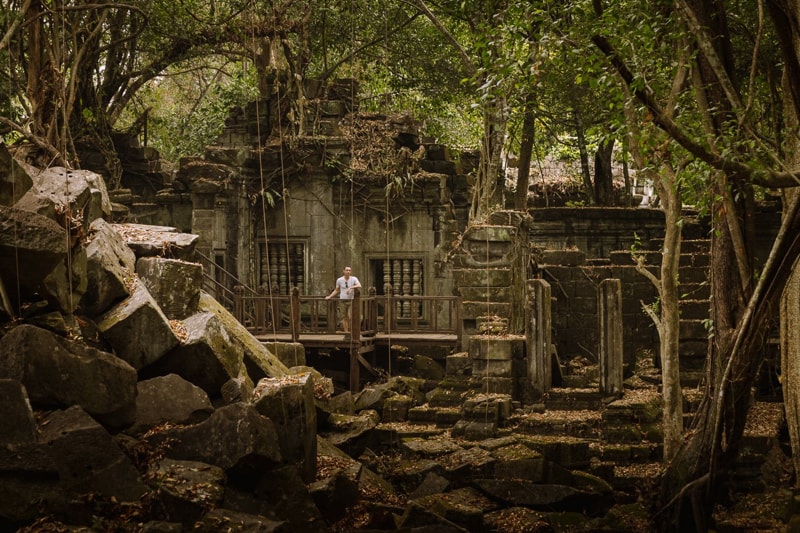
Beng Mealea is a 12th-century Hindu temple about 65 km east of Siem Reap, left almost unrestored in the jungle, with collapsed galleries that visitors explore on wooden walkways. Its layout is similar to Angkor Wat, and many scholars date it to the same reign.
Beng Mealea is included in the Angkor Pass, or costs US$10 (₹950) on its own. The drive takes about 1.5 hours, and the temple pairs well with Koh Ker on a full-day trip.
- Ticket: Angkor Pass, or US$10 (₹950) alone.
- Time needed: 1 to 1.5 hours, plus the drive.
Koh Ker: The Pyramid Temple Capital
Koh Ker is a 10th-century temple city about 120 km north-east of Siem Reap, once the capital of the Khmer Empire under King Jayavarman IV, and UNESCO listed it as a World Heritage Site in 2023. Entry costs US$15 (₹1,425).
The star of Koh Ker is Prasat Thom, a seven-tiered sandstone pyramid about 36 m high, which looks more like a Maya temple than an Angkor tower. More than 100 smaller shrines, many dedicated to Shiva, are scattered through the forest around it. Koh Ker is about 2.5 hours by road from Siem Reap and is the quietest UNESCO-listed Cambodian temple site, even in the high season.
- Ticket: US$15 (₹1,425), separate from the Angkor Pass.
- Best for: a full-day trip with Beng Mealea.
Sambor Prei Kuk: Pre-Angkor Temple Complex
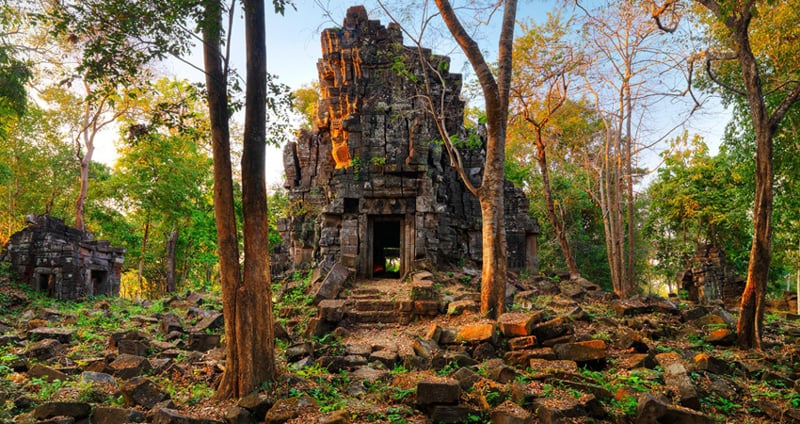
Sambor Prei Kuk is a 7th-century temple complex in Kampong Thom Province, the capital of the Chenla kingdom, and UNESCO listed it as a World Heritage Site in 2017. Entry costs US$10 (₹950).
The brick temples of Sambor Prei Kuk are the oldest temples in Cambodia on this list and predate Angkor by about 500 years and are grouped in three main clusters in the forest. Many have rare octagonal towers and carved “flying palaces” on the walls. The site lies about 30 km north of Kampong Thom town, roughly halfway between Siem Reap and Phnom Penh, so it works as a stop on the road between the two cities.
- Ticket: US$10 (₹950).
- Time needed: 2 to 3 hours.
Preah Vihear: Cliff-Top Cambodia Temple
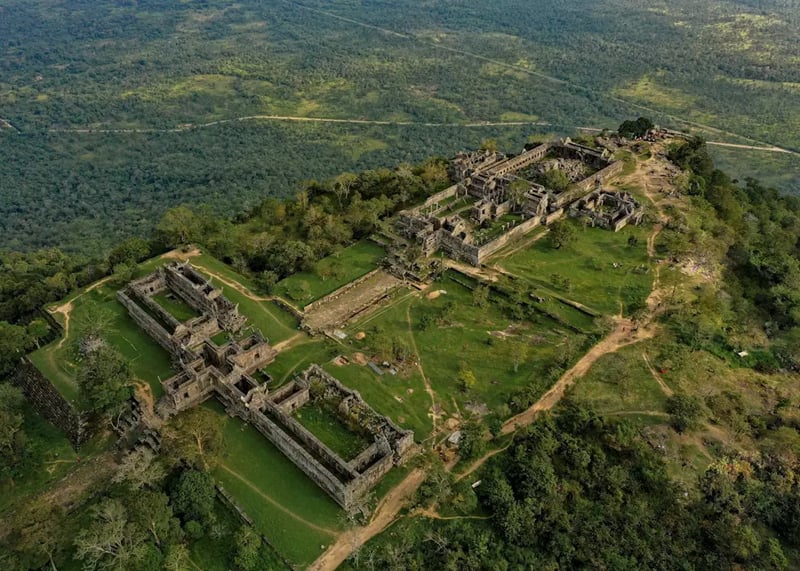
Preah Vihear is a mainly 11th-century Hindu temple to Shiva on a 525 m cliff in the Dangrek Mountains, and UNESCO listed it as a World Heritage Site in 2008; the temple is closed to visitors in 2026 after border clashes between Cambodia and Thailand. AP and Travel and Tour World reported in March 2026 that only security staff and conservation workers were allowed on the site.
The temple climbs the cliff in an 800 m line of gopuras and courtyards, built over several centuries, and ends at a sanctuary on the edge of the cliff with views over the Cambodian plain. The site has been damaged in the fighting, and landmines and unexploded ordnance remain in the area. Check the latest status with your tour operator before planning a visit, and choose Koh Ker or Sambor Prei Kuk instead for now.
Lesser-Known Cambodia Temples Worth Visiting
The best lesser-known Cambodian temples are Ta Som, Banteay Kdei and Neak Pean inside the Angkor park, and Wat Banan near Battambang. These temples are quieter and easy to add to a longer trip.
- Ta Som: a small temple on the Grand Circuit with a strangler fig growing over its eastern gate; included in the Angkor Pass.
- Banteay Kdei: a Buddhist monastery opposite the Srah Srang royal pool, with maze-like galleries and few visitors; included in the Angkor Pass.
- Neak Pean: a small shrine on an island in an artificial pool, reached by a long boardwalk; included in the Angkor Pass.
- Wat Banan: an 11th-century hilltop temple near Battambang, often called a mini Angkor Wat, reached by a long stone staircase with views over the rice fields.
Angkor Pass: Tickets And Opening Hours For Cambodia Temples
The Angkor Pass costs US$37 (₹3,515) for 1 day, US$62 (₹5,890) for 3 days and US$72 (₹6,840) for 7 days, and covers more than 50 temples, including Angkor Wat, Bayon, Ta Prohm, Banteay Srei and Beng Mealea. Children under 12 enter free with a passport.
The table below lists the Angkor Pass options as of 2026.
| Pass | Price | Valid for |
|---|---|---|
| 1-day pass | US$37 (₹3,515) | 1 day, used within 5 days of purchase |
| 3-day pass | US$62 (₹5,890) | Any 3 days within 10 days |
| 7-day pass | US$72 (₹6,840) | Any 7 days within 30 days |
Buy the pass at the Angkor Ticket Center, which opens at 5:00 AM, or online on the official Angkor Enterprise website, which sends a QR code to your phone. A 1-day pass bought after 4:45 PM is also valid for the sunset that evening.
Ticket prices last checked in November 2026. Sources: Mototom Cambodia (July 2026), ASEAN Angkor Guide (May 2026).
Suggested Cambodia Temple Itinerary
A 3-day Angkor Pass is enough to see the main Cambodia temples at an easy pace, and 5 days add Koh Ker, Beng Mealea or Sambor Prei Kuk. The plan below starts and ends in Siem Reap.
- Day 1: sunrise at Angkor Wat, then the South Gate and the Bayon in Angkor Thom, the Terrace of the Elephants and sunset at Phnom Bakheng.
- Day 2: Ta Prohm at 7:30 AM, Banteay Kdei and Srah Srang, then Banteay Srei in the late afternoon.
- Day 3: the Grand Circuit with Preah Khan, Neak Pean and Ta Som, and a return to Angkor Wat for the bas-relief galleries.
- Days 4 and 5 (optional): a full day to Beng Mealea and Koh Ker, and a stop at Sambor Prei Kuk on the road to Phnom Penh.
Vegetarian travellers will find vegetarian Khmer dishes and Indian restaurants in Siem Reap, so lunch between temples is easy to arrange. The heat peaks between 11:00 AM and 2:00 PM from March to May, so plan a hotel break at midday.
For the beaches, cities and nightlife beyond the temples, see our guide to the places to visit in Cambodia.
FAQs About Cambodia Temples
What is the most famous temple in Cambodia?
Angkor Wat is the most famous temple in Cambodia and the largest religious monument in the world. It stands 6 km north of Siem Reap.
How many temples are there in Cambodia?
Cambodia has hundreds of ancient temples, and the Angkor Archaeological Park alone covers more than 50 temples on one Angkor Pass. The park spreads over 401 square kilometres around Siem Reap.
Is Angkor Wat a Hindu temple?
Yes. Angkor Wat was built as a Hindu temple to Vishnu in the 12th century and later became a Buddhist temple. Its galleries show scenes from the Ramayana and the Mahabharata.
How many days do you need for the temples of Cambodia?
Three days are enough for the main temples around Angkor, and 5 days add Koh Ker, Beng Mealea and Sambor Prei Kuk. A 1-day pass covers only Angkor Wat, the Bayon and Ta Prohm.
Conclusion
A Cambodian temple trip is one of the richest ways to learn about the history, beliefs and art of the Khmer Empire, and for visitors from India, it is also a journey through Hindu stories carved in stone 900 years ago. From the sunrise at Angkor Wat to the forest towers of Koh Ker, each temple shows a different side of the Khmer kings.
Most travellers from India combine Siem Reap with Vietnam. A Vietnam and Cambodia tour pairs Angkor with Ho Chi Minh City or Hanoi, our Indochina tour packages add Laos, and you can compare all Vietnam tours on one page.
To plan your days at the temples of Cambodia, share your travel dates, group size and departure city in the form below. A local expert at Vietnamtour.in, which has hosted 428,000+ travellers from India since 2015, will book your Angkor Pass, an English-speaking guide, sunrise transfers and vegetarian or Jain meals in Siem Reap.