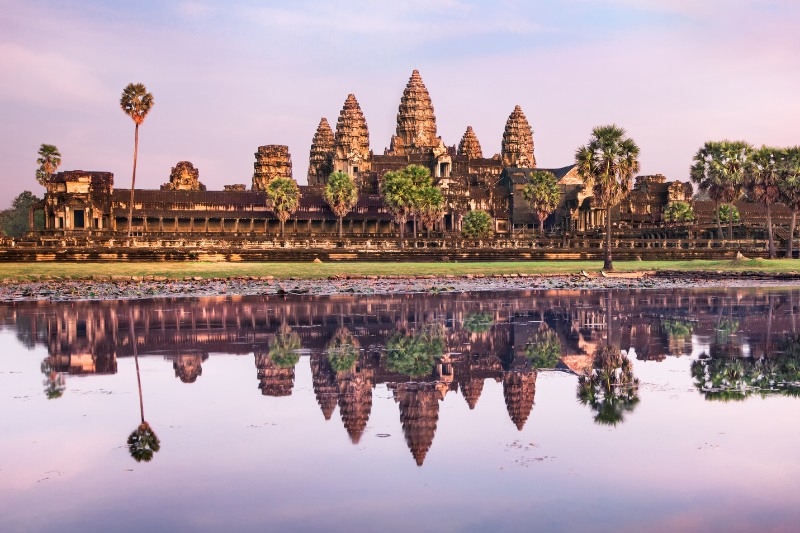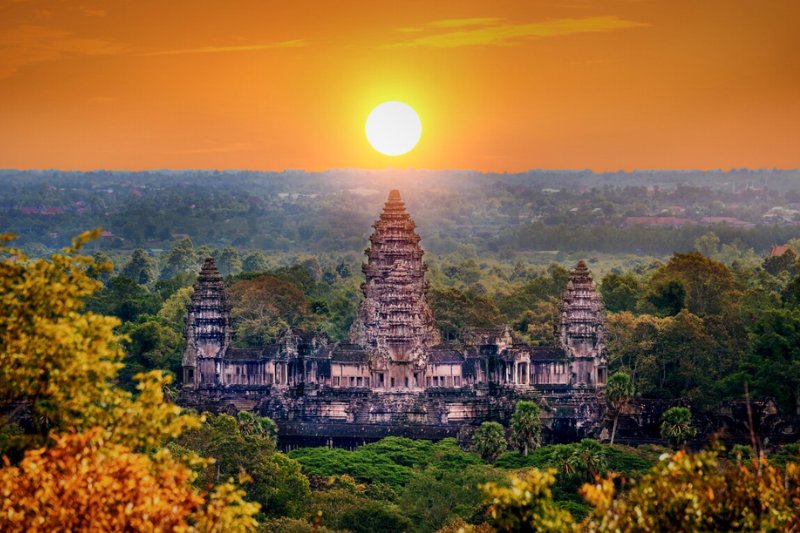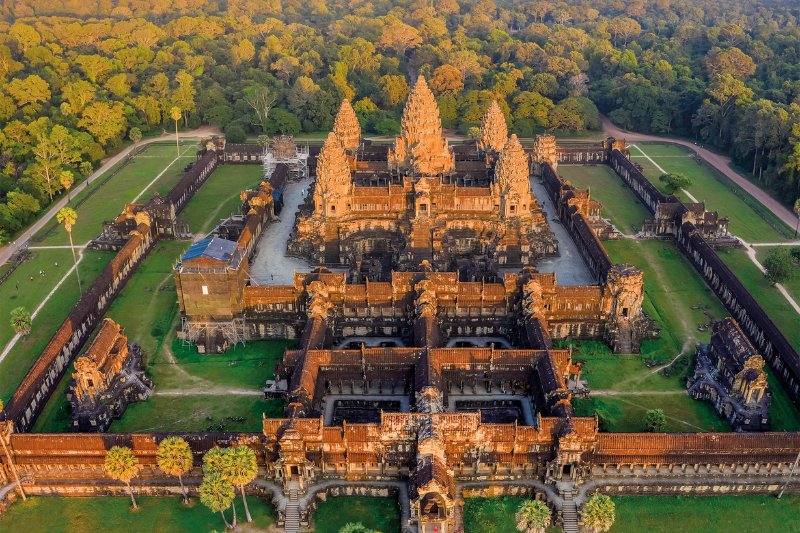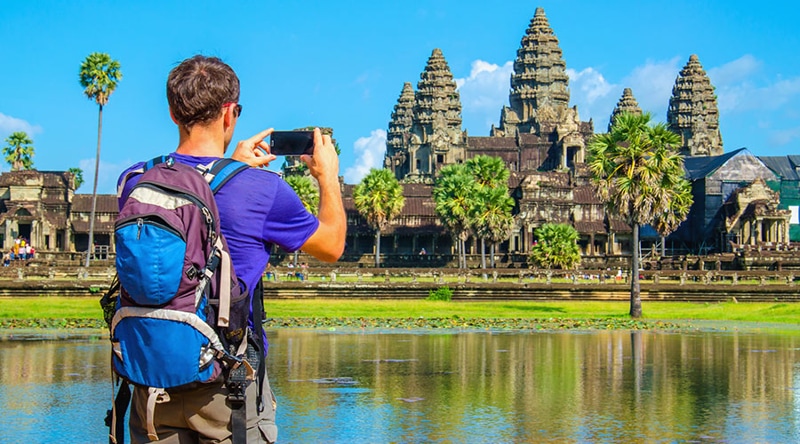
Angkor Thom (“Great City”) was the last and greatest capital of the Khmer Empire, built by King Jayavarman VII in the late 12th century. Its square walls, 3 km on each side, enclose about 9 km² of temples, terraces and royal grounds, including the famous Bayon Temple with its giant smiling stone faces. Angkor Thom lies just north of Angkor Wat, about 10 km from Siem Reap town, and is included in the Angkor Pass (from US$37, about ₹3,515, for one day).
In this guide, Vietnamtour.in covers Angkor Thom’s history, its five gates, the main sights inside, 2026 tickets and opening hours, how to get there from India and Vietnam, and tips for Indian travellers, who will find many links to Hindu mythology here.
Angkor Thom at a glance (updated November 2026)
- Location: Angkor Archaeological Park, about 10 km north of Siem Reap town, Cambodia.
- Built: Late 12th century by King Jayavarman VII.
- Size: 3 km × 3 km walls (about 9 km²), surrounded by a moat about 100 m wide.
- Tickets (Angkor Pass): 1 day US$37, 3 days US$62, 7 days US$72; children under 12 free.
- Opening hours: About 6:00 AM – 6:30 PM for Angkor Thom and Bayon.
- Time needed: Half a day for the main sights.
- Best time: November to February, early in the morning.
Introduction to Angkor Thom
Angkor Thom was not a single temple but a royal city. Within its walls stood the king’s palace, state temples, ceremonial terraces and the homes of officials and priests, while ordinary people lived outside the walls. At its centre is the Bayon, the state temple of Jayavarman VII.
Where is Angkor Thom
- Address: Inside the Angkor Archaeological Park, about 10 km north of Siem Reap town, Cambodia.
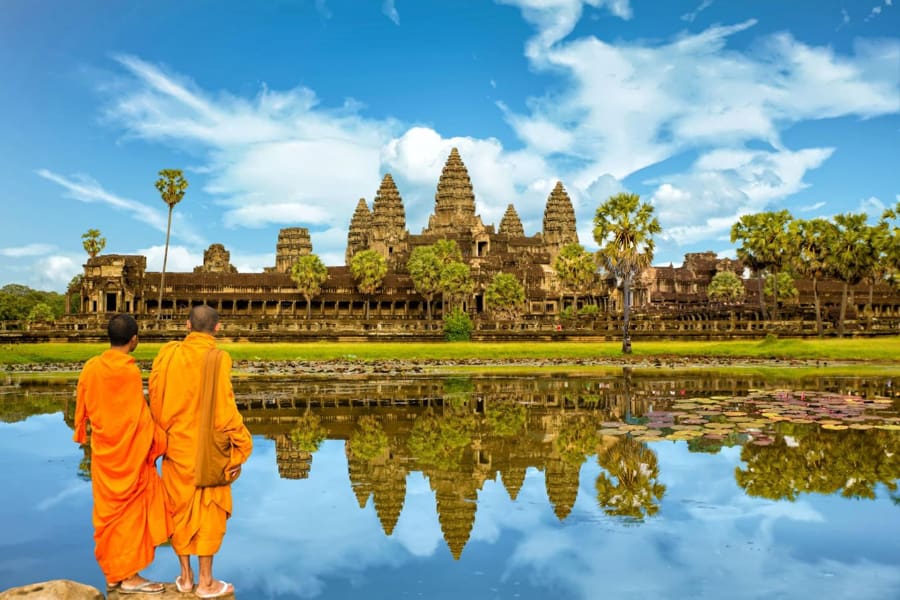
Angkor Thom sits at the heart of the Angkor temple complex, just north of Angkor Wat. Most visitors see it on the “Small Circuit”, a one-day loop that also includes Angkor Wat and Ta Prohm. The usual entrance is the South Gate, the closest gate to Angkor Wat.
Opening Hours & Entrance Fee
Since August 2024, most temples in the Angkor Park, including Angkor Thom and Bayon, open from about 6:00 AM to 6:30 PM. Angkor Wat opens earlier, at 5:00 AM, for sunrise. Some older signs and websites still show 7:30 AM – 5:30 PM, so check on the day.
You need an Angkor Pass to enter, and it covers all the main temples, including Angkor Thom. Buy it at the official ticket centre on Road 60 (about 4 km from town), at machines at some sites, or online through Angkor Enterprise.
| Ticket type | Price per person | Validity | Best for |
| 1-day pass | US$37 (about ₹3,515) | 1 day | A short visit to Angkor Wat, Angkor Thom and Ta Prohm |
| 3-day pass | US$62 (about ₹5,890) | Any 3 days within 7 days | Most travellers; a relaxed visit to the main temples |
| 7-day pass | US$72 (about ₹6,840) | Any 7 days within 1 month | Temple lovers who want to explore in depth |
Children under 12 enter free, but bring their passport as proof of age. The 3-day and 7-day passes include your photo, so you need to buy them in person or upload a photo online. If you buy a 1-day pass after 4:30 PM, it is valid for the next day, and you can enter that evening for sunset.
History of Angkor Thom
In 1177, the Cham army from present-day central Vietnam attacked and sacked the Khmer capital. Jayavarman VII drove them out, became king around 1181 and built Angkor Thom as a new, fortified capital. He was one of the greatest Khmer kings, known for building temples, hospitals and rest houses across his empire.
The city remained the Khmer capital for centuries. When the Chinese envoy Zhou Daguan visited in 1296–97, he described its golden towers, royal processions and busy markets. After the capital moved south in the 15th century, Angkor Thom was gradually taken over by the forest. Today, it is part of the UNESCO World Heritage Site of Angkor.
Religious Meanings of Angkor Thom with the Cambodian People
Angkor Thom was planned as a model of the universe. The walls represent the mountains around the world, the moat is the cosmic ocean, and the Bayon at the centre stands for Mount Meru, the home of the gods in Hindu and Buddhist belief.
Jayavarman VII was a Mahayana Buddhist, so the Bayon was built as a Buddhist temple, unlike the Hindu temple of Angkor Wat. Later kings returned to Hinduism, and Buddhist images were changed, before Theravada Buddhism became the main religion of Cambodia. For Cambodians today, Angkor Thom and the Bayon faces are powerful symbols of national pride.
5 Main Gates of Angkor Thom
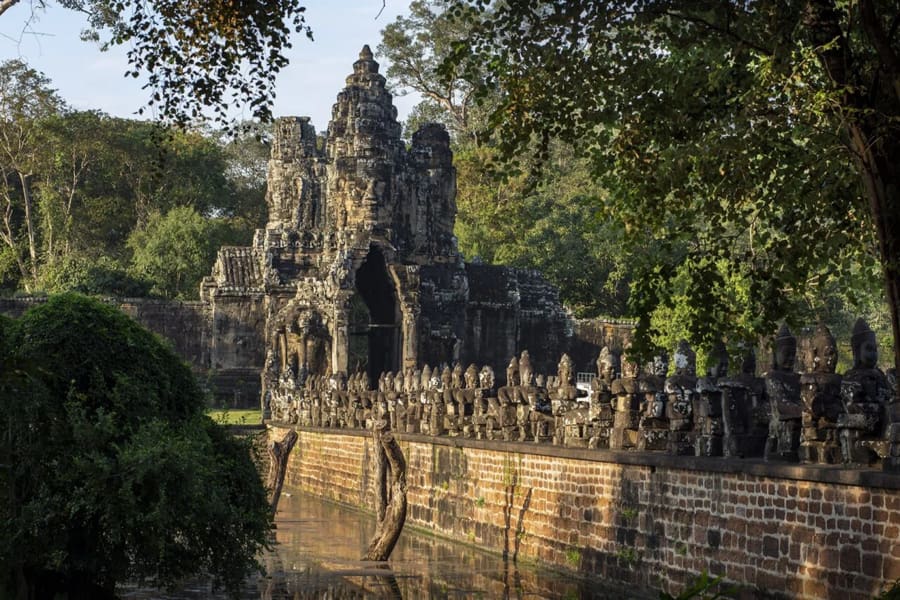
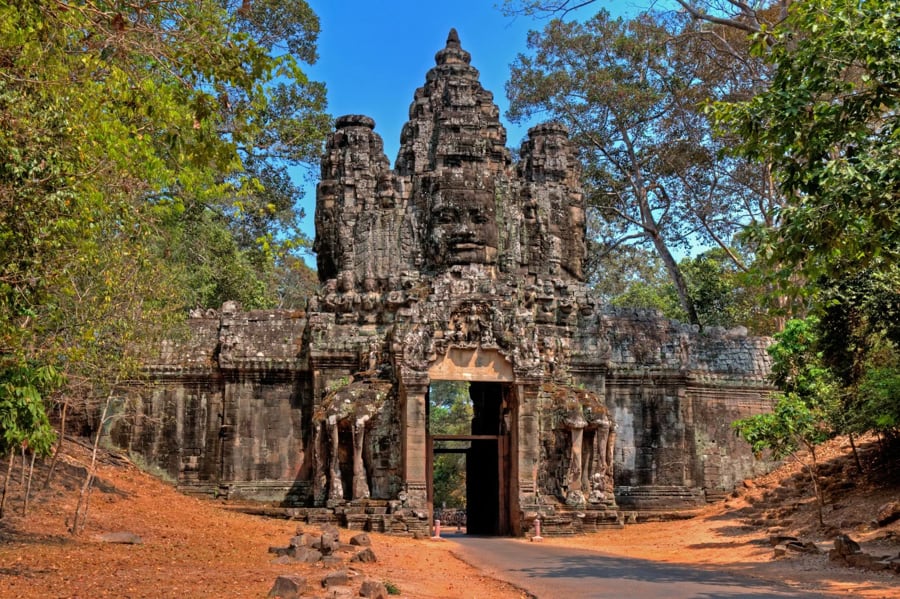
Angkor Thom has five gates. Four face the cardinal directions (north, south, east and west), and the fifth, the Victory Gate, also opens to the east, about 500 m north of the East Gate, in line with the Royal Palace. Each gate tower is about 23 m high and topped with four giant stone faces looking in every direction. Many scholars believe these faces represent the Bodhisattva Avalokiteshvara, possibly in the likeness of Jayavarman VII himself.
South Gate: The Most Popular Angkor Wat Entrance
The South Gate is the closest to Angkor Wat, the best preserved and the most photographed. It is the main entrance for most visitors.
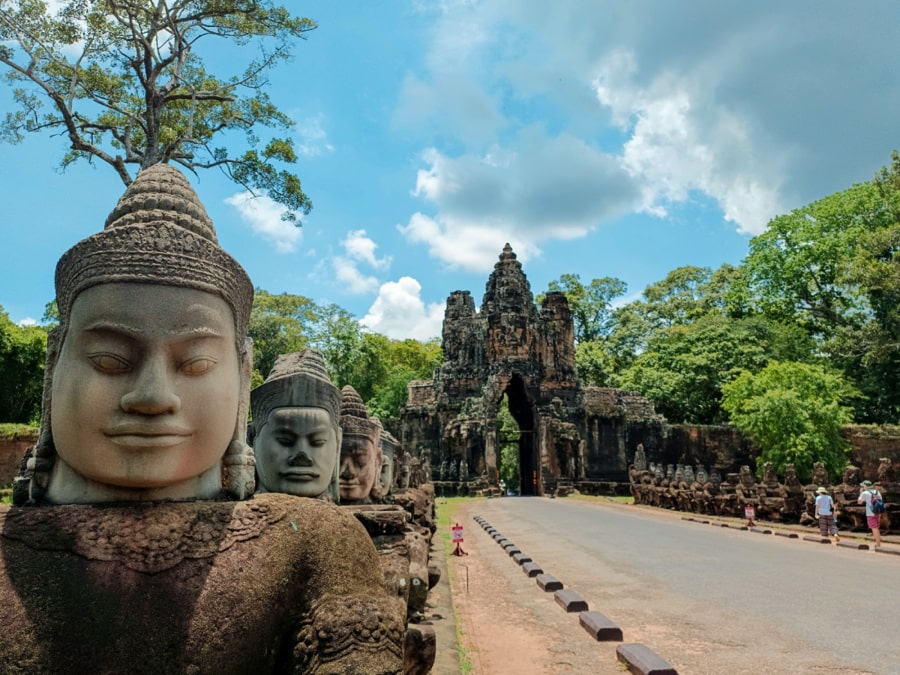
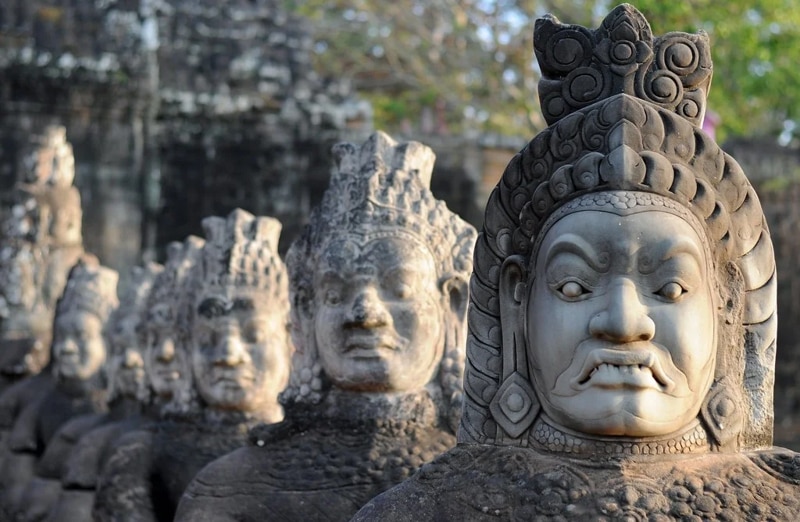
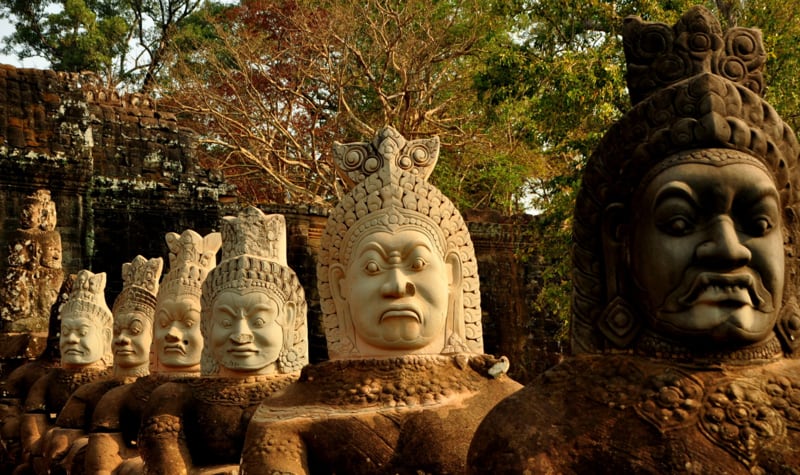
The causeway across the moat is lined with 54 gods (devas) on one side and 54 demons (asuras) on the other, all pulling the body of a giant serpent (naga). Many of the heads are restored copies, but the scene is still one of the most memorable in Angkor. In 2026, a section of the laterite wall near the South Gate was under restoration, but the gate remained open.
North Gate, East Gate, West Gate, and Victory Gate
The other gates are much quieter and are good choices if you want photos without crowds:
- Victory Gate: Leads straight to the Royal Square and the Terrace of the Elephants; armies are said to have returned through it after victories. In October 2026, two deva and asura heads were reattached here during restoration.
- East Gate: Also called the “Gate of the Dead”, it is quiet and partly ruined.
- North Gate: On the road to Preah Khan and the Grand Circuit temples.
- West Gate: The most remote and least visited gate.
Symbolism of the Gods and Demons Pulling the Naga
Indian visitors will instantly recognise the scene on the causeways: it is the Samudra Manthan, the Churning of the Ocean of Milk. In the myth, the devas and asuras churn the ocean with the serpent Vasuki to obtain amrita, the nectar of immortality. At Angkor Thom, the gods and demons line the bridges into the city, as if the royal capital itself were the source of prosperity and order. The same story appears in a famous bas-relief at Angkor Wat.
Top Attractions Inside Angkor Thom
Inside the walls, the main sights are close together around the centre of the city. Here are the highlights, in the order most visitors see them.
Bayon Temple (Prasat Bayon)
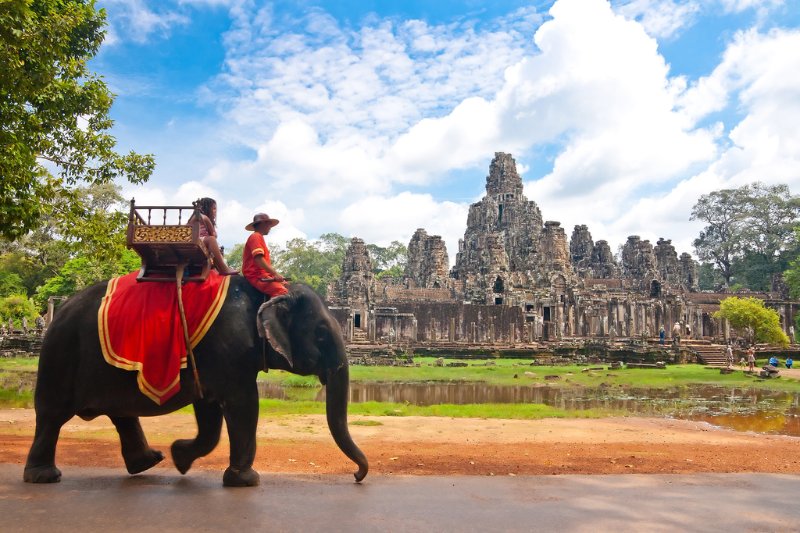
The Bayon Temple is the heart of Angkor Thom and its most famous monument. Its 37 surviving towers carry around 200 huge smiling faces that seem to watch you from every direction. Do not miss the outer galleries, whose bas-reliefs show a naval battle between the Khmer and the Cham on the Tonle Sap Lake, as well as scenes of daily life: markets, cooking, fishing and even a cockfight.
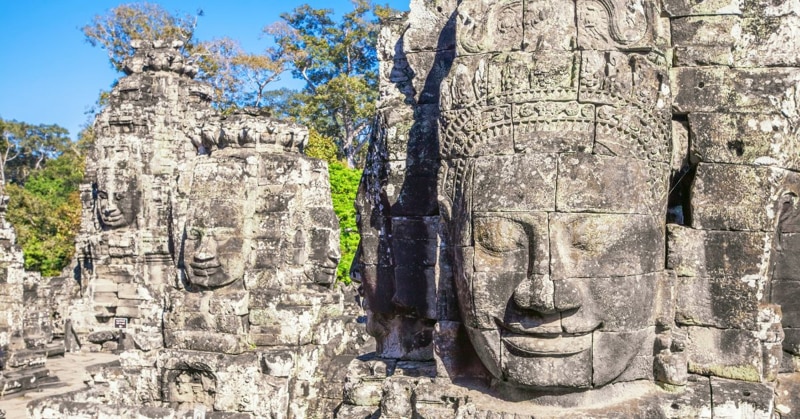
Unlike Angkor Wat, which stands south of the city, the Bayon was built at the exact centre of the capital.
Baphuon Temple (Prasat Baphuon)
The Baphuon is a huge three-tiered temple mountain north-west of the Bayon. It was built in the mid-11th century as a Hindu temple to Shiva, about a century before the rest of Angkor Thom. In the 15th century, a giant reclining Buddha was added to its western side.
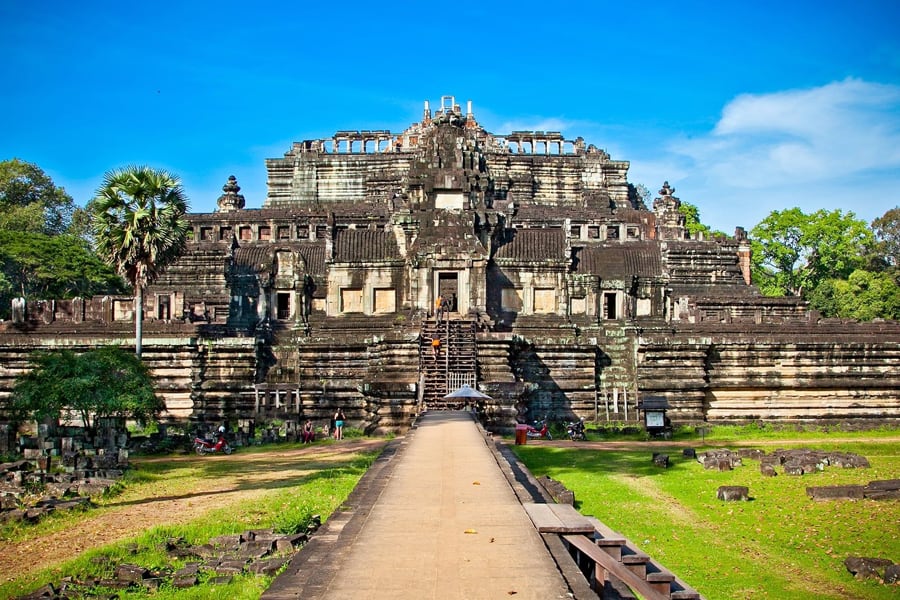
The Baphuon is famous for the “world’s largest jigsaw puzzle”. From 1960, French archaeologists took it apart stone by stone, around 300,000 blocks in total, to rebuild it on a stronger base. The war stopped the work in 1970, and the records were lost. Work restarted in 1995, and the temple finally reopened in 2011.
Phimeanakas
Phimeanakas is a small, steep pyramid temple inside the Royal Palace enclosure, built in the late 10th century. Zhou Daguan recorded a famous legend: every night, the king had to climb the tower to meet a naga spirit in the form of a woman. If she failed to appear, it meant the king’s death was near; if he missed a night, disaster would fall on the kingdom.
Royal Palace of Angkor Thom (Preah Barom Reach Veang)
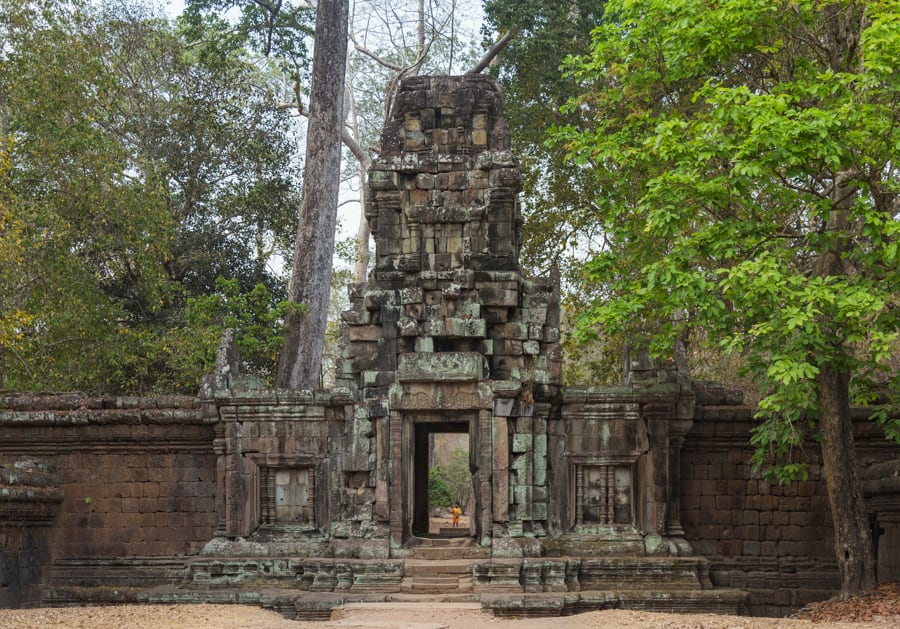
The Royal Palace was the home of the Khmer kings. Its buildings were made of wood and have long disappeared, but you can still walk through its stone gateways, see the large royal bathing pools and imagine court life in the shade of tall trees.
Terrace of the Elephants (Sala Damrei)
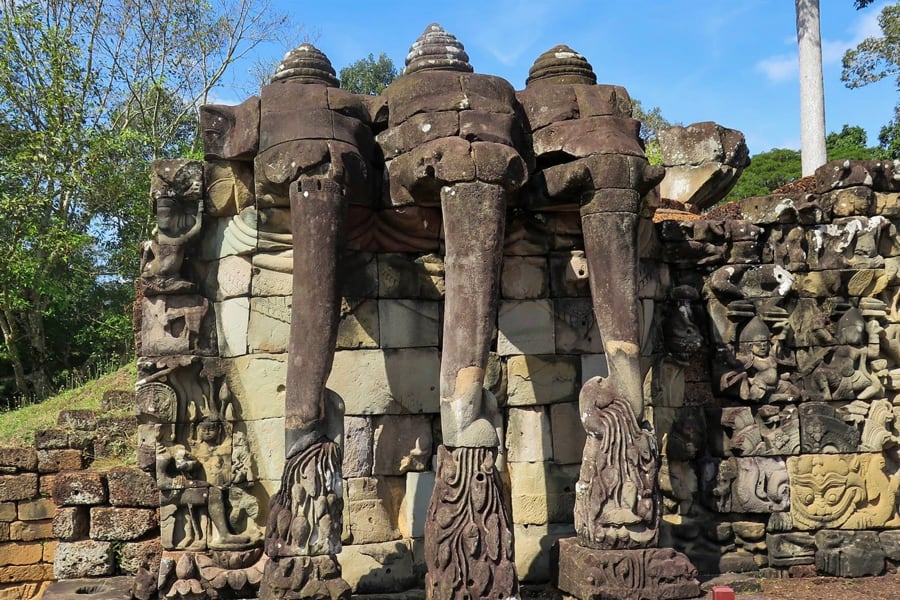
The Terrace of the Elephants is a platform about 350 m long, facing the Royal Square. Its walls are carved with life-size elephants, as well as garudas and lions. Kings watched parades, ceremonies and games from here.
Terrace of the Leper King (Preah Bat Damrong Kroung)
Just north of the Terrace of the Elephants, this terrace has walls covered in rows of carved gods, nagas and celestial dancers, including an inner hidden wall that was only uncovered during restoration. It gets its name from a statue found on top, whose stained surface looked like a skin disease. An inscription identifies the statue as Yama, the Hindu god of death and justice. The statue on the terrace today is a copy, and the original is in the National Museum in Phnom Penh.
How to Get to Angkor Thom
Angkor Thom is about 10 km from Siem Reap town, and the Bayon is a 30–40 minute ride. Here are your options inside the Angkor Park.
By Tuk Tuk
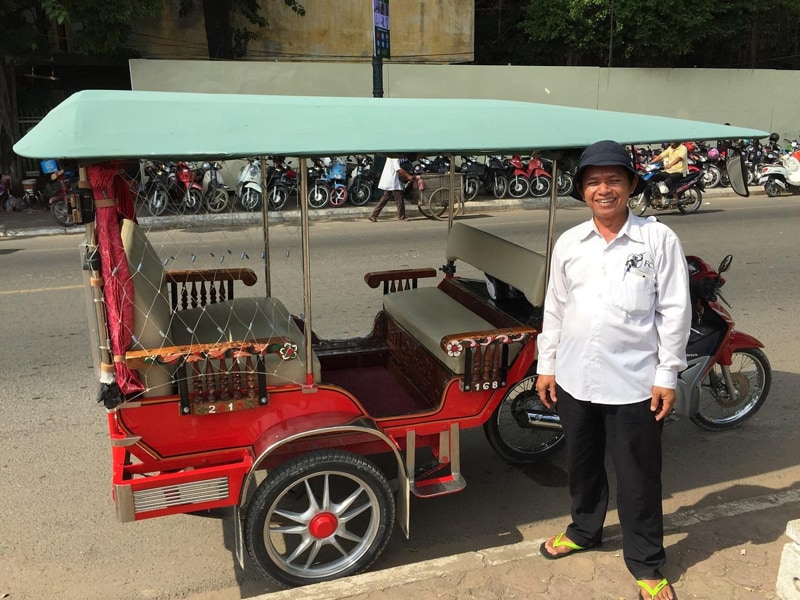
A tuk-tuk is the most popular way to visit Angkor Thom. Drivers wait at each temple, and you can hire one for the whole day.
- Estimated cost: US$15–20 (about ₹1,425–1,900) for the Small Circuit; US$25–35 for the Grand Circuit.
By Taxi
An air-conditioned car with driver is the most comfortable option for families, elderly parents and the hot season. Grab and PassApp also work in Siem Reap for short rides.
- Estimated cost: US$30–50 (about ₹2,850–4,750) per day.
By Bicycle
Cycling is fun for fit travellers in the cooler months; the roads inside the park are flat and shaded in places, but distances add up in the heat.
- Bike rental: US$2–5 per day; e-bikes cost about US$8–12.
By Guided Tour
For first-time visitors, a guided tour is the easiest way to understand Angkor Thom’s history and symbols. Vietnamtour.in arranges English-speaking guides, air-conditioned transport and a route that covers the main temples without backtracking.
Getting to Siem Reap from India and Vietnam
- From India: IndiGo flies directly from Kolkata to Siem Reap three times a week (the route resumed on 1 October 2026 after a seasonal break). Otherwise, connect via Bangkok, Singapore, Kuala Lumpur or Vietnam.
- From Vietnam: Flights from Ho Chi Minh City and Hanoi make it easy to combine Vietnam and Angkor in one trip.
- Airport: The new Siem Reap Angkor International Airport (SAI) is about 40–50 km from town; the airport bus costs about US$8 (1 hour 15 minutes), and a taxi about US$25.
- Visa: Indians can get a Cambodia e-visa (about US$30) or a visa on arrival, and must complete the free online e-Arrival form before flying.
- Land border with Thailand: After the 2025 border conflict, land crossings such as Poipet have been closed to tourists, so fly into Siem Reap instead. Siem Reap itself is far from the border and safe for visitors.
Best Time to Visit Angkor Thom
The best months to visit Angkor Thom are November to February, when the weather is dry and relatively cool. March to May is very hot, often above 35–40°C, with April the hottest month. The rainy season, from May to October, brings afternoon showers but also green landscapes and fewer tourists.
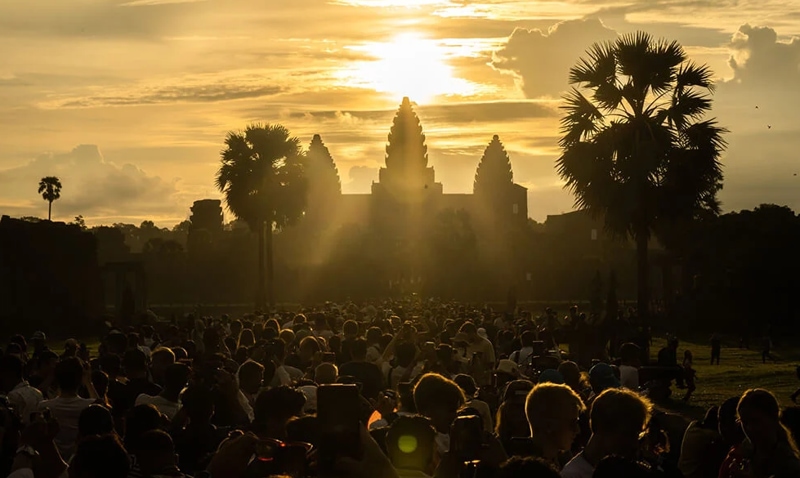
Within a day, go early: from about 7:00 to 10:00 AM, the Bayon is cooler and quieter, and the morning light is beautiful on the stone faces. Avoid 11:00 AM to 2:00 PM, when it is hottest and tour groups arrive.
Angkor Thom for First-Time Angkor Visitors
Follow these tips for a smooth first visit:
- Follow a simple route: Enter through the South Gate, visit the Bayon, walk north to the Baphuon, the Royal Palace and Phimeanakas, then the Terrace of the Elephants and the Terrace of the Leper King, and leave by the Victory Gate towards Ta Prohm.
- Use transport between sights: Angkor Thom is large, so a tuk-tuk or car saves time and energy.
- Dress modestly: Cover shoulders and knees at all temples. Since 2026, visitors in costumes that imitate traditional Khmer dress incorrectly can also be refused entry.
- Wear good shoes: The stone steps are uneven and steep in places.
- Beat the heat: Carry water, a hat, sunscreen and sunglasses, as there is little shade at midday.
- Respect the ruins: Do not climb in restricted areas or touch the carvings; drones need special permission.
- Focus on the highlights: On a first visit, concentrate on the Bayon, the Baphuon, Phimeanakas and the terraces.
Angkor Thom for Indian Travellers: The Hindu Connection
Angkor feels surprisingly familiar to many Indian visitors. The Khmer kings adopted Hinduism and Buddhism from India, and Sanskrit inscriptions, Shiva lingas and scenes from the Ramayana and Mahabharata appear across the temples. In Angkor Thom alone, you will see the Samudra Manthan on the causeways, the Shiva temple of the Baphuon and the statue of Yama on the Terrace of the Leper King.
India also helps protect this heritage: the Archaeological Survey of India (ASI) restored Angkor Wat from 1986 to 1993 and has worked at Ta Prohm since 2003. Siem Reap also has several Indian restaurants with vegetarian food, so it is easy to find familiar meals after a day at the temples.
Plan Your Angkor Thom Trip
Angkor Thom fits perfectly into a combined Vietnam and Cambodia holiday. Many Indian travellers fly from Ho Chi Minh City to Siem Reap for 2–3 days of temples, then continue to Vietnam’s beaches or north to Hanoi and Halong Bay. To see more of the country, read our guide to places to visit in Cambodia, including the Tonle Sap Lake near Siem Reap.
Vietnamtour.in can arrange flights, hotels, guides and Indian meals for the whole trip. Explore our Vietnam and Cambodia tour packages, our wider Indochina tour packages covering Vietnam, Cambodia and Laos, or a Vietnam tourism package if you want to focus on Vietnam. Send us your dates for a free itinerary.
FAQs about Visiting Angkor Thom
Is Angkor Thom the same as Angkor Wat?
No. Angkor Wat is a single, huge temple, while Angkor Thom is a walled royal city just to the north, containing the Bayon, the Baphuon, the Royal Palace and the terraces. Both are covered by the same Angkor Pass.
How much time do I need to visit Angkor Thom?
Most visitors spend 2–4 hours at Angkor Thom. Allow half a day if you want to see the Bayon, the Baphuon, the Royal Palace, the terraces and one of the quieter gates.
How much is the Angkor Thom ticket in 2026?
There is no separate ticket; you need an Angkor Pass: US$37 for one day, US$62 for three days within a week, or US$72 for seven days within a month. Children under 12 enter free.
Can I walk around Angkor Thom?
Yes, the main sights around the Bayon are within walking distance of each other. However, the city is large, so use a tuk-tuk, bicycle or car to reach it and to visit the gates.
Is a guide necessary to visit Angkor Thom?
A guide is not required, but a good guide helps you understand the carvings, the history and the Hindu and Buddhist symbols, which makes the visit much richer.
Is it safe to visit Angkor Thom after the Thailand–Cambodia border conflict?
Yes. Siem Reap and the Angkor Park are far from the border areas and have remained open and safe for visitors. Avoid travelling overland to Thailand, and fly into Siem Reap instead.
Ticket prices, opening hours and travel information were last checked in November 2026 and may change. Please confirm with your Vietnamtour.in travel consultant before you travel.