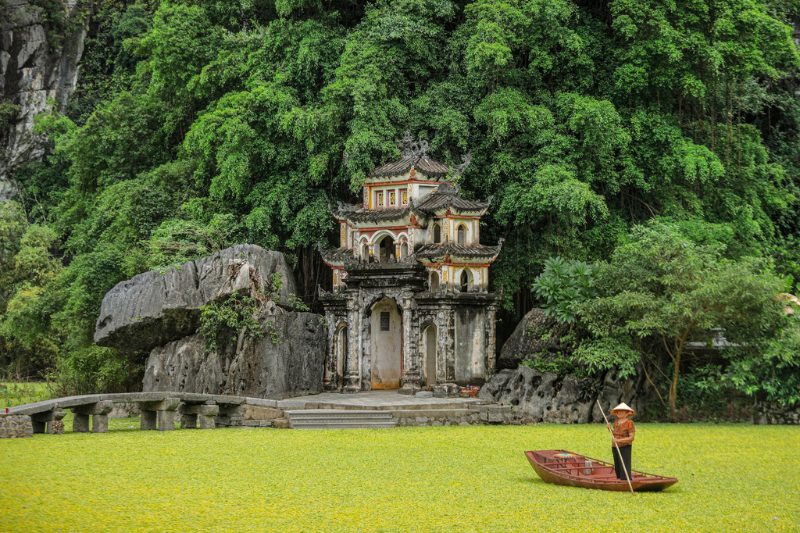

Bich Dong Pagoda (pronounced “BIK-DOHM” — Vietnamese: Chùa Bích Động, meaning “Green Grotto Pagoda”) is a rare cave temple complex in Vietnam built across three ascending tiers — a Lower, Middle, and Upper Pagoda, each constructed at a different elevation inside the limestone cliffs of Bich Dong Mountain, Ninh Binh province. Bich Dong Pagoda sits 2 km south of the Tam Coc boat pier within the Tam Coc–Bich Dong scenic area, opens daily at 7:00 AM, and closes at 5:30 PM. The Tam Coc–Bich Dong scenic zone ticket costs ₹915 (250,000 VND) per adult, with no separate Bich Dong Pagoda entrance fee for the pagoda itself.

The three tiers are Chua Ha (Lower Pagoda) at the mountain base, Chua Trung (Middle Pagoda) built entirely inside a natural cave chamber, and Chua Thuong (Upper Pagoda) at the summit with panoramic views over Tam Coc rice paddies. Bich Dong Pagoda was founded in 1428 during the Later Le Dynasty and expanded into its current 3-tier form in 1705. A complete visit through all three tiers takes 1.5 to 2 hours. Indian tourists visiting from Hanoi reach Bich Dong as a day trip — about 95 km south — and most combine the pagoda visit with Tam Coc on the same day.
History of Bich Dong Pagoda
Bich Dong Pagoda was founded in 1428 during the early Later Le Dynasty, when a small temple was first built on the summit of Bich Dong Mountain. The current 3-tier complex was expanded in 1705 by two Buddhist monks, Tri Kien and Tri The, who connected the upper sanctuary to two new tiers carved into the cliff face below.
The pagoda received its present name “Bich Dong” — meaning “Green Grotto” — in 1773, when Lord Trinh Sam visited the site and inscribed the name in honour of the moss-covered limestone walls that surround the cave temple. The Vietnamese script “Bích Động” carved on the entrance gate dates from this 1773 royal visit.
Bich Dong Pagoda was officially recognised as a national historical and cultural relic by the Vietnamese Ministry of Culture in 1962. In 2014, the wider Trang An Landscape Complex — which includes the Tam Coc–Bich Dong scenic area — was inscribed as Vietnam’s first UNESCO Mixed Cultural and Natural World Heritage Site, a designation that protects both Bich Dong Pagoda and the surrounding karst landscape under international conservation status.
Bich Dong Pagoda Location
Bich Dong Pagoda is located in the Tam Coc area of Ninh Binh Province (formerly Ninh Hai Commune, Hoa Lu District, before the 2025 administrative merger), at the foot of Bich Dong Mountain. Bich Dong Pagoda sits within the Tam Coc–Bich Dong scenic area, which is a designated zone within the Trang An Landscape Complex — Vietnam’s first UNESCO Mixed Cultural and Natural World Heritage Site, inscribed in 2014.

Bich Dong Pagoda is about 9 km from Ninh Binh city centre by road, following the main route south-west toward Tam Coc. The Tam Coc boat pier — departure point for the Tam Coc rowing boat tour — is 2 km north of Bich Dong Pagoda entrance, placing Bich Dong Pagoda and Tam Coc within a single half-day circuit: Tam Coc boat tour in the morning (2–3 hours) followed by Bich Dong Pagoda in the afternoon (1–1.5 hours), with a total travel distance of 2 km between the two sites.
For Indian travellers, the roughly 95 km distance from Hanoi to Bich Dong Pagoda is shorter than the Delhi to Agra route (about 230 km), making the day-trip return feasible within a single tourist day even when the route includes a Tam Coc boat tour and a Mua Cave climb.
Bich Dong Pagoda Opening Hours and Entry Conditions in 2026
Bich Dong Pagoda opens at 7:00 AM and closes at 5:30 PM every day of the year, including weekends, Vietnamese public holidays, and Indian public holidays. No advance booking or reservation is required to enter Bich Dong Pagoda. The pagoda complex does not close during Tet (Vietnamese Lunar New Year) — Bich Dong Pagoda remains accessible as an active religious site throughout the entire holiday period.

The Upper Pagoda (Chua Thuong) at Bich Dong Pagoda has a separate access cutoff of 5:00 PM. Visitors who arrive at the Bich Dong Pagoda main entrance after 4:00 PM may not have sufficient time to complete all three tiers before the Upper Pagoda (Chua Thuong) closes. Weekend mornings between 9:00 AM and 11:00 AM are the busiest windows at Bich Dong Pagoda — arriving before 8:30 AM ensures a quieter, cooler experience.
Three entry conditions apply to all visitors at Bich Dong Pagoda:
- Dress code: Shoulders and knees must be covered before entering any of the three pagoda buildings at Bich Dong Pagoda. Indian tourists accustomed to similar requirements at Hindu mandirs and Sikh gurudwaras will find this dress code protocol familiar.
- Footwear: Shoes and sandals must be removed before entering each pagoda building at Bich Dong Pagoda. Slip-on sandals are recommended over lace-up shoes for convenience during the multi-tier climb through the complex.
- Upper Pagoda access cutoff: The final ascent to the Upper Pagoda (Chua Thuong) at Bich Dong Pagoda is not permitted after 5:00 PM, regardless of how much time the visitor has spent at the lower tiers.
Bich Dong Pagoda Ticket Price for Indian Tourists in 2026
Bich Dong Pagoda does not charge a separate entrance fee. The ticket required to enter Bich Dong Pagoda is the Tam Coc–Bich Dong Scenic Zone admission ticket, which covers access to both Tam Coc boat rides and the Bich Dong Pagoda complex within the same landscape zone.
The ticket price structure for the Tam Coc–Bich Dong Scenic Zone in 2026 is as follows:
- Adults: ₹915 (250,000 VND) per person
- Senior citizens (above 60 years): ₹440 (120,000 VND) per person
- Children (1 to 1.3 metres in height): ₹440 (120,000 VND) per child
- Children under 1 metre in height: Free of charge
- Cave and pagoda admission: Included in the Tam Coc–Bich Dong Scenic Zone ticket — no additional payment is required at any of the three Bich Dong Pagoda tiers

A separate parking fee applies at Bich Dong Pagoda for vehicles: ₹37–₹73 (10,000–20,000 VND) for motorbikes and ₹73–₹147 (20,000–40,000 VND) for cars.
The Bich Dong Pagoda ticket counter accepts cash only — UPI, credit cards, and debit cards are not accepted at the counter. The nearest ATMs to the Bich Dong Pagoda entrance are in Tam Coc village near the boat pier, about 2 km away, with more in Ninh Binh city — Indian tourists should withdraw VND cash before arriving at the pagoda. The cash-only requirement at Bich Dong Pagoda is one of several practical logistics gaps that catch first-time Indian visitors off guard in Ninh Binh, a province where card payment outside the main towns remains limited.
INR amounts are converted at ₹1 ≈ 273 VND (October 2026).
The 3-Tier Cave Pagoda Structure of Bich Dong
Bich Dong Pagoda is built across three progressively elevated tiers into the same limestone mountain, with each temple constructed at a distinct elevation — at the base, inside a cave, and near the summit of Bich Dong Mountain. The Lower Pagoda (Chua Ha), the Middle Pagoda (Chua Trung), and the Upper Pagoda (Chua Thuong) are not separate buildings placed near each other — these three sacred structures are connected by stone staircases cut directly into the cliff face of Bich Dong Mountain. A complete visit through all three tiers of Bich Dong Pagoda takes 1.5 to 2 hours and covers a total vertical climb of approximately 100 metres.

Chua Ha
Chua Ha (Lower Pagoda) is the first of the three tiers at Bich Dong Pagoda, situated on flat ground at the foot of Bich Dong Mountain. Chua Ha is constructed in traditional Vietnamese communal hall (dinh) architecture, with red-lacquered wooden pillars, curved roof ridges decorated with ceramic dragons, and a central altar housing multiple gilded statues. The original Bich Dong Pagoda was founded in 1428 during the Later Le Dynasty, and the present Chua Ha structure was rebuilt during the 1705 expansion under the monks Tri Kien and Tri The.
Chua Ha is fully accessible on flat ground — no steps are required to enter or move through the Lower Pagoda. Indian visitors familiar with multi-deity altar arrangements in Hindu temple sanctuaries will recognize a structurally similar layout at Chua Ha: a central presiding figure flanked by attendant deities on either side, with incense burners positioned at the front of each altar. Budget 10 to 15 minutes at Chua Ha before beginning the ascent to the Middle Pagoda (Chua Trung).
Chua Trung
Chua Trung (Middle Pagoda) is the second and most visually distinctive tier at Bich Dong Pagoda, built entirely inside a natural limestone cave chamber approximately 30 to 40 metres above the base of the mountain. The cave ceiling of Chua Trung itself forms the roof of the pagoda — no constructed roof exists. Stalactites hang from the Chua Trung cave ceiling above the altar, and stalagmite formations rise from the cave floor on either side of the main pathway through the chamber.
Natural light enters the Chua Trung cave chamber through two openings in the rock face — one above the altar and one near the exit staircase. Between 7:00 AM and 9:30 AM, the morning light entering through the upper opening creates a concentrated illumination on the central Buddha statue, making 7:00 AM to 9:30 AM the most photographically optimal window for visiting Chua Trung.
The ascent from Chua Ha to Chua Trung involves approximately 30 to 40 stone steps, manageable for most healthy adults including elderly visitors. Budget 15 to 20 minutes at Chua Trung, including the climb.
Chua Thuong
Chua Thuong (Upper Pagoda) is the third and highest tier at Bich Dong Pagoda, reached by a steep stone staircase of approximately 100 steps from the exit of Chua Trung. Chua Thuong is a smaller structure than Chua Ha and Chua Trung below it, built onto a rock ledge near the summit of Bich Dong Mountain. The primary reason to complete the climb to Chua Thuong is the viewpoint: from the Chua Thuong summit platform, the Tam Coc rice paddy valley opens below, framed by karst limestone peaks.
The panoramic view from Chua Thuong is similar in feel to the famous Mua Cave viewpoint but closer to the valley floor and far less crowded. The staircase to Chua Thuong does not have handrails in several sections and is not recommended for visitors with knee problems or limited mobility. Budget 20 to 25 minutes at Chua Thuong, including the ascent, time at the viewpoint, and the descent. The last entry to the Chua Thuong (Upper Pagoda) staircase is 5:00 PM — plan to begin the ascent no later than 4:30 PM.
2 Ways to Reach Bich Dong Pagoda from Ninh Binh City
Bich Dong Pagoda is located about 9 km south-west of Ninh Binh city centre, with no direct bus service connecting the railway station to the pagoda entrance. Two transport options are available for Indian tourists arriving at Ninh Binh station to reach Bich Dong Pagoda: rented two-wheelers (motorbike or bicycle) and hired four-wheelers (taxi or private car).
Rented Motorbike or Bicycle to Bich Dong Pagoda
Motorbike and bicycle rental is the most commonly used method for independent travellers visiting Bich Dong Pagoda from Ninh Binh. Motorbike rental costs ₹365–₹550 (100,000–150,000 VND) per day, depending on bike model and rental shop. Bicycle rental costs ₹183–₹293 (50,000–80,000 VND) per day. Motorbike and bicycle rentals are available from shops clustered near the Ninh Binh railway station, along the road toward Tam Coc and in Tam Coc village itself.

The route from Ninh Binh city centre to Bich Dong Pagoda follows the main road south-west to Tam Coc village, then continues 2 km past the boat pier to the pagoda, with no complex turns or navigation required. The road is flat, well-paved, and carries light traffic outside of peak weekend hours. Riding time from Ninh Binh city centre to Bich Dong Pagoda is approximately 25 to 30 minutes by motorbike and 40 to 45 minutes by bicycle. Motorbike rental is particularly practical for Indian tourists who want to combine Bich Dong Pagoda with Tam Coc and Mua Cave in a single day without depending on taxis between sites.
Hired Car or Taxi from Ninh Binh Station to Bich Dong
The taxi rate from Ninh Binh railway station to the Bich Dong Pagoda entrance is ₹550–₹733 (150,000–200,000 VND) one-way for a 4-seater car. A hired car or taxi is the recommended option for Indian families travelling with elderly members or children under 5 years old. Grab ride-hailing is available in Ninh Binh city and provides an app-confirmed fare that removes negotiation from the journey.

For groups of 4 to 6 people, a private car hire for the full day — covering Ninh Binh station, Mua Cave, Tam Coc, and Bich Dong Pagoda, then return to the station — costs ₹2,200–₹3,300 (600,000–900,000 VND) per vehicle. The private car hire rate of ₹2,200–₹3,300 per vehicle is cost-competitive with individual taxi rides when the group is 3 or more people.
Bich Dong Pagoda Day Trip from Hanoi
Bich Dong Pagoda is located about 95 km south of Hanoi, making it reachable as a day trip when combined with 1 to 2 other Ninh Binh attractions. The 4 planning considerations that determine whether the Bich Dong Pagoda day trip from Hanoi works are departure time, transport mode from Hanoi, the combination with Tam Coc, and the return train window.

First: Departure time from Hanoi. Leaving Hanoi by 7:00 AM allows arrival at Bich Dong Pagoda by approximately 9:30 AM — early enough to complete all three tiers before midday heat peaks, and well within the 5:00 PM Upper Pagoda cutoff. Departure from Hanoi after 9:00 AM compresses the available time at Ninh Binh and risks missing Chua Thuong access at Bich Dong Pagoda.
Second: Transport from Hanoi to Ninh Binh. The train from Hanoi to Ninh Binh station takes approximately 2 hours and costs ₹238–₹550 (65,000–150,000 VND) per person for a soft seat in the SE train series. A private hired car from Hanoi to Ninh Binh costs ₹3,665–₹5,495 (1,000,000–1,500,000 VND) per vehicle, offering door-to-door convenience with no station-to-pagoda transfer required. Limousine vans, buses and the train are compared side by side in the guide on how to get from Hanoi to Ninh Binh.
Third: Combination with Tam Coc. Bich Dong Pagoda is 2 km from the Tam Coc boat pier, and most Indian tourists pair Tam Coc and Bich Dong Pagoda into a single day. The recommended sequence is Tam Coc boat tour in the morning (2 hours, departure 8:00–9:00 AM) followed by lunch near the pier, then Bich Dong Pagoda in the early afternoon (arrival by 1:30–2:00 PM). The Tam Coc morning and Bich Dong Pagoda afternoon sequence leaves sufficient time for all three pagoda tiers before the 5:00 PM Upper Pagoda cutoff.
Fourth: Return train from Ninh Binh to Hanoi. Trains depart Ninh Binh station for Hanoi between 6:30 PM and 8:30 PM in the evening SE series. Leaving Bich Dong Pagoda by 4:00 PM allows time to return to Ninh Binh station, purchase dinner near the station, and board a comfortable return service.
A structured Ninh Binh day trip from Hanoi covering Tam Coc, Bich Dong Pagoda, and the return train requires coordinating 4 separate transport segments — Hanoi departure, Ninh Binh arrival transfer, inter-site movement, and the evening return train — within a fixed 11 to 12-hour window. Travellers who prefer a slower pace can stay overnight near Tam Coc, and the homestays and resorts near each boat pier are compared in the guide on where to stay in Ninh Binh.
Bich Dong and Mua Cave Tour
Bich Dong Pagoda and Mua Cave are the two most visited cave-and-viewpoint attractions in the Tam Coc–Bich Dong scenic zone, separated by approximately 4 km. Bich Dong Pagoda and Mua Cave are both built around limestone karst formations, but the experience each offers is structurally different: Mua Cave requires a single 500-step climb to a dragon-sculpture viewpoint above the Tam Coc valley, while Bich Dong Pagoda involves a three-stage ascent through functioning Buddhist temples built into a limestone cliff.

The recommended full-day sequence for combining Bich Dong Pagoda and Mua Cave is:
- 8:00 AM: Arrive at Mua Cave and begin the 500-step climb. Morning arrival is the best time for Mua Cave because the temperature is lower and the valley light is optimal for photography. Mua Cave admission: ₹365 (100,000 VND) per person.
- 10:30 AM: Descend from Mua Cave. Optional: take a Tam Coc boat tour (2 hours, departs from Tam Coc pier, 2 km north of Bich Dong) if the group wants the rowing boat experience.
- 1:00 PM: Lunch near Tam Coc pier. Vegetarian and Jain-friendly restaurants are available in the Tam Coc village cluster.
- 2:30 PM: Enter Bich Dong Pagoda. Complete all three tiers of Bich Dong Pagoda at a comfortable pace, targeting departure from Chua Thuong by 4:30 PM.
- 5:00 PM: Return to Ninh Binh city or Hanoi to conclude the day.
The total estimated cost for the Bich Dong Pagoda and Mua Cave combination for 2 adults — covering all admission tickets but excluding transport from Hanoi — is ₹2,565–₹3,665 (700,000–1,000,000 VND). The climb, the best light and the time needed at the summit are covered in the guide to Mua Cave Ninh Binh.
Best Time to Visit Bich Dong Pagoda for Indian Tourists in 2026
The best months to visit Bich Dong Pagoda are October, November, and December — when the post-monsoon dry season brings clear skies, temperatures between 18°C and 25°C and dry stone staircases for the climb to Chua Thuong. The October–December window gives clear karst ridgelines from the Chua Thuong viewpoint and the most comfortable conditions for the full three-tier visit.

The secondary good season for visiting Bich Dong Pagoda is February to April. Spring temperatures at Ninh Binh range from 18°C to 24°C with low humidity, and flowering plants around the Bich Dong Pagoda temple grounds add colour to the visit. The Bich Dong Pagoda stone staircases are dry and not slippery from February to April, which improves safety on the Upper Pagoda (Chua Thuong) climb.
The Tam Coc rice fields seen from the pagoda turn gold for the harvest in late May and early June, the most photographed weeks of the year in the valley. The weather is already hot by then, so visitors who come for the golden rice should climb in the early morning.
The months to avoid for Bich Dong Pagoda are June, July, and August. Temperatures reach 35°C to 38°C with high humidity, and heavy afternoon rain is common in Ninh Binh during this period. The Bich Dong Pagoda Upper Cave (Chua Thuong) staircase becomes slippery during and after rain, creating a safety concern on the sections without handrails. Crowding at Bich Dong Pagoda also peaks during the Vietnamese summer school holidays in June to August.
That said, visitors prioritising solitude over weather may still choose June to August despite the heat — Indian tourists from southern states like Kerala and Tamil Nadu often find Ninh Binh’s 35°C summer manageable compared to peak Delhi summers, and the young rice of the summer crop gives the valley a different green palette.
For Indian tourists specifically, two Indian calendar windows align well with the best seasons at Bich Dong Pagoda:
- Diwali period (October–November): The Diwali travel window falls directly within the Bich Dong Pagoda peak season, with dry staircases and clear views from the Chua Thuong viewpoint. Bich Dong Pagoda is a practical day trip addition during a Hanoi-based Diwali holiday itinerary.
- Holi period (March): Comfortable spring temperatures and dry staircases at Bich Dong Pagoda make March suitable for the full three-tier climb, including Chua Thuong. March also falls within the blooming season near the Bich Dong Pagoda temple grounds.
The best time of day to visit Bich Dong Pagoda is between 7:00 AM and 10:00 AM. Morning light enters the Chua Trung cave opening at Bich Dong Pagoda at an angle that illuminates the central altar naturally. Crowds at Bich Dong Pagoda are thinner before 9:30 AM on weekdays.
6 Things Indian Tourists Must Know Before Visiting Bich Dong Pagoda
The 6 essential things Indian tourists must know before visiting Bich Dong Pagoda are: physical fitness for the Upper Cave climb, photography etiquette inside cave chambers, dress code and religious conduct, food and drink restrictions, cash-only payment, and minimum time allocation of 1.5 to 2 hours for a complete visit.

1. The Upper Cave Climb Requires Physical Fitness
The Upper Cave climb at Bich Dong Pagoda requires physical fitness. Chua Thuong is reached by approximately 100 steep stone steps, several of which have no handrail. The Chua Thuong climb at Bich Dong Pagoda is not suitable for visitors with knee problems, hip replacements, or limited lower-body mobility. Children under 5 years old should be carried rather than allowed to climb independently on the steeper sections. The Bich Dong Pagoda Lower Pagoda (Chua Ha) and Middle Pagoda (Chua Trung) are fully accessible for visitors who cannot complete the Upper tier.
2. Flash Photography Inside Cave Chambers Is Disrespectful
Flash photography inside the Bich Dong Pagoda cave chambers is considered disrespectful. Photography is permitted throughout all three Bich Dong Pagoda buildings, including inside the cave chamber at Chua Trung. Flash photography directed at the altars and statues inside the Chua Trung cave chamber is not acceptable at this active Buddhist site — disable flash before entering. Natural light inside Chua Trung is sufficient for photography between 7:00 AM and 10:00 AM.
3. Bich Dong Is an Active Buddhist Site
Bich Dong Pagoda is an active Buddhist site with ongoing religious observance. Incense bundles are available for purchase near the Bich Dong Pagoda entrance at ₹37–₹73 (10,000–20,000 VND) per bundle. Indian tourists familiar with puja protocol at Hindu temples will find the behavioural expectations at Bich Dong Pagoda intuitive: remove footwear, speak quietly, do not touch statues, and let monks or worshippers pass through the altar space first.
4. No Food or Drink Inside the Pagoda Grounds
No food or drink is permitted inside the Bich Dong Pagoda grounds. Vendors outside the Bich Dong Pagoda main gate sell coconut water, fresh sugarcane juice, and packaged snacks. Eat and drink before entering Bich Dong Pagoda — the full visit through all three tiers takes up to 2 hours and heat increases on the upper sections of the climb.
5. Cash-Only Payments — No UPI or Cards Accepted
The ticket counter and all vendors at Bich Dong Pagoda accept cash only — no UPI, credit card, or debit card payments are accepted at the Tam Coc–Bich Dong ticket booth. The nearest ATMs are in Tam Coc village, about 2 km from the pagoda. Indian tourists should carry sufficient VND cash before arriving at the pagoda.
6. Allocate 1.5 to 2 Hours for a Complete Visit
Budget 1.5 to 2 hours for a complete visit through all three tiers of Bich Dong Pagoda. A visit covering only Chua Ha and Chua Trung without ascending to Chua Thuong takes approximately 45 to 60 minutes. Rushing through Bich Dong Pagoda in under 45 minutes means missing the Chua Thuong Upper Pagoda viewpoint — the most rewarding element of the entire complex. Indian tourists planning a combined Bich Dong Pagoda and Tam Coc day should allocate the afternoon slot (2:30 PM to 4:30 PM) to Bich Dong Pagoda to ensure a complete visit.
Frequently Asked Questions: Bich Dong Pagoda for Indian Tourists
Is Bich Dong Pagoda Open on Indian Public Holidays and Weekends?
Bich Dong Pagoda is open every day of the year, including Indian public holidays such as Diwali, Holi, Eid, and Republic Day, as well as Vietnamese national holidays. Bich Dong Pagoda operating hours of 7:00 AM to 5:30 PM apply without exception on all days. No advance booking is required to enter Bich Dong Pagoda. Weekend mornings between 9:00 AM and 11:00 AM are the busiest window at Bich Dong Pagoda — arriving before 8:30 AM on a Saturday or Sunday ensures a significantly quieter experience at all three Bich Dong Pagoda tiers.
Is the Bich Dong Pagoda Climb Difficult for Elderly Visitors?
The climb difficulty at Bich Dong Pagoda varies by tier. Chua Ha (Lower Pagoda) is fully accessible on flat ground with no steps, making it suitable for all visitors regardless of mobility level. Chua Trung (Middle Pagoda) requires approximately 30 to 40 stone steps and is manageable for most healthy adults, including senior visitors in good health. Chua Thuong (Upper Pagoda) requires approximately 100 steep steps, several without handrails — this section is not recommended for elderly visitors with knee problems, arthritis, or limited mobility. Elderly Indian tourists can visit Bich Dong Pagoda’s Lower Pagoda (Chua Ha) and Middle Pagoda (Chua Trung) comfortably and still experience the cave chamber, the stalactite formations, and the cave pagoda interior without completing the full ascent to Chua Thuong.
How Long Does a Full Visit to All 3 Tiers of Bich Dong Pagoda Take?
A complete visit through all three tiers of Bich Dong Pagoda takes 1.5 to 2 hours. Chua Ha (Lower Pagoda) requires 10 to 15 minutes; Chua Trung (Middle Pagoda) requires 15 to 20 minutes, including the ascent; Chua Thuong (Upper Pagoda) and its viewpoint require 20 to 25 minutes including the climb up and descent back to Chua Trung. Add 15 to 20 minutes for the walk between the Bich Dong Pagoda entrance gate and Chua Ha, and for transitioning between tiers. Visitors who limit their visit to Bich Dong Pagoda’s Lower Pagoda (Chua Ha) and Middle Pagoda (Chua Trung) only should budget 45 to 60 minutes.
What Is the Cheapest Way to Reach Bich Dong Pagoda from Hanoi?
The cheapest route from Hanoi to Bich Dong Pagoda combines the train with a bicycle rental. The train from Hanoi to Ninh Binh station takes approximately 2 hours and costs from ₹238 (65,000 VND) per person for a soft seat on the SE series. From Ninh Binh station, a bicycle rental costs ₹183 (50,000 VND) per day and covers the 9 km flat road to Bich Dong Pagoda in approximately 40 to 45 minutes. Total transport cost from Hanoi to Bich Dong Pagoda and back is under ₹700 per person using this combination.
Can Bich Dong Pagoda Be Combined with Tam Coc on the Same Day?
Yes — Bich Dong Pagoda and Tam Coc are 2 km apart and are routinely visited together in a single day. The standard combination for Indian tourists is a Tam Coc rowing boat tour in the morning (2 hours, departure between 8:00 AM and 10:00 AM) followed by lunch near the Tam Coc pier, then Bich Dong Pagoda in the early afternoon. The afternoon slot for Bich Dong Pagoda should begin by 2:00 PM to 2:30 PM at the latest — this allows a complete visit through all three tiers of Bich Dong Pagoda, with departure from Chua Thuong by 4:30 PM, and comfortable return to Ninh Binh or Hanoi before evening.
Planning a Ninh Binh Trip Around Bich Dong Pagoda
Bich Dong Pagoda fills an afternoon, and the rest of a Ninh Binh day or overnight is easy to build around it. The largest temple complex in the province is covered in the guide to Bai Dinh Pagoda, the quietest boat ride in the guide to Van Long Nature Reserve, and every main sight with tickets and timings in the list of places to visit in Ninh Binh. The province as a whole, from getting there to the best months, is set out in the travel guide to Ninh Binh.
Vietnamtour.in adds Bich Dong Pagoda, Tam Coc and Mua Cave to northern Vietnam itineraries with a private car from Hanoi, a local guide and vegetarian or Jain lunches, and the Vietnam packages from India that include Hanoi take a Ninh Binh day as a standard stop.