Hoa Lu Ancient Capital was the political and military capital of Vietnam from 968 to 1009 AD — a walled imperial citadel carved into karst limestone mountains in Ninh Binh province and the seat of Vietnam’s first two feudal dynasties. The site served the Đinh dynasty (968–980 AD) and the Early Lê dynasty (980–1009 AD) across 42 years before the capital moved north to Thang Long (present-day Hanoi) in 1010 AD.

The original palaces no longer stand above ground. What survives today are two 17th-century temples built directly on the original palace foundations: Dinh Tien Hoang Temple and Le Dai Hanh Temple.
The Hoa Lu Ancient Capital guide below covers 9 facts Indian tourists need before arrival: the site served the Đinh and Early Lê dynasties for 42 years before the capital moved to Thang Long in 1010 AD; two 17th-century temples — Dinh Tien Hoang Temple and Le Dai Hanh Temple — stand on the original palace foundations; the site opens 7:00 AM–6:00 PM daily, year-round, with a ₹70 (VND 20,000) entrance fee; Hoa Lu sits 96 km south of Hanoi, reachable in 2 hours by organised tour, self-drive, or local bus plus taxi; an on-site 3–5 km cycling route extends the visit from 1.5 to 3 hours; the dominant itinerary combines Hoa Lu with Trang An UNESCO Complex into an 8-hour day trip; October to December offers the best weather (20–25 °C, low humidity); the temple ticket counter is cash-only in VND — no UPI or international cards; dress code requires shoulders and knees covered inside both temple halls.
Hoa Lu Ancient Capital: Vietnam’s First Feudal Seat from 968 to 1009 AD
Hoa Lu Ancient Capital became Vietnam’s first centralised feudal capital in 968 AD when Emperor Đinh Bộ Lĩnh united 12 warlord factions and established the Đinh Dynasty. Vietnam’s unification under Đinh Bộ Lĩnh followed nearly 1,000 years of Chinese rule — making the founding of Hoa Lu the starting point of Vietnam as a sovereign state under its own dynastic line.
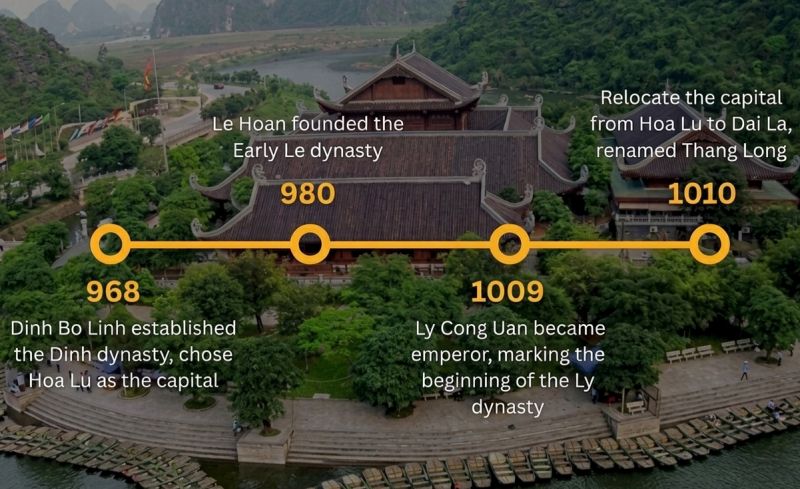
Hoa Lu was selected for its geographic logic rather than its economic position. Its valley is surrounded by near-vertical karst limestone mountains that functioned as natural citadel walls — eliminating the need for extensive man-made fortifications along most of the perimeter. The walled area covered approximately 300 hectares, divided into two concentric precincts: the inner citadel (Hoa Lu proper) contained the palaces and royal temples, while the outer citadel (Trường Yên) housed military garrisons and administrative buildings.
The capital ceased to function as Vietnam’s imperial centre in 1010 AD, when Emperor Lý Thái Tổ moved the capital north to Thang Long (present-day Hanoi). The 1010 AD relocation reflected a strategic shift: Hoa Lu’s defensive terrain, ideal for the unstable 10th century, had become a barrier to economic expansion and administrative reach across the wider Red River Delta.
Dinh Dynasty (968–980 AD)
Emperor Đinh Bộ Lĩnh unified 12 rival warlords between 965 and 968 AD to end the Loạn 12 Sứ Quân period, rising from a local chieftain in Hoa Lu village to the founder of Vietnam’s first centralised feudal state. After unifying Vietnam in 968 AD, Đinh Bộ Lĩnh proclaimed the new state Đại Cồ Việt — the first sovereign name used by Vietnam as an independent nation — and established Hoa Lu as its capital.
The first imperial palace at the site was built between 968 and 970 AD on the ground where Dinh Tien Hoang Temple now stands. Đinh Bộ Lĩnh ruled Đại Cồ Việt for 12 years from this palace complex.
Emperor Đinh Bộ Lĩnh was assassinated in 979 AD along with his eldest son and heir, ending direct Đinh family rule over the capital. The Đinh Dynasty officially ended in 980 AD when the throne passed to the general Lê Hoàn under the threat of imminent Song Chinese invasion.
Early Lê Dynasty (980–1009 AD)
Lê Hoàn assumed the throne in 980 AD with the support of the Đinh court — including Queen Dương Vân Nga, widow of the assassinated Đinh emperor — and ruled posthumously known as Emperor Lê Đại Hành. In 981 AD, Lê Hoàn repelled the Song Dynasty invasion at the Battle of Bạch Đằng while governing from Hoa Lu — securing Vietnamese sovereignty against Chinese re-conquest for the following centuries.
The Early Lê Dynasty ruled from the capital for 29 years until 1009 AD, when the last emperor Lê Long Đĩnh died without a stable heir. After the dynasty collapsed in 1009 AD, General Lý Công Uẩn took the throne and founded the Lý Dynasty. In 1010 AD, Lý Công Uẩn relocated the capital from Hoa Lu to Thang Long — a decision driven by Hoa Lu’s economic isolation behind its karst walls.
Hoa Lu Ancient Capital’s imperial era ended after 42 years of dynastic rule. The original palaces fell into disuse after 1010 AD, and the present-day temples were built on their foundations approximately 600 years later during the 17th century.
Hoa Lu Temple Complex
The original Hoa Lu palaces no longer exist above ground — the two temples on the site today were built in the 17th century on the exact palace foundations. A trip to Hoa Lu Ancient Capital means standing on the ruins of Vietnam’s first imperial court, not walking through intact 10th-century architecture.
Dinh Tien Hoang Temple
Dinh Tien Hoang Temple stands on the foundation of Emperor Đinh Bộ Lĩnh’s original royal palace and follows a classic 3-hall Vietnamese temple layout: main gate → front courtyard → three successive halls (Bái Đường, Thiêu Hương, Chính Cung).
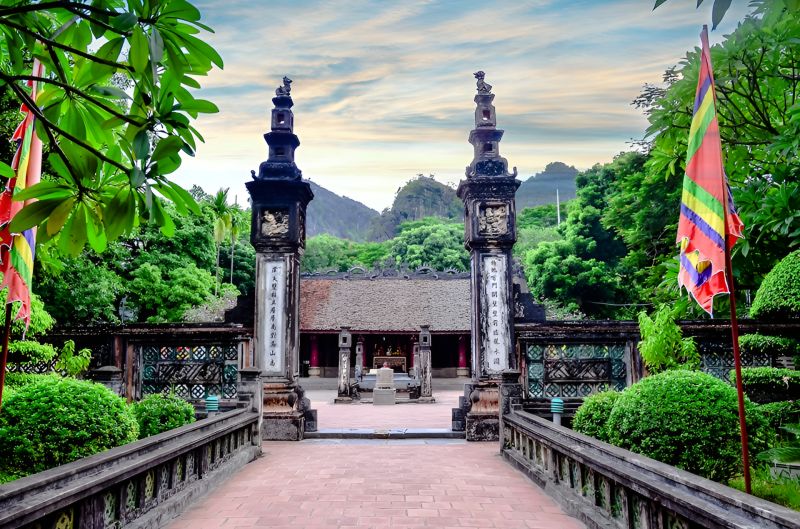
The main entrance is marked by a dragon stone staircase — a 17th-century restoration carved from solid limestone with intertwining dragon motifs on the balustrades.
The central altar in Chính Cung holds a bronze statue of Emperor Đinh Bộ Lĩnh flanked by statues of his three sons: Đinh Liễn, Đinh Toàn, and Đinh Hạng Lang. Behind the main bronze statue stands the stone dragon throne — a replica of the original imperial throne used during the Đinh court ceremonies.
The temple orients directly toward Mã Yên Mountain (Saddle Mountain), where Emperor Đinh Bộ Lĩnh’s tomb is located on the summit. Its roof uses yellow-glazed curved tiles — a colour reserved for imperial buildings in Vietnamese tradition.
Indian tourists typically spend time at two features of Dinh Tien Hoang Temple: the stone stelae in the front courtyard, which carry historical inscriptions in classical Chinese documenting the Đinh Dynasty, and the incense offering ritual in the main hall, which is open to respectful participation by non-Vietnamese visitors.
Le Dai Hanh Temple
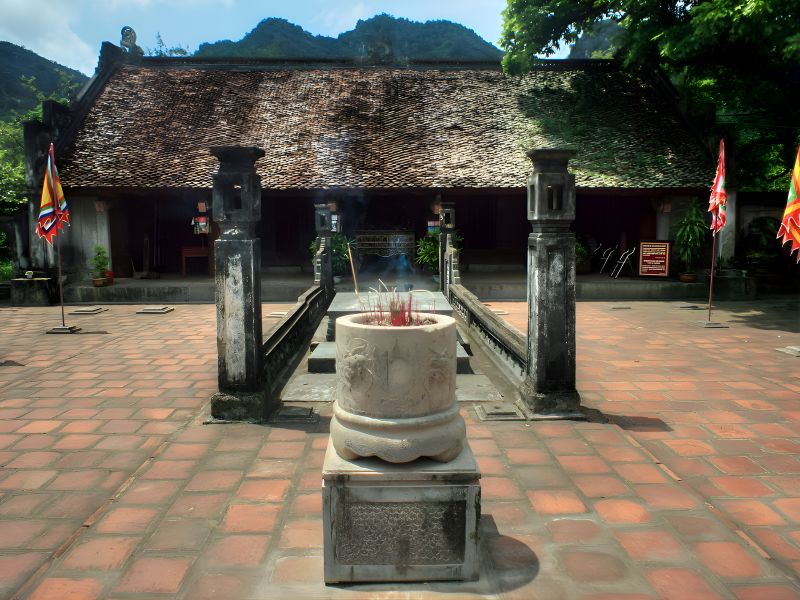
Le Dai Hanh Temple stands 500 metres from Dinh Tien Hoang Temple on the same palace grounds, built on the foundations of the Early Lê Dynasty’s royal residence. Le Dai Hanh Temple follows the same 3-hall layout as Dinh Tien Hoang Temple but is slightly smaller in footprint and less ornate in exterior decoration.
The central altar holds a bronze statue of Emperor Lê Hoàn, flanked by his wife Queen Dương Vân Nga and his son Lê Long Đĩnh. Queen Dương Vân Nga occupies a historically unique position in Vietnamese imperial history — she served as queen consort across both the Đinh and Early Lê dynasties, providing direct political continuity between the two houses.
Le Dai Hanh Temple’s notable sacred object is an incense burner cast during the Nguyễn Dynasty (19th century), still in active liturgical use. Interior wooden carvings here are visibly better preserved than those at Dinh Tien Hoang Temple — the absence of later tourism-driven renovation has protected the original 17th-century relief work on the hall beams and door panels.
Both temples allow respectful entry without an additional fee beyond the site ticket.
Hoa Lu Ancient Capital Opening Hours
Hoa Lu Ancient Capital opens every day of the year, including Vietnamese public holidays and Tết — no advance booking is required for individual entry. Operating hours are 7:00 AM to 6:00 PM daily.
Four timing guidelines apply for Indian tourists planning a Hoa Lu visit:
- Best arrival window: 7:00 AM to 8:30 AM — before the main tour-group wave arrives from Hanoi (typically 9:30 AM to 10:00 AM).
- Average time on-site (temples only, no cycling): 1 to 1.5 hours.
- Average time on-site (temples plus cycling route): 2.5 to 3 hours.
- Peak crowd hours: 10:00 AM to 12:00 PM on weekends and during Tết.
Hoa Lu Entrance Fee for Indian Tourists
Hoa Lu Ancient Capital’s standard entrance fee is approximately ₹70 (VND 20,000) per adult. Children under 1.2 metres tall enter free of charge.
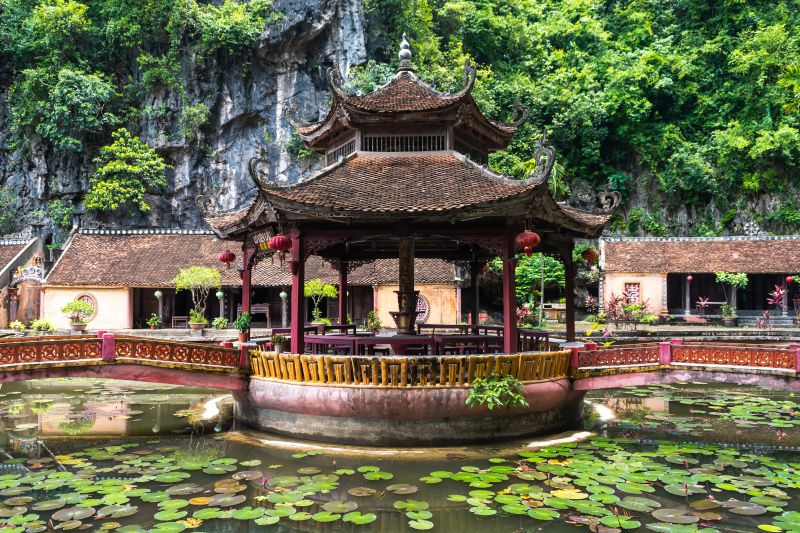
Payment at the ticket counter is cash only in Vietnamese Dong — UPI, international credit cards, and digital wallets are not accepted at the gate. ATMs are not located within the complex. Indian tourists should exchange INR to VND at Hanoi before departure, as exchange counters in Ninh Binh city are limited and operate with tighter hours.
Licensed English-speaking guides are available at the entrance gate for an additional ₹750 to ₹1,100 per group (not per person) — a 60- to 90-minute temple tour covers the Đinh and Early Lê dynasty history, the altar objects, and the temple architecture.
How to Reach Hoa Lu From Hanoi
Hoa Lu Ancient Capital is 96 km south of Hanoi city centre, with a standard travel time of 1 hour 45 minutes to 2 hours 30 minutes depending on transport mode.
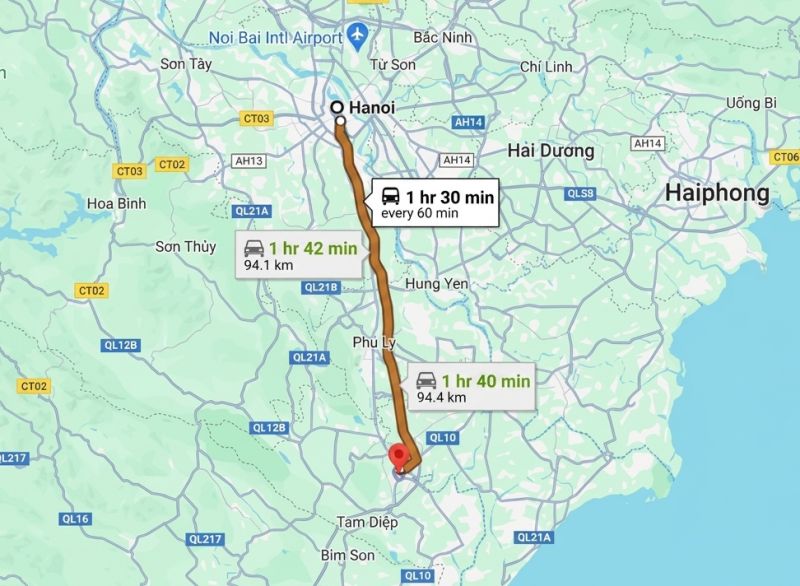
Three transport options cover the Hanoi-to-Hoa Lu route for Indian tourists: an organised day tour, self-drive rental (motorbike or car), and local buses combined with a taxi.
Organised Day Tour From Hanoi
Organised day tours from Hanoi to Hoa Lu Ancient Capital are the most common format selected by Indian tourists, especially those visiting Ninh Binh as a single-day excursion rather than an overnight stay.
Pricing ranges from ₹1,800 to ₹3,500 per person, depending on group size and whether Trang An Scenic Landscape Complex is combined into the same itinerary. Tour inclusions cover air-conditioned vehicle transport, an English-speaking guide, hotel pickup from Hanoi Old Quarter and most central Hanoi districts, Hoa Lu entrance tickets, and — when combined — Trang An boat tickets.
The standard schedule for a Hanoi-to-Hoa Lu organised day tour runs from 7:00 AM departure to 5:30–6:30 PM return: departure from Hanoi hotels between 7:00 AM and 7:30 AM, arrival at Hoa Lu around 9:30 AM, 1 to 1.5 hours at the temples, transfer to the Trang An boat dock, 2 to 3 hours on the boat circuit, lunch near the dock, and return to Hanoi by 5:30 PM to 6:30 PM.
An organised day tour removes navigation effort and includes guide context for the temples, unlike a self-drive. Hoa Lu Ancient Capital is a site where guide-delivered historical narration significantly upgrades the visit, because the two temples do not contain English-language signage sufficient to explain the Đinh and Early Lê dynasty context. Vietnamtour.in will pre-confirm Jain-capable lunch stops, secure priority boat boarding at the Trang An dock, and assign senior-paced guides before departure.
Self-Drive by Motorbike or Rental Car
Self-drive from Hanoi to Hoa Lu Ancient Capital follows a single well-signposted route: Hanoi → National Highway 1A southbound → Ninh Binh city → Provincial Road DT491C → Hoa Lu (signed in both Vietnamese and English at major intersections).
Self-drive costs by vehicle type:
- Motorbike rental in Hanoi: VND 105,000–170,000 (₹375–₹600) per day.
- Fuel (motorbike, round trip): approximately VND 55,000 (₹200).
- Car rental with driver: VND 855,000–1,285,000 (₹3,000–₹4,500) for a private vehicle with flexible return time.
- Parking at Hoa Lu Ancient Capital: VND 10,000 (₹40) for a motorbike, VND 45,000 (₹150) for a car.
Road conditions on the Hanoi–Hoa Lu route are consistent: smooth tarmac throughout, no mountain passes, no significant elevation gain, and well-maintained shoulders.
Self-drive allows flexible timing — earlier and longer stay at the site than organised tours typically permit — but no guide is included. Self-driving is recommended only for Indian tourists who are comfortable with Vietnamese traffic patterns and hold a valid international driving permit for motorbikes above 50cc.
Hoa Lu Cycling Tour
Cycling is available within the Hoa Lu–Trang An complex, extending the visit from 1.5 hours to 3+ hours and accessing sections of the outer citadel unreachable on foot. The on-site cycling route is a separate experience layer beyond the temple visit and is where most of the photographable karst-valley landscape becomes visible.

Cycling Route Through the Hoa Lu Ancient Capital Grounds
The Hoa Lu Ancient Capital cycling route starts at the temple main gate, passes through the flat valley between the limestone karst hills, and connects to the outer citadel remnants and rice-paddy paths. Total cycling distance within the site is approximately 3 to 5 km, depending on the circuit selected. Terrain along the route is flat throughout, combining paved sections near the temples with dirt paths through the outer fields — no elevation gain is involved.
Cycle rental is available on-site at the main gate at VND 30,000–50,000 (₹105–₹175) per hour, with no deposit required. The duration of the standard Hoa Lu cycling loop is 45 to 75 minutes.
The route passes four points of interest: sections of the original city wall remnants (earthen embankments from the 10th century), the mouth of Sinh Duong cave, Dau pagoda (a small local temple), and the karst-framed rice paddies that form the visual backdrop of most published Hoa Lu photography.
Hoa Lu Cycling vs. Walking
Walking-only visits to Hoa Lu Ancient Capital cover approximately 0.8 km across the two temples and main courtyard, take 1 to 1.5 hours, and miss the outer citadel landscape entirely. Cycling visits cover 3 to 5 km, take 2.5 to 3 hours, and include the outer wall ruins, the valley floor, and the cave-mouth area.
Physical requirements for cycling are minimal — the terrain is flat and suitable for all fitness levels, including seniors. Cycling between 11:00 AM and 2:00 PM in the May-to-August window is not recommended due to direct sun exposure with minimal shade on the dirt paths. Indian tourists should start the cycling loop by 8:30 AM or after 3:00 PM during the May-to-August months.
Indian tourists with 3 or more hours at Hoa Lu Ancient Capital should include the cycling route — the karst valley landscape between the temples and the outer citadel is the most photogenic and least-crowded experience at the site.
Hoa Lu and Trang An Day Trip
Hoa Lu Ancient Capital is rarely visited in isolation by Indian tourists — the dominant visit pattern combines Hoa Lu with Trang An Scenic Landscape Complex into a single 8-hour day trip from Hanoi. Trang An Scenic Landscape Complex is a UNESCO World Heritage Site located 2.3 km from Hoa Lu’s temple gate.

The Hoa Lu plus Trang An combination represents the standard “Ninh Binh day trip” structure for Indian travellers and delivers both historical (Hoa Lu) and natural-scenic (Trang An) experiences on the same day.
Hoa Lu to Trang An Route and Boat Ride Timing
The distance from Hoa Lu Ancient Capital’s main temple gate to the Trang An boat dock is 2.3 km — a 5-minute drive or 15-minute cycle.
The recommended sequence for the combined Hoa Lu plus Trang An day trip is to visit the Hoa Lu temples first (7:30 AM to 9:00 AM arrival window), then transfer to the Trang An boat dock for a 9:00 AM to 9:30 AM boat departure — before the peak tourist wave arrives from Hanoi.
Trang An boat tour duration depends on the circuit selected:
- Circuit 1: 2 hours, passes through 9 caves and 3 temples.
- Circuit 2: 2.5 hours, passes through 4 caves and 3 temples, including Kong: Skull Island film location.
- Circuit 3: 3 hours, the longest route with 3 caves and 4 temples.
Trang An boat fee is VND 150,000–300,000 (₹520–₹1,040) per person for the standard boat ticket (included in most Hanoi day tour packages). Each rowing boat at Trang An carries 4 passengers plus the rower.
The total combined Hoa Lu plus Trang An itinerary takes 7.5 to 9 hours from Hanoi departure to return: Hoa Lu temples (1.5 hours) + transfer (15 minutes) + Trang An boat (2–3 hours) + lunch near the boat dock (1 hour) + return to Hanoi (2 hours).
The Trang An boat tour operates from a separate dock 2.3 km from Hoa Lu’s main temple gate. Indian tourists planning to visit both as independent walk-in travellers should account for the transfer time and purchase tickets separately at each gate.
Hoa Lu and Tam Coc Combination
Tam Coc is located 10 km from Hoa Lu Ancient Capital (a 20-minute drive) and offers a second karst-landscape boat tour option through limestone formations. Tam Coc differs from Trang An in three measurable ways: Tam Coc boat rides are shorter (1.5 hours versus 2 to 3 hours at Trang An), the route is rice-paddy-framed rather than cave-heavy, and the experience is more commercialised with stronger vendor pressure on boats.
The decision framework for Indian tourists combining Hoa Lu with a boat tour depends on the available days in Ninh Binh:
- 1 day in Ninh Binh: Choose Trang An over Tam Coc — Trang An holds UNESCO status, offers more value, and operates with less commercial pressure.
- 1.5 to 2 days in Ninh Binh: Hoa Lu plus Trang An on Day 1 (historical + nature combined); Tam Coc plus Mua Cave on Day 2 (second boat tour + viewpoint climb).
Trang An and Tam Coc cannot be completed comfortably on the same day alongside Hoa Lu Ancient Capital without sacrificing time at each site.
Best Time to Visit Hoa Lu Ancient Capital for Indian Tourists
October to December is the best time for Indian tourists to visit Hoa Lu Ancient Capital, when temperatures in Ninh Binh range from 20 °C to 25 °C, humidity drops significantly compared to the summer months, and the surrounding karst landscape turns golden with the rice harvest.
Hoa Lu Ancient Capital operates year-round with no seasonal closure and no flood risk — the elevated karst-surrounded terrain sits above the flood lines that affect lower-elevation Ninh Binh attractions such as Tam Coc rice paddies.
Rain does not prevent temple visits because the courtyards connect via covered walkways between the halls.
Indian tourists travelling during Tết (late January to early February) will find Hoa Lu open as normal, though Vietnamese domestic visitor volume rises significantly on the first 3 days of the Lunar New Year. Arrival before 8:00 AM is recommended during the Tết window.
7 Things Indian Tourists Must Know Before Visiting Hoa Lu Ancient Capital
Seven practical requirements apply to Indian tourists visiting Hoa Lu Ancient Capital: temple dress code, cash-only payment at the gate, absence of vegetarian restaurants inside the complex, photography permissions, the value of guided tours, mosquito protection for the cycling route, and the absence of luggage storage facilities.
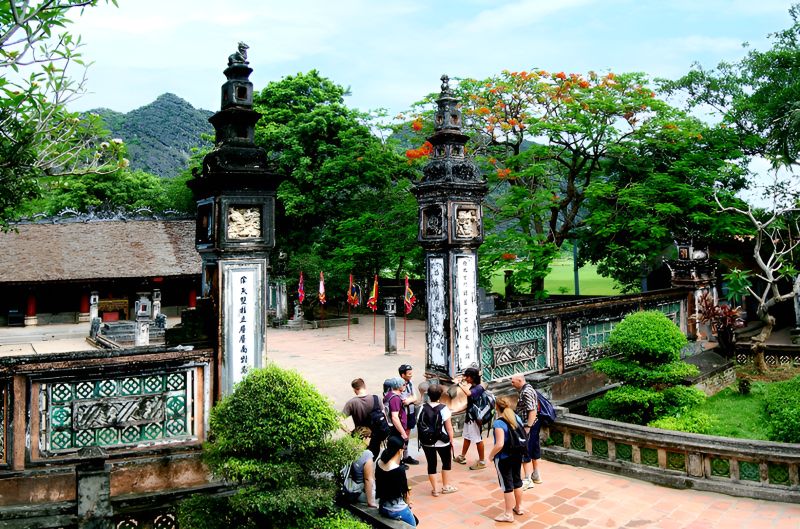
1. Dress Code Applies at Both Temples
Shoulders and knees must be covered to enter the Dinh Tien Hoang Temple and Le Dai Hanh Temple main halls. Tank tops, sleeveless shirts, shorts above the knee, and short skirts are not permitted inside the hall areas. Indian tourists in typical travel attire (salwar kameez, kurta with churidar, and long trousers with full-sleeve shirts) meet the Hoa Lu dress code without modification.
2. Cash Only at the Entrance Gate
The Hoa Lu Ancient Capital ticket counter accepts Vietnamese Dong in cash only — UPI, international cards, and digital wallets are not accepted. ATMs are not available within the complex, and the closest reliable ATMs are in Ninh Binh city, 12 km away. Indian tourists must exchange INR to VND at Hanoi before departure; carry small denominations (VND 20,000 to 100,000 notes, approximately ₹70 to ₹350) to simplify ticket and cycle rental transactions at the gate.
3. No Dedicated Vegetarian Restaurant Inside the Complex
The food stalls near the Hoa Lu Ancient Capital gate sell local Vietnamese snacks — bánh mì, steamed corn, seasonal fruit, and soft drinks — but no dedicated Indian or vegetarian restaurant operates within the site. Indian vegetarian tourists, particularly those observing Jain dietary restrictions, should plan lunch in Ninh Binh city (20-minute drive) at a vegetarian-capable restaurant, or pack lunch from Hanoi before departure. On organised tours, confirm the included lunch restaurant’s vegetarian capability at booking time — standard Ninh Binh tour lunch stops often serve only mixed or meat-based set menus without advance briefing.
4. Photography Inside the Temples Is Permitted
Photography is allowed inside both Dinh Tien Hoang Temple and Le Dai Hanh Temple halls without a separate photography fee. Flash photography is not permitted near the altar objects and bronze statues — the heat from camera flash accelerates wood-lacquer degradation on the 17th-century carvings. Tripods are allowed in the outdoor courtyards but not inside the main halls, where space is limited.
5. Guided Tours Add Significant Value at This Site
Hoa Lu Ancient Capital’s visitor value is almost entirely historical — without context, the temples appear modest in scale and decoration compared to Vietnam’s later imperial sites such as Hue. A licensed English-speaking guide at VND 215,000–315,000 (₹750–₹1,100) per group transforms the 1.5-hour temple visit into a substantive historical experience, covering the Đinh and Early Lê dynasty timeline, the Queen Dương Vân Nga story, and the architectural details of the altar objects.
6. Mosquito Repellent Is Necessary for the Cycling Route
The cycling path between the temples and the outer citadel passes through shaded, humid sections along the valley floor — an environment where mosquitoes are active year-round, with peak activity from May to September. Indian tourists should apply DEET-based repellent before starting the Hoa Lu cycling loop, particularly on exposed arms and ankles. The temple area itself is less mosquito-prone due to the open courtyards and higher foot-traffic disturbance.
7. Hoa Lu Ancient Capital Does Not Have a Luggage Storage Facility
No left-luggage counter operates at the Hoa Lu gate or within the complex. Indian tourists on a day trip from Hanoi should leave all large bags at their Hanoi hotel (most hotels offer free day-use left-luggage) or keep items in the tour vehicle. Only small daypacks with essentials — water, sunscreen, camera, and wallet — are recommended for carrying inside the complex.
Beyond Hoa Lu — Extending the Ninh Binh Itinerary
Beyond Hoa Lu Ancient Capital, Ninh Binh province contains 4 connected attractions Indian tourists typically combine into a 1.5- to 3-day itinerary: Trang An UNESCO Complex, Tam Coc rice paddies, Mua Cave viewpoint, and Bich Dong Pagoda. The complete attraction-by-attraction sequencing, accommodation tiers, food logistics, and boat tour comparisons across the province are documented in the places to visit in Ninh Binh guide.
Frequently Asked Questions — Hoa Lu Ancient Capital for Indian Tourists
Is Hoa Lu Worth Visiting as a Day Trip From Hanoi?
Yes — Hoa Lu Ancient Capital is the only surviving site of Vietnam’s first feudal capital and serves as the historical foundation of the Ninh Binh day trip for Indian tourists. Indian tourists with an interest in Vietnamese imperial history, or those combining Hoa Lu with the Trang An boat tour (2.3 km away) for a historical-plus-natural itinerary, will find the combination fills a full 8-hour day.
Tourists seeking purely nature-based experiences or beach destinations may find Hoa Lu’s value secondary — the site rewards historical curiosity specifically rather than general sightseeing interest.
Can Indian Tourists Enter Hoa Lu Without a Pre-Booked Tour?
Yes — individual walk-in entry to Hoa Lu Ancient Capital is available at the gate without advance booking. The walk-in adult ticket costs VND 20,000 (₹70), and the site does not require a licensed guide for entry. Unguided visits to both Hoa Lu temples take 60 to 90 minutes.
Pre-booked day tours from Hanoi — typically covering Hoa Lu plus Trang An in a combined itinerary — provide structured timing, transport, and guide narration, which most Indian tourists prefer on a first Ninh Binh visit.
How Long Does a Full Visit to Hoa Lu Ancient Capital Take?
A full visit to Hoa Lu Ancient Capital takes 1 to 1.5 hours for the temples alone, 2.5 to 3 hours including the on-site cycling loop, and 7 to 8 hours when combined with the Trang An boat tour and a return trip from Hanoi. Most organised Ninh Binh day tours from Hanoi allocate 1.5 to 2 hours at Hoa Lu before moving to the Trang An boat dock for the next segment of the itinerary.
What Is the Cheapest Way to Reach Hoa Lu From Hanoi?
The cheapest way to reach Hoa Lu Ancient Capital from Hanoi is by a local bus from Giap Bat bus station to Ninh Binh city at VND 30,000–45,000 (₹110–₹150) one-way, followed by a local taxi or xe ôm (motorbike taxi) from Ninh Binh city to Hoa Lu for approximately VND 30,000–45,000 (₹110–₹150) each way.
The total round-trip budget by local bus plus taxi is approximately VND 130,000–170,000 (₹450–₹600) per person — lower than organised tour pricing of VND 515,000–1,000,000 (₹1,800–₹3,500) but requires independent navigation, offers no English-speaking guide, and excludes Trang An boat tickets.
Is the Entrance Fee to Hoa Lu Separate From the Trang An Boat Ticket?
Yes — the Hoa Lu Ancient Capital entrance fee (VND 20,000 / ₹70 per adult) and the Trang An boat ticket (VND 150,000–300,000 / ₹520–₹1,040 per person) are purchased separately at different gates 2.3 km apart. Most Hanoi day tour packages bundle both the Hoa Lu entrance fee and the Trang An boat ticket into a single tour price — confirm this inclusion at booking. Independent travellers must purchase the Hoa Lu ticket at the temple complex gate and then proceed to the separate Trang An boat dock to buy the boat ticket.