Ban Gioc Waterfall is a three-tier waterfall on the Vietnam–China border in Cao Bang Province, about 330–360 km by road from Hanoi. Adult entry costs about 40,000 VND (₹145). Most travellers need 2 days from Hanoi, with one night near the falls. This guide covers how to get to Ban Gioc Waterfall from Hanoi, ticket prices, the best season and what to see nearby.

Ban Gioc Waterfall at a glance (updated November 2026)
- Location: On the Quay Son River in Dam Thuy Commune, Cao Bang Province, on the Vietnam–China border.
- Size: The main drop is about 30 m and the falls are about 300 m wide in total. It is the 4th largest waterfall on a national border.
- Distance from Hanoi: About 330–360 km by road, a drive of 7–8 hours.
- Entrance fee: About 40,000 VND (₹145) for adults. The site is open from about 7:00 AM to 6:00 PM daily.
- Best season: Mid-September to October for strong flow and clear water. June to September for the fullest falls.
- Trip length: 2 days and 1 night from Hanoi, sleeping in Dam Thuy or Cao Bang city.
- Must know: Indian passport holders cannot cross to China’s Detian side. Carry your original passport and e-visa, plus cash in VND.
Where Is Ban Gioc Waterfall?
Ban Gioc Waterfall is in Dam Thuy Commune, Cao Bang Province, in the far northeast of Vietnam. Here the Quay Son River forms the border with China’s Guangxi region. Until 1 July 2025 the commune was part of Trung Khanh District. Vietnam has since reorganised its local administration, but older guides still list the falls under the district name.
The falls drop about 30 m over limestone ledges and split into several streams, spreading roughly 300 m across both banks. Vietnamese sources describe Ban Gioc as one waterfall with a main fall and a secondary fall; the Chinese bank calls its half Detian Falls. Together, the Ban Gioc–Detian falls are the 4th largest waterfall on a national border, after Iguazu, Victoria and Niagara.

Ban Gioc Waterfall is part of the Non Nuoc Cao Bang UNESCO Global Geopark, which is known for its limestone karst, caves and fossils. The Ban Gioc Waterfall Management Board reported about 181,000 visitors in the first nine months of 2026, including 7,672 international visitors.
The table below shows why the falls take a full day to reach from most starting points. Search engines often show a distance of about 270 km from Hanoi, but that is a straight-line figure, not the road distance.
| From | Distance | Typical travel time |
|---|---|---|
| Hanoi | About 270 km straight-line; 330–360 km by road | 7–8 hours by car |
| Cao Bang city | 85–90 km | 2–2.5 hours by car |
| Sapa | About 450 km by road | About 10 hours by private car |
| Nguom Ngao Cave | About 3–5 km | 10 minutes by car |
How Much Is the Ban Gioc Waterfall Ticket?
A ticket to Ban Gioc Waterfall costs about 40,000 VND (₹145) for adults and 20,000 VND (₹75) for children aged 6 to under 16. Children under 6 enter free.
| Item | Price |
|---|---|
| Adult entry | About 40,000 VND (₹145) |
| Child entry, aged 6 to under 16 | About 20,000 VND (₹75) |
| Child under 6 | Free |
| Raft to the foot of the falls | 50,000 VND (₹185) per person, about 10 minutes |
| Opening hours | About 7:00 AM to 6:00 PM daily |
₹ at about 273 VND per ₹1; prices checked November 2026.
The ticket kiosk at the car park accepts cash only. Some older guides still quote 45,000 VND for adults, so carry a little extra. A family of 2 adults and 1 child aged 8 pays about 100,000 VND (₹365) for entry.
How to Get to Ban Gioc Waterfall from Hanoi
From Hanoi, you can reach Ban Gioc Waterfall by private car in about 7–8 hours. Alternatively, take a limousine bus to Cao Bang city (6–8 hours), then a local bus or taxi for the last 85 km.
Most travellers from India spend 2 or 3 nights in the capital first. Our guide to Hanoi covers Old Quarter hotels, Indian restaurants and day trips you can fit in before the drive to Cao Bang. Cao Bang has no airport or railway, so every route to the falls is by road, usually via Thai Nguyen and Bac Kan on Highway 3. The new Dong Dang–Tra Linh expressway via Lang Son was still under construction in late 2026, with the first phase due in 2027.
| Option | Travel time | Cost | Best for |
|---|---|---|---|
| Private car with driver, Hanoi–Ban Gioc | 7–8 hours each way | About US$127 one way or US$254 return per 7-seat car (₹12,065 / ₹24,130) | Families, seniors, groups of 3–6 |
| Group Ban Gioc waterfall tour, 2 days from Hanoi | 2 days | About US$189–269 per person (₹17,955–25,555) | Solo travellers and couples |
| Limousine bus, Hanoi–Cao Bang city | 6–8 hours | From about 350,000–400,000 VND (₹1,280–1,465) | Budget travellers |
| Local bus, Cao Bang city–Ban Gioc | 3–4 hours | About 80,000 VND (₹295) | Budget travellers with time |
| Taxi, Cao Bang city–Ban Gioc | About 2 hours | 800,000–1,200,000 VND (₹2,930–4,395) per car | Bus travellers short on time |
Bus, taxi and car prices are market rates checked October–November 2026 and change by season and operator.
- Direct limousines: Some Hanoi–Cao Bang limousine companies continue to Trung Khanh, the town closest to the falls, for about 420,000 VND (₹1,540). This saves changing buses in Cao Bang city.
- Limited ride-hailing: Grab cars and bikes are not reliably available in Cao Bang Province. If you arrive by bus, ask your hotel or bus company to arrange the onward taxi.
- Road conditions: The last 3 hours, from Bac Kan to Ban Gioc, wind over mountain passes including Ma Phuc Pass. If you get motion sickness, carry medication.
Cao Bang to Ban Gioc Waterfall
The drive from Cao Bang city to Ban Gioc Waterfall is 85–90 km and takes 2–2.5 hours by car, or 3–4 hours by local bus. Most private-car itineraries stop at Thang Hen Lake or Angel Eye Mountain on the way, so plan the leg as a half day rather than a straight transfer.
Ban Gioc Waterfall from Sapa
There is no direct bus from Sapa to Ban Gioc Waterfall. You can either take connecting buses to Cao Bang city (12.5–14 hours in total) or hire a private car for about 10 hours on mountain roads.
- Via Ha Giang (scenic): The bus from Sapa to Ha Giang takes about 6 hours, and Ha Giang to Cao Bang is another long mountain day. This route works best as a 2-day private-car trip, costing about US$220–400 in total (₹20,900–38,000).
- Via Hanoi (simplest): Take a night bus from Sapa back to Hanoi (about 6 hours), then continue on the Hanoi–Cao Bang limousine the next morning.
If you are already in the mountains, our guide to Sapa lists bus companies, Fansipan cable car times and homestays, and nearby Silver Waterfall Sapa makes a good warm-up. With 2 extra days, you can ride the Ha Giang Loop first and continue east to Cao Bang. That links Dong Van, Ma Pi Leng Pass and Ban Gioc in one northern circuit.
2-Day Ban Gioc Waterfall Tour from Hanoi
A 2-day Ban Gioc waterfall tour from Hanoi covers Nguom Ngao Cave and Khuoi Ky Stone Village on day 1, then the waterfall and Phat Tich Truc Lam Ban Gioc Pagoda on day 2, with one night near the falls. This plan puts the waterfall in the middle of day 2, when the flow is usually strongest in the dry season.
| Time | Day 1 | Day 2 |
|---|---|---|
| Morning | Leave Hanoi at 6:30 AM; lunch in Bac Kan or Cao Bang | Breakfast; viewpoint at Phat Tich Truc Lam Ban Gioc Pagoda |
| Afternoon | Nguom Ngao Cave (45 minutes) and Khuoi Ky Stone Village | Ban Gioc Waterfall and raft ride, ideally between 11 AM and 3 PM |
| Evening | Night at a Dam Thuy homestay or Saigon–Ban Gioc Resort | Drive back to Hanoi, arriving around 10 PM |
Most Ban Gioc waterfall tours follow this pattern. A private trip lets you set your own pace and arrange vegetarian meals in advance.
When Is the Best Time to Visit Ban Gioc Waterfall?
The best time to visit Ban Gioc Waterfall is mid-September to October. The falls still carry monsoon water, the Quay Son River turns clear and the rice around Dam Thuy ripens.
| Period | Daytime high | Rain | The waterfall | Verdict |
|---|---|---|---|---|
| December–February | 18–20°C (night lows about 10°C) | Very low | Lowest flow, turquoise water | Mixed |
| March–April | 23–27°C | Rising | Moderate flow | Good |
| May–August | 31–32°C | Heaviest (June about 260 mm) | Fullest, one wall of water | Good, wet roads |
| Mid-September–October | 27–30°C | Falling | Strong flow, clear water, ripe rice | Best |
| November | About 24°C | About 44 mm | Clear, lower flow | Good |
Climate averages for Cao Bang city; Ban Gioc is slightly cooler.
Time of day matters in the dry season. In April 2023, Vietnamese media reported that an upstream hydropower plant held back water until about 11 AM. This left the main fall thin in the morning; water was released roughly between 11 AM and 3 PM. If you visit between November and April, plan to see the waterfall around the middle of the day.

Ban Gioc Waterfall in December
December is a good month for clear skies and turquoise water at Ban Gioc Waterfall, but the flow is lower and it gets cold: about 12–20°C by day and close to 10°C at night. Rain is rare, with about 20 mm over 6 days on average in Cao Bang. Roads are dry and crowds are thin. The falls split into separate white streams rather than one wall of water. Aim for midday, when the flow is strongest, and pack a fleece, as most homestays have no heating. December also falls in chestnut season, so you will find roasted Trung Khanh chestnuts at the car park.
To combine Ban Gioc with Ha Long Bay or Phu Quoc, our guide to the best time to visit Vietnam compares the north, centre and south month by month.
Things to Do at Ban Gioc Waterfall
The main things to do at Ban Gioc Waterfall are a raft ride to the foot of the falls, the climb to Phat Tich Truc Lam Ban Gioc Pagoda and the new second-tier viewpoint, which opened in September 2026.
- Raft ride: The motor-powered bamboo raft costs 50,000 VND (₹185) per person and spends about 10 minutes beneath the main fall before turning towards the Chinese bank. Spray reaches the raft on most days, so put cameras and phones in a dry bag.
- Phat Tich Truc Lam Ban Gioc Pagoda: Inaugurated on 15 December 2014, the pagoda stands on Phia Nham Mountain above the falls. A climb of several hundred stone steps (about 15 minutes) leads to a view over the whole waterfall and the Chinese bank.
- Second-tier viewpoint: The Ban Gioc Waterfall Management Board opened a new viewpoint on the second tier of the falls in September 2026. It gives a higher angle over the cascades and forest.
- Detian side: The Ban Gioc–Detian cross-border scenic area has operated officially since 15 October 2024, but third-country citizens are not yet allowed to cross. That means Indian passport holders can see Detian Falls only from the Vietnamese bank or from the raft.


When Is the Ban Gioc Waterfall Festival?
The Ban Gioc Waterfall Festival is usually held in early October, and Cao Bang authorities announce the exact dates each year. Recent editions ran on 5–7 October 2023 and 5–6 October 2024.
The festival began in 2017 and became a provincial-level event in 2023. The programme usually includes a water procession from the Quay Son River, and Tay and Nung artists performing Then singing with the Tinh lute. There is also a photo exhibition, folk games and a chestnut-garden week for Trung Khanh chestnuts. Some years add a light show at the foot of the falls, and hotels in Dam Thuy fill up early during festival week.

Places to Visit Near Ban Gioc
The best places to visit near Ban Gioc Waterfall are Nguom Ngao Cave and Khuoi Ky Stone Village, both within a few kilometres, plus Angel Eye Mountain and Thang Hen Lake on the drive from Cao Bang city.
Nguom Ngao Cave
Nguom Ngao Cave is a limestone cave in Dam Thuy Commune, about 3–5 km from Ban Gioc Waterfall, with a lit walkway past stalactite curtains.
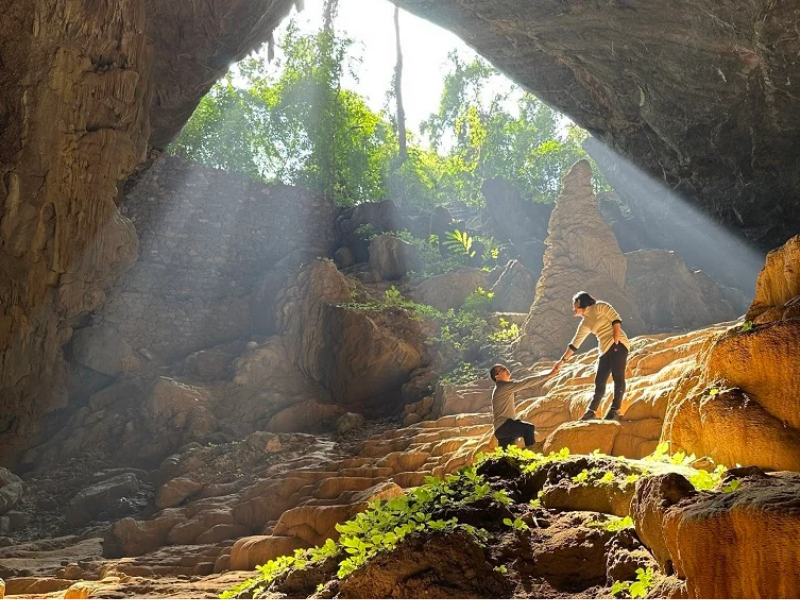
- Entry fee: about 45,000 VND (₹165) for the short route; about 195,000 VND (₹715) for the guided trekking route.
- Time needed: about 45 minutes for the short route of about 1 km.
- Best time: any season; a useful shelter on rainy days.
A British caving survey in 1995 measured the cave at 2,144 m with 3 entrances, and a 2016 Vietnamese survey recorded nearly 2,770 m. Less than half of it is open to visitors. On every tour, guides point out a stone “lotus” formation along the lit route.
Khuoi Ky Stone Village
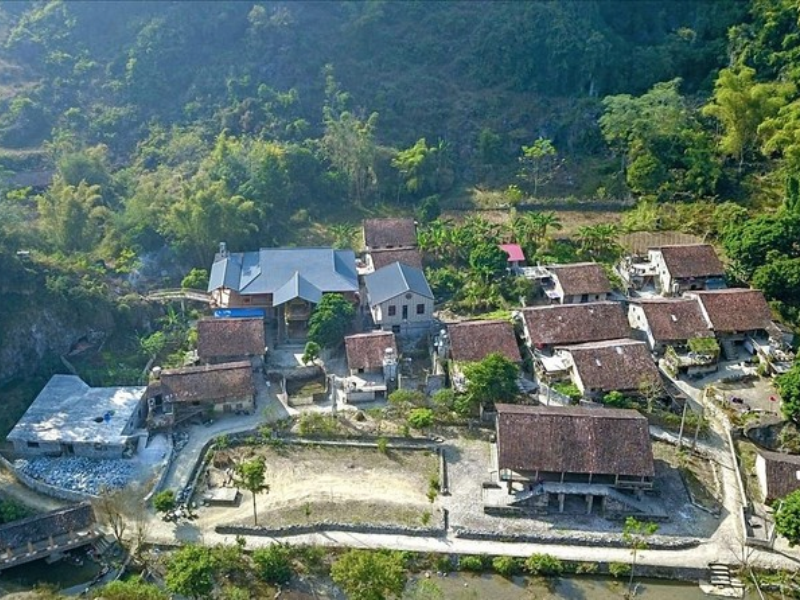
Khuoi Ky is a Tay village of stone stilt houses, home to about 14 households, roughly 3 km from Ban Gioc Waterfall.
- Opening hours: open village, daylight hours.
- Entry fee: free.
- Time needed: 30–45 minutes.
The houses have stone walls bonded with lime and sand under timber frames, and some are several centuries old. Several families run homestays, which makes the village a convenient overnight base for the waterfall.
Angel Eye Mountain (Nui Mat Than)
Angel Eye Mountain is a limestone peak with a hole about 50 m wide near its summit, about 45–50 km from Cao Bang city.
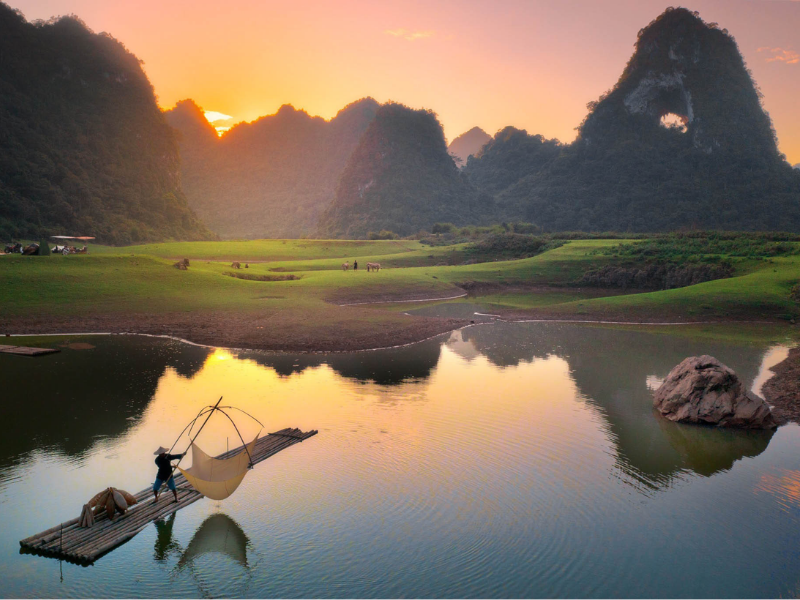
- Location: near Thang Hen Lake, on the road from Cao Bang city towards Tra Linh.
- Best time: late afternoon for side light; in the wet season the valley floor floods.
- Time needed: 1–2 hours.
The peak rises over a grassy valley that becomes a shallow lake in the wet season. You can see the hole from the road long before you reach the car park.
Thang Hen Lake
Thang Hen Lake is the largest of a chain of mountain lakes linked by underground caves, in Tra Linh Commune on the drive between Cao Bang city and Ban Gioc.
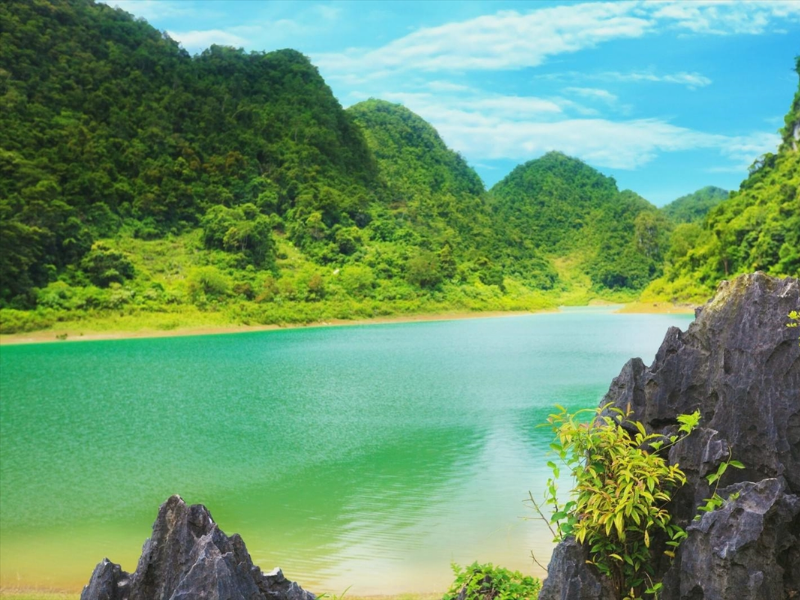
- Opening hours: open area, daylight hours.
- Time needed: 1–2 hours.
- Best time: June to September, when rain brings the lakes to their highest level; in the dry winter months they shrink.
Most private-car itineraries stop here on day 1 or day 2. If you love waterfalls, add Elephant Waterfall near Da Lat to a later leg of your trip, or Tad Fane waterfall on a Laos extension.
Where to Eat and Stay near Ban Gioc
Around Ban Gioc you can try local Tay dishes such as Trung Khanh roast duck and chestnuts, but vegetarian and Jain meals must be arranged in advance. Stay at the 4-star Saigon–Ban Gioc Resort or at a homestay in Dam Thuy.
Local specialities around Ban Gioc include Trung Khanh roast duck, smoked sausage, sour pork, grilled agarwood fish from the Quay Son River and Trung Khanh chestnuts. Cao Bang city is known for sour pho and steamed rice rolls. From October, roadside stalls near the car park sell roasted chestnuts by the bag.

Neither Cao Bang city nor Dam Thuy has a verified Indian or dedicated vegetarian restaurant. Local eateries will cook rice, tofu and stir-fried vegetables on request, but sauces often contain fish sauce or pork fat. Jain travellers should arrange meals with the hotel in advance and carry dry snacks from Hanoi.
| Stay | Type | Price guide |
|---|---|---|
| Saigon–Ban Gioc Resort | 4-star resort with 53 rooms, near the falls | On request |
| Khuoi Ky and Dam Thuy homestays | Stone or wooden stilt houses, 2–6 km from the falls | From about 405,000 VND (₹1,485) per night |
| Cao Bang city hotels | City base, 85 km from the falls | Wider choice and more restaurants |
Ban Gioc Waterfall Travel Tips
Ban Gioc is a remote border zone, so carry your original passport with your Vietnam e-visa, enough cash in VND and, from November to February, warm layers.
- Passport and e-visa: Indian passport holders need a Vietnam e-visa before travelling. The ticket kiosk does not check documents, but police can ask for passports anywhere in the Cao Bang border zone. Our guide to the Vietnam visa for Indian travelers explains the US$25 (₹2,375) government fee, processing times and how to check your result.
- Cash: The ticket kiosk and raft operators take cash only, so withdraw VND in Cao Bang city.
- No swimming: Swimming is not allowed at Ban Gioc Waterfall for safety reasons.
- Border rules: Stay on the Vietnamese bank, do not buy goods from boats crossing from the Chinese side, and follow the no-photo signs near border markers.
- Clothing: Night temperatures fall to about 10°C in January. From November to February bring a fleece, and wear non-slip shoes for the pagoda steps.
Planning a Ban Gioc Waterfall Trip from Hanoi
Ban Gioc Waterfall is worth 2 days. In the dry season, visit at midday, take a raft ride under the main fall and use the rest of the trip for Nguom Ngao Cave and Khuoi Ky village.
The hard part is the logistics: a 7–8 hour drive each way, a night near the falls and vegetarian or Jain meals in a province with no Indian restaurants. Vietnamtour.in, part of Seni World Travel, has arranged trips for 428,000+ Indian travellers since 2015, with local experts in Vietnam and a team in Delhi. Our private Vietnam tourism packages from India can add a Cao Bang extension with a driver, a guide and meals arranged in advance. Many travellers end a northern trip on the beach with our Phu Quoc tour packages. Share your dates below and our team will plan the route.
Ban Gioc Waterfall FAQs
Is Ban Gioc Waterfall worth visiting?
Yes, if you have 2 days to spare from Hanoi. The falls, Nguom Ngao Cave and Khuoi Ky village fit into one short trip. If you have only one free day, skip it: the return drive alone takes 14–16 hours.
What is the biggest waterfall in Vietnam?
Ban Gioc Waterfall is generally described as the largest natural waterfall in Vietnam by width and water volume, although there are taller falls elsewhere. To compare Ban Gioc with Datanla, Silver Waterfall and others, see our full list of waterfalls in Vietnam.
Is Ban Gioc Waterfall in Vietnam or China?
It lies on the border. The Vietnamese half is in Cao Bang Province, and the Chinese half, called Detian Falls, is in Guangxi. Visitors on the Vietnamese bank face both the main fall and the secondary fall.
How many days do you need for Ban Gioc Waterfall?
You need at least 2 days and 1 night from Hanoi, or 3 days if you want to add Angel Eye Mountain and Thang Hen Lake. A same-day return from Hanoi is possible, but only with 14–16 hours on the road.
Can visitors swim at Ban Gioc Waterfall?
No. Swimming is banned on this stretch of the Quay Son River for safety reasons. The raft is the only way to get close to the falls.
Is there a direct bus from Hanoi to Ban Gioc Waterfall?
Partly. Some limousine companies run from Hanoi to Trung Khanh, the town nearest the falls, for about 420,000 VND (₹1,540), but most buses stop in Cao Bang city. From Cao Bang city, continue by local bus or taxi for the last 85 km.
Last checked: November 2026. Ticket prices and opening hours can change, so confirm on arrival.
Hanoi HQ: Floor 4, Bao Anh Building, 85 Tran Thai Tong, Cau Giay, Hanoi
Delhi: A 10/1 Gujrawala Town Part 1, Main G T Karnal Road, Delhi 110009
India hotline: +91 88502 95722
Vietnam / WhatsApp: +84 948 333 087
Email: [email protected]
Itineraries Recommended By Local Experts
Hanoi · Ninh Binh · Halong Bay · Da Nang · Hoi An
Hanoi · Halong Bay · Da Nang · Hoi An · Phu Quoc
Phnom Penh · Siem Reap · Da Nang · Hoi An · Hanoi · Halong Bay
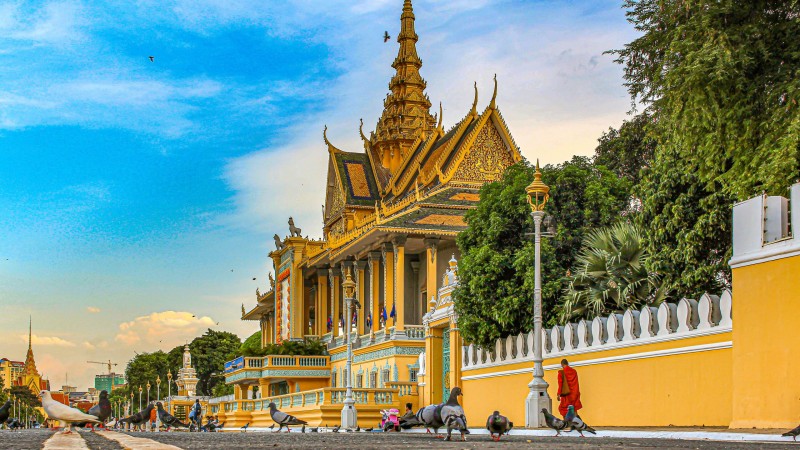
Siem Reap · Phnom Penh · Ho Chi Minh City · Mekong Delta
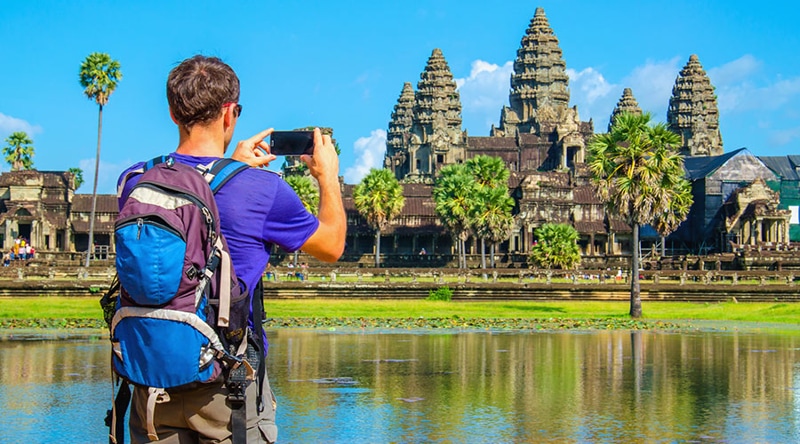
Phnom Penh · Siem Reap
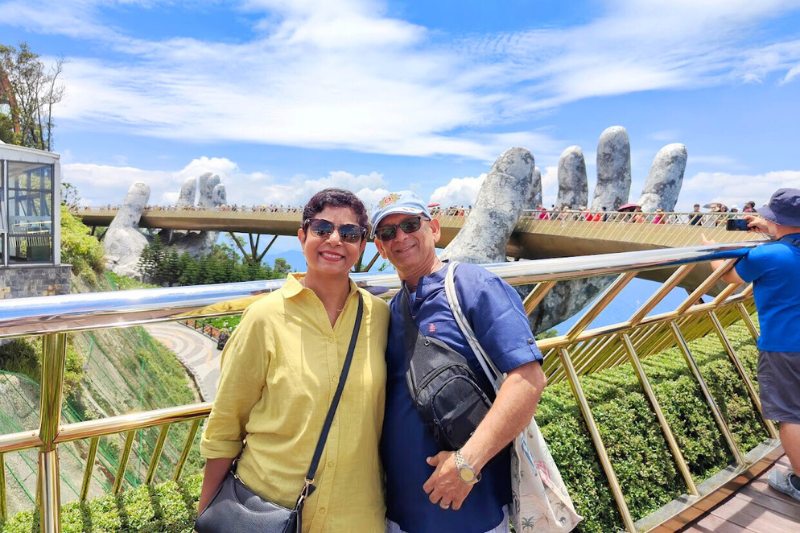
Ho Chi Minh City · Mekong Delta · Da Nang · Hoi An · Hanoi · Sapa · Halong Bay

Hanoi · Halong Bay · Da Nang · Hoi An · Phu Quoc
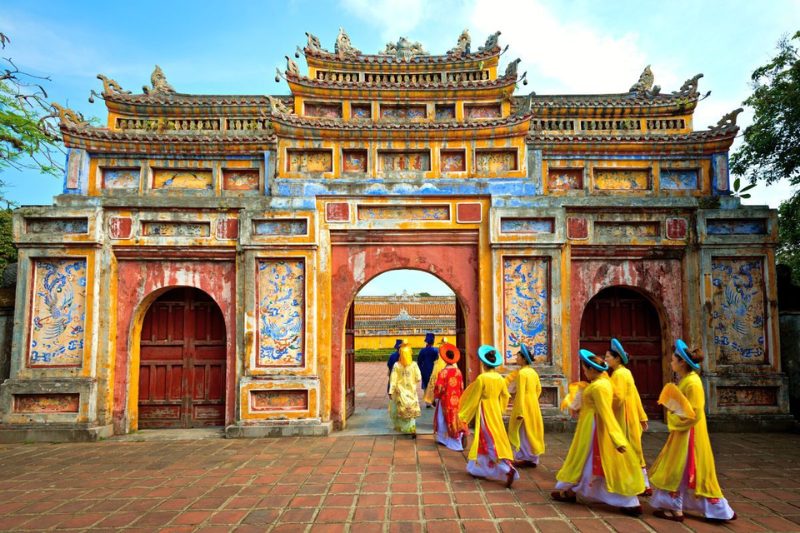
Ho Chi Minh City · Mekong Delta · Da Nang · Hoi An · Hue · Hanoi · Halong Bay