Hoi An Night Market is a 300-metre pedestrian-only night market on Nguyen Hoang Street, An Hoi Island, located 400 metres from the Japanese Covered Bridge across the Hoai River from Hoi An Ancient Town. Hoi An Night Market runs nightly from 6:00 PM to 11:00 PM with free entry — 50 to 100 stalls across 3 zones cover lanterns, street food, and clothing. Vegetarian-labelled food is available at 8 to 10 dedicated stalls, and the floating lantern ritual on the Hoai River is accessible directly from the market’s riverbank.
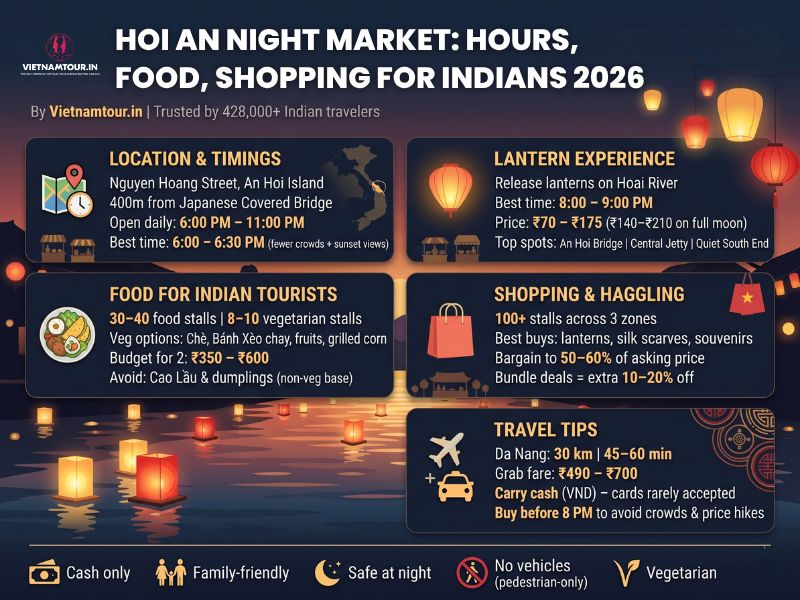
The Hoi An Night Market travel guide is built specifically for Indian tourists planning a 2026 visit. This guide covers location and zone layout, opening hours and best arrival window, lantern release on the Hoai River, vegetarian food and Indian-friendly options, souvenir shopping and tailor turnaround, haggling strategy with INR price baselines, Da Nang to Hoi An transport (Grab and day tour), best months by season, and 6 practical issues Indian tourists must know.
Hoi An Night Market – Location, Size, and What to Expect
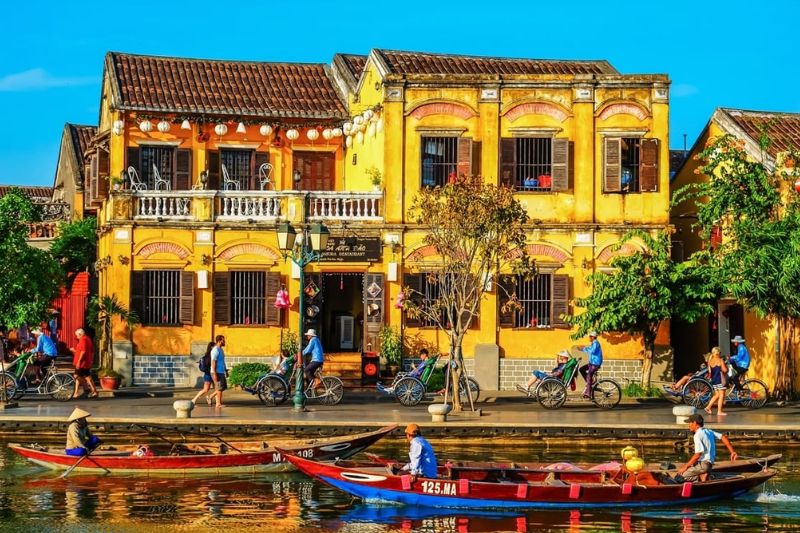
Hoi An Night Market occupies Nguyen Hoang Street on An Hoi Island — a 300-metre pedestrian-only corridor with 50 to 100 stalls offering lanterns, street food, and tailoring across 3 zones, accessible by a 5-minute walk from Hoi An Ancient Town’s Japanese Covered Bridge. An Hoi Island is a small island separated from Hoi An Ancient Town by the Hoai River.
The Hoai River serves as the natural boundary between An Hoi Island and Hoi An Ancient Town. Crossing the Hoai River — either by foot over An Hoi Bridge or by the footbridge near the Japanese Covered Bridge — takes under 5 minutes from Hoi An Ancient Town’s UNESCO-listed historic centre.
What distinguishes Hoi An Night Market from every other night market in Vietnam is the total absence of vehicles. The market operates as a closed pedestrian zone from 6:00 PM onward, creating a fully vehicle-free corridor not found at night markets in Hanoi or Da Nang, where traffic runs alongside stalls.
How to Find Hoi An Night Market from Hoi An Ancient Town
The address of Hoi An Night Market is Nguyen Hoang Street, Minh An Ward, Hoi An City, Quang Nam Province. The market’s entrance is located 400 metres from the Japanese Covered Bridge (Chùa Cầu) — the most recognisable landmark in Hoi An Ancient Town. Walking from the Japanese Covered Bridge to the entrance takes 5 minutes on foot.
The Hoai River runs between Hoi An Ancient Town and An Hoi Island. Pedestrians cross the Hoai River using the An Hoi footbridge near Nguyen Phuc Chu Street. The An Hoi footbridge is well-lit at night and takes under 2 minutes to cross.
From Hoi An Ancient Town’s centre at Tran Phu Street, the walk to the market entrance is 600 metres, or 8 minutes on foot.
Hoi An Night Market Size
Hoi An Night Market hosts 50 to 100 stalls along 300 metres of Nguyen Hoang Street, with stall count fluctuating by season — peak months (June to August, December to February) reach the upper bound, while off-peak nights operate with 50 to 70 active stalls. The market’s layout follows a clear 3-zone structure from north to south along Nguyen Hoang Street.
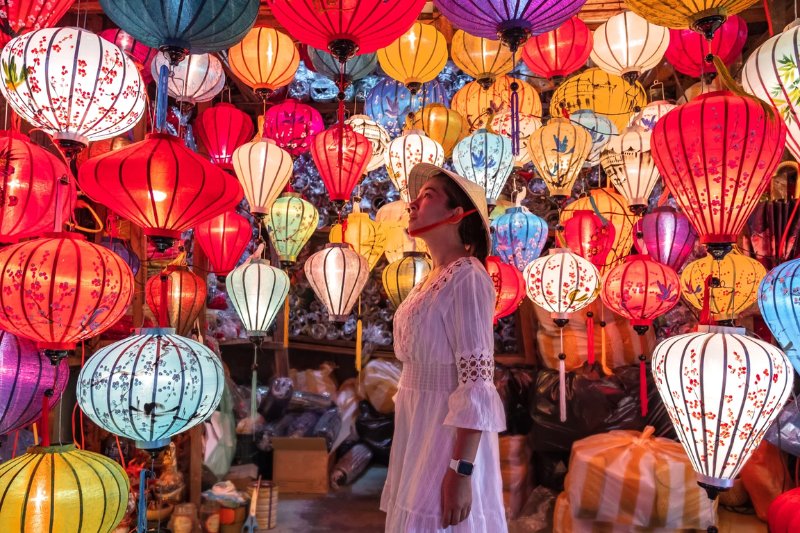
Zone 1 of Hoi An Night Market, from the northern entrance near An Hoi Bridge, houses handmade lanterns, silk products, and decorative handicrafts. Zone 1 is where lantern vendors operate the floating lantern service on the Hoai River.
Zone 2, in the middle section of Nguyen Hoang Street, houses food and beverage stalls. Zone 2 is where local dishes like White Rose Dumplings, Cao Lầu, and Bánh Mì are served hot from open-air cooking stations.
Zone 3, toward the southern end near Cam Nam Bridge, houses ready-made clothing, fabric stalls, and tailor shops. Indian tourists who want custom stitching find most tailoring services in Zone 3.
Hoi An Night Market Opening Hours
Hoi An Night Market opens at 6:00 PM and closes at 11:00 PM, 7 days a week, including Vietnamese public holidays. Stalls begin setting up from 5:30 PM, but the pedestrian zone is fully operational only after 6:00 PM.
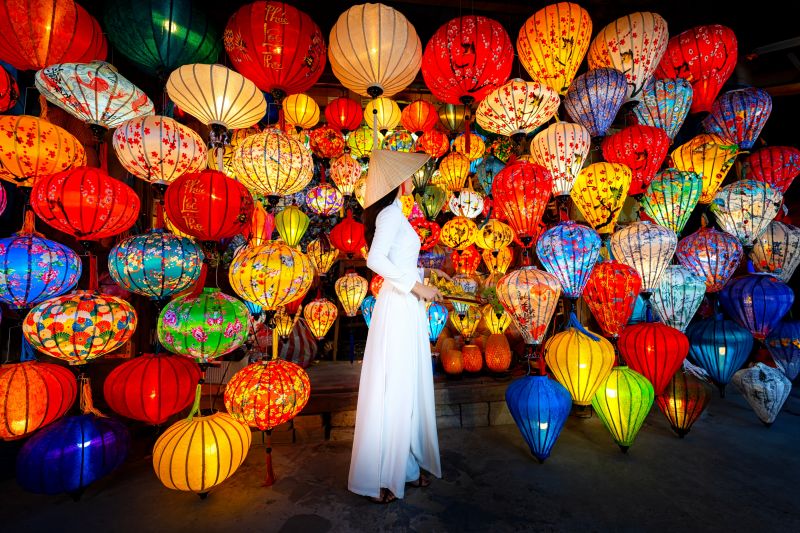
Saturday and Sunday at the market draw the highest crowd volume as domestic Vietnamese tourists join international visitors. Tuesday through Thursday offer quieter conditions — fewer visitors compete for vendor attention and more room to negotiate.
Best Arrival Time at Hoi An Night Market for Indian Tourists
The best arrival time at Hoi An Night Market for Indian tourists is 6:00 PM to 6:30 PM. The 6:00 PM to 6:30 PM arrival window offers 2 simultaneous advantages: golden-hour light reflecting off the Hoai River creates the best photographic conditions, and crowd volume is still manageable.
Arriving at the market after 8:00 PM produces 2 disadvantages: higher stall density and adjusted vendor pricing. Stall density increases as vendors finish their setup later in the evening. Some merchants adjust asking prices upward after 8:00 PM, recognising that late-arriving tourists have limited time to comparison-shop before the 11:00 PM closing.
A 6:00 PM arrival at Hoi An Night Market for Indian families travelling with children ensures younger members complete the full market circuit and lantern release before 9:30 PM, allowing return to Hoi An Ancient Town before 10:00 PM.
Hoi An Night Market on Full Moon Nights
Hoi An holds its Lantern Festival on the 14th day of each lunar month, during which all electric lights in Hoi An Ancient Town are switched off and replaced entirely by lanterns. Hoi An Night Market remains open on Lantern Festival nights, but the lighting format changes entirely — electricity-powered stall lighting disappears on Lantern Festival nights, replaced by candlelight and hanging lanterns.
Floating lantern prices on the Hoai River increase on Lantern Festival full moon nights. Standard lantern prices rise from ₹70 to ₹105 (20,000 to 30,000 VND) to ₹140 to ₹210 (40,000 to 60,000 VND) during the Lantern Festival due to demand.
The Lantern Festival full moon night is the most atmospheric time to visit Hoi An Night Market, but also the most crowded. Indian tourists who want their stay to coincide with the Hoi An Lantern Festival book accommodation in Hoi An 2 to 3 weeks in advance — hotels in Hoi An fill rapidly for Lantern Festival dates.
Releasing Lanterns on the Hoai River
Releasing a paper lantern on the Hoai River is the single experience that distinguishes Hoi An Night Market from every other night market in Vietnam. No other night market in Vietnam offers a comparable riverside ritual that is both accessible to tourists and culturally grounded.
Lantern Prices
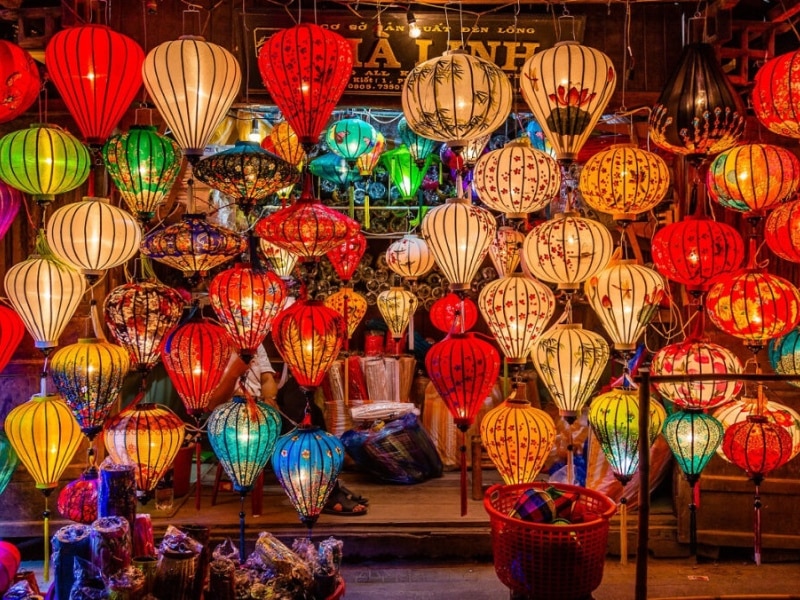
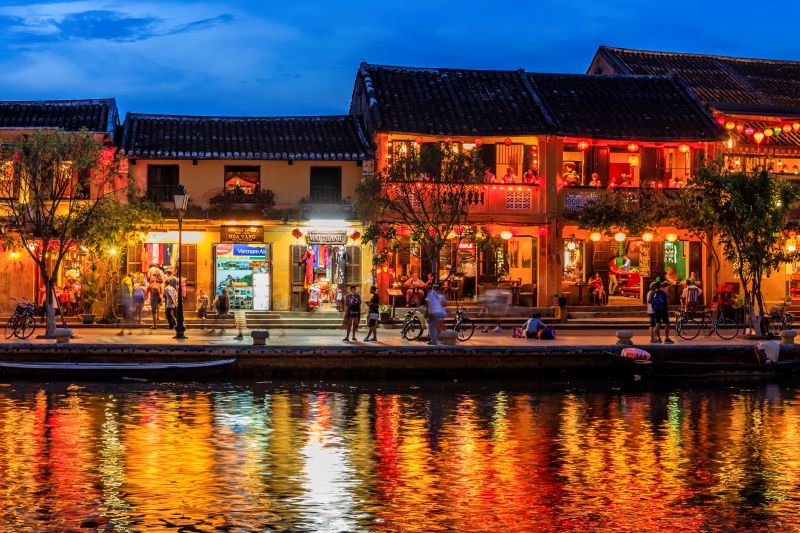
Paper lanterns at Hoi An Night Market are priced at ₹70 to ₹175 (20,000 to 50,000 VND), depending on size and material. Traditional circular paper lanterns in multiple colours are the most authentic option. Plastic LED lanterns do not biodegrade, and Hoi An’s 2024 environmental regulation issued by the Hoi An City People’s Committee prohibits releasing non-paper materials into the Hoai River, with vendors reminded of the rule at the lantern stall point of sale.
Indian tourists buying lanterns at Hoi An Night Market verify that the lantern base holds a wax candle rather than a plastic battery-powered LED unit. Wax candle lantern bases are biodegradable and comply with Hoi An’s Hoai River release regulations.
Hoi An Night Market lantern colour symbolism carries direct parallels to Indian festival traditions. Yellow lanterns represent prosperity and wealth. Red lanterns represent luck and celebration. Yellow and red lanterns at Hoi An Night Market align closely with the colour symbolism Indian tourists associate with Diwali and Holi.
Best Spots to Release Lanterns on the Hoai River
3 release points along Nguyen Hoang Street offer the best conditions for floating lanterns on the Hoai River — each with a distinct advantage depending on what Indian tourists prioritise.
Spot 1 at An Hoi Bridge at the market’s northern entrance provides the widest open view of the Hoai River and attracts the most photographers. An Hoi Bridge is the most popular lantern release location and the best choice for capturing photographs with the market lights in the background.
Spot 2 at the central jetty midway along Nguyen Hoang Street is less crowded than An Hoi Bridge and offers varied camera angles, including views both upstream and downstream simultaneously.
Spot 3 at the southern end near Cam Nam Bridge is the quietest of the 3 lantern release spots. Spot 3 suits Indian families with young children who prefer more space and less crowding during the lantern release.
The optimal time for lantern release on the Hoai River at Hoi An Night Market is 8:00 PM to 9:00 PM, when the sky is fully dark and lantern light is most visible against the river surface.
Food Stalls at Hoi An Night Market
Hoi An Night Market contains 30 to 40 food stalls, of which at least 8 to 10 consistently offer clearly labelled vegetarian options. The full food budget for two people eating a complete meal at the market is approximately ₹350 to ₹600, representing a 30 to 40% saving compared to sit-down restaurant prices inside Hoi An Ancient Town for equivalent dishes. The vegetarian-labelled proportion at Hoi An Night Market is significantly higher than at night markets in Hanoi or Ho Chi Minh City, where vegetarian-labelled street food is less common.
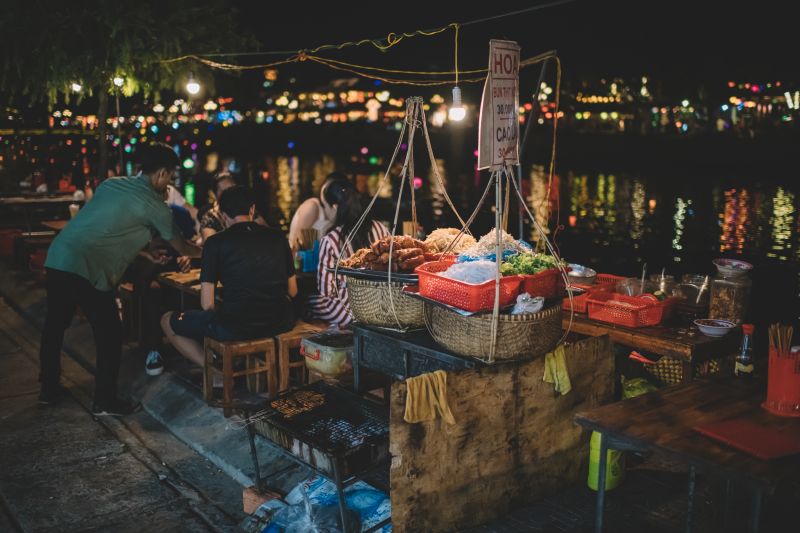
The food zone focuses on dishes specific to Hoi An rather than generic Vietnamese street food. 3 dishes define the culinary identity of Hoi An Night Market: Cao Lầu (a regional noodle dish made with water from a specific ancient well in Hoi An), Bánh Vạc (White Rose Dumplings — thin rice dumplings shaped like white roses and filled with shrimp), and Bánh Mì Hội An (a local variation of the Vietnamese baguette sandwich unique to Hoi An). Cao Lầu, Bánh Vạc, and Bánh Mì Hội An are not reliably available in other Vietnamese cities and are exclusive to Hoi An’s food culture.
Vegetarian and Indian-Friendly Food Options at Hoi An Night Market
Indian tourists at Hoi An Night Market have at least 4 reliable vegetarian food categories available without needing to negotiate special preparation: Chè, Bánh Xèo chay, fresh fruit stalls, and grilled corn on the cob.
Chè (Vietnamese sweet dessert soup) is entirely plant-based across all variations and is available in multiple forms at Hoi An Night Market — taro, mung bean, lotus seed, and coconut milk versions. Chè costs ₹35 to ₹70 (10,000 to 20,000 VND) per serving.
Bánh Xèo chay (vegetarian sizzling rice crepe) is the non-meat version of the classic Vietnamese crêpe, filled with bean sprouts, mushrooms, and green onions. Indian tourists ordering Bánh Xèo chay at Hoi An Night Market use the phrase “không thịt, không hải sản” (no meat, no seafood) to confirm vegetarian preparation.
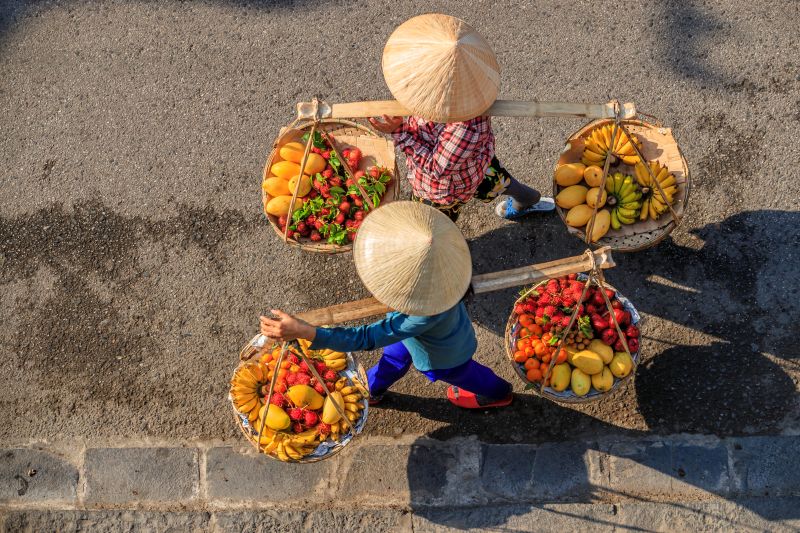
Fresh fruit stalls offer mango, dragon fruit (thanh long), and fresh coconut throughout Hoi An Night Market. Dragon fruit is grown in Vietnam’s central and southern regions and is freshest at the market’s fruit stalls compared to northern Vietnam.
Grilled corn on the cob (bắp nướng) is entirely vegetarian, consistently priced at ₹35 (10,000 VND), and is one of the most popular items at Hoi An Night Market among all nationalities.
Cao Lầu broth uses pork-based stock by default — strict vegetarians and Jain travellers avoid Cao Lầu unless the stall explicitly confirms a vegetarian broth version. White Rose Dumplings (Bánh Vạc) contain shrimp as the standard filling and are not suitable for vegetarians unless a special order is confirmed directly with the vendor.
Food Prices at Hoi An Night Market in INR (2026)
The following price table of food at Hoi An Night Market reflects 2026 market rates. The exchange reference is 1 INR ≈ 290–300 VND.
| Dish | VND Price | INR Price |
|---|---|---|
| Bánh Mì Hội An | 10,000–20,000 | ₹35–₹70 |
| White Rose Dumplings (Bánh Vạc), per plate | 30,000–40,000 | ₹105–₹140 |
| Chè (Vietnamese sweet soup), per cup | 10,000–20,000 | ₹35–₹70 |
| Fresh coconut | 20,000–30,000 | ₹70–₹105 |
| Cao Lầu, per bowl | 30,000–50,000 | ₹105–₹175 |
| Grilled corn (bắp nướng) | 10,000 | ₹35 |
Shopping at Hoi An Night Market
Hoi An Night Market is best known for 3 product categories: handmade silk lanterns, traditional handicrafts, and custom tailoring services. These 3 categories together account for the majority of purchase activity among international tourists at the market — Indian, Korean, Japanese, Australian, and European visitors account for the largest segments.
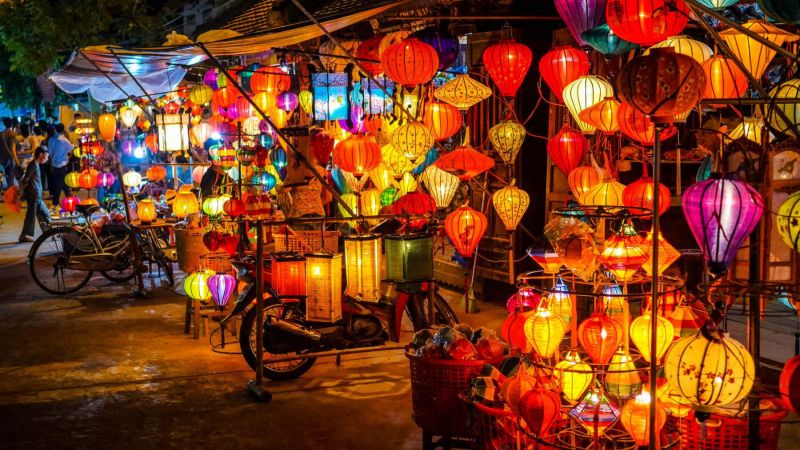
Stalls inside Hoi An Night Market’s boundary on Nguyen Hoang Street primarily sell ready-made souvenirs, lanterns, scarves, and small decorative items. Tailor shops are concentrated toward the southern end of Nguyen Hoang Street and in the side lanes around An Hoi Island. Several tailor shops operate with storefronts opening directly onto Nguyen Hoang Street, but fitting rooms and fabric inventory are located in each shop’s interior.
Hoi An holds an established reputation as Vietnam’s tailoring capital — a status Hoi An has maintained for over 2 centuries. Indian tourists familiar with bespoke tailoring culture — a deeply embedded tradition across India — navigate tailor negotiations in Hoi An more confidently than tourists from other markets.
Best Souvenirs to Buy at Hoi An Night Market for Indian Tourists
The 5 best souvenirs to buy at Hoi An Night Market for Indian tourists are silk scarves, small decorative lanterns, embroidered tablecloths and cushion covers, wooden lacquerware items, and custom name stamps carved in wood — each priced between ₹105 and ₹1,400 (30,000 to 400,000 VND).
- Silk scarves at Hoi An Night Market are priced at ₹350 to ₹1,050 (100,000 to 300,000 VND) depending on size and silk grade. The colour range — deep jewel tones, gold embroidery, and saffron-adjacent oranges — aligns more closely with Indian aesthetic preferences than the muted palette typical of Hanoi market textiles.
- Small decorative lanterns for bringing home are priced at ₹175 to ₹525 (50,000 to 150,000 VND). These lanterns are collapsible, flat-packable, and available in versions designed for air travel without damage.
- Embroidered tablecloths and cushion covers are priced at ₹350 to ₹1,400 (100,000 to 400,000 VND). They fit within standard baggage allowances without exceeding weight limits.
- Wooden lacquerware items — including bowls, trays, and decorative boxes — are priced at ₹210 to ₹700 (60,000 to 200,000 VND). The lacquerware uses a traditional multi-layer technique distinct from machine-produced lacquer products.
- Custom name stamps carved in wood are priced at ₹105 to ₹210 (30,000 to 60,000 VND). The stamps are personalised on-site and make inexpensive but memorable gifts for children or colleagues.
3 signals identify authentic handmade products at Hoi An Night Market: slight imperfections in symmetry, irregular stitching, and minor colour variation — the opposite of machine-produced items from China, which show perfect uniformity. Handmade items are priced 20 to 30% higher than mass-produced equivalents at the same stall.
Tailor Shops Near Hoi An Night Market
Tailor shops near Hoi An Night Market complete most garments within 24 to 48 hours, making custom tailoring viable for any visitor staying at least 2 nights in Hoi An.
The most popular custom garments ordered by Indian tourists at Hoi An Night Market tailor shops are Áo Dài (the traditional Vietnamese long dress, frequently purchased as a gift), linen shirts, and silk kurtas. Indian tourists provide a photograph of the desired cut to tailor shops on Nguyen Hoang Street and adjacent lanes, which have experience adapting garments to Indian silhouettes and style references.
Shirts at Hoi An Night Market tailor shops are priced at ₹700 to ₹1,750 (200,000 to 500,000 VND) depending on fabric selection; full dresses and formal garments are priced at ₹1,400 to ₹3,500 (400,000 to 1,000,000 VND).
Indian tourists who bring a well-fitting garment from home to use as a physical template receive more accurately fitted results from Hoi An Night Market tailor shops than those who rely on body measurements alone.
Haggling at Hoi An Night Market
Bargaining at Hoi An Night Market is a standard and expected part of the transaction process for handicrafts, souvenirs, clothing, and tailor services. Bargaining is not considered disrespectful or aggressive behaviour — vendors set initial asking prices with the explicit expectation that negotiation will follow.
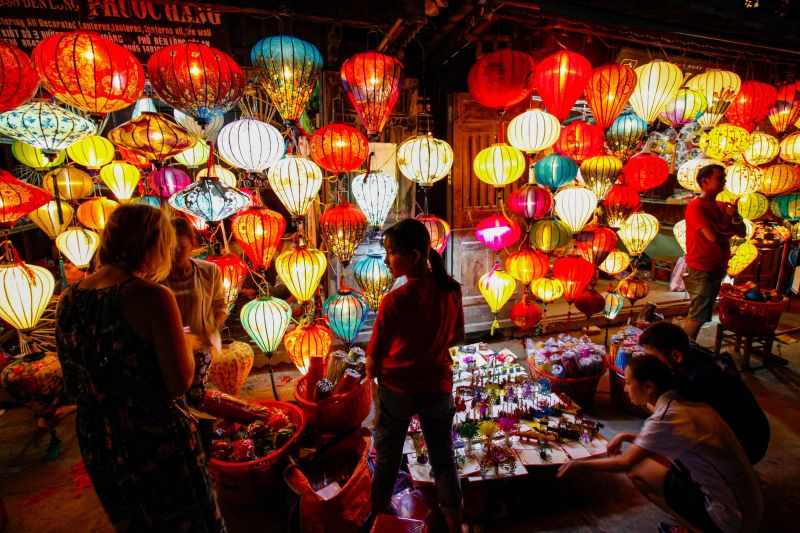
Indian tourists hold a cultural advantage at Hoi An Night Market — bargaining is a familiar transaction format across Indian markets, from Rajasthan bazaars to Crawford Market in Mumbai. The negotiation dynamics follow the same structure as Indian bazaar bargaining: the initial price offered is high, the buyer counters significantly lower, and both parties settle at a mid-point.
Initial asking prices at Hoi An Night Market run 40 to 60% above the actual transactable price. A realistic target settlement price is 50 to 60% of the original asking price.
Items You Can and Cannot Haggle for at Hoi An Night Market
Haggling at Hoi An Night Market is appropriate and expected for 8 product categories: lanterns, silk scarves, clothing and fabric, lacquerware, wooden items, embroidered products, tailor service quotes, and multi-item souvenir purchases.
Haggling is not appropriate for food and beverages (fixed prices displayed on menus or boards), boat fees for lantern release on the Hoai River (fixed rates set by the operator), and entry fees where applicable.
Purchasing 3 or more items from the same stall creates the strongest basis for requesting a bundle price — Indian tourists use the phrase “Bundle deal?” with vendors, who respond by reducing the per-item cost by 10 to 20%.
The most useful Vietnamese phrase for price negotiation at Hoi An Night Market is “Rẻ hơn không?” (Can you go cheaper?). The pronunciation is “Reh hun khong?” — even approximate pronunciation is recognised and appreciated by vendors as a sign of respect.
Haggling Strategy and Common Mistakes Indian Tourists Make at the Market
A four-step negotiation process works consistently well at Hoi An Night Market:
- Step 1: Indian tourists walk the full length of Nguyen Hoang Street once before purchasing anything at Hoi An Night Market. The reconnaissance walk establishes the price range for identical or similar items across multiple stalls — tourists who skip the reconnaissance walk overpay at the first stall they visit due to no reference baseline.
- Step 2: Indian tourists express interest calmly and neutrally when stopping at a Hoi An Night Market stall. Visible enthusiasm — picking up an item immediately or calling others over excitedly — signals high buyer motivation to vendors and anchors the opening price higher.
- Step 3: Indian tourists counter-offer at 40% of the initial asking price at Hoi An Night Market. The expected settlement zone is 55 to 60% of the initial asking price — starting at 40% creates enough room to negotiate upward while landing in the 55 to 60% target settlement zone.
- Step 4: Indian tourists begin walking away from the stall if the vendor does not meet the target price. Most Hoi An Night Market vendors — Vietnamtour.in field observations across 200+ Indian group transactions estimate roughly 7 in 10 — call the buyer back within 3 to 5 steps and accept a revised offer close to the target price.
Indian tourists make 3 common negotiation mistakes at Hoi An Night Market that reduce bargaining effectiveness:
The first common mistake is completing a negotiation and then declining to purchase. In Vietnamese market culture, finalising a negotiation creates a social commitment. Walking away from a stall after agreeing on a price — without buying — is considered disrespectful and creates an uncomfortable interaction for both parties. Indian tourists at Hoi An Night Market negotiate only when genuinely intending to buy.
The second common mistake is making price comparisons loudly in front of the vendor — for example, telling a travel companion in English or Hindi that the same item was cheaper at a different stall while the vendor is present. Making loud price comparisons damages the negotiation relationship.
The third common mistake is aggressive bargaining on items priced below ₹175 (50,000 VND). The time and social friction invested in negotiating small-value items at Hoi An Night Market does not justify the marginal saving — Indian tourists reserve negotiation energy for higher-value purchases like scarves, lacquerware, and tailor services.
Hoi An Night Market Tour from Da Nang vs Travelling Independently in 2026
2 primary transport options connect Indian tourists from Da Nang to Hoi An Night Market: travelling independently by Grab or taxi, or joining an organised day tour that includes Hoi An Night Market as its final stop. The distance between Da Nang city centre and Hoi An Night Market is 30 kilometres, with a typical travel time of 45 to 60 minutes depending on traffic.
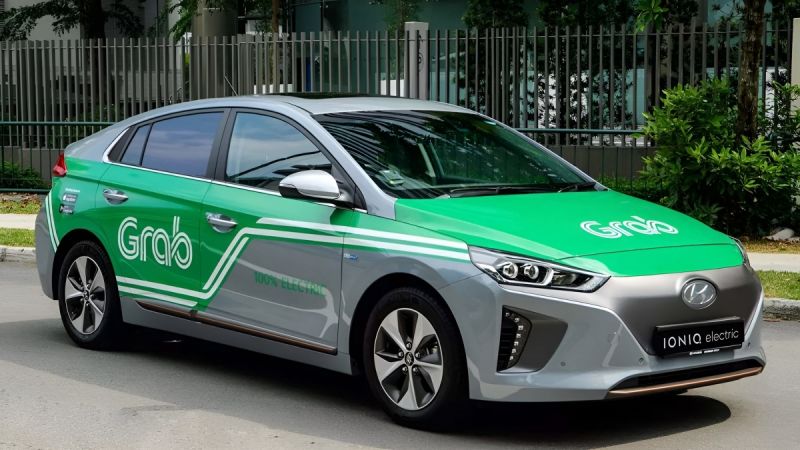
The choice between Grab and an organised day tour from Da Nang to Hoi An Night Market depends on budget, group size, flexibility preference, and whether Indian tourists want to see additional Hoi An attractions beyond Hoi An Night Market.
Da Nang to Hoi An Night Market by Grab or Taxi
Travelling from Da Nang to Hoi An Night Market by Grab car covers 30 kilometres and costs ₹490 to ₹700 one way (180,000 to 250,000 VND), with a travel time of 45 to 60 minutes from Da Nang city centre. Metered taxis on the Da Nang to Hoi An Night Market route charge 10 to 15% more than Grab. Vietnamtour.in transport coordinators handling Da Nang–Hoi An evening transfers for Indian groups recommend pre-booking the return ride before 10:30 PM, as surge pricing increases average fares by 15 to 25% during market closing hours.
Grab does not operate pick-up or drop-off inside Hoi An Ancient Town’s pedestrian zone. The Grab drop-off point is at the boundary of Hoi An Ancient Town’s pedestrian zone, 500 metres walking distance from Hoi An Night Market’s entrance on Nguyen Hoang Street. The 500-metre walk from the Grab drop-off point to Hoi An Night Market is well-lit and clearly signed.
Indian tourists book the return Grab ride from Hoi An Night Market before 10:30 PM rather than waiting until 11:00 PM closing. Surge pricing on Grab activates in the final 30 to 45 minutes of market operation as multiple visitors simultaneously request rides. Pre-scheduling the return inside the Grab app prevents both surge pricing and waiting time.
Hoi An Night Market Day Tours from Da Nang
Organised day tours from Da Nang to Hoi An Night Market depart at 3:30 PM and return to Da Nang by 9:00 PM — a 5.5-hour circuit covering Marble Mountains, Hoi An Ancient Town, dinner, and Hoi An Night Market in a single evening. The tour includes hotel pickup from Da Nang, a guided stop at Non Nuoc Stone Carving Village and Marble Mountains (Linh Ung Pagoda, Huyen Khong Cave, and Vong Giang Dai viewpoint), a sit-down dinner at a Hoi An restaurant, a guided walk through Hoi An Ancient Town, and free time at Hoi An Night Market before the 8:30 PM return departure.
Da Nang to Hoi An Night Market day tour prices range from ₹530 to ₹1,580 (150,000 to 450,000 VND) per person, depending on the operator and whether dinner is included. Indian group tours of 8 or more people negotiate a group rate that reduces the per-person cost by 15 to 25%.
The primary advantage of a Da Nang to Hoi An Night Market day tour over independent Grab travel is logistical simplicity — return transport is pre-arranged, Hoi An Ancient Town navigation is guided, and the cost per person for groups is lower than individual Grab fares from Da Nang. Tour departure times are fixed on day tours, limiting spontaneous extended shopping or additional time at specific Hoi An Night Market stalls.
Beyond the Hoi An Night Market itself, Indian tourists planning a multi-day Hoi An stay benefit from a consolidated reference covering Ancient Town assembly halls, riverside restaurants, and day-trip options. The things to do in Hoi An guide covers these adjacent attractions in a single reference.
Best Time to Visit Hoi An Night Market for Indian Tourists
The best time to visit Hoi An Night Market is February to July, during the dry season, when clear skies and temperatures of 24 to 32°C (75 to 90°F) create stable evening conditions for walking the full market length and releasing lanterns on the Hoai River.
January and February in Hoi An — the post-Lunar New Year shoulder season — sit at the quieter end of the dry season. Tourist volume is at its annual low during January and February, hotel prices drop 20 to 40% compared to peak months, and negotiation conditions across all market stall categories are the most favourable of the year.
October through December brings Hoi An’s flood and typhoon season. Hoi An Night Market remains open from October through December, but flooding from the Thu Bon River system can affect the low-lying streets of An Hoi Island, including Nguyen Hoang Street. Flooding events on An Hoi Island are short in duration but disrupt market stall operations when they occur.
According to Vietnamtour.in seasonal travel planners for Indian holiday calendars, March (Holi period) and June school holidays generate the highest Indian visitor concentration at Hoi An Night Market due to dry weather and family travel windows. Diwali (October to November) falls at the start of Hoi An’s rainy season — Indian tourists monitor flood forecasts for Hoi An in the week before departure during this window.
Indian travellers planning a Vietnam trip timing around Central Vietnam’s seasonal weather patterns require a consolidated seasonal reference covering Hoi An’s monthly conditions, festival dates, and crowd levels. The best time to visit Hoi An guide covers the complete seasonal breakdown for Indian tourists planning around Holi, Diwali, and school holiday windows.
6 Things Indian Tourists Must Know Before Visiting Hoi An Night Market
6 practical issues consistently affect Indian tourists at Hoi An Night Market — each confirmed from direct on-ground experience.
- Cash is the only accepted payment at most Hoi An Night Market stalls — the majority of vendors do not accept credit cards, debit cards, or UPI-linked international payment apps. Indian tourists bring Vietnamese Dong (VND) in cash before entering the market. The nearest ATM to the entrance is 600 metres away on Tran Phu Street inside Hoi An Ancient Town. Exchange rates at jewellery shops (vàng bạc) within Hoi An Ancient Town are 1 to 2% better than bank rates.
- Shoulder and knee coverage is required in the public areas adjacent to Hoi An Night Market’s UNESCO-listed historic area. Light cotton or linen clothing that covers shoulders and knees is appropriate and practical for the market’s warm evening temperatures.
- Complete the purchase once price is finalised. In Vietnamese market culture, completing a price negotiation and then declining to buy is considered disrespectful — Indian tourists at Hoi An Night Market enter bargaining only for items they intend to purchase.
- Keep bags positioned in front of the body in the market’s crowded sections. The food stall zone in the middle of Hoi An Night Market reaches the highest crowd density between 7:30 PM and 9:00 PM — keeping bags in front reduces the risk of opportunistic theft in dense crowds.
- Download offline maps before arriving. Hoi An Night Market does not have public Wi-Fi infrastructure. Google Maps and Maps.me both support offline map downloads for Hoi An — Indian tourists download the Quang Nam Province map in advance to navigate the An Hoi Island lane network without mobile data.
- Bring a cloth tote bag for purchases. Many Hoi An Night Market stalls charge for plastic bags or no longer stock them due to Hoi An’s plastic reduction policies — a compact reusable tote takes minimal luggage space and eliminates the plastic bag inconvenience entirely.
Frequently Asked Questions: Hoi An Night Market for Indian Tourists
Is Hoi An Night Market Free to Enter?
Hoi An Night Market has no entry fee. There are no tickets, no gate charges, and no registration required to enter Hoi An Night Market on Nguyen Hoang Street. All costs incurred during a Hoi An Night Market visit are entirely voluntary — from food to souvenirs to lantern release. The minimum realistic budget for one person at Hoi An Night Market is ₹350 to ₹700 (100,000 to 200,000 VND), covering one food item or meal, one paper lantern for the Hoai River release, and one or two small souvenir purchases.
Can Indian Tourists Use Indian Rupees at Hoi An Night Market?
Indian Rupees (INR) are not accepted at any stall in Hoi An Night Market. The only currencies accepted at Hoi An Night Market are Vietnamese Dong (VND) and, at some larger souvenir stalls, US Dollars (USD). No Hoi An Night Market vendor accepts INR as direct payment. Currency exchange is available inside Hoi An Ancient Town at jewellery shops, which offer rates 1 to 2% better than commercial bank exchange booths. The 2026 reference exchange rate is 1 INR = 290 to 300 VND.
How Many Hours Do Indian Tourists Need at Hoi An Night Market?
2 to 3 hours is sufficient to complete the full Hoi An Night Market experience. A structured 2 to 3 hour time allocation breaks down as follows: one complete walk along the market’s 300-metre length takes 30 minutes at a browsing pace; dinner at a food stall takes 45 to 60 minutes; shopping and negotiation across 2 to 4 stalls takes 45 to 60 minutes; and lantern release on the Hoai River takes 20 to 30 minutes.
Indian tourists who visit a tailor shop near Hoi An Night Market to begin the measurement and fabric-selection process add 30 to 45 minutes to the total visit duration.
The optimal arrival time is 6:30 PM, with departure at 9:30 to 10:00 PM. The 6:30 PM to 10:00 PM window allows a full experience without rushing and ensures return transport booking before Grab surge pricing activates.
How Do I Get Directions to Hoi An Night Market from My Hotel?
Hoi An Night Market is located at Nguyen Hoang Street, An Hoi Island, Hoi An City — searchable on Google Maps as “Hoi An Night Market” or “Chợ Đêm Hội An”. Indian tourists staying inside Hoi An Ancient Town walk to Hoi An Night Market in 5 to 10 minutes via the An Hoi footbridge near Nguyen Phuc Chu Street. Indian tourists staying in Da Nang travel 30 kilometres by Grab (45 to 60 minutes, ₹490 to ₹700 one way) or organised day tour. The Grab drop-off point is at Hoi An Ancient Town’s pedestrian zone boundary, 500 metres walk from the market’s entrance — Google Maps directions from the drop-off to Nguyen Hoang Street are signposted in English and Vietnamese.
What Should Indian Tourists Buy at Hoi An Night Market?
Indian tourists buy 5 product categories at Hoi An Night Market: silk scarves (₹350 to ₹1,050), small decorative lanterns (₹175 to ₹525), embroidered tablecloths and cushion covers (₹350 to ₹1,400), wooden lacquerware (₹210 to ₹700), and custom wooden name stamps (₹105 to ₹210). Custom-tailored garments — Áo Dài, linen shirts, and silk kurtas — are completed within 24 to 48 hours by Hoi An tailor shops adjacent to Hoi An Night Market, priced ₹700 to ₹3,500 depending on fabric.
Is Hoi An Night Market Safe for Indian Families and Solo Female Travelers?
Hoi An Night Market is one of the safest night markets in Vietnam for Indian families and solo female travellers. The market’s pedestrian-only zone is monitored by security cameras throughout, and police patrols operate in Hoi An Ancient Town adjacent to Hoi An Night Market during evening hours.
The absence of vehicle traffic at Hoi An Night Market eliminates road safety concerns for Indian families with young children. The main strip is fully lit from end to end, with no unlit sections or side alleys within the official market boundary.
3 standard precautions apply at Hoi An Night Market during peak hours: Indian tourists keep bags in front of the body during peak hours (7:30 to 9:00 PM); mobile phones are kept off table surfaces at food stalls; and awareness of immediate surroundings is most important in the food zone, where crowd density peaks between 7:30 to 9:00 PM.
What Is the Difference Between Hoi An Night Market and Hoi An Lantern Festival?
Hoi An Night Market and Hoi An Lantern Festival are two distinct events that overlap on one night each month.
Hoi An Night Market is a nightly event operating from 6:00 PM to 11:00 PM, 365 nights per year. The market focuses on commercial activity: food, shopping, and the floating lantern experience on the Hoai River.
The Hoi An Lantern Festival — also called Phố Cổ Night — occurs exclusively on the 14th day of each lunar month. On Hoi An Lantern Festival night, all electric lighting in Hoi An Ancient Town is extinguished — oil lamps and hanging lanterns replace artificial lighting across Hoi An Ancient Town’s entire heritage zone. Traditional musical performances and cultural demonstrations take place at public venues throughout Hoi An Ancient Town on Lantern Festival night.
On Hoi An Lantern Festival nights, Hoi An Night Market continues operating within the darkened Hoi An Ancient Town atmosphere. The market’s commercial activity and the Hoi An Lantern Festival atmosphere overlap — visitors participate in both on the same evening.
Indian travellers who want the full Hoi An Lantern Festival experience — including traditional performances and Hoi An Ancient Town with all electric lights extinguished — require a dedicated reference beyond the scope of Hoi An Night Market alone. The Hoi An Lantern Festival guide covers the complete monthly festival schedule, traditional performance venues, and planning details for Indian tourists.