Markets in Vietnam are part of daily life in every town: each ward has a daily market (chợ), cities add night markets and flower markets, the Mekong Delta has floating markets, and the northern highlands hold weekly ethnic markets. Markets are where Vietnamese families eat breakfast, buy the day’s vegetables and meet neighbours, so a morning at one is the fastest way to see everyday life in a Vietnamese town.
This guide from Vietnamtour.in covers 12 local markets from Hanoi to Phu Quoc, with opening hours, the best time to go, what to eat and practical tips for each visit.
Markets in Vietnam at a Glance
Markets in Vietnam come in 5 kinds, and most are busiest before 8 AM or after 6 PM.
- Daily markets (chợ): every ward has one, busiest from about 5 AM to 8 AM.
- Night markets: Hanoi’s Old Quarter runs one from Friday to Sunday evenings, while Hoi An, Nha Trang and Phu Quoc hold one every night.
- Floating markets: Cai Rang in Can Tho is the largest still trading, starting around 4–5 AM.
- Highland ethnic markets: these fall on fixed weekdays, with Bac Ha on Sunday, Can Cau on Saturday about 20 km further north and Coc Ly on Tuesday.
- Wholesale flower markets: Quang Ba in Hanoi and Ho Thi Ky in Ho Chi Minh City trade through the night.
| Market | City | Type | Best for | Hours | Go when |
|---|---|---|---|---|---|
| Ben Thanh Market | Ho Chi Minh City | Day market + evening stalls | City landmark, food corner | Indoor 6 AM–6 PM; evening stalls outside | Morning or after 6 PM |
| Cai Rang Floating Market | Can Tho | Floating market | Boat trade on the river | About 4–9 AM | 5:30–7 AM |
| Dong Xuan Market | Hanoi | Wholesale hall | Old Quarter life, street-food lanes | 6 AM–6 PM; night market outside Fri–Sun | Morning |
| Bac Ha Market | Bac Ha, Lao Cai | Weekly highland market | Ethnic dress, livestock trade | Sun, about 6 AM–2 PM | Sunday, 7–10 AM |
| Hoi An Night Market | Hoi An | Night market | Lanterns, street snacks | About 5–11 PM | After 6 PM |
| Hoi An Central Market | Hoi An | Day market | Cao lau, riverside fish landing | Early morning to about 7 PM | 6–8 AM |
| Ho Thi Ky Flower Market | Ho Chi Minh City | Flower market + food alley | Colour, late-night trade | 24 hrs; food alley about 3–11 PM | 7–10 PM |
| Dong Ba Market | Hue | Day market | Hue food, riverside setting | About 6 AM–6 PM | Early morning |
| Han Market | Da Nang | Day market | Dried seafood, fish sauces, quick lunch | 6 AM–7 PM | Morning |
| Dam Market | Nha Trang | Day market | Seafood, dried squid, local snacks | About 5 AM–6:30 PM | Morning |
| Phu Quoc Night Market | Phu Quoc | Night market | Seafood grills | About 5–11:30 PM | After 6 PM |
| Quang Ba Flower Market | Hanoi | Wholesale flower market | Pre-dawn flower trade | About midnight to early morning | 1–4 AM |
Hours vary around Tet, when many markets close for several days.
Ben Thanh Market

Ben Thanh Market is Ho Chi Minh City’s best-known market, a hall with a clock tower that opened in March 1914 and is ringed by street-food stalls after dark.
- Address: Quach Thi Trang Square, Le Loi Street, Ho Chi Minh City
- Open: indoor hall 6 AM to 6 PM, with evening stalls on the surrounding streets
- Getting there: Metro Line 1 Ben Thanh station stands beside the market
- Tip: prices quoted to visitors run high, so eating is better value than buying
Ben Thanh Market was built from 1912, with 4 main gates facing the streets around the square. The indoor food corner is the reason most visitors stay, with banh xeo, com tam and che served at counters with stools, and coffee, spices, dried fruit and nuts fill the aisles nearby.
Cai Rang Floating Market

Cai Rang Floating Market is the largest floating market in the Mekong Delta, where wholesale boats trade fruit and vegetables on the Can Tho River at dawn.
- Address: Can Tho River near Cai Rang Bridge, Can Tho
- Open: daily, about 4 AM to 9 AM
- Best time: 5:30–7 AM, as the market thins out after about 8 AM
- Getting there: about 30 minutes by boat from Ninh Kieu Wharf, roughly 6 km downriver
Wholesale boats hang samples on a tall bamboo pole called a cay beo, so buyers can see what each boat carries from a distance. Pineapples, pomelos and watermelons change hands by the sackful, and smaller boats sell hu tieu noodle soup and coffee to passing tourist boats. Cai Rang was recognised as a national intangible cultural heritage in 2016, although fewer trading boats work the river than in past decades.
Dong Xuan Market

Dong Xuan Market is Hanoi’s largest wholesale market, a 3-floor hall in the Old Quarter ringed by lanes of street-food stalls.
- Address: Dong Xuan Street, Old Quarter, Hanoi, about 1 km north of Hoan Kiem Lake
- Open: daily, 6 AM to 6 PM
- Best time: morning; the Old Quarter night market runs from Hang Dao Street to the market gate from Friday to Sunday evenings
- Tip: stalls inside sell mostly wholesale, so individual buyers do better in the lanes outside
Dong Xuan Market dates from 1889, and its first hall went up in 1890 behind a facade of 5 arches. A fire destroyed the building on 14 July 1994, and the market reopened as a 3-floor hall that keeps the old 5-arch outline. The surrounding lanes serve bun cha, banh cuon and pho from early morning until late, and craft shops nearby sell Dong Ho paintings and Bat Trang ceramics.
Bac Ha Market

Bac Ha Market is the largest weekly market in Lao Cai Province, where Flower Hmong, Dao, Tay and Nung families gather every Sunday to trade buffalo, horses, food and handwoven cloth.
- Address: centre of Bac Ha town, Lao Cai Province
- Open: Sundays, about 6 AM to 2 PM
- Best time: 7–10 AM, before the tour vehicles from Sapa arrive
- Getting there: about 100 km from Sapa, around 3 hours by road
The market fills with Flower Hmong women in embroidered skirts and bright headscarves, and the textile rows hold the densest patterns on sale. A livestock section at the edge of town trades buffalo and horses from first light. Can Cau on Saturday and Coc Ly on Tuesday suit trips that miss Sunday, and market days can shift around Tet, so a Sapa route works best when it is planned around the market calendar.
Hoi An Night Market

Hoi An Night Market is the town’s lantern-lit evening market across the river from the old town, strung with silk lanterns and street-snack stalls.
- Address: Nguyen Hoang Street, An Hoi, Hoi An
- Open: nightly, about 5 PM to 11 PM
- Best time: after 6 PM, and busiest on the 14th day of each lunar month for Full Moon Lantern Night
- Tip: paper lanterns are floated on the Thu Bon River beside the An Hoi bridge
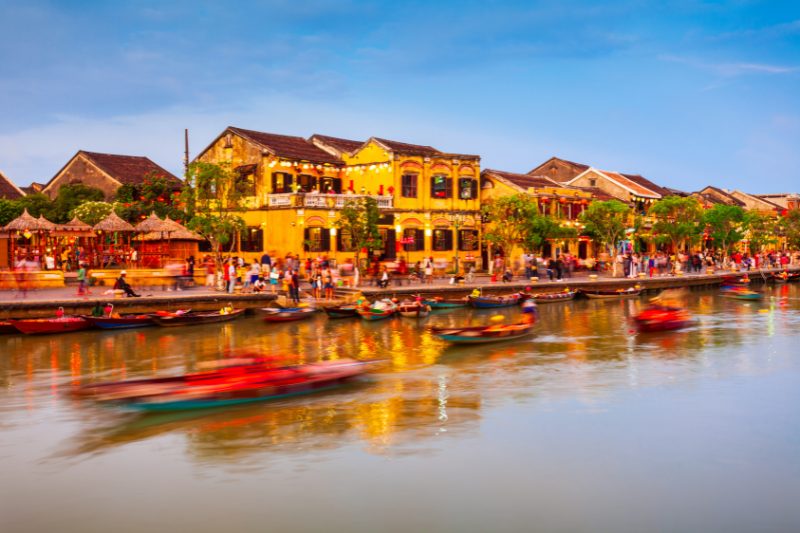
Silk lanterns hang the length of Nguyen Hoang Street, with lantern makers working at the back of several stalls. Food carts serve banh mi, grilled skewers, mango rice paper and fresh juice, and the An Hoi bridge links the market to the old town, so most visitors arrive on foot after dinner.
Hoi An Central Market
Hoi An Central Market is the old town’s main day market on the Thu Bon riverside, where fishing boats unload at dawn and the food court serves cao lau.
- Address: 19 Tran Phu Street, Hoi An Ancient Town
- Open: from early morning, with food stalls until about 7 PM
- Best time: 6–8 AM
- Price: food-court dishes cost about 10,000–40,000 VND (₹35–₹140)
The market occupies a French-era hall that opens straight onto the Thu Bon River, where fishing boats land the night’s catch at first light. The food court behind the hall serves cao lau with its thick noodles, mi Quang, banh xeo and che, herb sellers line the aisles nearest the water, and the cloth market sits a short walk along the same street.
Ho Thi Ky Flower Market
Ho Thi Ky Flower Market is Ho Chi Minh City’s largest flower market, a round-the-clock lane of blooms from Da Lat and the Mekong Delta with a street-food alley beside it.
- Address: Alley 52, Ho Thi Ky Street, Ho Chi Minh City
- Open: 24 hours, with the food alley running from about 3 PM to 11 PM
- Best time: 7–10 PM for food and flowers, or after midnight for the wholesale unloading
- Tip: the food alley behind the flower lanes has a Cambodian-influenced food row
Ho Thi Ky has traded since 1987 and has sold only flowers since 1996, with orchids from Da Lat, chrysanthemums from the Mekong Delta and lilies from the central provinces filling a dense network of lanes. Trucks unload from about midnight to dawn, and the market is at its busiest before Tet, when deliveries multiply.
Dong Ba Market
Dong Ba Market is the largest market in Hue, a riverside market on the Perfume River that has traded on its current site since 1899.
- Address: 2 Tran Hung Dao Street, Hue, by Truong Tien Bridge
- Open: daily, about 6 AM to 6 PM
- Best time: early morning, when the hall is cooler and most vendors are trading
- Tip: a separate row of food stalls sets up at the front of the market after dark
Emperor Thanh Thai moved the market to its present site in 1899, and it has remained Hue’s main trading place ever since. Food aisles inside serve bun bo Hue, banh beo and com hen, the clam rice dish of the riverbank villages, while me xung sesame candy is cut in the same rows and conical hats from nearby craft villages hang near the front gates.
Han Market
Han Market is Da Nang’s central market, a 2-floor hall known for dried squid, fish sauces and quick local lunches.
- Address: 119 Tran Phu Street, Da Nang, near the Han River Bridge
- Open: daily, 6 AM to 7 PM
- Best time: morning, when the seafood counters are busiest
- Tip: food and dried goods sit downstairs and fabric upstairs
Han Market stands a short walk from the Da Nang riverfront and the pink cathedral. The ground floor holds dried squid, dried shrimp and rows of fish sauce from Nam O and Phu Quoc, along with a food row serving bun mam and banh beo, and the upper floor is given over to fabric, with tailors who take measurements on the spot.
Dam Market

Dam Market is Nha Trang’s central market, recognised by its round lotus-roofed hall, with trading now held in a 3-floor building directly behind it.
- Address: Ben Cho Street, Nha Trang, about 2 km north of the beachfront centre
- Open: daily, about 5 AM to 6:30 PM
- Best time: morning, for the freshest seafood
- Tip: dried squid and dried fish are the market’s best-known take-home buys
The round hall from the 1970s is no longer used for trading but remains a Nha Trang landmark, and stalls now fill the new 3-floor market behind it, with fresh-food areas spilling around the outside. Seafood and dried squid fill much of the ground floor, and small stalls serve banh can and bun cha ca through the morning.
Phu Quoc Night Market

Phu Quoc Night Market is the island’s main night market in Duong Dong, where seafood is picked from tanks and grilled to order.
- Address: Bach Dang Street, Duong Dong, Phu Quoc, near Dinh Cau Temple
- Open: nightly, about 5 PM to 11:30 PM, with some stalls later in peak season
- Best time: after 6 PM, following sunset at Dinh Cau Temple
- Tip: ask the price by weight before any seafood goes on the grill
The market lines Bach Dang Street along the Duong Dong River with tanks of prawns, scallops, squid and reef fish cooked over charcoal. Snack stalls fill the gaps with banh trang nuong and ice-cream rolls, and souvenir stalls sell pearls, shells and Phu Quoc pepper.
Quang Ba Flower Market
Quang Ba Flower Market is Hanoi’s night wholesale flower market, where growers unload roses, lilies and seasonal blooms under dim lights while most of the city sleeps.
- Address: 236 Au Co Street, Tay Ho, Hanoi, about 4.5 km from the Old Quarter
- Open: nightly, from about midnight until early morning; closed over the Tet holiday
- Best time: 1–4 AM, and busiest in the weeks before Tet
- Getting there: a Grab car is the easiest option at that hour
Growers arrive by motorbike stacked with bundles and sort stems by flashlight, selling roses, lilies and chrysanthemums by species rather than in mixed bouquets. Peach branches take over the lanes before Tet, and demand rises again before the 1st and 15th of each lunar month, when households buy flowers for family altars.
Tips for Visiting Markets in Vietnam
The best way to see markets in Vietnam is to go early for day markets, late for night markets and carry small cash notes.
| Tip | Why |
|---|---|
| Arrive before 8 AM for day markets and after 6 PM for night markets | Produce is freshest early, and night stalls only open in the evening |
| Carry small notes of 10,000–50,000 VND (₹35–₹170) | Vendors rarely have change for a 500,000 VND note |
| Keep bags in front and phones in a zipped pocket | Aisles get crowded, especially at Ben Thanh and Dong Xuan |
| Ask before photographing a vendor | Most agree, and some prefer not to be photographed |
| Bargain only for non-food items, starting around 60–70% of the asking price | Cooked food usually has set prices, while craft and things to buy in Vietnam such as silk, lacquer and coffee do not |
| Eat where local people are already sitting | Higher turnover means fresher food |
| Go with a guide for the first market visit | A guide reads the labels, confirms prices and finds the vegetarian and Jain stalls |
FAQs about Markets in Vietnam
What is the most famous market in Vietnam?
Ben Thanh Market in Ho Chi Minh City and Dong Xuan Market in Hanoi are the most famous markets in Vietnam. Ben Thanh is the southern city’s 1914 landmark with its clock tower, while Dong Xuan is the capital’s largest wholesale hall. Bac Ha and Cai Rang are better known among travellers looking for regional trade rather than city landmarks.
What time do markets in Vietnam open?
Most day markets open around 5–6 AM, night markets open around 5–6 PM, and floating markets start trading by 4–5 AM. Wholesale flower markets such as Quang Ba and Ho Thi Ky trade through the night, and hours shift around Tet, when many markets close for several days.
What mistakes should visitors avoid at markets in Vietnam?
The most common mistakes are paying with large notes, ordering seafood without asking the price by weight and bargaining over cooked food. Arriving at a day market at midday also misses most of the trade, and photographing vendors without asking can cause offence.
Are markets in Vietnam safe?
Yes, markets in Vietnam are safe for visitors, although pickpocketing can happen in crowded aisles. Bags worn in front and phones kept in zipped pockets solve most problems, and walking at the edge of the aisle helps where motorbikes pass, as at Ho Thi Ky and Dong Xuan.
Which markets in Vietnam are best for photography?
Bac Ha, Cai Rang and Quang Ba are the best markets in Vietnam for photography. Each peaks in low light: sunrise on the Can Tho River, the small hours under flower-market lamps and the Sunday morning crowd in Bac Ha. Vendors should always be asked before a portrait.
Can you pay by card at markets in Vietnam?
Cash is standard at markets in Vietnam, and card terminals are rare outside a few larger indoor stalls. Many vendors accept VietQR bank transfers, but visitors without a Vietnamese bank account should carry notes, and ATMs stand near the entrances of Ben Thanh, Han and Dam markets.
Plan Your Vietnam Markets Visit
Markets in Vietnam run from Sunday mornings in the Lao Cai highlands to dawn on the Can Tho River and midnight flower lanes in Hanoi and Ho Chi Minh City. Day markets reward an early start and night markets an evening one, and the 12 in this guide cover both ends of the country.
Market visits work best slotted into a wider route, with a guide who knows which stalls cook vegetarian and Jain food to order. Vietnamtour.in has planned trips for more than 428,000 travellers since 2015, and every Vietnam tour package 2026 can be timed around market days, from Sunday in Bac Ha to dawn at Cai Rang. Share the travel dates in the form below for a private itinerary.
RELATED ARTICLES