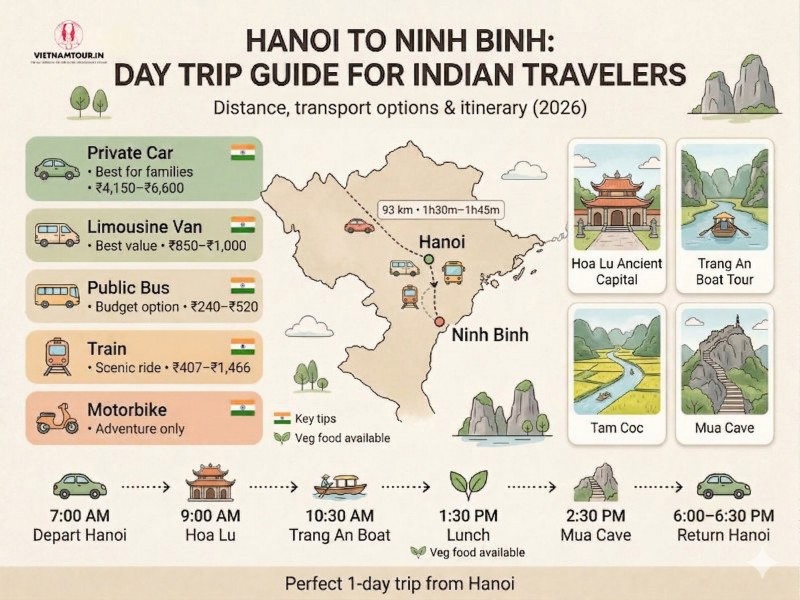
Ninh Binh is 93 km south of Hanoi and reachable in 1 hour 30 minutes to 1 hour 45 minutes by private car via the Pháp Vân – Cầu Giẽ – Ninh Bình Expressway — making it the closest UNESCO-connected landscape to the capital and the most practical day trip destination for Indian travelers visiting North Vietnam. This guide covers all 5 transport options with INR pricing, a cost-and-time comparison, day trip departure logistics, and practical tips — based on 2026 pricing.
Hanoi to Ninh Binh Transport Comparison
Indian travelers reach Ninh Binh from Hanoi by 5 transport options — each with different INR costs, travel times, and suitability for a day trip:
| Option | Cost (INR) | Duration | Door-to-Door | Best For |
|---|---|---|---|---|
| Private Car | ₹4,150–₹6,600/vehicle | 1h 30m–1h 45m | Yes | Families, groups |
| Limousine Van | ₹850–₹1,000/person | 1h 45m–2h | Yes | Couples, small groups |
| Public Bus | ₹240–₹520/person | 2–2.5h | No | Budget solo travelers |
| Train | ₹407–₹1,466/person | ~2h | No | Budget travelers, scenic experience |
| Motorbike | ₹500–₹700/day total | 2.5–3h | Yes | Adventure riders only |
Private car and limousine van are the only 2 options that deliver door-to-door service between your Hanoi hotel and Ninh Binh attractions. Bus and train both require secondary Grab rides at Ninh Binh to reach Trang An or Tam Coc, adding extra cost and transfer time at each end. The following sections break down each option with detailed pricing, booking timelines, and head-to-head comparisons.
Private Car Transfer from Hanoi to Ninh Binh
A private car transfer costs ₹4,150–₹6,600 (1,203,500–1,914,000 VND) one-way for a 4-seater AC vehicle, ₹5,800–₹9,960 for a 7-seater, and ₹8,300–₹14,900 for a 16-seater minibus. All prices are per vehicle, not per person. Expressway tolls (Pháp Vân – Cầu Giẽ – Ninh Bình) are ₹155–₹500 (45,000–145,000 VND) per trip depending on vehicle size — typically included in the transfer price; confirm with the operator at booking.
One-Way Transfer Pricing (per vehicle):
| Vehicle Type | Cost (INR) | VND Equivalent |
|---|---|---|
| 4-seater AC car | ₹4,150–₹6,600 | 1,203,500–1,914,000 |
| 7-seater van | ₹5,800–₹9,960 | 1,682,000–2,888,400 |
| 16-seater minibus | ₹8,300–₹14,900 | 2,407,000–4,321,000 |
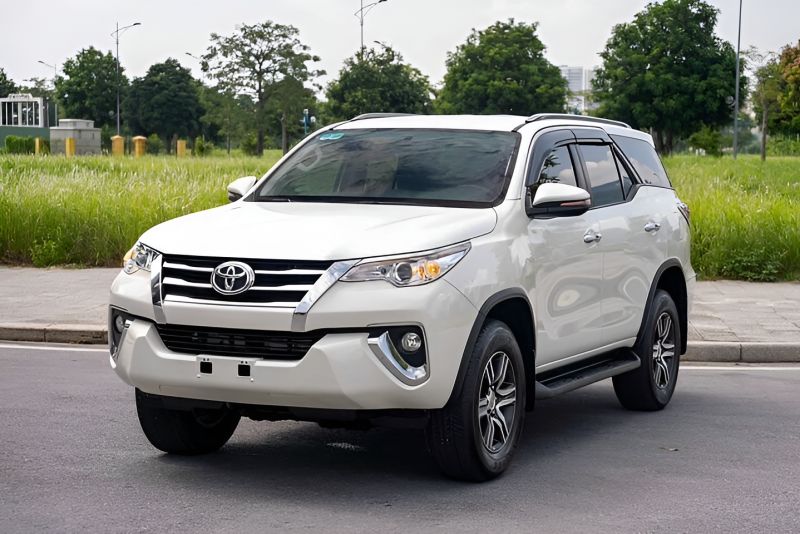
Full-day guided return packages — the most common booking format for Indian tourists — include hotel pickup from the Old Quarter, an AC vehicle, a licensed English-speaking guide, all entrance fees, a Trang An boat tour, and return transfer. Lunch (₹400–₹800), personal shopping, and tips are not included.
Full-Day Guided Return Package (per person):
| Group Size | Cost per Person (INR) |
|---|---|
| Solo traveler | ₹8,000–₹10,000 |
| Couple | ₹5,500–₹7,000 |
| Family of 4 | ₹4,500–₹6,000 |
| Group of 8+ | ₹3,500–₹4,500 |
Door-to-door travel time from Old Quarter hotels is 1 hour 30 minutes to 1 hour 45 minutes via the expressway. Book a minimum of 3 days ahead for weekends and 5 days ahead for the October–November peak season.
Private Car vs. Limousine Van
A private car costs ₹4,150–₹6,600 per vehicle versus ₹850–₹1,000 per person for a limousine van. For a family of 4, the per-person private car cost (₹1,040–₹1,650) is comparable to the limousine van — but with exclusive use of the vehicle, flexible stop timings, and no sharing with strangers. Private car is the stronger choice for families with senior travelers or children who need specific meal schedules and rest stops. Limousine van is better value for couples and solo travelers.
Full-Day Package Pricing by Group Size in INR
The per-person cost drops significantly with group size. A solo traveler pays ₹8,000–₹10,000, while a group of 8+ pays ₹3,500–₹4,500 per person — a 55–60% reduction. Indian joint families traveling as a group of 6–8 members typically find this the most cost-effective option compared to booking individual limousine van seats.
Limousine Van (Shared) from Hanoi to Ninh Binh
Limousine shared vans cost ₹850–₹1,000 (246,500–290,000 VND) per person one-way, or ₹1,600–₹2,000 for a return journey. Vehicles are 9–11 seater Ford Transit or D-Car style minivans with leather seats, AC, Wi-Fi, and USB charging ports. Travel time is 1 hour 45 minutes to 2 hours.
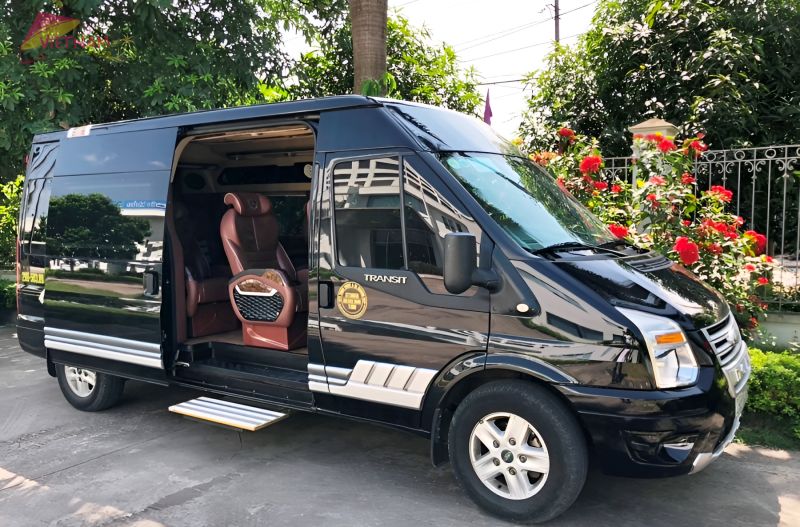
Pickup is from Old Quarter hotels, with drop-off directly at Trang An or Tam Coc entrance — eliminating the secondary transport required by bus and train. Established operators include Trang An Limousine, Duy Khang Limousine, and Khanh An Limousine. Book 2–3 days in advance; luggage space is limited to cabin-size bags only.
For Indian couples and small groups of 3–4 who want hotel-to-attraction comfort without the private car price, the limousine van is the strongest value option — comparable to a premium Ola or Uber shared ride concept familiar to Indian travelers.
Limousine Van vs. Public Bus
A limousine van costs ₹850–₹1,000 per person versus ₹240–₹520 for a public bus — roughly 2–3× the price. The critical difference is door-to-door service: the limousine van picks up from your hotel and drops at the attraction entrance, while the public bus requires a Grab taxi to Giap Bat station (₹200–₹350) plus another Grab from Ninh Binh bus station to Trang An (₹150–₹250). After adding secondary transport costs, the public bus total reaches ₹590–₹1,120 — narrowing the gap while adding 45–60 minutes of transfer time and language barrier complexity.
Booking Timeline and Luggage Limitations
Book limousine vans 2–3 days in advance for weekday travel and 4–5 days for weekends and Vietnamese public holidays. Each passenger is allowed 1 cabin-size bag (20 kg maximum). Larger suitcases must be arranged with the operator at booking — an extra luggage surcharge may apply. Indian travelers on multi-city itineraries with large luggage should consider a private car instead.
Public Bus from Hanoi to Ninh Binh
Public buses cost ₹240–₹520 (69,600–150,800 VND) per person one-way, departing from Giap Bat Bus Station — located 8 km south of the Old Quarter, requiring a prior Grab taxi (₹200–₹350) to reach. Travel time is 2–2.5 hours. Operators including Hoang Long, Hai Au, and Minh Dung run multiple daily departures from 5:30 AM.
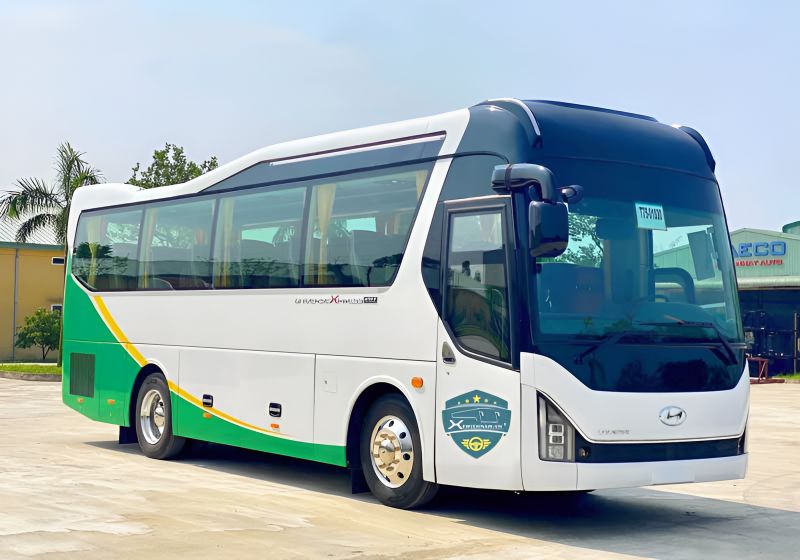
The primary limitation: buses drop at Ninh Binh town bus station, which is 8–12 km from Trang An and Tam Coc — requiring a secondary Grab ride at ₹150–₹250 per leg. For Indian families or first-time Vietnam visitors, the combination of language barriers at the station and the need for secondary transport makes this option unnecessarily complex. The public bus is suitable only for budget-conscious solo travelers who can navigate local transport independently.
Public Bus vs. Train
The public bus (₹240–₹520) and train (from ₹407 for a soft seat) are both budget-friendly, but they differ in flexibility and experience. The bus runs from 5:30 AM with departures every 10–15 minutes — no advance booking needed. The train has 7 daily departures including 3 daytime options (SE7 at 6:00 AM, SE5 at 8:55 AM, SE9 at 12:50 PM), but runs on a fixed timetable and seats sell out during peak season. Other key differences: the bus leaves from Giap Bat (8 km from Old Quarter, requires Grab), while the train departs from Hanoi Railway Station (walkable from Old Quarter). Both arrive at stations requiring secondary Grab transport to reach attractions.
Secondary Transport from Ninh Binh Bus Station to Trang An and Tam Coc
From Ninh Binh bus station, a Grab car to Trang An takes 15 minutes and costs ₹150–₹250 (43,500–72,500 VND). To Tam Coc, the ride is 20 minutes at ₹200–₹300. Local xe om (motorbike taxi) is cheaper at ₹80–₹150 but communication without Vietnamese language skills is difficult. Pre-download the Grab app with a Vietnamese SIM card before arriving at Ninh Binh bus station — Wi-Fi is not available at the station.
Train from Hanoi to Ninh Binh
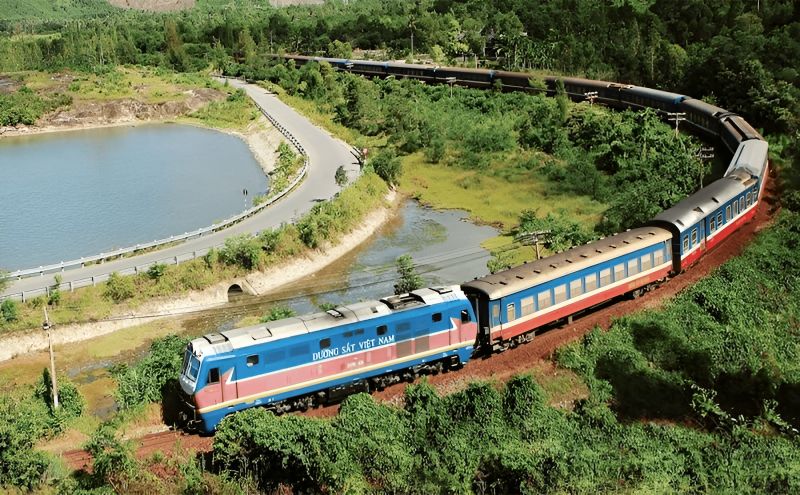
Trains from Hanoi to Ninh Binh cost ₹410–₹1,470 (118,000–425,000 VND) per person one-way, depending on seat class. Departure is from Hanoi Railway Station (Ga Hà Nội), Tran Quy Cap Street — centrally located and walkable from the Old Quarter.
2026 Daily Train Schedule (dsvn.vn — all 7 trains run daily):
| Train | Departs Hanoi | Arrives Ninh Binh | Travel Time | Day/Night |
|---|---|---|---|---|
| SE7 | 6:00 AM | 8:14 AM | 2h 14m | Morning |
| SE5 | 8:55 AM | 11:08 AM | 2h 13m | Morning |
| SE9 | 12:50 PM | 3:05 PM | 2h 15m | Afternoon |
| SE3 | 7:20 PM | 9:32 PM | 2h 12m | Evening |
| SE19 | 7:45 PM | 9:52 PM | 2h 07m | Evening |
| SE1 | 8:50 PM | 11:04 PM | 2h 14m | Night |
| SE11 | 9:25 PM | 11:40 PM | 2h 15m | Night |
Departure times may shift slightly by date — check dsvn.vn for the exact schedule on your travel day. Trains run daily except in rare cases (track maintenance, severe weather).
Seat classes and pricing (from dsvn.vn, starting prices):
| Class | Price (VND) | Price (INR) |
|---|---|---|
| Soft seat | from 118,000 | from ₹407 |
| Sleeper berth, 6-bed cabin | from 151,000 | from ₹521 |
| Sleeper berth, 4-bed cabin | from 187,000 | from ₹645 |
| VIP 2-bed cabin (select trains) | from 425,000 | from ₹1,466 |
Ninh Binh station sits 2 km from town and 10 km from Trang An — a Grab taxi (₹150–₹200) is required upon arrival. For evening arrivals (9:30–11:40 PM), pre-arrange pickup with your accommodation as Grab availability near the station is limited at night.
Train Day Trip Feasibility
The SE7 at 6:00 AM (arriving 8:14 AM) is the best train for a day trip — it places you at Trang An boat dock by 8:30 AM, ahead of the main tourist wave. The SE5 at 8:55 AM (arriving 11:08 AM) also works but compresses on-site time to 4–5 hours. For the return, the SE9 departs Ninh Binh in the early afternoon and evening trains (SE3, SE19) depart after 7:00 PM — check dsvn.vn for return options on your specific date.
The key limitation versus private car: the train adds secondary Grab transport at Ninh Binh station (₹150–₹200, 15 minutes to Trang An) and locks you to a fixed departure time. A private car or limousine van departs on your schedule and drops you directly at the attraction entrance.
Train vs. Private Car
A train soft seat costs ₹407 versus ₹4,150–₹6,600 for a private car (per vehicle) — the cheapest option on this route. For a couple, the per-person saving is ₹1,668–₹2,893 one-way compared to splitting a private car. The trade-off is flexibility: the private car departs when you want and delivers door-to-door, while the train runs on a fixed schedule with a Grab transfer at each end. For budget-conscious couples and solo travelers who can plan around the timetable, the train offers the best cost-to-experience ratio — the 2-hour ride through Red River Delta paddy fields is the most scenic transport option on this route. The remaining option — motorbike — costs even less but comes with significant restrictions for foreign riders.
Motorbike from Hanoi to Ninh Binh
Motorbike rental in Hanoi costs ₹350–₹500 (101,500–145,000 VND) per day, with petrol for the route adding ₹150–₹200. Riding time is 2.5–3 hours along National Highway 1A (Quốc lộ 1A) — motorbikes are prohibited on the Cầu Giẽ – Ninh Bình Expressway, so the journey is slower than car or van. An International Driving Permit (IDP) is mandatory — Vietnamese traffic police regularly check foreign riders, and the IDP must be obtained in India before departure.
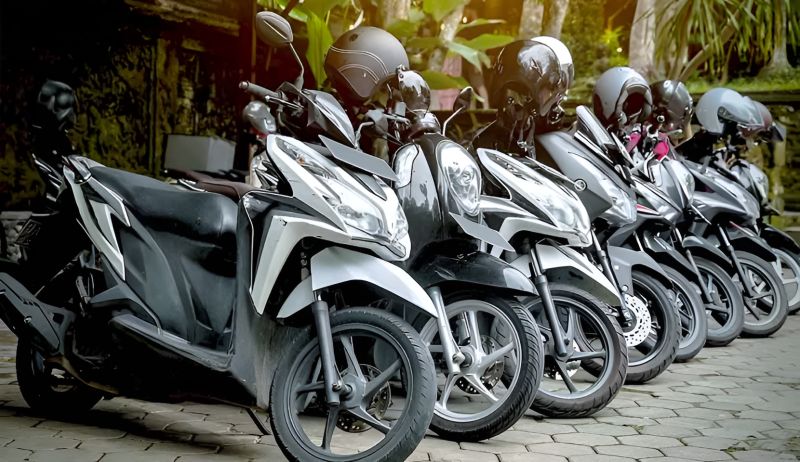
Hanoi’s city traffic is complex for first-time riders. This option is not suitable for Indian families, senior travelers, or anyone carrying significant luggage. Comprehensive travel insurance covering motorbike accidents is essential.
IDP Requirements and Insurance for Indian Riders
Indian tourists need an International Driving Permit (IDP) issued by the Regional Transport Office (RTO) in India — the standard Indian driving licence is not valid for riding in Vietnam. Apply at your nearest RTO at least 2 weeks before departure. Without an IDP, Vietnamese traffic police can fine ₹1,379–₹2,759 (400,000–800,000 VND) and impound the vehicle. Travel insurance must explicitly list “motorbike/scooter riding” as a covered activity — many standard Indian travel insurance policies exclude two-wheeler accidents.
Motorbike vs. Limousine Van
Motorbike (₹500–₹700 total including rental and petrol) is cheaper than a limousine van (₹850–₹1,000), but the cost saving is marginal. Motorbike makes sense only for experienced riders on a multi-day independent itinerary who plan to explore Ninh Binh’s countryside roads (Tam Coc → Bich Dong → Thung Nham) at their own pace — stops that a limousine van does not cover. For a standard Hanoi-to-Ninh-Binh day trip, the limousine van is faster, safer, and more practical. With transport chosen, the next step is planning the departure schedule and site sequence for the day.
Hanoi to Ninh Binh Day Trip
Depart Hanoi by 7:00 AM to arrive at Ninh Binh attractions by 8:45–9:00 AM, giving a 6–7 hour on-site window before the recommended return departure at 4:00–4:30 PM. Arriving back at Hanoi Old Quarter by 6:00–6:30 PM avoids the worst evening traffic.
The 7:00 AM departure clears Hanoi’s city traffic before the 8:00 AM weekday peak. Departing later than 7:30 AM adds 20–30 minutes to the outbound journey and compresses on-site time. For private car and limousine van travelers, hotel pickup from the Old Quarter or Hoan Kiem Lake area is standard.
A typical day trip sequence covers 3 sites in order: Hoa Lu Ancient Capital (closest to highway exit, 45–60 minutes) → Trang An boat tour (arrive before 10:30 AM to avoid peak queues, 2–2.5 hours) → Mua Cave (afternoon light for photography, 60–90 minutes). For travel in October–November, some travelers replace Mua Cave with Tam Coc to see the harvest golden paddy fields at their peak.
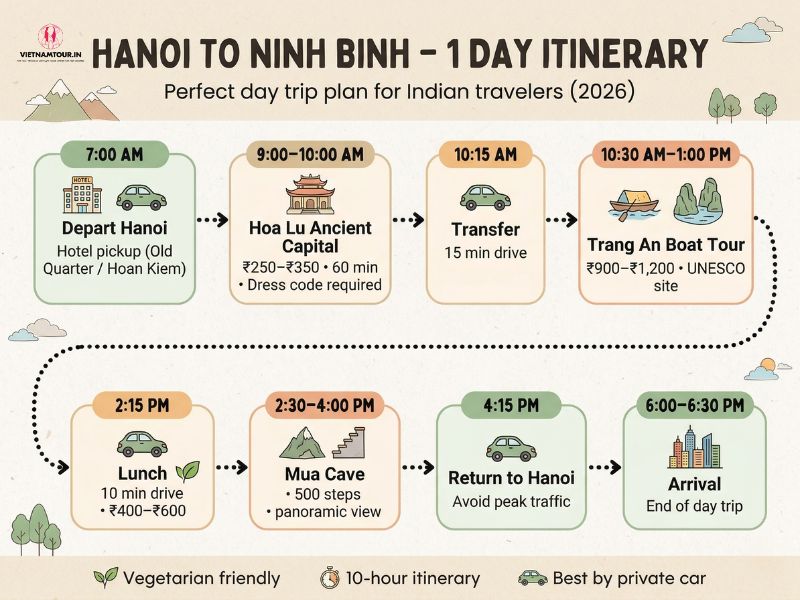

Indian travelers planning Ninh Binh as part of a broader North Vietnam itinerary can browse Vietnam tour packages that combine Ninh Binh with Hanoi, Ha Long Bay, and Sapa in a single multi-day package with INR pricing and vegetarian meal arrangements. Before committing to a day trip, however, it is worth considering whether an overnight stay would deliver a significantly better experience.
Ninh Binh Day Trip vs. Overnight Stay from Hanoi
A day trip covers 2–3 sites (Hoa Lu + Trang An + Mua Cave) within a 10-hour window at a total cost of ₹3,500–₹6,000 per person including transport. An overnight stay adds 4–5 additional sites — Bai Dinh Pagoda (Southeast Asia’s largest Buddhist temple), Cuc Phuong National Park, Thung Nham Bird Garden, Van Long Wetland, and evening cycling through Tam Coc paddy fields — at an additional ₹2,000–₹4,000 for accommodation.
Day trip is better for: Indian travelers with 7 nights or fewer in Vietnam, families who prefer returning to Hanoi hotel comforts each night, and travelers who have already allocated overnights to Ha Long Bay or Sapa.
Overnight is better for: photography enthusiasts who want sunrise at Tam Coc (5:30–6:30 AM, not reachable on a day trip from Hanoi), travelers visiting during Diwali/Navratri season who want the Bai Dinh Pagoda experience, and couples seeking a quieter evening in Ninh Binh’s countryside homestays.
For those choosing overnight, the Ninh Binh travel guide covers accommodation options, village cycling routes, and the full Bai Dinh Pagoda complex. Whether day trip or overnight, the month you travel significantly affects both the landscape and the boat tour experience.
Best Time to Travel from Hanoi to Ninh Binh for Indian Tourists
March–May and September–November are the best months for the Hanoi to Ninh Binh journey, with temperatures between 23–30°C, low rainfall, and clear conditions for boat tours and photography.
Peak recommendation: October — the golden rice harvest turns Tam Coc’s paddy fields into a landscape that Indian travelers frequently compare to terraced fields in Munnar or Coorg. This period aligns with the Dussehra–Diwali holiday window (October–November), when many Indian families schedule Vietnam trips.

Months to avoid: June–August — monsoon rainfall exceeds 250mm per month. Trang An and Tam Coc boat tours face cancellations on heavy rain days, and the Mua Cave staircase (500 steps) becomes dangerously slippery. The expressway remains safe year-round, but reduced visibility during monsoon downpours adds 15–20 minutes to driving time.
December–February: dry but cold (12–18°C). The boat ride through Trang An’s cave passages feels significantly colder on the water. Indian travelers accustomed to North Indian winters will manage comfortably; those from South India or tropical states should bring a windproof jacket. Regardless of which month you travel, there are several practical details specific to this route that Indian tourists should prepare for before leaving Hanoi.
6 Things Indian Tourists Must Know Before Traveling from Hanoi to Ninh Binh
1. Grab app is essential for secondary transport. Download the Grab app and activate it with a Vietnamese SIM card before leaving Hanoi. Train and bus travelers need Grab at Ninh Binh station to reach attractions — without it, negotiating with local xe om drivers in Vietnamese is difficult and often overpriced.
2. Carry Vietnamese Dong in small denominations. ATMs in Ninh Binh town exist but are scarce near Trang An and Tam Coc entrances. Boat rowers at Tam Coc may request a tip mid-ride — carry 50,000 VND (~₹172) as a standard tip. Entrance fees at Hoa Lu, Mua Cave, and Trang An are cash-only.
3. Vegetarian food is available but limited. Local restaurants near Trang An and Tam Coc serve Vietnamese vegetarian dishes: steamed rice with tofu, rau muống (water spinach) stir-fry, and vegetable soup, priced ₹400–₹600 per person. Request “không thịt” (no meat) when ordering. No dedicated Indian restaurant operates in Ninh Binh as of 2026 — pack Indian snacks (Parle-G, Haldiram’s namkeen) for the journey.
4. Dress code applies at Hoa Lu Ancient Capital. No shorts or sleeveless clothing is permitted inside the temple grounds — the same modesty standard familiar to Indian travelers at South Indian temples. Carry a light scarf or shawl that doubles as a jacket for the Trang An cave boat ride.
5. Avoid re-entering Hanoi after 5:30 PM. Hanoi’s evening rush peaks between 5:30–7:00 PM. Departing Ninh Binh after 5:00 PM adds 30–45 minutes to the return journey due to congestion at Hanoi’s southern entry points.
6. Book ahead for Vietnamese public holidays. Booking lead times for each transport option are listed in their sections above. The critical dates to watch: Tết (January–February), Hung Kings Festival (early April), and National Day (September 2) — transport to Ninh Binh sells out 7+ days before these holidays, and Trang An boat queues stretch to 2–3 hours without pre-booked tickets. The following section addresses the most common questions Indian travelers ask before making this journey.
Frequently Asked Questions: Hanoi to Ninh Binh for Indian Tourists
Can I Travel from Hanoi to Ninh Binh and Back in One Day?
Yes. At 93 km and 1 hour 30 minutes to 1 hour 45 minutes by private car via the expressway, Ninh Binh allows a comfortable round trip within a 10-hour window. A 7:00 AM departure gives 6–7 hours on-site with return to Hanoi by 6:30 PM. Private car and limousine van are the most convenient options; the train (SE7 at 6:00 AM) is also feasible for budget travelers but requires a Grab transfer at Ninh Binh station and runs on a fixed timetable.
Is a Ninh Binh Day Trip from Hanoi Worth It for Indian Tourists?
Yes. At ₹3,500–₹6,000 per person including transport, the day trip covers Vietnam’s only UNESCO Mixed World Heritage Site (Trang An), Vietnam’s first imperial capital (Hoa Lu, 968 AD), and a karst limestone landscape boat ride — all within a single day. Ninh Binh is 40% cheaper than a Ha Long Bay day tour and saves 90 minutes of round-trip travel time (93 km vs. 170 km).
What Is the Cheapest Way to Get from Hanoi to Ninh Binh?
Public bus at ₹240–₹520 per person from Giap Bat Bus Station is the cheapest single-ticket option. However, after adding Grab taxi costs at both ends, the total reaches ₹590–₹1,120 — close to the ₹850–₹1,000 limousine van fare that includes hotel pickup and attraction drop-off. For most Indian travelers, the limousine van offers better overall value.
Is Ninh Binh Safe for Indian Solo Female Travelers?
Yes. Hoa Lu, Trang An, Tam Coc, and Mua Cave are all managed tourism zones with security presence and established international visitor infrastructure. Travel by pre-booked private vehicle or limousine van rather than local motorbike taxi for consistent safety and route control throughout the day.
Are Vegetarian Meals Available Near Ninh Binh Attractions?
Yes. Vietnamese vegetarian dishes are served at restaurants near Trang An and Tam Coc at ₹400–₹600 per meal — use the phrase “không thịt” (no meat) when ordering. If traveling with a private car and English-speaking guide, inform the guide at booking — they will pre-arrange restaurant selection.
For Indian travelers planning their broader Hanoi itinerary — including hotel zone selection, airport transfers from Noi Bai International Airport, and comparative day trip options — the Hanoi travel guide covers all logistics with INR pricing.