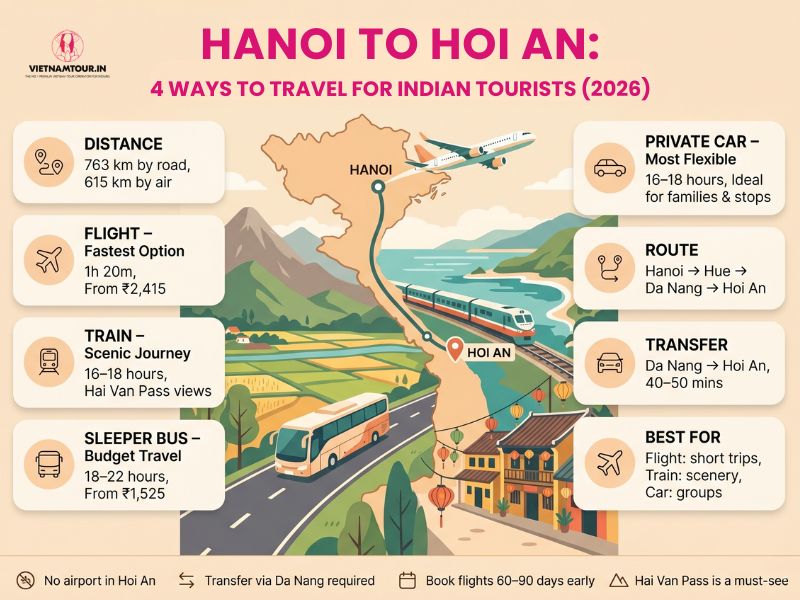
Indian tourists travel from Hanoi to Hoi An across a 763 km journey using 4 transport options — flight (1 hour 20 minutes, fastest), train (16–18 hours, scenic), sleeper bus (18–22 hours, cheapest), or private car (16–18 hours, most flexible) — with flight via Da Nang airport being the fastest route at advance booking prices from ₹2,415. The Hanoi to Hoi An journey covers central Vietnam from north to centre, and the choice of transport depends on the Indian tourist’s trip length, budget, and whether scenic stops at Hue, Hai Van Pass, and Lang Co Beach factor into the itinerary.
This Hanoi to Hoi An guide from Vietnamtour.in for Indian tourists in 2026 covers the journey across four practical layers: the 4 transport options with full INR pricing and booking platforms, comparative breakdowns (flight vs train, bus vs train, private car vs flight by group size), tour package options for 2-day to 4-day Hanoi–Hoi An trips, and the supplementary planning factors, the scenic stops, best time to travel, and 5 things Indian tourists must know before the journey.
How Far Is Hanoi from Hoi An and How Long Does the Journey Take?
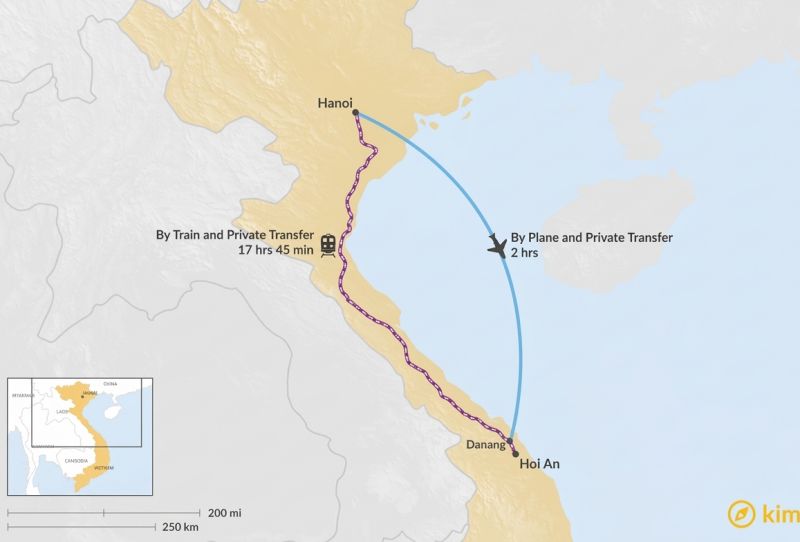
The Hanoi to Hoi An distance is 763 km by road and 615 km in a straight line, with travel time ranging from 1 hour 20 minutes by flight to 22 hours by sleeper bus. Hanoi sits in northern Vietnam, while Hoi An sits in central Vietnam, with the route passing through Hue and the Hai Van Pass between Hanoi and Hoi An.
| Mode | Travel Time | INR Cost Range |
| Flight (via Da Nang) | 1 hr 20 min + 50 min transfer | ₹2,415–₹14,394 |
| Train (to Da Nang) | 16–18 hours + transfer | ₹2,810–₹4,830 |
| Sleeper bus (direct to Hoi An) | 18–22 hours | ₹1,525–₹2,370 |
| Private car (door-to-door) | 16–18 hours | ₹12,000–₹24,000 per car |
Hoi An has no airport and no train station — every Hanoi to Hoi An journey by flight or train ends at Da Nang, with a 30 km transfer to Hoi An Old Town adding 40–50 minutes to the total trip time. The sleeper bus and private car are the only 2 options that deliver Indian tourists directly to Hoi An without a Da Nang transfer.
Hanoi to Hoi An by Flight: Schedule, Airlines, and Ticket Price in INR
The Hanoi to Hoi An flight runs from Noi Bai International Airport to Da Nang International Airport with 4 airlines operating 8–12 flights daily and a flight time of 1 hour 20 minutes to 1 hour 30 minutes. Hanoi to Hoi An one-way fares range from ₹2,415 for advance booking to ₹14,395 for last-minute.
The flight option is the fastest Hanoi to Hoi An route and the standard recommendation for Indian tourists with a Vietnam itinerary under 14 days. The 4 airlines operating Noi Bai (HAN) to Da Nang (DAD) for Indian tourists in 2026 are:
-
Vietravel Airlines — one-way fare from 2,860,000 VND (₹9,695)
-
Bamboo Airways — one-way fare from 3,185,000 VND (₹10,795)
-
Vietjet Air — one-way fare from 3,250,000 VND (₹11,015)
-
Vietnam Airlines — one-way fare from 4,245,000 VND (₹14,395)
Advance booking 60–90 days ahead via Skyscanner India brings the lowest Hanoi to Da Nang fares down to 710,000 VND (₹2,415), making the flight competitive with sleeper bus pricing during the September–October booking window.
Hanoi to Da Nang flight frequency runs 8–12 daily departures across the 4 airlines, with the heaviest schedule between 7:00 AM and 9:00 PM and reduced overnight flights.

Is a Direct Flight from Hanoi to Hoi An Available?
No, there is no direct flight from Hanoi to Hoi An. Every Hanoi to Hoi An flight terminates at Da Nang International Airport (IATA code: DAD). Indian tourists complete the final 30 km to Hoi An Old Town by Grab, taxi, or pre-booked transfer. Hoi An has no commercial airport and no plans for one because Da Nang sits within 50 minutes of Hoi An by road, making a separate Hoi An airport unnecessary.
Da Nang Airport to Hoi An Old Town: Transfer Options and Cost in INR
The Da Nang airport to Hoi An Old Town transfer covers 30 km in 40–50 minutes, with 3 transfer options for Indian tourists: Grab ride, metered taxi, or pre-booked private transfer. The Da Nang to Hoi An transfer is required for every flight and train arrival and represents the single highest scam-risk point on the entire Hanoi to Hoi An journey for Indian tourists.
-
Grab ride — 145,000–205,000 VND (₹500–700), Grab app booking, fixed fare with no negotiation
-
Metered taxi — 235,000–355,000 VND (₹800–1,200), Mai Linh and Vinasun are the trusted operators with fixed meter rates
-
Pre-booked private transfer — 440,000–740,000 VND (₹1,500–2,500), arranged through Hoi An hotels or Vietnam tour operators in advance
Indian tourists pre-book the Da Nang to Hoi An transfer through their Hoi An hotel concierge to avoid airport taxi touts, who quote inflated rates of 590,000–880,000 VND (₹2,000–3,000) for the same 30 km ride. Pre-booked Da Nang to Hoi An transfers also include English-speaking driver service and door-to-door drop at the Hoi An Old Town hotel.
Indian tourists who book the Hanoi to Hoi An journey through a Vietnam tour operator avoid the Da Nang airport taxi negotiation entirely, with the transfer pre-arranged before arrival. Vietnamtour.in operates a fixed-rate Da Nang airport pickup desk for Indian guests, with English-speaking drivers and Hindi-speaking coordination support handled by Mr. Sagnik, Country Manager (India) — a service refined across 428,000+ Indian travellers served since 2015.
Hanoi to Hoi An by Train: Duration, Ticket Classes, and Cost in INR
The Hanoi to Hoi An train journey runs 16–18 hours on the Reunification Express from Hanoi Railway Station to Da Nang Station, with 4 ticket classes ranging from 830,000 VND (₹2,815) for Soft Seat to 1,425,000 VND (₹4,830) for Hard Sleeper 4-berth.
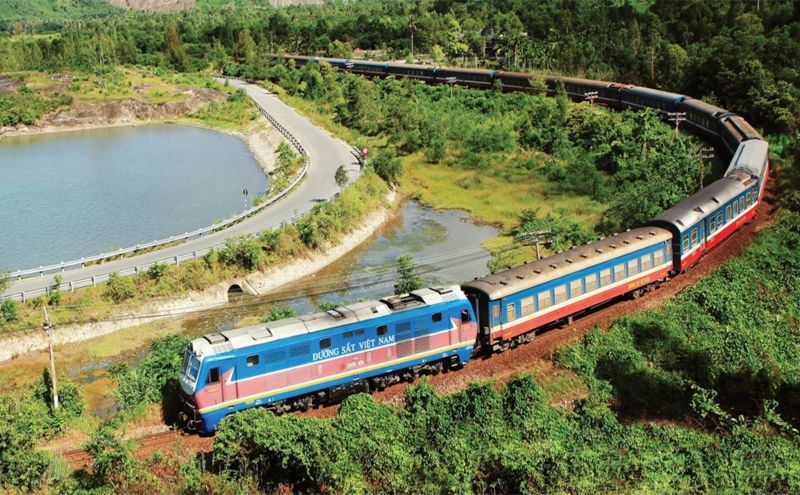
The Reunification Express delivers the most scenic Hanoi to Hoi An option, with the route hugging the central Vietnamese coastline through cliffs, rice paddies, and the Hai Van Pass — comparable to India’s Konkan Railway from Mumbai to Goa.
The 4 Reunification Express ticket classes from Hanoi to Da Nang for Indian tourists in 2026 are:
-
Soft Seat — 830,000–850,000 VND (₹2,815–2,880), reclining airline-style seat, no berth
-
Soft Sleeper 6-berth — 1,170,000–1,305,000 VND (₹3,965–4,425), shared 6-person cabin with bunk beds
-
Solf Sleeper 4-berth — 1,425,000 VND (₹4,830), 4-person cabin with private door, AC, and power outlet
Indian tourists book the Reunification Express through 2 platforms: dsvn.vn (the official Vietnam Railways website with English interface) or 12go.asia (an English-language aggregator with credit card payment). Both platforms accept Indian-issued cards, and 12go.asia adds a small booking fee in exchange for SMS ticket delivery and customer support in English.
The Reunification Express coastal stretch between Hue and Da Nang covers the Hai Van Pass — 21 km of cliff-edge rail with sea views on one side and mountains on the other. Indian tourists who prefer the experience of the journey itself over speed find this stretch one of Vietnam’s most scenic rail routes.
Is the Train from Hanoi to Hoi An Comfortable for Indian Travelers?
Yes, the Reunification Express train from Hanoi to Hoi An is comfortable for Indian travellers in Soft Sleeper 4-berth or Hard Sleeper 4-berth class, with air conditioning, a private cabin door, power outlets in every cabin, and clean shared toilets at each carriage end. The 4-berth sleeper classes match the comfort standard of Indian Railways AC 2-tier or AC 3-tier, with quieter cabins because the door closes between the corridor and the berth.
Vegetarian food on the Reunification Express runs limited — the onboard food cart serves Vietnamese rice meals weighted heavily toward meat dishes, with vegetable-only options available but not labelled clearly in English. Indian tourists travelling on the Hanoi to Hoi An train carry dry food from Hanoi (instant noodles, biscuits, fruit, namkeen, dry snacks) to cover the 16–18 hour journey, and supplement with hot water available free at every carriage.
The same vegetarian preparation applies to the Hanoi to Hoi An sleeper bus — Indian tourists do not need to prepare separately for the bus option.
Hanoi to Hoi An Train vs. Flight: Which Is Better for Indians?
The flight is better for Indian tourists with Vietnam itineraries under 14 days who prioritise time over scenery, and the train is better for Indian tourists who want the central Vietnam coastal experience and a cheaper alternative to flying. The Hanoi to Hoi An flight versus train choice is the single most common transport decision Indian tourists face on a Vietnam trip from India.
| Factor | Flight | Train |
| Total travel time | 2 hr 30 min (incl. transfer) | 17–19 hr (incl. transfer) |
| INR cost | ₹2,415–14,395 | ₹2,815–4,830 |
| Comfort | Airline economy seat | 4-berth sleeper cabin |
| Scenic value | None (cabin window only) | Hai Van Pass coastal rail |
| Recommended for | Short trips, families with kids | Honeymooners, scenic enthusiasts |
Indian families with children under 8 and Indian tourists with trip lengths of 7 days or fewer choose the Hanoi to Hoi An flight as the standard option. Indian honeymooners, photography enthusiasts, and travellers on 14+ day Vietnam itineraries often choose the Hanoi to Hoi An train for the Hai Van Pass experience.
Hanoi to Hoi An by Sleeper Bus: Schedule, Operators, and Cost in INR
The Hanoi to Hoi An sleeper bus runs 18–22 hours overnight with 3 main operators — Futa Bus Lines, The Sinh Tourist, and Camel Travel — at one-way fares from 450,000 VND to 700,000 VND (₹1,525–2,375). The Hanoi to Hoi An sleeper bus is the cheapest Hanoi to Hoi An transport option and the only ground-transport option besides a private car that delivers Indian tourists directly to Hoi An without a Da Nang transfer.

Sleeper bus departures from Hanoi run between 6:00 PM and 8:00 PM, with arrival in Hoi An between 12:00 PM and 4:00 PM the following afternoon. Indian tourists book Hanoi to Hoi An sleeper bus tickets through 12go.asia (English interface, Indian card payment) or the Futa Bus Lines website directly.
Is the Overnight Sleeper Bus from Hanoi to Hoi An Safe?
Yes, the overnight sleeper bus from Hanoi to Hoi An is safe for Indian tourists across all 3 main operators, with 2 cabin layouts available — flat-bed sleeper pods with privacy curtains, or reclining seats in the budget tier. Sleeper bus safety risk in Vietnam runs lower than equivalent overnight bus services in India, with operator regulation, GPS tracking, and 2-driver shifts on long-haul routes.
The Hanoi to Hoi An sleeper bus stops 2–3 times during the journey for meal breaks at highway service stations, where vegetarian options are limited. Indian tourists carry dry food from Hanoi for the bus journey — instant noodles, biscuits, fruit, namkeen, and dry snacks — covering the full 18–22 hour ride.
Hanoi to Hoi An Bus vs. Train: Cost and Comfort Comparison
The sleeper bus is cheaper than the train at the entry tier — 450,000 VND (₹1,525) for Camel Travel versus 830,000 VND (₹2,815) for Soft Seat — and delivers Indian tourists directly to Hoi An without a Da Nang transfer, while the train wins on scenic value and predictable arrival times. The Hanoi to Hoi An bus versus train choice splits along budget priority versus experience priority for Indian tourists.
| Factor | Sleeper Bus | Train |
| Entry cost | ₹1,525 | ₹2,815 |
| Arrival point | Hoi An (direct) | Da Nang (+ transfer) |
| Comfort | Sleeper pod or reclining seat | 4-berth sleeper cabin |
| Scenic value | Limited (highway) | Coastal Hai Van Pass |
| Reliability | Traffic-dependent | Schedule-fixed |
| Recommended for | Backpackers, budget solo | Families, honeymooners |
Indian backpackers and budget solo travellers choose the Hanoi to Hoi An sleeper bus. Indian families and honeymooners on a longer Vietnam itinerary choose the train or flight.
Hanoi to Hoi An by Private Car Transfer: Cost, Duration, and Inclusions
The Hanoi to Hoi An private car transfer runs 16–18 hours door-to-door, with sedan rates from 3,540,000–5,310,000 VND (₹12,000–18,000) for 2–3 passengers and SUV/van rates from 6,300,000–7,100,000 VND (₹21,355–24,070) for 4–7 passengers. The private car transfer rate includes air conditioning, English-speaking driver, and unlimited stops.

The private car is the only Hanoi to Hoi An option that allows free stops at Hue, Hai Van Pass, and Lang Co Beach — making it the experience-priority choice for Indian tourists who want to combine transport with sightseeing.
Private car transfer inclusions for Indian tourists in 2026:
-
Vehicle types — sedan (2–3 passengers), 7-seat SUV (3–4 passengers), 16-seat van (5–7 passengers)
-
Driver — English-speaking, professional Vietnamese driver licensed for tourist transport
-
Air conditioning and music — standard across all vehicle classes
-
Door-to-door service — pickup at Hanoi hotel, drop at Hoi An hotel, no transfers required
-
Free stops — Hue Imperial City, Hai Van Pass viewpoint, Lang Co Beach, Marble Mountains
The Hanoi to Hoi An private car route covers the same 763 km road distance as the sleeper bus, but delivers a fundamentally different experience because of the stop flexibility. Indian tourists who book a 2-day private car transfer with a Hue overnight stop convert the journey itself into a 2-day Central Vietnam mini-itinerary.
Indian families booking the Hanoi to Hoi An private car transfer often request itinerary customisation — Hue overnight, Hai Van Pass photo stops, or an early Lang Co Beach halt — which fixed-route operators do not accommodate. Vietnamtour.in’s tailor-made tour team designs the Hanoi to Hoi An private car route around the family’s pace, dietary stops, and child-friendly bathroom breaks, an approach reflected in the operator’s TripAdvisor Best of the Best 2023 recognition (top 1% of travel operators globally).
Is a Private Car Transfer Worth It for Indian Families?
Yes, the private car transfer is worth the cost for Indian families of 4 or more passengers, because it delivers door-to-door service, child-friendly bathroom flexibility, and free scenic stops that the train and sleeper bus cannot match. Indian families with children under 12 face 2 specific challenges on the train and bus options — shared toilet access and fixed schedule rigidity — both of which the private car eliminates.
-
Bathroom flexibility — children stop at clean highway service stations on driver request rather than using shared train or bus toilets
-
Free scenic stops — Hue Imperial City, Hai Van Pass, and Lang Co Beach all fit into the day with no additional cost
-
Door-to-door luggage handling — no station transfers, no waiting at Da Nang airport, no taxi negotiations in Hoi An
-
Schedule control — Indian families control departure time, lunch stops, and rest breaks without operator constraints
Private Car vs. Flight: Cost per Person by Group Size
The private car transfer becomes cheaper than flight for Indian tourist groups of 6 or more passengers, with the per-person cost dropping to ₹3,560–4,010 at 6 passengers compared to ₹3,015–4,300 flight cost including Da Nang transfer. The Hanoi to Hoi An private car versus flight calculation depends entirely on group size, with 2–4 passengers favouring flight and 6+ passengers favouring private car.
| Group Size | Private Car (per person) | Flight + Transfer (per person) | Better Option |
| 2 pax | ₹6,000–9,000 (sedan) | ₹3,015–4,300 | Flight |
| 4 pax | ₹5,340–6,015 (SUV/van) | ₹3,015–4,300 | Flight |
| 5 pax | ₹4,270–4,810 (SUV/van) | ₹3,015–4,300 | Flight (closer) |
| 6 pax | ₹3,560–4,010 (SUV/van) | ₹3,015–4,300 | Private Car |
| 7 pax | ₹3,050–3,440 (SUV/van) | ₹3,015–4,300 | Private Car |
The private car cost calculation uses the sedan rate of 3,540,000–5,310,000 VND (₹12,000–18,000) for 2-passenger groups and the SUV/van rate of 6,300,000–7,100,000 VND (₹21,355–24,070) for 4–7 passenger groups. The flight cost calculation uses the mid-tier Bamboo Airways fare of 3,185,000 VND (₹10,795) plus Da Nang to Hoi An transfer at 440,000 VND (₹1,495 per vehicle, split across the group).
Indian tourist groups of 6+ passengers also gain free scenic stops by choosing the private car — value that does not appear in the per-person cost but materially affects the experience.
Beyond the four transport options, Indian tourists planning the Hanoi to Hoi An journey often package the route into a structured 2-day to 4-day Central Vietnam itinerary, with tour operators handling transport, accommodation, and Hue and Hai Van Pass scenic stops as a single booking. The following sections cover Hanoi to Hoi An tour packages, scenic stops, best travel timing, and the practical pre-trip knowledge Indian tourists need before booking.
Hanoi to Hoi An Tour Packages for Indian Tourists: 2-Day, 3-Day, and 4-Day Options
Indian tourists typically combine Hanoi and Hoi An within a 10–14 day Vietnam itinerary, and 3 standard tour package formats handle the Hanoi to Hoi An segment: 2-day flight round-trip, 3-day flight + train + Hue overnight, and 4-day private car with Hue and Hai Van Pass stops.
Hanoi to Hoi An tour packages remove the booking complexity for Indian tourists travelling on a tight schedule, and Vietnam tour operators serve the Indian market bundle accommodation, guide, and meals into the package.

The 3 most common Hanoi to Hoi An tour package formats are:
-
2-day flight round-trip package — flight Hanoi to Da Nang and return, 1 night Hoi An accommodation, half-day Hoi An Ancient Town tour
-
3-day flight + train + Hue stopover package — flight Hanoi to Da Nang, 1 night Hue, train Hue to Da Nang scenic stretch, 1 night Hoi An, includes Imperial City entry
-
4-day private car package with Hai Van Pass — full private car transfer Hanoi to Hoi An, 1 night Hue, Hai Van Pass scenic drive, 2 nights Hoi An, includes Marble Mountains and Lang Co Beach stops
Indian tourists planning the full Vietnam circuit with multiple cities — Hanoi, Halong Bay, Hoi An, and Ho Chi Minh City — often book the entire trip as a single Vietnam tour package from India rather than handling each segment separately. A complete breakdown of multi-city Vietnam tour packages from India, including pricing, itineraries, and operator comparisons for the Indian market, appears in our Vietnam tour packages from India guide.
How Much Does a Hanoi to Hoi An Tour Package Cost from India in INR?
Hanoi to Hoi An tour packages start from ₹8,500 per person for a 2-day format excluding international flights from India, and reach ₹35,000–45,000 per person for a 4-day private car package with Hue, Hai Van Pass, and 2 nights Hoi An accommodation included. Indian tourist tour package pricing covers transport, accommodation, English-speaking guide, and 2–3 meals per day depending on the package tier:
-
2-day basic package — from 2,510,000 VND (₹8,505) per person, covers flight + 1 night + half-day tour
-
3-day standard package — from 5,015,000 VND (₹17,000) per person, covers flight + train + 2 nights + guide
-
4-day premium package — from 10,325,000–13,275,000 VND (₹35,000–45,000) per person, covers private car + 3 nights + guide + meals
Indian tourists who book transport and accommodation independently save 20–30% compared to tour package pricing — a self-organised 3-day Hanoi to Hoi An trip costs ₹12,000–13,500 per person versus ₹17,000+ for the equivalent tour package. Tour packages remain the standard recommendation for first-time Indian visitors to Vietnam, families with children, and travellers who prefer single-point booking.
Hanoi to Hoi An Tour with Hue Stopover: Itinerary and Inclusions
A 3-day Hanoi to Hoi An tour with Hue stopover delivers the standard Central Vietnam Indian tourist experience: Day 1 Hanoi to Hue (Imperial City and Tu Duc Tomb), Day 2 Hue to Hoi An via Hai Van Pass, Day 3 Hoi An Ancient Town and tailor pickup. The Hue stopover format works particularly well for Indian honeymooners and culture-focused travellers who want to maximise UNESCO heritage exposure within a fixed time window:
-
Day 1 — Hanoi to Hue — flight or train Hanoi to Da Nang, transfer to Hue, afternoon Imperial City visit, evening Tu Duc Tomb
-
Day 2 — Hue to Hoi An — morning departure, Hai Van Pass scenic drive, Lang Co Beach photo stop, afternoon arrival Hoi An, evening lantern boat ride
-
Day 3 — Hoi An Old Town — morning Ancient Town walking tour, afternoon tailor fitting pickup, evening departure
The 3-day Hue stopover itinerary covers 2 UNESCO World Heritage Sites — Hue Imperial City complex and Hoi An Ancient Town — within a single Central Vietnam circuit.
Best Time to Travel from Hanoi to Hoi An for Indian Tourists
The best time for Indian tourists to travel from Hanoi to Hoi An is February to August, when central Vietnam runs the dry season and Hoi An Ancient Town stays flood-free with daily temperatures of 22–32°C. The Hanoi to Hoi An journey timing aligns well with 2 major Indian travel windows — Holi in March and summer school holidays in May–June — both of which fall inside the central Vietnam dry season:
-
February to April — 22–28°C, low humidity, minimal rainfall, ideal Hoi An tailor and beach weather
-
May to August — 28–32°C, summer warmth, school holiday alignment for Indian families, occasional afternoon thunderstorms in July
-
September — transition month, increasing rainfall toward the end of the month, manageable for travel
-
October to November — peak flood season in Hoi An, Ancient Town floods up to 1 metre during heavy rain weeks; Indian tourists who can shift dates schedule outside this window
-
December to January — cool and dry, but peak Christmas–New Year tourist crowds and highest accommodation pricing
Indian tourists travelling during Diwali (October–November) and Christmas–New Year (late December) book Hanoi to Hoi An transport and Hoi An accommodation 60–90 days in advance — both windows run as peak tourist season for the Vietnam–India travel corridor with limited last-minute availability.
3 Scenic Stops on the Hanoi to Hoi An Route Indian Tourists Should Not Miss
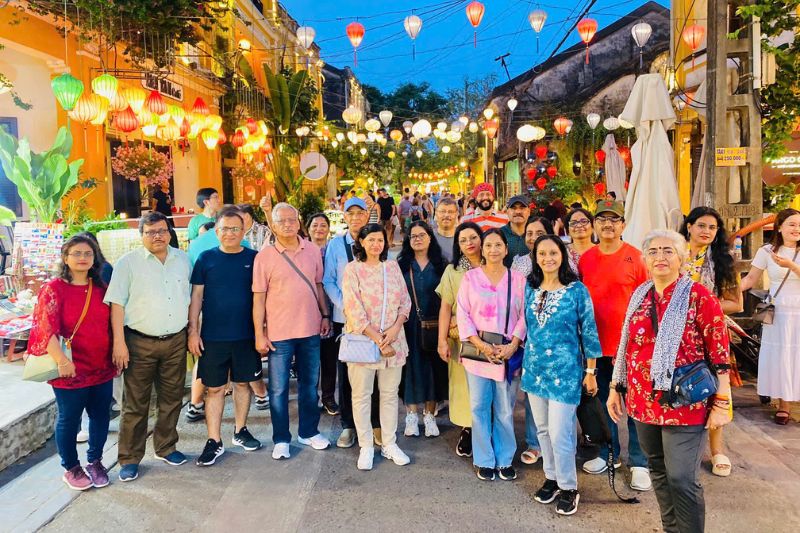
The 3 scenic stops on the Hanoi to Hoi An route are Hue Imperial City, Hai Van Pass, and Lang Co Beach — listed north to south by geographic order — and only the private car transfer option allows Indian tourists to stop at all 3 within a single journey. These 3 Central Vietnam stops complete the cultural and scenic context of the Hanoi to Hoi An route, transforming the 763 km journey from a transit segment into a multi-attraction itinerary:
-
Hue Imperial City — the UNESCO-listed former capital of Vietnam under the Nguyen Dynasty, scale comparable to Fatehpur Sikri in India, with the Imperial Citadel, Forbidden Purple City, and 7 royal tombs scattered along the Perfume River. Indian tourists spend 1–2 nights in Hue to cover the Imperial City plus Tu Duc Tomb and Khai Dinh Tomb.

-
Hai Van Pass — the highest mountain pass in central Vietnam at 496 metres elevation, running 21 km between Hue and Da Nang with sea views to the east and mountain ranges to the west. Hai Van Pass is accessible only by private car, motorbike, or the Reunification Express train route — no commercial flights or sleeper buses use the pass.
-
Lang Co Beach — a crescent-shaped beach at the southern foot of the Hai Van Pass, ideal for a 30-minute photo and rest stop. Lang Co Beach sits 35 km north of Da Nang and combines easily with the Hai Van Pass viewpoint as a single afternoon halt.
Indian tourists who book the private car Hanoi to Hoi An transfer with a 1-night Hue overnight cover all 3 scenic stops within a 2-day journey at no additional transport cost. Train passengers see the Hai Van Pass coastline from the carriage window but cannot disembark, and flight and sleeper bus passengers miss all 3 stops entirely.
5 Things Indian Tourists Must Know Before Traveling Hanoi to Hoi An
Indian tourists travelling from Hanoi to Hoi An need to know 5 specific facts before booking: Hoi An has no airport, October–November is peak flood season, flight pricing varies seasonally, tailoring takes 24–48 hours, and ATM access in Hoi An is unreliable on weekends. These 5 items cover the most common Indian tourist preparation gaps on the Hanoi to Hoi An journey:
-
Hoi An has no airport — flights and trains terminate at Da Nang International Airport with a 30 km transfer to Hoi An Old Town required, with Grab, metered taxi, or pre-booked private car serving as the standard transfer options
-
October–November is flood season — Hoi An Ancient Town floods up to 1 metre during heavy rain weeks, and Indian tourists who can shift dates schedule beach and walking-tour focused trips outside this window
-
Flight pricing varies seasonally — the cheapest Hanoi to Da Nang flights run September–October with advance booking from ₹2,415, the most expensive run December–January at ₹14,395+ last-minute
-
Tailoring requires 24–48 hours — Hoi An has 600+ tailor shops producing custom suits, dresses, and áo dài, with the standard turnaround running 24–48 hours including 1–2 fittings; Indian tourists factor this into the Hoi An stay length
-
VND currency exchange before Hoi An — Indian tourists exchange Indian rupees to Vietnamese dong at Hanoi banks before travelling onward, because Hoi An Old Town ATMs run limited and frequently empty during weekend tourist peaks
Frequently Asked Questions: Hanoi to Hoi An for Indian Tourists
Is Hanoi to Hoi An Safe for Indian Tourists Traveling Independently?
Yes, the Hanoi to Hoi An journey is safe for Indian tourists travelling independently across all 4 transport options, with the highest risk point being unmarked taxis at Da Nang airport rather than any safety concern on the transport itself. Indian tourists handle the Da Nang airport taxi risk by using the Grab app or a pre-booked transfer, both of which deliver fixed-price service and trip documentation in English.
Can I Travel from Hanoi to Hoi An Without a Tour Guide?
Yes, all 4 Hanoi to Hoi An transport options accommodate independent Indian travellers without a tour guide, and the booking process runs in English with Indian-issued credit card support across all major platforms. Indian tourists book flights through Skyscanner India, train and sleeper buses through 12go.asia, and private car transfers through Vietnam tour operators serving the Indian market.
How Many Days Should Indian Tourists Spend in Hoi An?
Indian tourists spend a minimum of 2 days and, ideally, 3 days in Hoi An — Day 1 covers the Ancient Town and the lantern boat ride, Day 2 covers the Cham Islands day trip, and Day 3 covers My Son Sanctuary plus tailor pickup. A 3-day Hoi An stay also allows 24–48 hours for any custom tailoring orders to be completed, which Indian tourists factor into the Hoi An itinerary.
For a complete breakdown of Hoi An attractions, accommodation, food, and the Cham Islands and My Son day trips for Indian tourists, see our dedicated Hoi An travel guide.
What Is the Cheapest Way to Travel from Hanoi to Hoi An in INR?
The cheapest Hanoi to Hoi An option is the sleeper bus from ₹1,525 per person on Camel Travel, but advance flight booking via Skyscanner India during September–October drops Hanoi to Da Nang fares to ₹2,415 — a 16+ hour time saving for an additional ₹890. Indian tourists comparing entry-level prices weigh the bus cost advantage against the flight time advantage based on overall trip length and schedule flexibility.
Is There a Ferry from Hanoi to Hoi An?
No, there is no ferry from Hanoi to Hoi An because Hanoi is an inland city 165 km from the coast, and Vietnam does not operate any commercial passenger ferries on the Hanoi–Hoi An corridor. The only ferry service connected to the Hoi An region runs from Hoi An to the Cham Islands — a 30-minute speedboat covering 18 km offshore, completely separate from any Hanoi-origin route.
For Indian travellers starting this journey from Hanoi, the city itself rewards a 2–3 day stay before departing south to Hoi An — a complete guide to Hanoi attractions, food, and accommodation for Indian tourists is covered in our Hanoi travel guide.