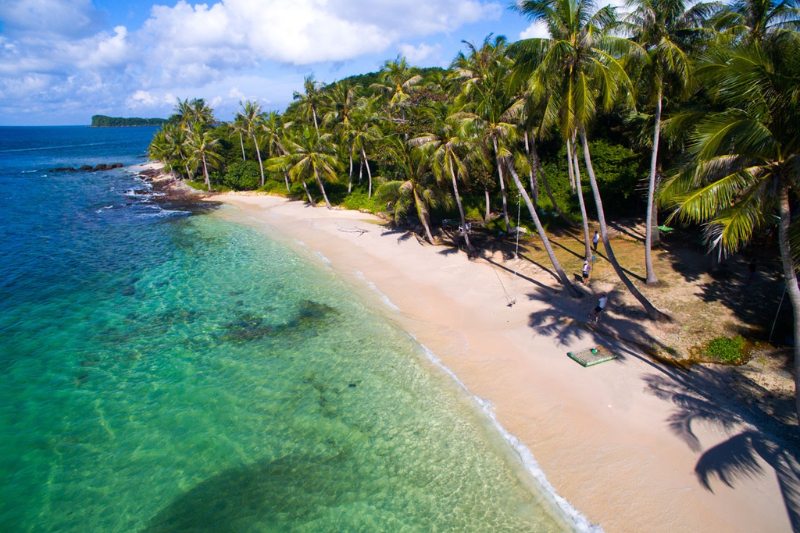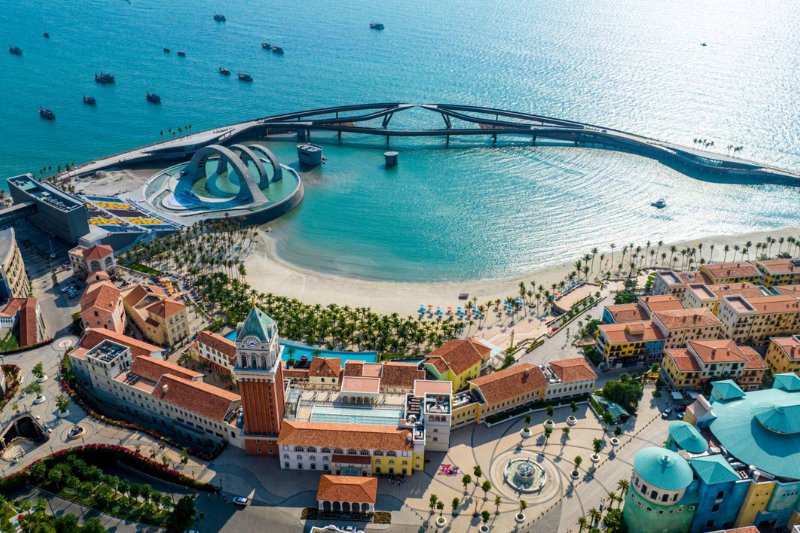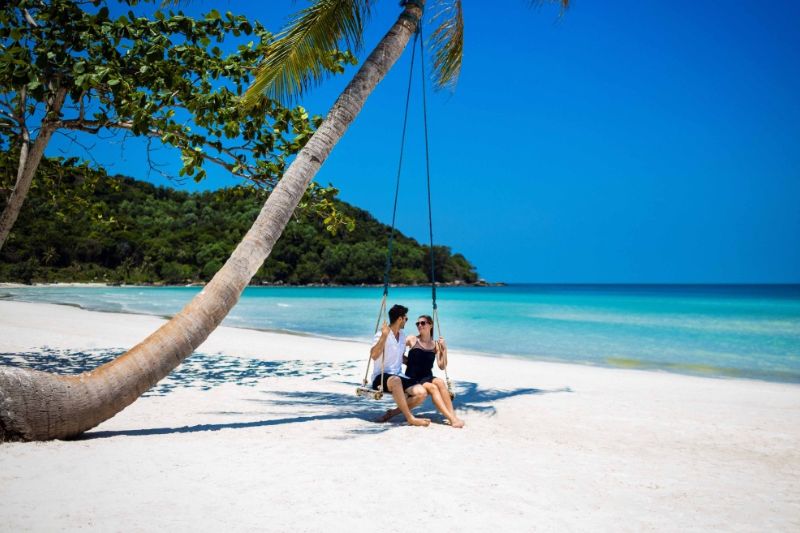
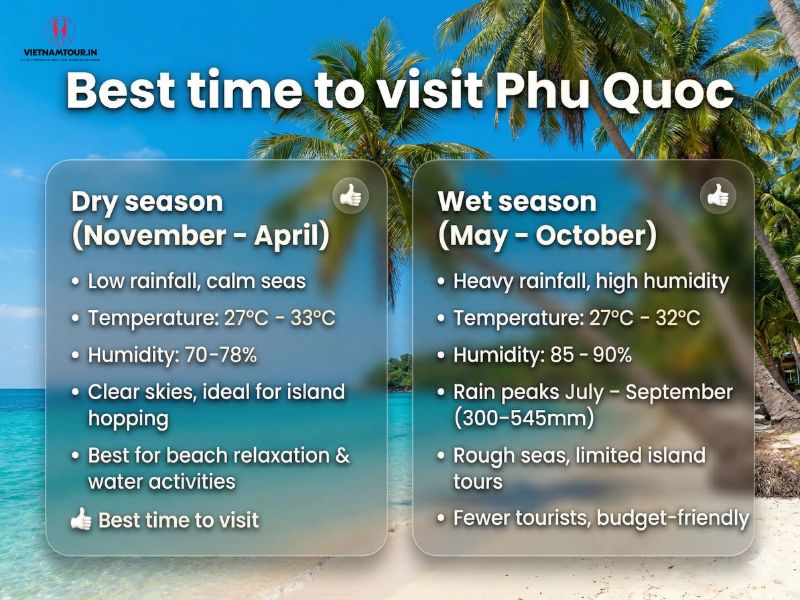
The best time to visit Phu Quoc is December to March, when the island gets 30–60 mm of rain a month, 8 hours of sun a day and a calm sea at 27.5–29°C. November and April sit on either side of that window as transition months: still warm and mostly sunny, but already carrying 170 mm and 150 mm of rain. From May to October the south-west monsoon takes over, rainfall climbs past 300 mm a month, and the sea turns rough. Hotel rates follow the same curve, peaking in February and bottoming out in June and July.
In this article, Vietnamtour.in rates Phu Quoc weather for all 12 months of the year, compares the island with Goa, and lines the calendar up with Indian holiday dates for the 2026–2027 season.
Phu Quoc Weather by Month at a Glance
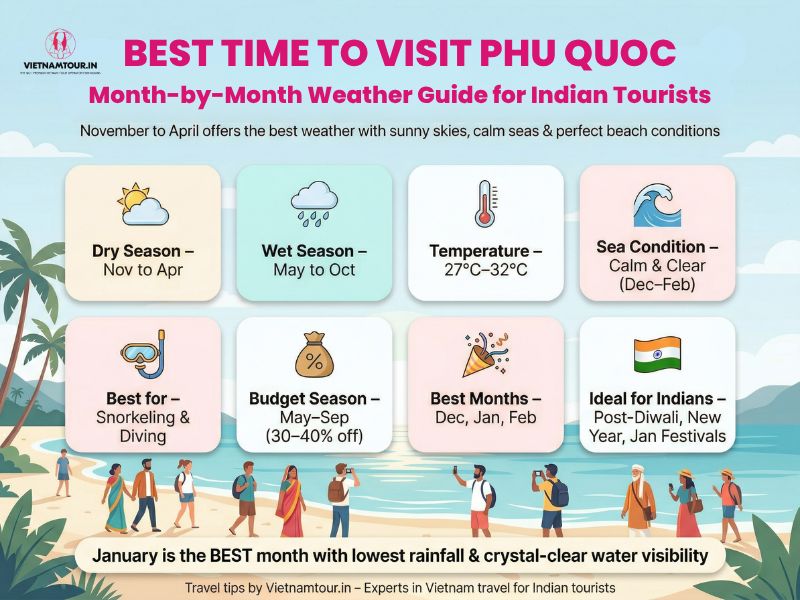
Phu Quoc has 2 seasons: a dry season from December to March and a wet season from May to October, with November and April as transition months. The island sits in the Gulf of Thailand at 10 degrees north, closer to the Cambodian coast than to mainland Vietnam, which gives the weather in Phu Quoc a rainfall pattern opposite to central Vietnam.
| Month | Temp (°C) | Rainfall | Sun | Sea | Season |
|---|---|---|---|---|---|
| Jan | 24–31 | 35 mm / 5 days | 8 h | 27.5°C, calm | Peak |
| Feb | 24–31 | 30 mm / 4 days | 8 h | 28°C, calm | Peak, driest |
| Mar | 25–32 | 55 mm / 6 days | 8 h | 29°C, calm | Peak |
| Apr | 26–33 | 150 mm / 12 days | 8 h | 30°C, calm to moderate | Shoulder |
| May | 27–32 | 300 mm / 20 days | 6.5 h | 30.5°C, moderate | Shoulder |
| Jun | 26–31 | 415 mm / 22 days | 5 h | 30°C, rough | Off-peak |
| Jul | 26–30 | 420 mm / 22 days | 5 h | 29.5°C, rough | Off-peak |
| Aug | 26–30 | 545 mm / 24 days | 4.5 h | 29°C, very rough | Off-peak, wettest |
| Sep | 26–30 | 475 mm / 22 days | 4.5 h | 29°C, rough | Off-peak |
| Oct | 25–31 | 385 mm / 22 days | 5.5 h | 29°C, calming late | Shoulder |
| Nov | 25–31 | 170 mm / 13 days | 7 h | 28.5°C, calm | Shoulder to peak |
| Dec | 24–31 | 60 mm / 6 days | 8 h | 28°C, calm | Peak |
Averages are based on the 2000–2020 climate period.
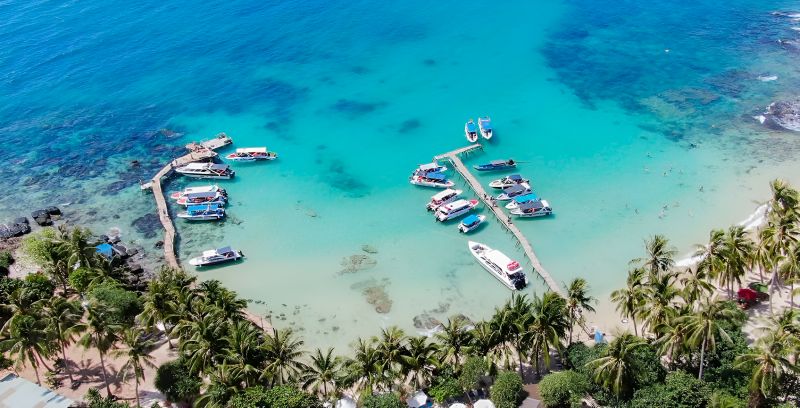
- Dry season (December to March): Days sit at 31–32°C and nights at 24–25°C, rain falls on only 4 to 6 days a month, and the island records 8 hours of sunshine a day. The sea stays flat and warm at 27.5–29°C, which is when island-hopping boats to the An Thoi archipelago run most reliably.
- Wet season (May to October): Temperatures barely move, but rainfall multiplies: 300 mm in May rising to 545 mm in August, spread across 20 to 24 days each month. Sunshine drops to 4.5 hours a day in August and September. Across the full year Phu Quoc records 3,030 mm of rain over 178 days, which is more than Goa.
Those 4 dry months are where almost every Phu Quoc itinerary belongs, so they deserve a closer look.
Dry Season (December–March): Best Time to Visit Phu Quoc for Beaches
December to March is the best time to visit Phu Quoc, with February the driest month of the year at 30 mm of rain over 4 days.
What Is the Dry Season Weather in Phu Quoc Like?
Rainfall in Phu Quoc across the 4 dry months runs 60 mm in December, 35 mm in January, 30 mm in February and 55 mm in March, and each of those months averages 8 hours of sunshine a day. The sea around the island warms steadily from 27.5°C in January to 29°C in March and stays calm throughout the dry season, which suits snorkelling, island hopping and sunset cruises.
The 4 dry months in Phu Quoc differ more in feel than in numbers. December carries the festive atmosphere and the heaviest crowds of the year. January and February are the driest and coolest months on the island, with nights around 24°C. March keeps the dry weather while daytime highs climb to 32°C, and it draws fewer visitors than the 2 months before it. Beaches, island trips and theme parks all run normally through this stretch, which is when Phu Quoc Vietnam sees its most settled Phu Quoc weather of the year.
Crowds, Prices and When to Book
February is the most expensive month of the year in Phu Quoc, and December to February is the busiest stretch on the island. Two short price spikes sit inside that window: Christmas and New Year, and Tet, the Vietnamese Lunar New Year, which falls on 6 February 2027. During Tet week, domestic visitor numbers in Phu Quoc rise sharply and some smaller shops and restaurants close for 2 to 3 days, while resorts and theme parks stay open.
Hotels and tours in Phu Quoc are usually booked 60 to 90 days ahead for the December to February peak. Late November and March work as quieter alternatives with nearly the same weather. There are no regular scheduled flights from India to Phu Quoc (a seasonal charter from Delhi operated over the 2025–26 peak), so most trips connect through Hanoi or Ho Chi Minh City, and the Hanoi to Phu Quoc and Ho Chi Minh to Phu Quoc legs fill up around the same peak dates.
Either side of that peak sit 4 months that trade a little weather for a much lower bill.
Shoulder Months (April–May and October–November): Best Value
April–May and October–November give the best balance of weather and price in Phu Quoc, with November and April the strongest of the 4. Each month trades some dry-season reliability for lower rates and thinner crowds.
- November in Phu Quoc brings rain down to 170 mm over 13 days, sunshine back to 7 hours a day and a calm sea at 28.5°C, and conditions keep improving through the month. Phu Quoc pairs easily with Hanoi or Ho Chi Minh City on a November Vietnam itinerary. Early November is also the peak of the southern Vietnam cyclone window, so flexible bookings are worth having.
- April in Phu Quoc keeps 8 hours of sunshine a day and a calm-to-moderate sea at 30°C, but rain rises to 150 mm over 12 days, usually as afternoon showers. It is also the hottest month on the island alongside May, with highs of 33°C.
- May in Phu Quoc brings the monsoon properly, with 300 mm of rain over 20 days and sunshine down to 6.5 hours a day. The sea reaches 30.5°C, the warmest reading of the year. May overlaps with the long summer school holiday in India, which makes it a resort-and-theme-park month rather than an island-hopping one.
- October in Phu Quoc still records 385 mm over 22 days, but the sea settles during the second half of the month and conditions improve week by week into November. Central Vietnam takes its heaviest rain at this time, so a multi-city route needs a separate check of the weather Vietnam in October brings to each stop.
Price is the reason these months belong on a shortlist. Booking platforms put February at the top of the Phu Quoc range and June to July at the bottom: KAYAK lists an average of $440 (₹41,800) a night in February against $120 (₹11,400) in July, while Skyscanner shows $519 (₹49,300) against $96 (₹9,100) in June. Those are whole-market averages rather than a discount at any single resort, but the shape of the curve is consistent across platforms. One local date is worth noting: the Vietnamese public holiday on 30 April and 1 May fills the island with domestic travellers.

Beyond these 4 months, the monsoon settles in over Phu Quoc, and the trade-off becomes much sharper.
Is Phu Quoc Worth Visiting in the Rainy Season (June–September)?
Yes, visiting Phu Quoc between June and September is worth it for a resort-based trip, but not if snorkelling and island hopping are the point.
- What still works. Grand World, VinWonders, Vinpearl Safari, the Dinh Cau shrine, Phu Quoc Prison and the Phu Quoc Night Market all operate year-round, and most land-based places to visit in Phu Quoc stay open whatever the weather. Rain in Phu Quoc during the monsoon usually arrives as afternoon and evening downpours rather than all-day drizzle, so mornings are often usable and wet afternoons suit shopping in Phu Quoc. The airport and resorts run normally.
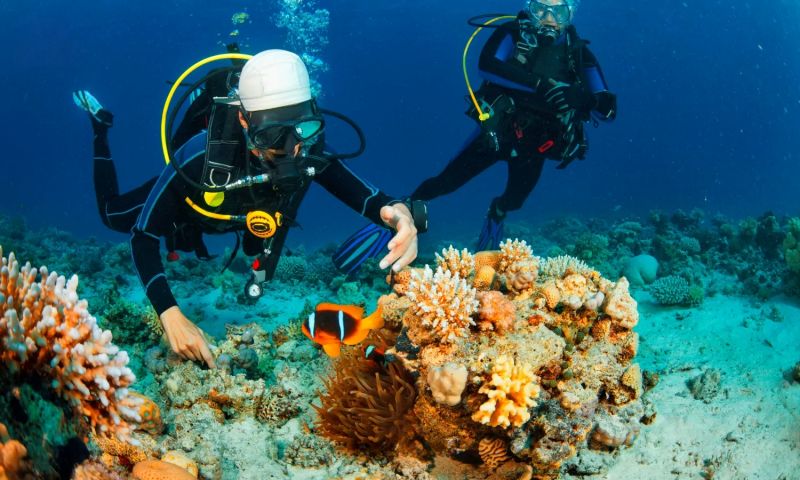
- What becomes unreliable. Boat trips to the An Thoi archipelago, snorkelling and diving all depend on sea conditions, and operators cancel when the swell builds. Diving guides advise against the June to September window because of swell and poor visibility, so planning a monsoon trip around a single island day rarely works.
- The worst months. August is the wettest month of the year in Phu Quoc, at 545 mm over 24 days, with September close behind at 475 mm. Sunshine drops to 4.5 hours a day in both months.
The compensation is price. June and July are the cheapest months of the year on the island, at roughly $96–120 (₹9,100–₹11,400) a night against $440–519 (₹41,800–₹49,300) in February, and several dive centres cut rates by 10–20% between May and October.
One point about the monsoon is often stated backwards. The south-west monsoon of June to September brings rain and rough seas to Phu Quoc, but tropical cyclones in southern Vietnam generally occur between 15 October and 20 December, with a peak in early November. The weather risk in midsummer is rain; the storm risk sits in late autumn.

Which month suits a trip to Phu Quoc depends on what fills the days, and activities split sharply by season.
Best Time to Visit Phu Quoc by Activity
December to March is the peak window for every water activity in Phu Quoc, while land-based attractions run year-round.
| Activity | Best months | Workable | Avoid |
|---|---|---|---|
| Snorkelling | Dec–Mar | Nov, Apr | Jun–Sep |
| Scuba diving | Dec–Mar | Nov, Apr | Jun–Sep |
| Island hopping (An Thoi) | Dec–Mar | Nov, Apr, late Oct | Jun–Sep |
| Beach and swimming | Dec–Apr | May, Oct, Nov | Jul–Sep |
| Sunset cruise | Dec–Mar | Nov, Apr | Jun–Sep |
| Grand World, VinWonders, Safari | Year-round | – | – |
| Night market and food tours | Year-round | – | – |
The main snorkelling and diving sites in Phu Quoc sit around the An Thoi archipelago off the southern tip of the island, including Hon Thom, Gam Ghi and May Rut, as any Phu Quoc tourist map shows. Underwater visibility reaches 15 to 20 m in the dry season, and the water never drops below 27.5°C at any point in the year, so a wetsuit is not needed in any season.
Evenings depend far less on the sea. A Grand World Phu Quoc night visit and the wider Phu Quoc nightlife scene run in every season, while sunset views from the Vietnam Kiss Bridge in the south of the island are most reliable under clear December to March skies.
Dry-season prices in 2026 run from $20 to $55 (₹1,900–₹5,200) for a group 4-island day trip with boat, gear, guide and lunch, rising to $168–294 (₹16,000–₹27,900) for a private speedboat charter. Certified divers pay $65–90 (₹6,200–₹8,550) for 2 boat dives, while a beginner Discover Scuba session with 2 dives costs about $100 (₹9,500). A PADI Open Water course over 3 to 4 days runs $350–465 (₹33,250–₹44,200).

Weather is only half the decision, because the calendar back home usually fixes the dates.
Which Phu Quoc Months Line Up With Holidays and School Breaks?
Most major Indian holiday windows fall in Phu Quoc’s dry season or its better shoulder months; only the May–June school break and mid-August land in heavy rain.
| Holiday or break | When | Phu Quoc conditions | Verdict |
|---|---|---|---|
| Diwali | 8 November 2026 | 170 mm, sea calming, 7 h sun | Good, but inside the cyclone window |
| Christmas and New Year | 24 Dec 2026 – 1 Jan 2027 | 60 mm, 8 h sun, calm sea | Excellent, most expensive |
| Makar Sankranti and Pongal | 14–17 January 2027 | 35 mm, driest stretch of the year | Excellent |
| Holi | 22 March 2027 | 55 mm, warming to 32°C | Very good |
| Ugadi and Gudi Padwa | 7 April 2027 | 150 mm, hot | Good value |
| Baisakhi, Tamil New Year, Vishu | 14 April 2027 | 150 mm, hot | Good value |
| Summer school break | May and June 2027 | 300–415 mm, rough sea | Resort stays only |
| Independence Day | 15 August 2027 | 545 mm, wettest month | Avoid |
Diwali on 8 November 2026 lands in the first shoulder month after the monsoon, which makes Phu Quoc a workable beach stop on Diwali tour packages to Vietnam.
Three Vietnamese dates also push Phu Quoc prices up and fill the island with domestic travellers: Tet on 6 February 2027, the public holiday on 30 April and 1 May, and National Day on 2 September.
For travellers weighing a familiar beach at home against a new one abroad, the numbers make the comparison concrete.
How Does Phu Quoc Weather Compare to Goa?
Goa is drier and sunnier than Phu Quoc from December to February, while Phu Quoc has the gentler monsoon and the calmer sea.
| Period | Goa | Phu Quoc |
|---|---|---|
| Dec–Feb temperature | 20–32°C | 24–31°C |
| Dec–Feb rainfall | 0–15 mm | 30–60 mm |
| Dec–Feb sunshine | 9.5–10.5 h a day | 8 h a day |
| Dec–Feb sea | 28–28.5°C | 27.5–28°C |
| March | 23–32°C, 1 mm | 25–32°C, 55 mm |
| Wettest month | July, 995 mm over 27 days | August, 545 mm over 24 days |
| Annual rainfall | 2,925 mm | 3,030 mm |
In peak season Goa wins on paper. January and February in Goa are effectively rainless, with 10 hours of sunshine a day, while Phu Quoc records 30–35 mm and 8 hours. Goan nights are also about 4°C cooler, which many travellers prefer for evenings out.
Where Phu Quoc pulls ahead in peak season is the water itself: a calm, warm sea around the An Thoi archipelago supports reef snorkelling and multi-island boat days that a mainland coastline cannot offer on the same scale.
Outside the peak window the 2 destinations reverse. Goa’s monsoon is short and violent, dropping 870 mm in June and 995 mm in July across 27 rainy days, and beach shacks close for months. Phu Quoc spreads a similar annual total over 6 months, with a peak of 545 mm, and its resorts and theme parks stay open throughout. Phu Quoc also sits outside Vietnam’s main typhoon belt, while Goa can be affected by Arabian Sea cyclones between April and December.
Whichever destination wins, the suitcase changes with the season.
What to Pack for Phu Quoc by Season
Phu Quoc needs beach clothing all year, plus rain gear from May to October.
| Dry (Dec–Mar) | Shoulder (Apr–May, Oct–Nov) | Rainy (Jun–Sep) |
|---|---|---|
| Reef-safe sunscreen | Sunscreen and sun hat | Lightweight rain jacket |
| Light cotton clothing | Light cotton clothing | Quick-dry clothing |
| Swimwear | Swimwear | Waterproof phone pouch |
| Sunglasses and hat | Folding umbrella | Quick-dry sandals |
| Snorkel gear, optional | Insect repellent | Insect repellent |
Visits to Dinh Cau and the island’s pagodas require covered shoulders and knees in every season.
The questions below cover what most first-time visitors to Phu Quoc ask before fixing dates.
FAQ about Best Time to Visit Phu Quoc
What is the best month to visit Phu Quoc?
February is the best month to visit Phu Quoc, with 30 mm of rain over 4 days, 8 hours of sunshine a day and a sea at 28°C. It is also the most expensive month on the island. January is nearly identical at 35 mm of rain and costs slightly less.
What is the cheapest time to visit Phu Quoc?
June and July are the cheapest months in Phu Quoc. Average hotel rates on booking platforms fall to $96–120 a night, against $440–519 in February. The trade-off is 415–420 mm of rain across 22 days a month and a rough sea that cancels island trips.
What is the worst time to visit Phu Quoc?
August and September are the worst months to visit Phu Quoc, with 545 mm and 475 mm of rain and only 4.5 hours of sunshine a day. Boat trips to the An Thoi islands cancel often, though resorts, theme parks and the airport keep running.
What is the weather in Phu Quoc in December?
Weather in Phu Quoc in December is dry, sunny and calm: 24–31°C, about 60 mm of rain over 6 days, 8 hours of sunshine a day and a 28°C sea. December opens the peak season, so Christmas and New Year dates book out early.
Can I visit Phu Quoc during Diwali?
Yes. Diwali 2026 falls on 8 November, when rain in Phu Quoc has eased to 170 mm and the sea is calming. Sunshine is back to 7 hours a day. Early November is also the peak of the southern Vietnam cyclone window, so travel insurance covering weather disruption is worth having.
How many days do you need in Phu Quoc?
Three to five days covers Phu Quoc comfortably: 1 day for the An Thoi islands, 1 for the theme parks and safari, and 1 or 2 for the beach. Longer stays suit the dry season, when boat trips rarely cancel.
Is vegetarian food available in Phu Quoc year-round?
Yes, vegetarian food is available in Phu Quoc in every season, concentrated in Duong Dong town, where most Indian restaurants in Phu Quoc and Vietnamese vegetarian eateries sit. Resorts arrange vegetarian and Jain meals when notified in advance.
Plan Your Phu Quoc Trip by Season
December to March gives the best weather in Phu Quoc, June and July the lowest prices, and April and November the middle ground.
- Beach seekers: December to March, when the sea is calm and boats run daily.
- Budget travellers: June and July, at roughly a quarter of February hotel rates.
- Holiday-aligned trips: Diwali, Pongal and Holi all land in workable weather.
Fixing dates means balancing weather, price and the holiday calendar at home, and the 3 rarely point at the same week. Vietnamtour.in, part of Seni World Travel, a three-time Tripadvisor Travelers’ Choice winner (2023–2025) and a PATA member, builds customizable island itineraries around those constraints, with local experts in Vietnam and a team in Delhi. Compare each Phu Quoc tour package by season, or share travel dates and preferences in the form below to receive a private itinerary built around the best time to visit Phu Quoc.