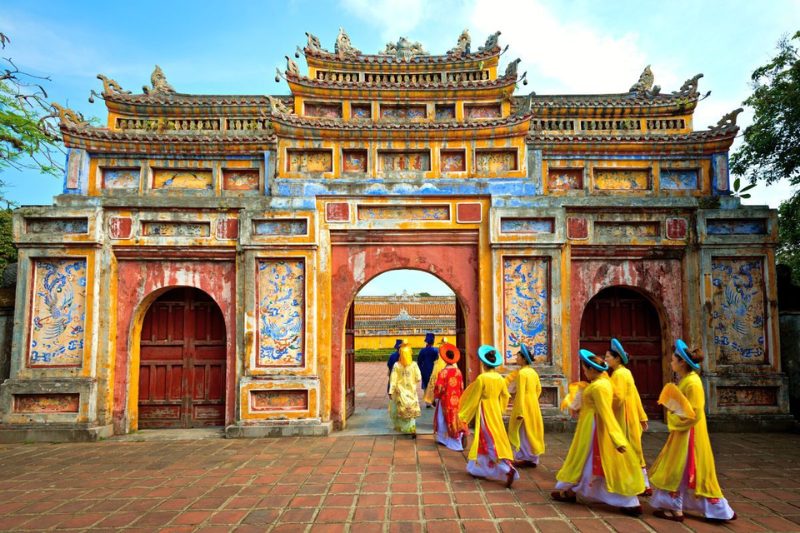

The best places to visit in Hue are the Imperial City, Thien Mu Pagoda, the Perfume River and the royal tombs of the Nguyen emperors, all part of the Complex of Hue Monuments that UNESCO listed as World Heritage in 1993. Beyond its historical architecture, Hue also boasts fantastic natural destinations, from Lang Co Beach to the rainforest of Bach Ma National Park, and most of them sit within 65 km of the city centre.
In this article, we list the top 10 Hue Vietnam tourist attractions and the best places to visit in Hue Vietnam for a first trip, in the order most sightseeing routes cover them, with ticket prices, opening hours and tips for Indian travellers. The table below gives a quick overview (prices converted at about 295 VND to ₹1).
| Place | Distance from centre | Entry fee (2026) |
|---|---|---|
| Hue Imperial City and Thai Hoa Palace | City centre, north bank | 200,000 VND (about ₹680) |
| Thien Mu Pagoda | 5 km west | Free |
| Perfume River | City centre | Evening music show about 100,000 VND |
| Khai Dinh Tomb | 10 km south | 150,000 VND (about ₹510) |
| Dong Ba Market | City centre | Free |
| Thanh Toan Bridge | 8 km east | Free |
| Hue History Museum | City centre | Small fee |
| Bach Ma National Park | 45 km south | 60,000 VND (about ₹200) |
| Tam Giang Lagoon | About 20 km north-east | Free |
| Lang Co Beach | 65 km south | Free |
A combined ticket for the Imperial City plus the Minh Mang, Tu Duc and Khai Dinh tombs costs 530,000 VND (about ₹1,800) and saves around 120,000 VND compared with single tickets.
Hue Imperial City and Thai Hoa Palace

Hue Imperial City is the first of all places to visit in Hue: the walled palace complex of the Nguyen dynasty, home to 13 emperors from 1802 to 1945, open daily for 200,000 VND (about ₹680) per adult. As a part of the Complex of Hue Monuments, Hue Imperial City played an essential role in Vietnamese history, and it takes at least three hours to explore, longer than any other Hue sightseeing stop.
Hue Imperial City comprises an architectural system featuring three significant structures perfectly aligned along a north-south axis:
- The Citadel: The outermost structure comprises defensive ramparts encircled by a protective moat, serving as the first line of defense for the Hue Imperial City.
- The Imperial City: The inside rampart is surrounded by four walls about 600 m long each and four gates. Among these gates, the south entrance, known as Ngo Mon, holds particular significance. The Imperial City consists of palaces, gardens, libraries, residences and theaters for the emperor, royal family, and mandarins to work, study and relax.
- The Purple Forbidden City: This structure is the internal part of the Imperial City and the place for emperor and royal habitation. The Purple Forbidden City is the most strictly protected area.

In the Imperial City, the venue after Ngo Mon gate is Thai Hoa Palace – one of the visitors’ favourite spots. This place has sophisticated architecture and keeps the significant historical values of Vietnam. Thai Hoa Palace was used to celebrate important court rituals, welcome ambassadors of other countries, or host diplomatic activities.
When touring Hue Imperial City, you’ll be captivated by the unique blend of East and West architectures and gain deeper insights into the royal life of Vietnamese feudal society. Arrive at opening time to avoid the midday heat, and hire an electric buggy inside if you are travelling with seniors.
- Location: 23/8 Street, Hue City, north bank of the Perfume River
- Ticket price: 200,000 VND per adult; 40,000 VND for children aged 7 to 12
- Opening hours: about 7:00 AM to 5:30 PM daily
Thien Mu Pagoda

Thien Mu Pagoda, built in 1601 on a hill above the Perfume River 5 km west of the centre, is Hue’s oldest pagoda and free to visit. Under the reign of Lord Nguyen Hoang, this hill was considered auspicious land, so he decided to construct the pagoda here, and it remains an active monastery today.
The two main architectures of Thien Mu Pagoda are Phuoc Duyen Tower and Dai Hung Palace.

The 21 m-high Phuoc Duyen tower has an octagon shape and seven stories, with each story dedicated to a Buddha. Dai Hung, the main palace of Thien Mu Pagoda, has majestic architecture. Besides the bronze Buddha statue, there are numerous bronze statues and chimes made in 1677 and many unique antiques in this place.
Emperors admired the serene and peaceful beauty of Thien Mu Pagoda, and Indian Buddhist visitors often find it the most moving stop on a trip to hue. Dress modestly, covering shoulders and knees.
- Location: Ha Khe Hill, north bank of the Perfume River, about 5 km from the city centre
- Ticket price: Free
- Opening hours: 08:00 AM – 06:00 PM (daily)
Perfume River

The Perfume River (Song Huong) runs through the centre of Hue, and a dragon-boat trip from the city to Thien Mu Pagoda, or an evening boat with Ca Hue royal court music, is one of the top things to do in Hue. The Perfume River is linked to the life of Hue residents throughout history, and you can see it from the Imperial City, the tombs and the pagoda.
The current of the Perfume River is gentle and slow, and in autumn flowers from upstream orchards float down the river, giving it a faint scent and its name. The evening music show on a dragon boat costs about 100,000 VND per person and runs from around 7 PM; private boats can be chartered by the hour to visit Thien Mu Pagoda and the tombs upstream.
- Evening Ca Hue music show: about 100,000 VND per person
- Departure point: Toa Kham Pier, Le Loi Street, south bank
Khai Dinh Tomb

Khai Dinh Tomb, 10 km south of the centre, is the most elaborate of the Nguyen royal tombs, built from 1920 to 1931 and open daily for 150,000 VND (about ₹510). The tombs of the Nguyen Emperors were built to cater to the emperors’ pleasures during their lifetimes and to serve as a place of eternal rest, so each one reflects the individuality of its owner.
Crowned in 1916, Khai Dinh was the twelfth emperor of the Nguyen dynasty. His tomb was constructed on Chau Chu Mountain and took 11 years to complete.

Unlike the styles of other tombs, the Khai Dinh Tomb is considered the most luxurious mausoleum, with many materials imported from France and Japan. Its architecture combines classic Eastern culture and Western influences, and the gate pillars carry clear echoes of Indian temple architecture, a detail Indian visitors often notice.
Two standout pieces of art in this tomb are “Cuu long an van” (nine dragons amidst fleeting clouds) on the ceiling of Thien Dinh Palace and the porcelain mosaics and paintings on the walls. If you have time for more royal tombs, Minh Mang Tomb, set among lakes, and Tu Duc Tomb, with its pine-shaded pavilions, cost 150,000 VND each and are included in the combo tickets.
- Location: Chau Chu Mountain, about 10 km south of Hue city centre
- Ticket price: 150,000 VND per adult; 30,000 VND for children aged 7 to 12
- Opening hours: 07:00 AM – 05:30 PM daily
Dong Ba Market

Dong Ba Market, founded in 1887 at No. 2 Tran Hung Dao Street, is Hue’s largest traditional market, free to enter and open from early morning to evening. It has three floors with a wide array of stalls and goods.
- 1st Floor: daily cooking ingredients, local foods (Bun Bo Hue, Banh Bot Loc, Com Hen) and specialities such as sesame candy (me xung) and dried food.
- 2nd Floor: handicrafts and souvenirs such as conical hats, ornaments, bamboo products and ceramics.
- 3rd Floor: fabrics and clothes, including the traditional Vietnamese dress (Ao Dai).
Hue’s poem conical hats (non bai tho) and sesame candy are the best buys here; for a longer list of vietnam famous products to take home, see our shopping guide. Bargain at the souvenir stalls and carry small cash.
- Location: No. 2 Tran Hung Dao Street, Hue City
- Opening hours: about 05:00 AM – 07:00 PM, with outside food stalls open later
Thanh Toan Bridge

Thanh Toan Bridge is an 18th-century tile-roofed wooden bridge in a village 8 km east of Hue, free to visit at any time and best combined with a countryside bicycle ride. The roughly 17-meter-long bridge was built in 1776 with the money of a noblewoman who wished to help villagers cross the canal easily, and it is now a national relic.
In the neighbouring area, a small village market and an agricultural museum show rural life around Hue. The rice fields around the bridge are greenest from February to April.
- Location: Thanh Thuy village, about 8 km east of Hue city centre
- Opening hours: 24 hours daily
Thua Thien Hue Historical Museum

The Hue History Museum, founded in July 1989 on 23/8 Street, holds more than 30,000 items on the history of Hue and is housed in the former Imperial Academy, the Nguyen dynasty’s first national university. If you want to learn more about the history of this poetic city before visiting the Imperial City, it is a good one-hour stop, and the original building has remained intact to the present day.
- Location: 23/8 Street, Hue City
- Opening hours: 07:30 AM – 11:00 AM and 01:30 PM – 05:00 PM daily
Bach Ma National Park

Bach Ma National Park is a mountain rainforest 45 km south of Hue, with a 1,450 m summit, a waterfall around 300 m high and an entry fee of 60,000 VND (about ₹200). Bach Ma National Park is a vast primeval forest with diverse flora and fauna and is home to several endangered animals, and a day here is a cool break from the heat of the city.
The Do Quyen (Rhododendron) Waterfall and the Five Lakes trail are the most popular walks. The road to the summit is steep, so book a park vehicle or a private car with driver rather than driving yourself.
- Location: about 45 km south of Hue city centre
- Ticket price: 60,000 VND per adult; 20,000 VND per child
- Best time to visit: February to August, when the trails are dry
Tam Giang Lagoon

Tam Giang Lagoon, about 20 km north-east of Hue, is part of one of the largest lagoon systems in Southeast Asia and is best visited at sunset, when the fishing nets turn gold. The Tam Giang Lagoon covers about 52 km² and is renowned for its rustic beauty and peaceful ambience.
Morning brings mist and fishermen at work; late afternoon brings the famous sunset over the bamboo fishing traps. Small boats take visitors out on the water, and the lagoon-side restaurants serve fresh fish and vegetable dishes at low prices.
- Location: about 20 km north-east of Hue city centre
- Best time of day: 4:30 PM to sunset
Lang Co Beach

Lang Co Beach, 65 km south of Hue at the foot of the Hai Van Pass, is a 10 km stretch of white sand between the sea and a lagoon, free to visit and best from April to July. It combines crystal-clear water, white sand and green mountains, and it is one of the best beaches in hue vietnam.
There is plenty of fresh seafood here, along with simple vegetable and rice dishes for vegetarian travellers. Lang Co sits on the road between Hue and Da Nang, so most visitors stop here on a transfer day rather than making a separate trip.
- Location: Lang Co town, about 65 km south of Hue city centre
- Best time to visit: April to July
How To Reach Hue
Phu Bai International Airport is 15 km south of Hue, with flights of about 1 hour 15 minutes from Hanoi and Ho Chi Minh City, while Da Nang and Hoi An are 2 to 3 hours away by road over the Hai Van Pass. There are no direct flights from India, so most Indian travellers reach Hue from Hanoi, Ho Chi Minh City or Da Nang.
| From | Distance | Fastest option | Route guide |
|---|---|---|---|
| Hanoi | 660 km | Flight 1 h 15 min; overnight train 12–14 h | hanoi to hue |
| Ho Chi Minh City | 1,050 km | Flight 1 h 20 min | ho chi minh to hue |
| Da Nang | 100 km | Private car 2–2.5 h via Hai Van Pass; train 2.5–3 h | da nang to hue |
| Hoi An | 130 km | Private car about 3 h | hoi an to hue |
| Nha Trang | 630 km | Flight via Da Nang or train 11–12 h | nha trang to hue |
Best Time To Visit Hue
The best time to visit Hue is from February to April, when the weather is dry and mild at 20 to 30°C; May to August is hot, up to 38°C, and September to December is the rainy season with frequent floods. Our full guide on the best time to visit hue covers each month and the Hue Festival dates.
October and November are the wettest months, and the Perfume River often floods low-lying streets, so Diwali travellers should keep indoor sights in reserve. Check our guides to the climate in vietnam in october and to whether is november good time to visit vietnam for the north and south, which are drier at that time.
FAQs About Places To Visit In Hue
How many days are enough for Hue?
Two days are enough for the main places to visit in Hue. Spend day one on the Imperial City, the Hue History Museum and an evening Perfume River music show, and day two on Thien Mu Pagoda and the royal tombs; add a third day for Bach Ma or Tam Giang Lagoon.
What is Hue, Vietnam famous for?
Hue is famous as the imperial capital of the Nguyen dynasty from 1802 to 1945, its UNESCO-listed monuments, royal court music and Buddhist vegetarian cuisine.
Is Hue good for vegetarian Indian travellers?
Yes. Hue has a strong Buddhist vegetarian tradition, and “com chay” restaurants are found across the city. Ask for dishes without fish sauce and, for Jain meals, without onion and garlic.
Plan Your Hue Trip
These are the top 10 places to visit in Hue, from the Imperial City and royal tombs to the beaches and forests around the city. Hue usually gets two nights in a central Vietnam route with Da Nang and Hoi An; our guides on how much does a 7 day trip to vietnam cost and how much does a 10 day trip to vietnam cost show where Hue fits and what it adds to the budget. You can compare every vietnam tour package from india, add a beach finish with a phu quoc island tour package, or browse the best places to visit vietnam beyond the old capital.
To turn these places to visit in Hue into a day-by-day plan, share your travel dates, group size and departure city in the form below. A Vietnamtour.in expert will arrange the Imperial City and tomb tickets, a private car over the Hai Van Pass and vegetarian or Jain meals in advance.
RELATED ARTICLES