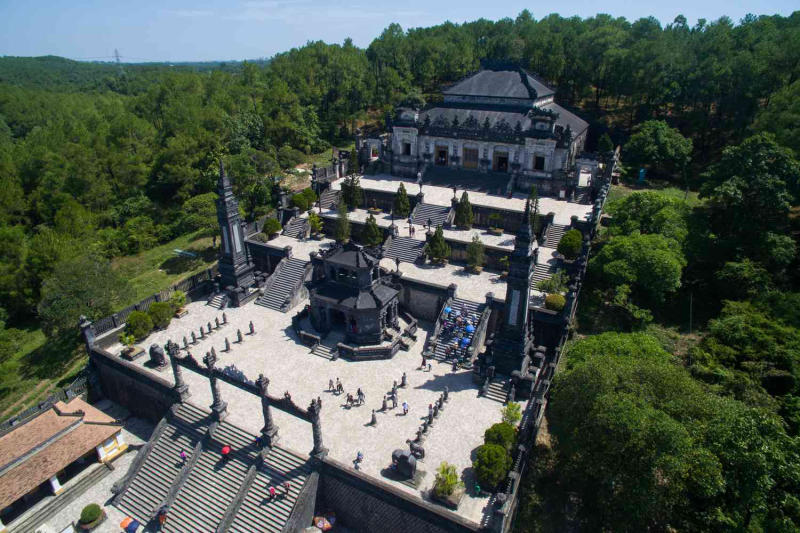

Khai Dinh Tomb, officially Ung Mausoleum, is the burial complex of Emperor Khai Dinh, the twelfth ruler of Vietnam’s Nguyen Dynasty, built between 1920 and 1931 on Chau Chu Mountain in Hue. The complex sits 10 kilometres (about 6.2 miles) from Hue city centre, opens daily from 7:00 AM to 5:30 PM, and charges 150,000 VND (about ₹535) per adult and 30,000 VND (about ₹107) per child. Khai Dinh Tomb belongs to the Complex of Hue Monuments, inscribed on the UNESCO World Heritage List in 1993, and stands out among Nguyen-era mausoleums for its fusion of Vietnamese, French, Hindu, Buddhist, and Roman architectural styles.
This guide covers the history, the architectural fusion, the address and feng-shui setting, opening hours and entry fee in 2026, four transport options from Hue city centre, the best months to visit, the five chambers inside the tomb, recommended visit duration, a comparison with Tu Duc and Minh Mang tombs, tips for Indian travellers, and nearby attractions you can combine into a one-day Hue itinerary.
History Of Khai Dinh Tomb And Emperor Khai Dinh
Khai Dinh Tomb is the mausoleum of Emperor Khai Dinh, who ruled Vietnam from 1916 to 1925 as the twelfth emperor of the Nguyen Dynasty, and whose burial complex took eleven years to build, from 1920 to 1931. Construction began under Khai Dinh’s own commission in 1920 and was completed in 1931 under his successor, Emperor Bao Dai. The project was funded through a roughly 30% surcharge on the national tax, a decision that historians cite as one source of Khai Dinh’s unpopular reputation along with his close collaboration with the French colonial administration.
Since 1993, Khai Dinh Tomb has been protected as part of the Complex of Hue Monuments on the UNESCO World Heritage List, alongside the Imperial Citadel, the Forbidden Purple City, and the six other Nguyen Dynasty royal tombs scattered across the hills west of Hue.
Architectural Fusion: East Meets West At Ung Mausoleum
Khai Dinh Tomb blends Vietnamese imperial tradition with French, Hindu, Buddhist, and Roman architectural elements, making it the only Nguyen Dynasty tomb to step away from the traditional square or circular plan in favour of a rectangular layout. The rectangular footprint and the use of slate, wrought iron, and reinforced concrete reflect the influence of Khai Dinh’s 1922 state visit to France.
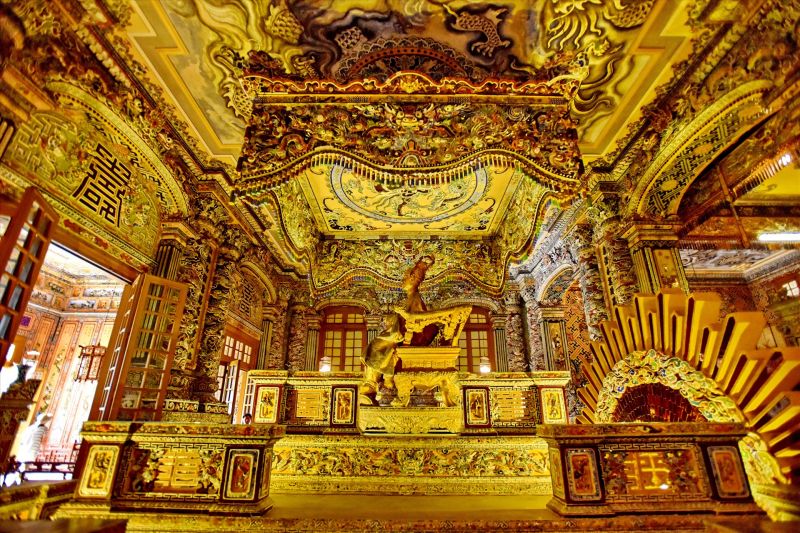
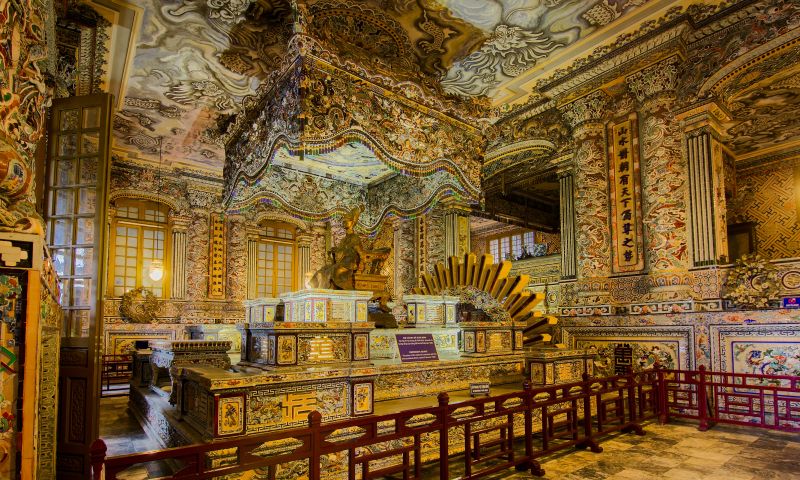
The exterior is finished in unpainted grey concrete that weathers over time, but the interior opens into Thien Dinh Palace, whose three chambers — the central hall, Khai Thanh Palace, and the rear sanctum — are covered floor-to-ceiling in ceramic and glass mosaics depicting the four sacred animals (dragon, unicorn, turtle, phoenix), the four seasons, and the eight precious objects of Vietnamese royal art. The dragon sculpture at the entrance is the largest of any Nguyen Dynasty tomb, and the mosaic programme is widely considered the most elaborate of any imperial monument in Vietnam.
Location And Address Of Khai Dinh Tomb
Khai Dinh Tomb is located on Chau Chu Mountain in Chau Chu Village, Thuy Bang Commune, Huong Thuy District, Thua Thien-Hue Province, about 10 kilometres (6.2 miles) south of Hue city centre. The full address registered on the UNESCO heritage record is Nui, Chau Chu, Thuy Xuan, Hue 530000, Vietnam.
The site was chosen by Khai Dinh himself using traditional feng shui principles: the mountain behind acts as the “azure dragon”, a small stream in front serves as the “white tiger”, and the mausoleum opens to the southeast for morning light.
Opening Hours And Entrance Fee In 2026
Khai Dinh Tomb opens daily from 7:00 AM to 5:30 PM with no weekly closing day, and the entrance fee is 150,000 VND (about ₹535) per adult and 30,000 VND (about ₹107) per child, payable in cash at the ticket gate. Conversion uses 1 INR = 280 VND, verified November 2025; check the Hue Monuments Conservation Centre for current rates.
A combined ticket covering Khai Dinh Tomb, Tu Duc Tomb, and Minh Mang Tomb costs 420,000 VND (about ₹1,500) per adult and offers a saving of 30,000 VND (about ₹107) compared with three separate tickets.
How To Get To Khai Dinh Tomb From Hue City Centre
The most popular ways to reach Khai Dinh Tomb from Hue city centre are private taxi, motorbike taxi (xe om), local bus, and a guided three-tomb tour, with one-way costs ranging from ₹40 to ₹1,000 depending on the mode. The route covers 10 kilometres (6.2 miles) and takes 15 to 25 minutes by road.
- Private taxi: ₹400 to ₹600 one-way (110,000 to 170,000 VND), 15 minutes. Mai Linh and Vinasun operate metered taxis from Hue Railway Station and most hotels.
- Motorbike taxi (xe om) or Grab Bike: ₹150 to ₹250 one-way (40,000 to 70,000 VND), 20 minutes. Faster in traffic and suited to solo travellers comfortable on a bike.
- Local bus: ₹40 one-way (around 12,000 VND), 45 minutes. Take the bus toward Dong Ba – Cho Tuan, which stops at the tomb’s main gate.
- Half-day guided tour (three tombs): ₹700 to ₹1,000 per person (about 200,000 to 280,000 VND), 4 hours, including transport and an English-speaking guide. Best value for first-time visitors.
By private car from the city centre, head southwest along Dien Bien Phu Street, join Minh Mang Street, and continue onto Khai Dinh Street; the tomb sits near the end of the road.
Best Time To Visit Khai Dinh Tomb
The best time to visit Khai Dinh Tomb is January to April, when Hue’s daytime temperature stays between 20 °C and 28 °C (68 °F to 82 °F) and monthly rainfall drops below 60 millimetres (2.4 inches). May to August is hot above 35 °C (95 °F), and September to December brings heavy rain from the northeast monsoon, with December rainfall averaging above 600 millimetres (23.6 inches).
For daily timing, arrive between 7:00 AM and 8:30 AM to beat the heat and the tour-bus crowd that arrives from Da Nang and Hoi An by mid-morning. On a March 2025 visit, the morning crowd cleared by 10:30 AM, leaving Thien Dinh Palace nearly empty for photography.
What To See Inside Khai Dinh Tomb
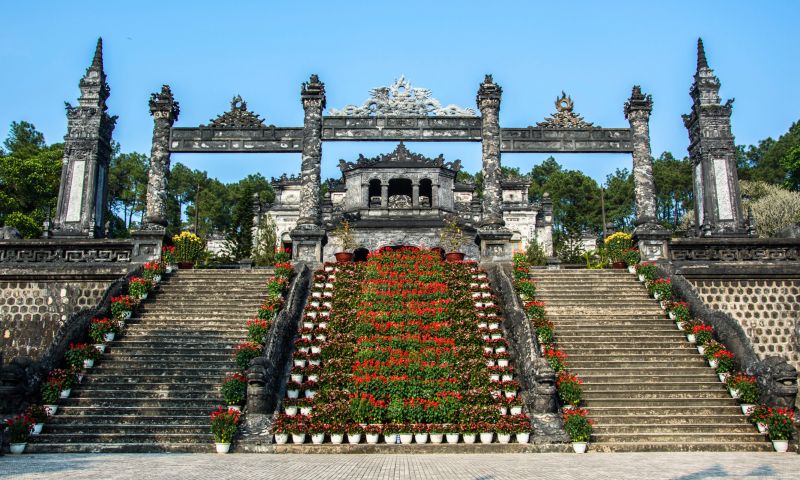
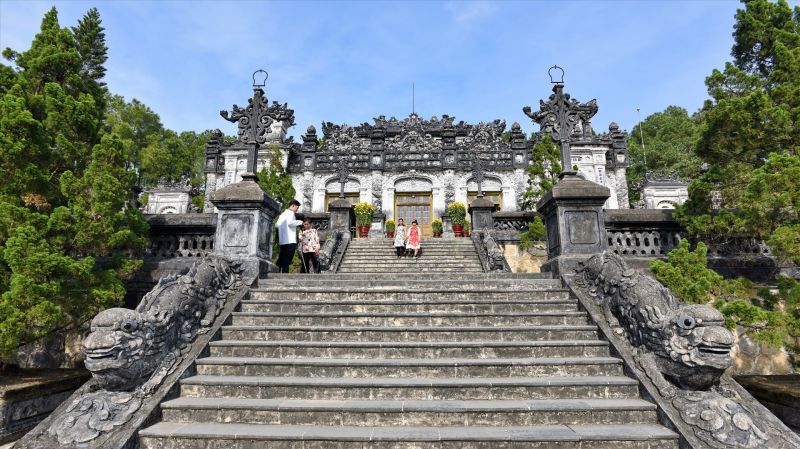
Khai Dinh Tomb has 127 stone steps that climb through five main sections — Tam Quan Gate, Nghi Mon Gate, the Stele Pavilion, the Tru Bieu Pillars, and Thien Dinh Palace — across three terraces rising up the slope of Chau Chu Mountain. A full circuit takes 60 to 90 minutes.
Tam Quan Gate
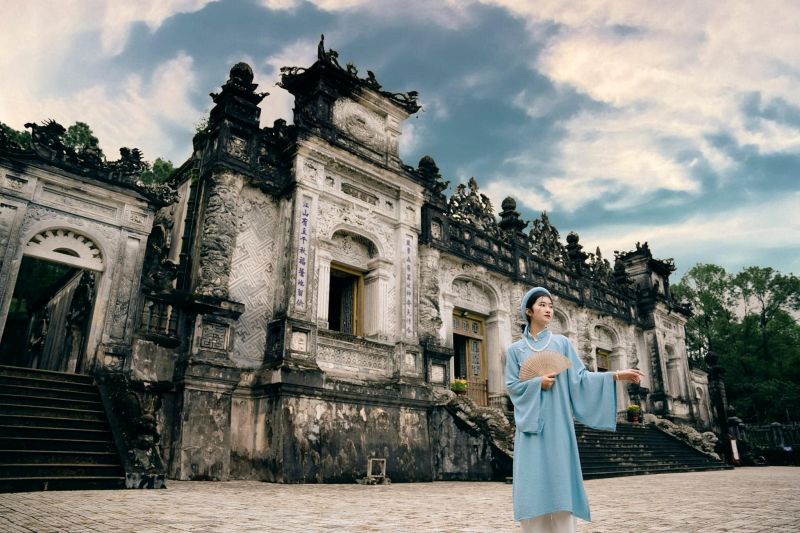
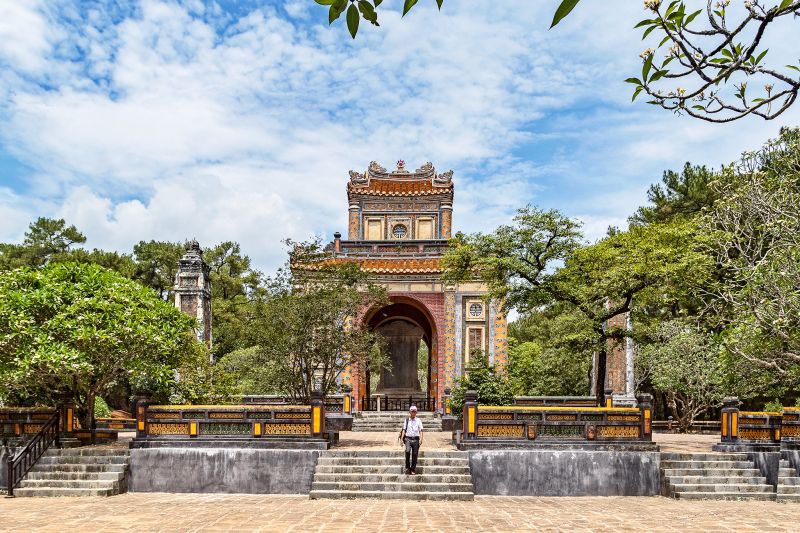
Tam Quan Gate sits at the base of the complex and is reached by climbing the first 37 of the 127 stone steps. The gate has three doorways: the left and right doors were reserved for civil and military mandarins, and the central door was reserved for the emperor. The arched lintels show Hindu-inspired motifs, reflecting Khai Dinh’s interest in colonial-era Indian temple architecture.
Nghi Mon Gate And Bai Dinh Yard
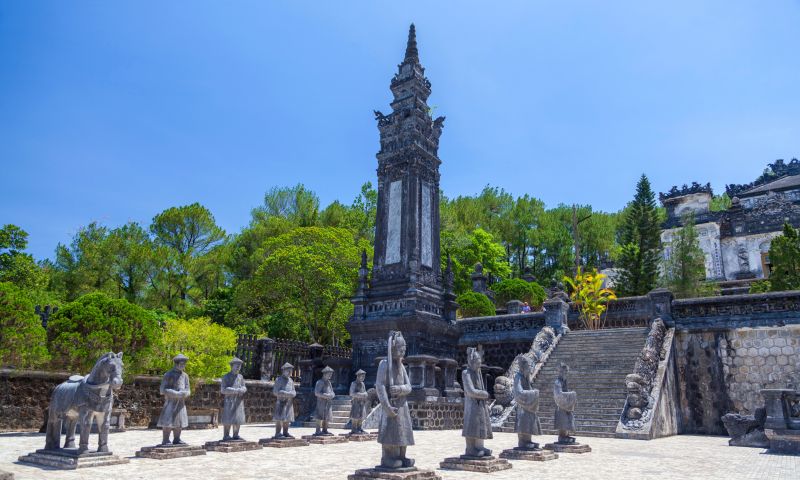
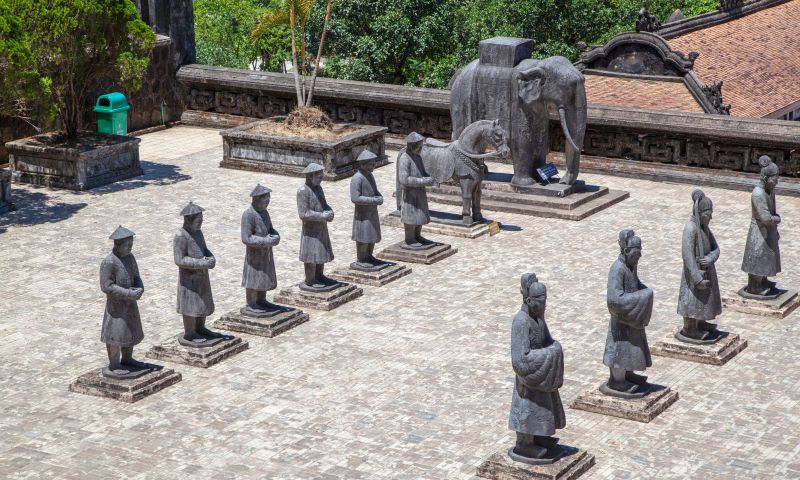
Twenty-nine steps above Tam Quan Gate, Nghi Mon Gate opens onto Bai Dinh Yard, a paved courtyard lined with 24 life-sized bluestone statues — eight mandarins, eight soldiers, four horses, and four elephants. Each figure has a unique facial expression and represents the imperial court continuing to serve the emperor in the afterlife. This is the largest set of stone honour-guard statues at any Nguyen Dynasty tomb.
The Stele Pavilion And Bi Dinh Monument
At the centre of Bai Dinh Yard stands an octagonal stone pavilion housing the Bi Dinh stele, a 3.1-metre (10.2-foot) tall, 10-tonne (about 9,072-kilogram / 20,000-pound) inscribed monument that records Khai Dinh’s life and accomplishments. The stele text was commissioned by Bao Dai, Khai Dinh’s son and successor, in 1931.
Tru Bieu Pillars
Flanking the Stele Pavilion are two tall Tru Bieu pillars, each shaped like a Buddhist stupa. The pillars symbolise a pair of illuminated candles guiding Khai Dinh’s soul through the afterlife, a motif borrowed from Theravada Buddhist funerary architecture seen across mainland Southeast Asia.
Thien Dinh Palace
Thien Dinh Palace sits at the top of the climb and is the highest and most decorated section of the tomb. The marble floor was imported from Italy, the wrought-iron grilles were cast in French Renault foundries, and the three chambers inside are covered in ceramic and glass mosaics across walls, columns, and the canopied ceiling. Beneath the gold-leafed canopy stands a life-size bronze statue of Khai Dinh, gilded by Vietnamese artisans in 1922. The emperor’s body rests in a vaulted crypt 18 metres (about 59 feet) below the statue.
How Long To Spend At Khai Dinh Tomb
A full visit to Khai Dinh Tomb takes 60 to 120 minutes — 60 minutes for a quick walkthrough of the five sections, 90 minutes for unhurried photography, and 120 minutes if you read every interpretive panel and take time inside Thien Dinh Palace. Most guided three-tomb tours allocate 45 minutes here, which is the minimum that allows climbing the 127 steps without rushing.
Allow an extra 15 minutes if you arrive by bus, as the bus stop is a 5-minute walk from the main gate.
Khai Dinh Tomb vs Tu Duc Tomb vs Minh Mang Tomb
Among Hue’s three most-visited royal tombs, Khai Dinh stands out for elaborate interior mosaics and East–West fusion, Tu Duc is the largest and most poetic with lakes and gardens, and Minh Mang is the most symmetrical and Confucian. Choose Khai Dinh for architecture and photography, Tu Duc for atmosphere and history, and Minh Mang for classical landscaping.
| Tomb | Built | Style | Size | Highlight | Entry Fee | Time Needed |
|---|---|---|---|---|---|---|
| Khai Dinh | 1920–1931 | Vietnamese + French + Hindu + Buddhist + Roman | 1.2 hectares | Mosaic interior of Thien Dinh Palace | 150,000 VND (₹535) | 60–120 min |
| Tu Duc | 1864–1867 | Classical Vietnamese, garden tomb | 12 hectares | Luu Khiem Lake and Xung Khiem Pavilion | 150,000 VND (₹535) | 90–150 min |
| Minh Mang | 1840–1843 | Classical Confucian, axial symmetry | 18 hectares | 40 monuments along a 700-m central axis | 150,000 VND (₹535) | 90–180 min |
A combined three-tomb ticket costs 420,000 VND (about ₹1,500) per adult.
Tips For Indian Travellers Visiting Khai Dinh Tomb
The tomb is photogenic, the steps are steep, and the surrounding hills offer little shade — a short tip list keeps the visit comfortable.
- Wear knee-length clothing and closed-toe walking shoes that handle 127 stone steps.
- Carry 200 millilitres of drinking water and sunscreen rated SPF 30 or higher.
- Bring small VND notes; the ticket counter does not accept INR or international cards.
- Hire a licensed local guide at the gate for 250,000 VND (about ₹895) if you want context on the architectural symbolism.
- Visit on a weekday morning to avoid the weekend tour-bus crowd from Hoi An and Da Nang.
- Do not touch the mosaic surfaces — they are original 1920s ceramic and fragile.
Other Attractions Near Khai Dinh Tomb In Hue
Once you finish the tomb circuit in roughly 90 minutes, four heritage sites within 12 kilometres complete a one-day Hue itinerary. Each pairs well with Khai Dinh and is covered in detail in our companion guides.
- Hue Imperial City: the UNESCO-listed Forbidden Purple City and the political heart of the Nguyen Dynasty, 8 kilometres north.
- Perfume River: a 1-hour dragon-boat cruise past Thien Mu Pagoda and the city’s old French quarter.
- Thien Mu Pagoda: a seven-tiered tower on Ha Khe Hill, the spiritual icon of Hue, 5 kilometres from the tomb.
- Tu Duc Tomb: the garden tomb of Emperor Tu Duc, 4 kilometres from Khai Dinh and ideal as the second stop on a combined three-tomb tour.
Read more: Top 10 Best Places to Visit in Hue for Indian Tourists.
Wrapping Up
Khai Dinh Tomb rewards a 60- to 120-minute visit with the most elaborate interior of any Nguyen Dynasty mausoleum, a UNESCO-protected setting on Chau Chu Mountain, and an architectural fusion you will not see anywhere else in Vietnam. Pair it with Tu Duc Tomb and Hue Imperial City for a complete one-day Hue heritage circuit, and book a Vietnam tour with Vietnamtour.in if you want our local guide to handle transport, tickets, and historical commentary.