The best places to visit in Hoi An are 11 sights within 7 km of the Ancient Town: the UNESCO-listed old town itself, 3 beaches (Cua Dai, An Bang and Cam An), 4 craft and farming villages (Cam Thanh, Kim Bong, Thanh Ha and Tra Que), and 3 heritage buildings covered by the 120,000 VND (₹440) Ancient Town ticket (Fujian Assembly Hall, Quan Cong Temple and the Museum of History and Culture). The old town was a trading port from the 15th to the 19th century, and its wooden houses and assembly halls mix Vietnamese, Chinese, Japanese and French styles. Hoi An has been a ward of Da Nang city since 1 July 2025, about 30 km south of Da Nang Airport, so older addresses still show Quang Nam province.
This guide from Vietnamtour.in covers the 11 Hoi An tourist attractions with entry fees in rupees, opening hours and time needed, a plan for 2 days, day trips and onward routes, the best time to visit, and the questions Indian travellers ask most often.
The 11 places to visit in Hoi An at a glance:
| # | Place | Distance from Ancient Town | Entry | Time needed |
|---|---|---|---|---|
| 1 | Hoi An Ancient Town | Centre | 120,000 VND (₹440) for 5 sights, valid 24 hours | Half a day to a full day |
| 2 | Cua Dai Beach | About 5 km east | Free | 2–3 hr |
| 3 | An Bang Beach | About 4 km north-east | Free | Half a day |
| 4 | Cam An Beach | About 5 km north-east | Free | 2–3 hr |
| 5 | Cam Thanh Coconut Village | About 3 km south-east | 30,000 VND (₹110) entry; basket boat 150,000–200,000 VND (₹550–₹735) per boat | 2–3 hr |
| 6 | Kim Bong Carpentry Village | Across the Thu Bon River | Free | 1–2 hr |
| 7 | Thanh Ha Pottery Village | About 3 km west | 35,000 VND (₹130), with a pottery gift | 1–2 hr |
| 8 | Tra Que Vegetable Village | About 3 km north-east | 35,000 VND (₹130) | 1–2 hr |
| 9 | Fujian Assembly Hall | Ancient Town | Covered by the Ancient Town ticket | 30 min |
| 10 | Quan Cong Temple | Ancient Town | Covered by the Ancient Town ticket | 20–30 min |
| 11 | Hoi An Museum of History and Culture | Ancient Town | Covered by the Ancient Town ticket | 45 min |
Prices are the published 2026 rates for foreign visitors, converted at ₹1 ≈ 273 VND; the Ancient Town ticket allows entry to 5 of the 21 listed heritage sites, and the villages charge separately.
Hoi An Ancient Town
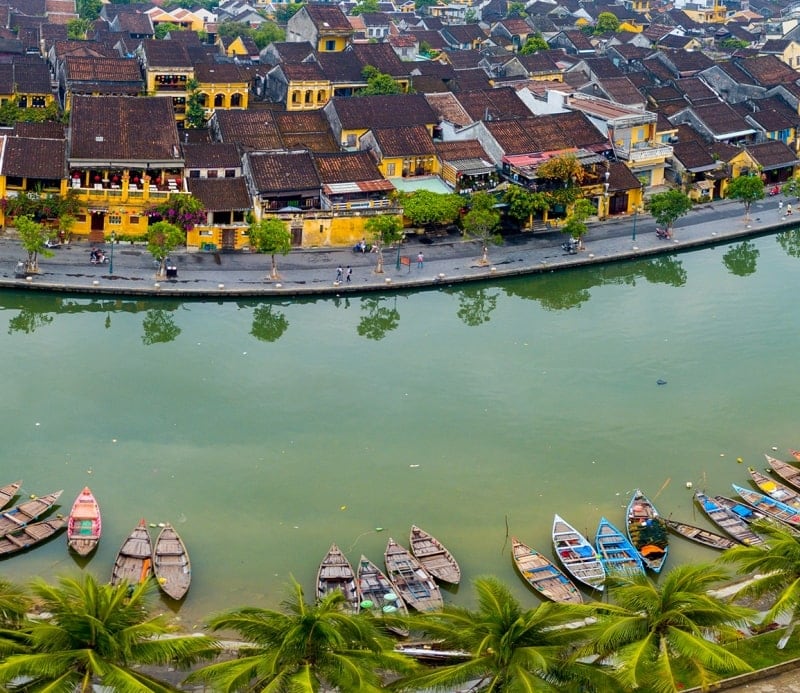
Hoi An Ancient Town is a UNESCO World Heritage Site since 1999 and the first of the places to visit in Hoi An, a preserved trading port of about 1,100 wooden buildings on the Thu Bon River. Founded as a port in the 15th century, Hoi An was 1 of the busiest trading hubs in South-East Asia from the 16th to the 18th century, with Japanese, Chinese and later European merchants building the houses, assembly halls and the Japanese Covered Bridge that still stand. The old town is closed to cars, and lanterns light the streets every evening.
The practical details are:
- Location: Centre of Hoi An, on the north bank of the Thu Bon River
- Opening hours: Heritage sites 8:00 AM–5:30 PM; the streets and lantern market stay open until about 10:00 PM
- Entry: 120,000 VND (₹440) per foreign visitor, valid 24 hours for 5 heritage sites; children under 1 m free, 1–1.4 m 50,000 VND (₹185)
- Time needed: Half a day for the sights; an evening for the lanterns
The ticket is sold at booths on the streets into the old town and is checked at the heritage sites, not on the streets themselves, and walking the lanes and the riverside costs nothing. Hoi An’s beaches sit 4–5 km from the old town, and the 3 below are the ones most visitors use.
Cua Dai Beach
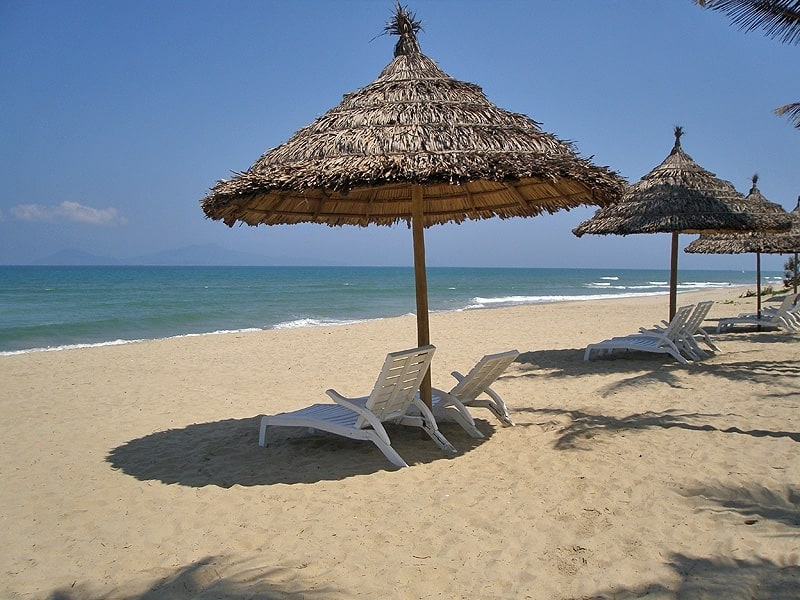
Cua Dai Beach is the long public beach about 5 km east of the Ancient Town, where the Thu Bon River meets the sea, with soft white sand and resorts along the road from town. The beach has lost sand to erosion in places, so the best stretch for swimming moves from year to year, and the water is calm from March to August. Weekdays are quiet, while local families fill the sand on weekend afternoons.
The practical details are:
- Location: About 5 km east of the Ancient Town, 10–15 minutes by taxi or bicycle
- Best time to visit: March to August; rough seas from October to January
- Entry: Free; loungers rented by the beachfront cafés
- Time needed: 2–3 hours
Sunrise over the sea is the best hour here, before the heat and before the road from town fills with bicycles.
An Bang Beach
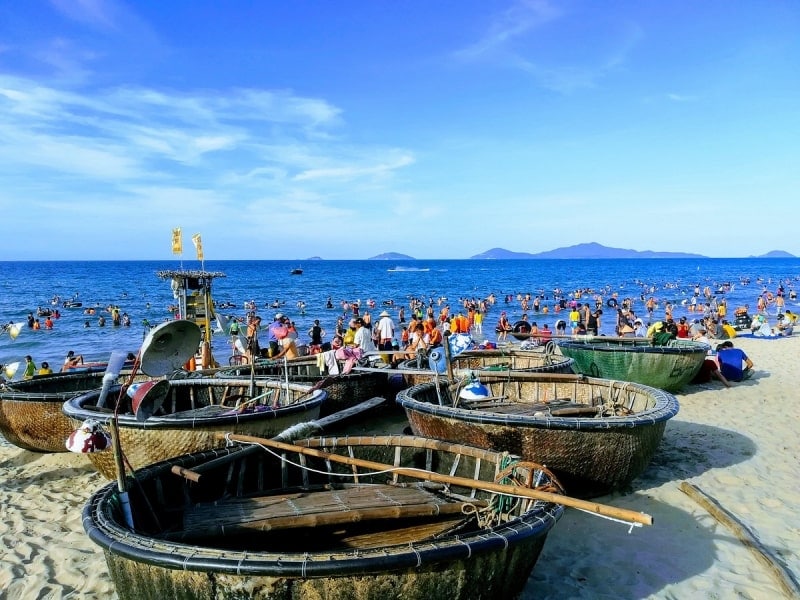
An Bang Beach is the most popular beach in Hoi An, a 4 km stretch of sand about 4 km north-east of the Ancient Town with beach bars, seafood restaurants and live music in the evenings. It draws more visitors each year for its clean sand, water sports and late-night cafés, and it was named among CNN’s 100 best beaches in the world in 2016. Basket boats line the shore where fishermen land their catch in the morning.
The practical details are:
- Location: About 4 km north-east of the Ancient Town, 10 minutes by taxi
- Best time to visit: March to August for swimming; evenings all year for the bars
- Entry: Free; parking and loungers charged by the cafés
- Time needed: Half a day
The bars on the sand are the centre of Hoi An nightlife outside the old town, and the guide to An Bang Beach covers the best cafés, the water sports and the sunrise swim. Travellers who want to sleep by the sea rather than in town can compare the Hoi An beach resorts along this coast.
Cam An Beach
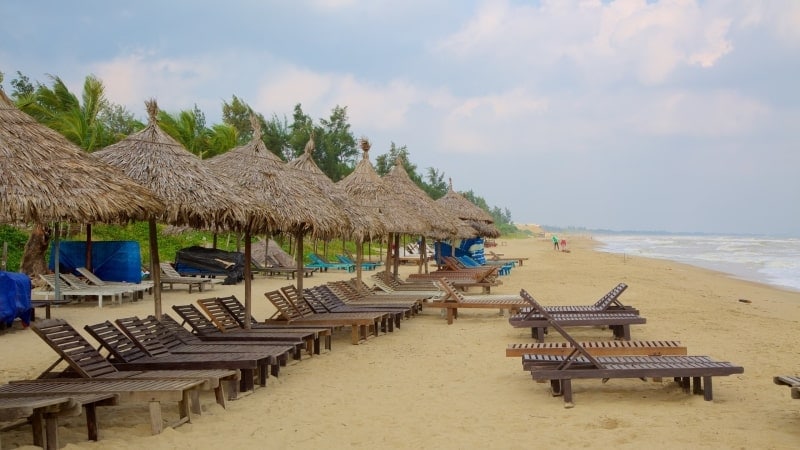
Cam An Beach is the quieter stretch of coast just north of An Bang in Cam An ward, used mainly by local families for dawn swims and evening barbecues, with views of the Cham Islands offshore. The coastline here has fewer bars and more fishing boats, and seafood shacks grill the morning catch at lunchtime. It suits travellers who want the sea without the An Bang crowd.
The practical details are:
- Location: Cam An ward, about 5 km north-east of the Ancient Town
- Best time to visit: Early morning and late afternoon, March to August
- Entry: Free
- Time needed: 2–3 hours
Cua Dai, An Bang and Cam An run into 1 another along the same coast, and the differences in sand, crowds and cafés are compared in the guide to the beaches in Hoi An.
Cam Thanh Coconut Village
Cam Thanh Coconut Village is the Bay Mau nipa palm forest about 3 km south-east of the Ancient Town, where visitors ride round basket boats through water-palm channels. The forest covers about 100 ha of nipa palms along the Thu Bon estuary, and the basket-boat rides, fishing and net-casting give it the feel of the Mekong Delta. Late afternoon brings the sunset over the river at the end of the ride.

The practical details are:
- Location: Cam Thanh, about 3 km south-east of the Ancient Town
- Opening hours: About 7:00 AM–5:30 PM
- Entry: 30,000 VND (₹110) per person; basket boat 150,000–200,000 VND (₹550–₹735) per boat for 2–3 people
- Time needed: 2–3 hours
The boat rowers, the spinning-basket show and the quieter channels are covered in the guide to Cam Thanh Coconut Village, which helps pick a calmer time of day.
Kim Bong Carpentry Village
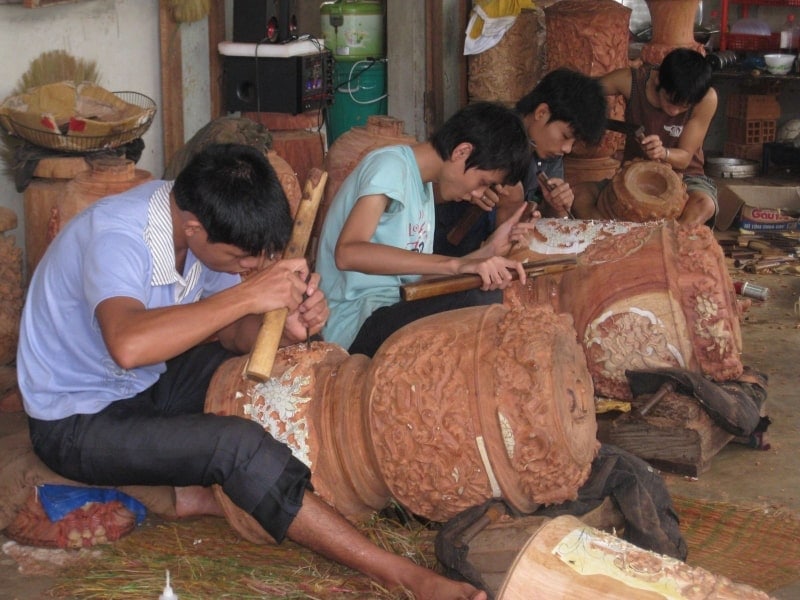
Kim Bong Carpentry Village is a 600-year-old woodworking village on Cam Kim island, a 10-minute ferry ride across the Thu Bon River from the Ancient Town. Its carpenters built many of the old town’s houses and the boats on the river, and today the workshops split into 3 trades: boat-building, furniture and carved architectural timber. Visitors watch the carvers at work and buy small pieces to take home.
The practical details are:
- Location: Cam Kim island, across the Thu Bon River from the old town
- Opening hours: Workshops open daytime, about 8:00 AM–5:00 PM
- Entry: Free
- Time needed: 1–2 hours, plus the ferry
Carved boxes and small statues from Kim Bong are among the things to buy in Hoi An that pack well, alongside lanterns and tailored clothes from the old town.
Thanh Ha Pottery Village
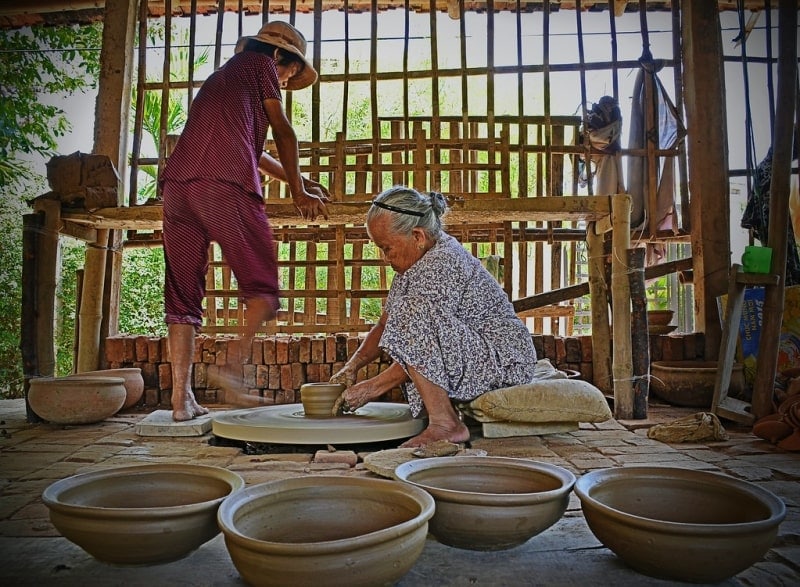
Thanh Ha Pottery Village is a 500-year-old pottery village about 3 km west of the Ancient Town, where potters still shape clay on kick-wheels without moulds. Founded in the 16th century by potters from northern Vietnam, the village supplied bricks and tiles for the old town, and its work is now mostly decorative. Visitors try the wheel, paint a piece and walk the Terracotta Park with its clay models of world landmarks.
The practical details are:
- Location: Thanh Ha, about 3 km west of the Ancient Town
- Opening hours: About 8:00 AM–5:30 PM
- Entry: 35,000 VND (₹130) per person, with a small pottery gift
- Time needed: 1–2 hours
Small clay whistles and bowls from Thanh Ha are the lightest souvenirs in Hoi An, and the wider list of Vietnam special items worth packing, from lacquer to coffee, is covered in a separate guide.
Tra Que Vegetable Village
Tra Que Vegetable Village is a 300-year-old farming village about 3 km north-east of the Ancient Town, where families grow herbs and vegetables with seaweed from the Tra Que lagoon as fertiliser. The farmers use no chemical fertiliser, and the neat green plots between the old town and An Bang Beach draw visitors for farming classes, cooking classes and photos. The village sits on the cycling route to the beach.

The practical details are:
- Location: Cam Ha, about 3 km north-east of the Ancient Town
- Opening hours: About 7:00 AM–6:00 PM
- Entry: 35,000 VND (₹130) per person; farming and cooking classes charged separately
- Time needed: 1–2 hours
Early morning and late afternoon are the farming hours, so visitors at those times see the watering and planting rather than empty plots.
Fujian Assembly Hall
Fujian Assembly Hall (Phuc Kien) is the largest and most visited of Hoi An’s Chinese assembly halls, built in the 1690s by merchants from Fujian and dedicated to Thien Hau, the goddess of the sea. The pink triple-arched gate, the dragon fountain and the incense coils inside make it the most photographed building on Tran Phu Street. Traders pray here for safe business, and couples hoping for children pray to the goddess of fertility in the rear hall.

The practical details are:
- Location: 46 Tran Phu Street, Ancient Town
- Opening hours: About 8:00 AM–5:30 PM
- Entry: 1 of the 5 sights on the Ancient Town ticket
- Time needed: 30 minutes
Shoulders and knees need to be covered inside the hall, and the incense coils are lit for visitors who buy one at the altar.
Quan Cong Temple
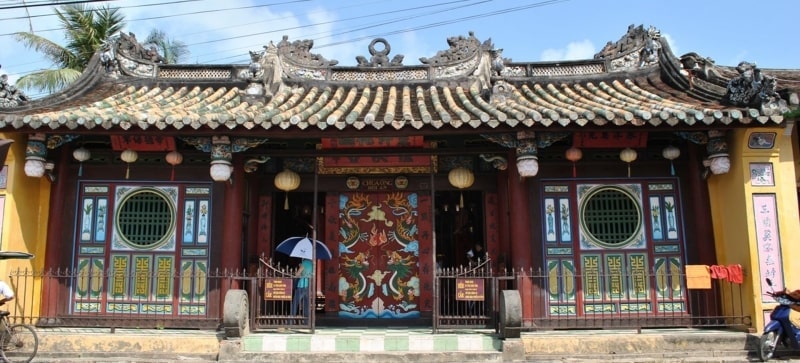
Quan Cong Temple is a 1653 temple in the Ancient Town dedicated to Quan Van Truong (Guan Yu), the Chinese general honoured for loyalty, courage and righteousness. The temple’s carved wooden beams, ceramic roof tiles and the statues of the general’s horses show Chinese temple design at its most detailed, and the central market sits just across the street. Merchants still come to pray for honest dealings.
The practical details are:
- Location: 24 Tran Phu Street, opposite Hoi An Market
- Opening hours: About 8:00 AM–5:00 PM
- Entry: 1 of the 5 sights on the Ancient Town ticket
- Time needed: 20–30 minutes
The temple pairs with the market across the road, where the food court serves cao lau noodles and banh mi at lunch.
Hoi An Museum of History And Culture
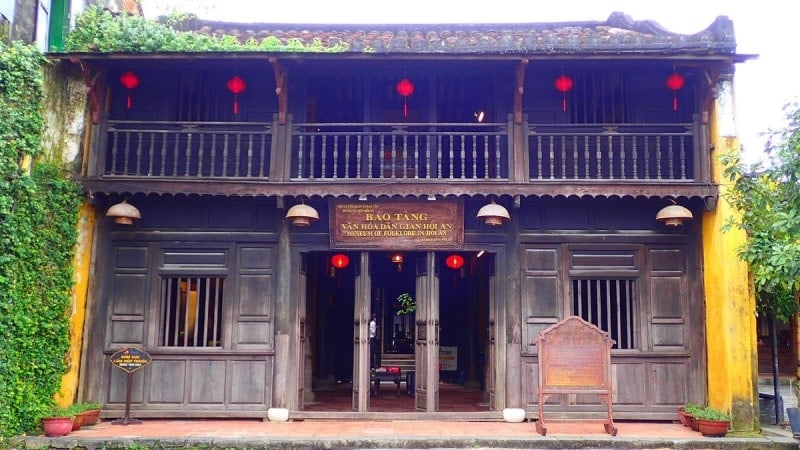
The Hoi An Museum of History and Culture, opened in 1989 on Tran Hung Dao Street, traces the town from the Sa Huynh and Champa periods through the trading port years to the present. Its galleries hold ceramics, coins, maps and models of the old port, and a visit before walking the streets explains why the houses, halls and bridge look the way they do. The upper floor looks over the old town’s tiled roofs.
The practical details are:
- Location: 10B Tran Hung Dao Street, Ancient Town
- Opening hours: About 8:00 AM–5:00 PM
- Entry: 1 of the 5 sights on the Ancient Town ticket
- Time needed: 45 minutes
The same ticket covers the old merchant houses, and Tan Ky Old House, a 200-year-old family home on Nguyen Thai Hoc Street, is the best of them to spend 1 of the 5 entries on.
How to Plan 2 Days Around the Places to Visit in Hoi An
2 days cover the places to visit in Hoi An: 1 day for the Ancient Town and 2 craft villages, and 1 day for a beach, the coconut village and the farming village, with the lantern-lit old town both evenings. The things to do in Hoi An group by distance from the old town, so most Hoi An sightseeing happens on foot or by bicycle:
| Day | Morning | Afternoon | Evening |
|---|---|---|---|
| Day 1 | Museum of History and Culture, Fujian Assembly Hall, Quan Cong Temple, Tan Ky Old House | Thanh Ha Pottery Village, Kim Bong by ferry | Lantern streets and boat ride on the Thu Bon River |
| Day 2 | An Bang or Cua Dai Beach | Tra Que Vegetable Village, Cam Thanh basket boats at sunset | Dinner at an Indian restaurant in town |
The 14th day of each lunar month is the Full Moon Lantern Night, when the old town switches off its electric lights, and the dates for the year, along with the Mid-Autumn and Tet celebrations, are listed in the guide to festivals in Hoi An. Hotel areas, the ward layout since 2025 and the airport transfer are covered in the travel guide to Hoi An, which helps choose between an old-town stay and a beach stay. Vegetarian and Jain meals are easy in town, where the Indian restaurants in Hoi An cluster within a 10-minute walk of the Japanese Covered Bridge.
Day Trips and Where to Go Next from Hoi An
The 2 main day trips from Hoi An are My Son Sanctuary, the Cham temple complex 40 km inland, and the Cham Islands, 20 km offshore, while Da Nang and Hue are the usual next stops on a central Vietnam route. The distances and travel times are:
| Destination | From Hoi An | Best for |
|---|---|---|
| My Son Sanctuary | About 40 km, 1 hr by car | Champa temples, half a day |
| Cham Islands | About 20 km, 30 min by speedboat from Cua Dai | Snorkelling, March to September |
| Da Nang | About 30 km, 45–60 min by car | Dragon Bridge, Ba Na Hills, airport |
| Hue | About 125 km, 3 hr by car via the Hai Van Pass | Imperial City, 1–2 nights |
| Hanoi / Ho Chi Minh City | 1 hr 20 min / 1 hr 15 min by air from Da Nang | Onward routes north or south |
The Hindu-origin temples of My Son Sanctuary, built by the Champa kingdom between the 4th and 13th centuries, are the day trip most Indian travellers choose, and the boat times and snorkelling season for the Cham Islands fill the second day for travellers with more time.
Hoi An has no airport or railway station, so every arrival runs through Da Nang. The transfer options are compared in the guides on Danang to Hoi An for arrivals, and Hoi An to Danang for the return to the airport. Travellers coming from the capital or the south use the routes in the guides on Hanoi to Hoi An and Ho Chi Minh to Hoi An, and the scenic road north over the Hai Van Pass is set out in the guide on Hoi An to Hue.
Best Time to Visit Hoi An
February to August is the best time to visit Hoi An, with dry days, calm seas on the beaches and clear evenings for the lanterns, while September to January brings the rainy season and the old town floods in some years in October and November. The craft villages and the old town work in any month, and the beaches suit swimming from March to August. October is the riskiest month for the old town, and the guide on whether is October good time to visit Vietnam explains how the rain shifts from the north to the centre. November improves in the south and the north before the centre, and the best places to go in Vietnam in November are set out for travellers planning a Diwali-week trip.
FAQs About Places to Visit in Hoi An
Indian travellers planning Hoi An most often ask how many days to stay, whether the ticket is worth it, which sights suit families, and how Hoi An fits into a longer Vietnam trip.
How many days are enough for Hoi An?
2 days are enough for the places to visit in Hoi An, and 3 days add My Son Sanctuary or the Cham Islands. Most Indian itineraries give Hoi An 2 nights inside a Vietnam tour package 7 days long with Da Nang, or 3 nights inside a Vietnam 10 day tour package that adds Hanoi or Ho Chi Minh City.
Is the Hoi An Ancient Town ticket worth buying?
Yes, the 120,000 VND (₹440) ticket is worth buying, because it is the only way inside the assembly halls, old houses and museums, and 5 entries cover the best of them in 1 day. Walking the streets, the riverside and the lantern market costs nothing without the ticket.
Which places in Hoi An suit families with children?
Cam Thanh’s basket boats, Thanh Ha’s pottery wheels, Tra Que’s farming classes and An Bang Beach suit families best, while the assembly halls and museums work better with children over 8. The old town’s car-free streets are easy with prams in the daytime and crowded after 7:00 PM.
Is Hoi An worth visiting on a Vietnam trip?
Yes, Hoi An is worth visiting because it combines a UNESCO old town, beaches, craft villages and Champa temples within an hour of Da Nang Airport. It ranks among the top places in Vietnam to visit for first-time travellers, and beach-first travellers often pair it with Phu Quoc packages from India for a second coast.
Plan Your Hoi An Trip with Vietnamtour.in
The 11 places to visit in Hoi An fit into 2 days when the old town and the craft villages take 1 day and the beaches and the coconut village take the other. The parts that catch most Indian travellers out are the October–November floods, the 24-hour limit on the Ancient Town ticket, and the airport transfer from Da Nang. Vietnamtour.in has planned Vietnam trips for more than 428,000 Indian travellers since 2015, and every Vietnam tours package that includes Hoi An comes with a private car from Da Nang, the Ancient Town ticket and Indian or Jain meals arranged in advance.
To build a Hoi An itinerary on your own dates, share the travel dates, group size and departure city in the form below. A Vietnamtour.in expert will group the sights by day, time the visit around the Full Moon Lantern Night, and arrange vegetarian or Jain meals near each of the places to visit in Hoi An.
RELATED ARTICLES