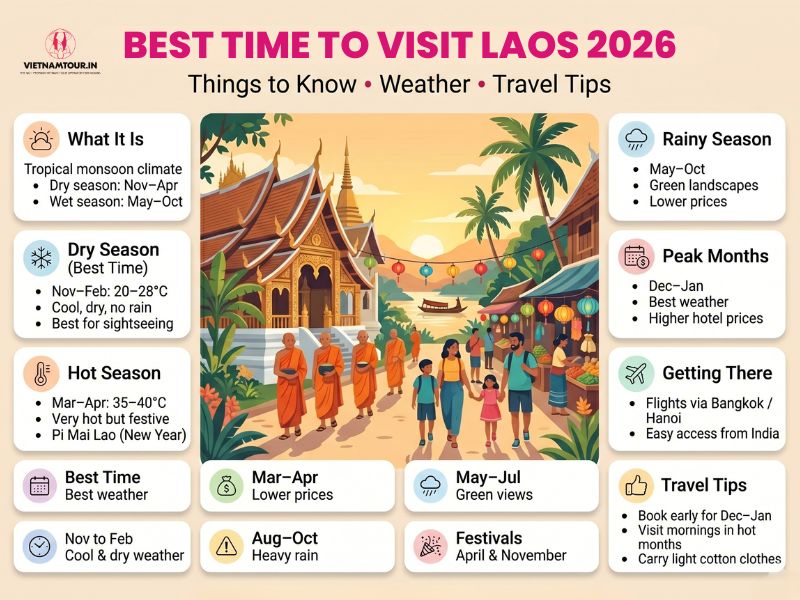
November to February is the best time to visit Laos — dry skies, temperatures between 20°C and 28°C (68°F to 82°F), and rainfall under 20 mm per month make this 4-month window the most comfortable for Indian travelers. Laos follows a tropical monsoon climate with 2 clearly defined seasons: a dry season from November to April and a wet season from May to October. Understanding which season aligns with your travel goals — and your Indian holiday calendar — determines how much you enjoy this landlocked Indochina destination.
This travel guide from Vietnamtour.in — The No.1 Premium Vietnam Tour Operator for Indians, serving 428,000+ Indian tourists across 46,000+ Indochina tours since 2015 — covers 7 areas: Laos weather month-by-month, dry vs rainy season trade-offs, the best months for Luang Prabang and Vientiane separately, alignment with Indian holiday windows (Diwali, Christmas, Holi, summer break), 5 major Lao festival dates, season-specific packing lists, and 5 logistical factors Indian tourists must know before booking.
Laos Weather by Month
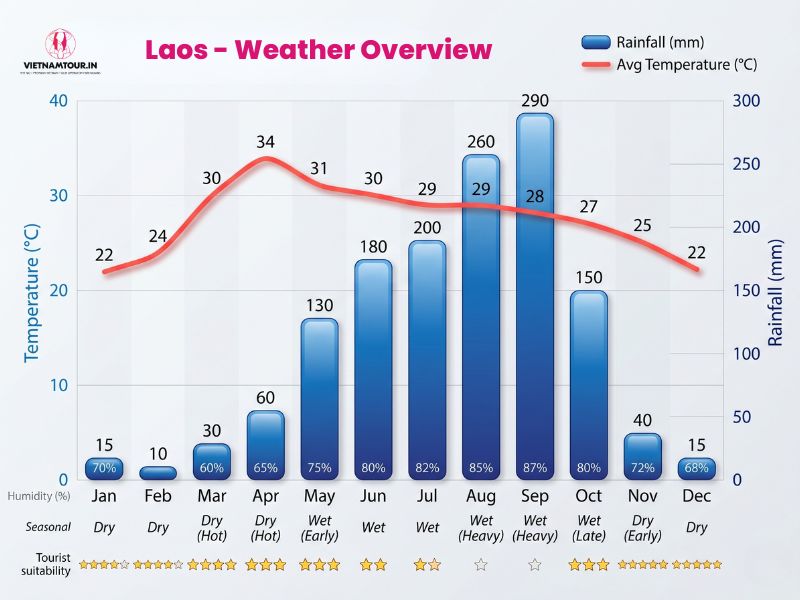
Laos weather varies sharply across 12 months — temperatures swing 20°C between January (15°C minimums) and April (40°C peaks), and rainfall jumps from 10 mm in December to 290 mm in September. The 12-month breakdown below gives Indian tourists the data needed to match travel windows to priorities — temperature comfort, rainfall avoidance, festival timing, or budget.
| Month | Avg Temp (°C / °F) | Rainfall (mm) | Condition | Indian Holiday Match |
|---|---|---|---|---|
| January | 17–28 / 63–82 | 10 | Dry, cool | New Year extension |
| February | 19–30 / 66–86 | 15 | Dry, warming | — |
| March | 22–35 / 72–95 | 35 | Hot, hazy (N. Laos) | Holi (2 March) |
| April | 25–40 / 77–104 | 90 | Peak heat, festival | Pi Mai Lao (14–16) |
| May | 25–35 / 77–95 | 180 | Early monsoon | Summer break starts |
| June | 24–33 / 75–91 | 230 | Wet, lush | Summer break |
| July | 24–32 / 75–90 | 260 | Heavy rain | Summer break |
| August | 24–32 / 75–90 | 270 | Heavy rain, flood risk | — |
| September | 23–31 / 73–88 | 290 | Peak monsoon | — |
| October | 22–30 / 72–86 | 130 | Tapering rain | Dussehra |
| November | 19–28 / 66–82 | 20 | Dry, ideal | Diwali (20 Oct 2026) |
| December | 17–26 / 63–79 | 10 | Dry, cool, peak | Christmas |
The dominant pattern of Laotian weather is clear: November through February delivers consistently low rainfall, moderate temperatures, and low humidity. Laos from May through September brings heavy precipitation, with August and September recording the highest monthly rainfall at 260–290 mm.
Laos Dry Season (November to April)
The Laos dry season runs from November to April — 6 months of progressively drier, hotter conditions that divide neatly into 2 sub-seasons with very different traveler experiences.
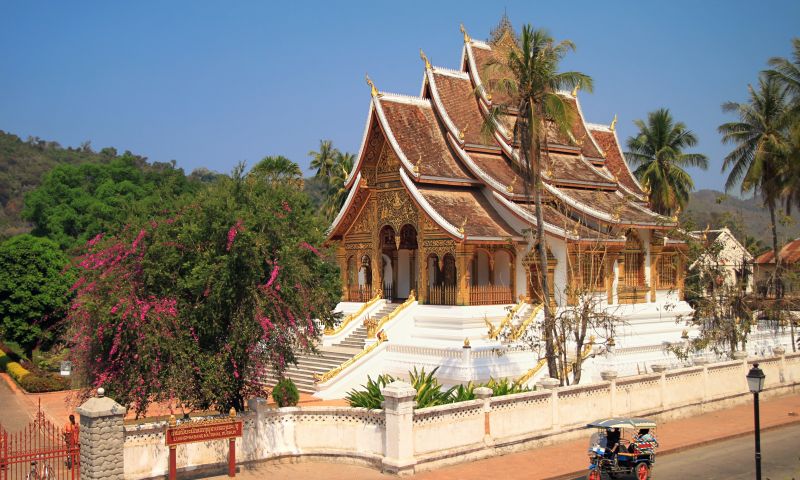
Peak Season (November to February)
November to February is the peak travel window for Laos. Temperatures in Laos from November to February stay between 20°C and 28°C (68°F to 82°F), skies are clear, and rainfall averages just 10 to 15 mm per month — comparable to Delhi in January.
Outdoor activities, temple exploration, river cruises, and trekking are all fully accessible across the November to February window in Laos. Hotel rates in Luang Prabang and Vientiane run 40 to 60% higher than in the shoulder season, and guesthouses at popular Laos destinations sell out weeks in advance.
Indian travelers planning trips during the November to February Laos peak season book accommodations and domestic flights 8 to 12 weeks ahead, particularly during the December to January peak.
Hot Season (March to April)
March and April push temperatures in Laos to 35 to 40°C (95°F to 104°F) — the hottest period of the Laos calendar year. 35 to 40°C heat in Laos is familiar to travelers from Delhi or Rajasthan. For travelers from Mumbai or Bengaluru, the same heat requires adjustment, and midday outdoor activity in Laos between 11:00 AM and 4:00 PM becomes uncomfortable during March and April.
March also coincides with Northern Laos’s slash-and-burn agricultural season — air quality in Luang Prabang and Vang Vieng drops to AQI 150–200 (unhealthy) between mid-February and mid-April, with peak haze in March. Indian travelers with asthma, young children under 6, or seniors over 65 avoid Northern Laos during this window. Vientiane and Southern Laos (Pakse, 4000 Islands) sit outside the burning corridor and remain travelable.
April hosts Pi Mai Lao (the Lao New Year), and hotel rates in Laos drop 25 to 35% compared to peak season. March to April in Laos suits budget travelers and festival seekers — travelers prioritizing physical comfort find November to February the more suitable Laos travel window.
Laos Rainy Season (May to October)
The Laos rainy season runs from May to October, with the heaviest rainfall concentrated between August and October. The Laos rainy season is not a travel write-off — hotel rates in Luang Prabang and Vientiane run 20 to 30% lower than peak season across the May to October window.
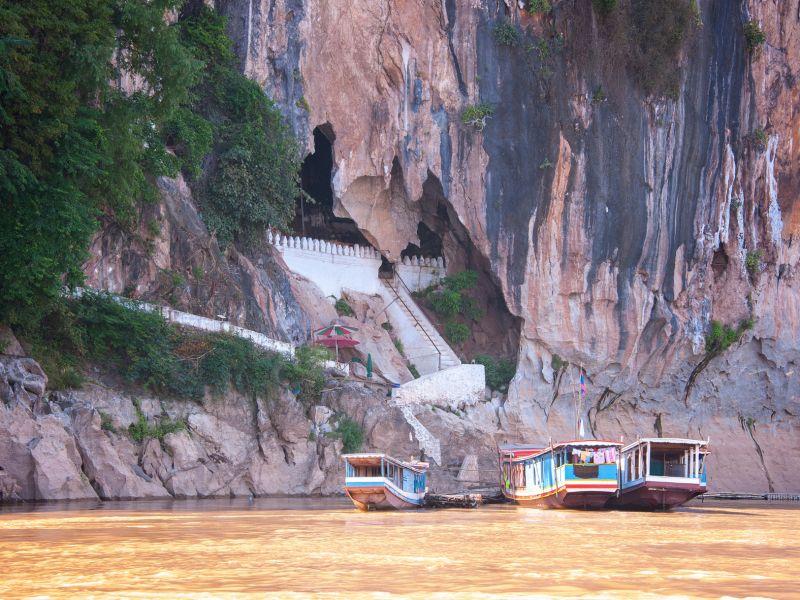
Early Monsoon (May to July)
Rain in Laos falls in afternoon or evening bursts of 2 to 4 hours from May to July, leaving mornings dry and accessible. The Laos landscape turns intensely green from May to July. Temple complexes, city walking tours, and indoor cultural sites in Laos remain fully functional from May to July.
Hotel rates in Luang Prabang and Vientiane are 20 to 30% lower than peak season from May to July. A 4-night stay in Luang Prabang that costs ₹28,000 (USD 295) during December drops to ₹19,000 to ₹22,000 (USD 200 to USD 232) in June — a meaningful saving for Indian family travelers.
Heavy Monsoon (August to October)
August to October is the most challenging travel period in Laos. September is the highest-risk month in Laos, with 290 mm of rainfall and documented flooding along the Mekong River corridor — particularly in southern Laos (Champasak province, Savannakhet lowlands) and rural areas of Khammouane.
Vientiane city infrastructure handles the August to October rainfall moderately well. Luang Prabang’s historic centre sits on a peninsula and experiences less flooding than riverside villages — trekking trails toward Kuang Si Falls become slippery during August to October and require waterproof footwear.
Between August and October, Indian travelers limit their Laos itinerary to Vientiane and Luang Prabang city centres. Multi-day treks, boat journeys on swollen rivers, and rural southern Laos remain unsuitable during this 3-month flood window. October transitions out of Laos’s peak rainfall period, and waterfall flow at Kuang Si Falls reaches its most spectacular volume of the year.
Best Time to Visit Luang Prabang for Indian Tourists
November to February is the best time to visit Luang Prabang — but the city’s unique attributes (waterfalls, temple density, and Mekong sunset viewpoints) mean that each month from October onward offers a distinctly different experience.
October to December
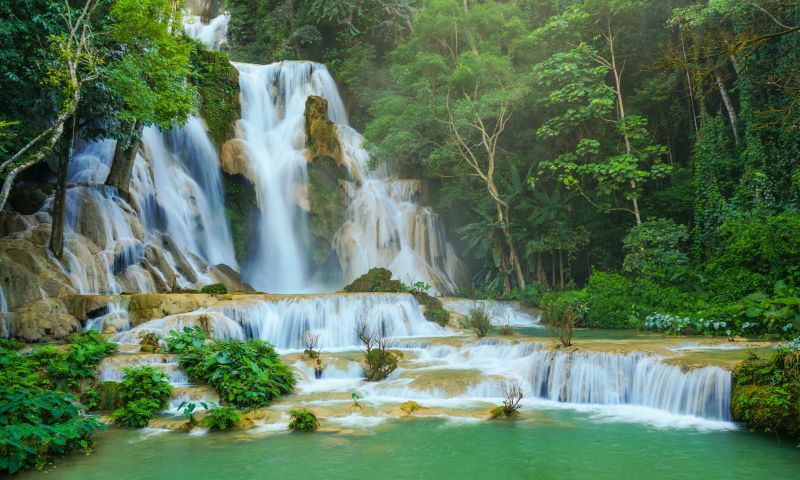
Kuang Si Falls — the most photographed attraction in Luang Prabang — reaches peak water volume in October and November. Water flow slows significantly during the dry season (February to May), and the turquoise pools become shallower from February to May.
Travelers visiting Luang Prabang in October experience Kuang Si Falls at its most dramatic: full-width cascades, maximum flow, and vivid turquoise colour from mineral saturation. Crowds in Luang Prabang are lower than peak season and hotel rates have not yet climbed. Temperatures in Luang Prabang begin to moderate from late October onward, dropping from 30°C to a more comfortable 24 to 26°C by November.
November to February
Morning temperatures in Luang Prabang from November to February drop to 15 to 20°C (59°F to 68°F) — noticeably cooler than most Indian cities in the same period. Indian travelers from South India or coastal regions pack one light jacket for early morning excursions in Luang Prabang during November to February.
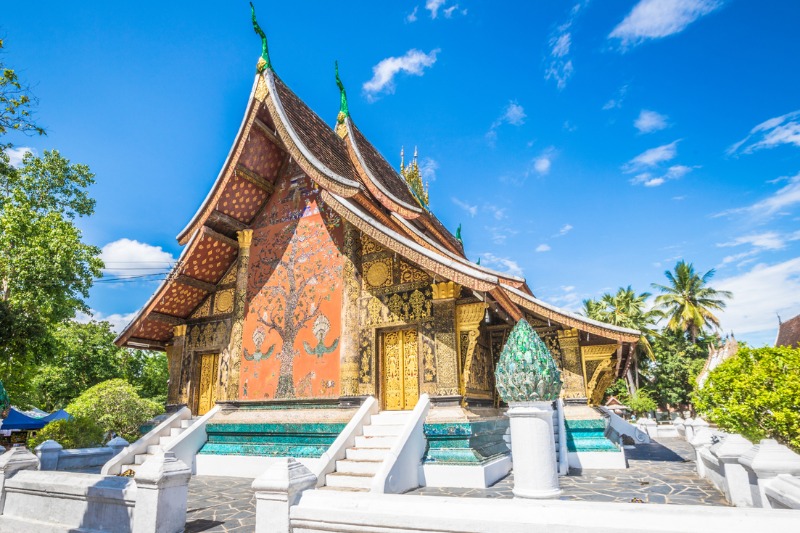
The alms-giving ceremony (Tak Bat) in Luang Prabang takes place at dawn — around 5:45 AM in November and 6:15 AM by February. Cool morning air during November to February makes early rising comfortable, and the soft morning light between 6:00 AM and 8:00 AM is optimal for photography at Wat Xieng Thong and Wat Visoun.
Sunrise in Luang Prabang during November to February occurs between 5:50 AM and 6:20 AM, giving photographers a consistent golden-hour window before temple crowds arrive.
Best Time to Visit Vientiane for Indian Tourists
November to March is the most comfortable period to visit Vientiane. As a capital city, Vientiane is less weather-dependent than Luang Prabang — but heat and humidity still affect how much ground you can cover on foot.
November to March
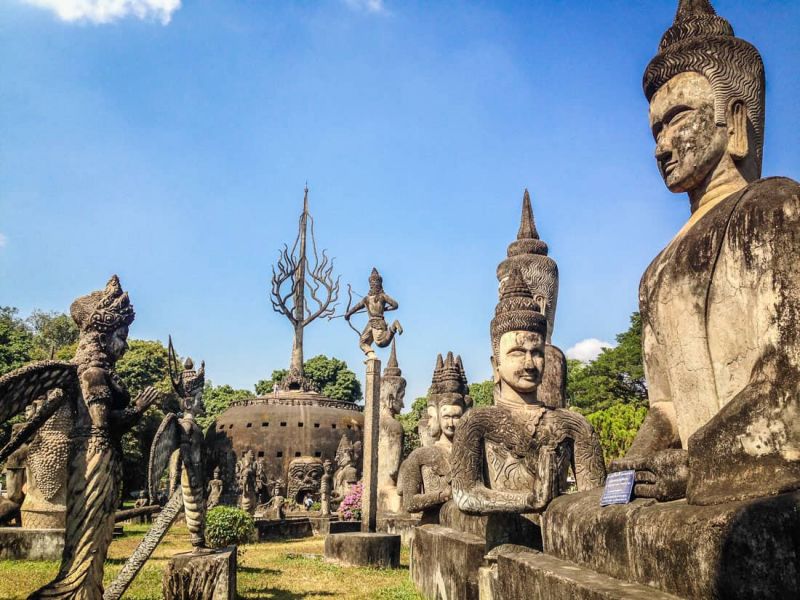
Temperatures in Vientiane during November to March stay between 25°C and 30°C (77°F to 86°F) — warm but manageable for walking between major sites. Vientiane’s 3 central landmarks — Patuxai Monument, That Luang Stupa, and Buddha Park (Xieng Khuan, located 25 km from Vientiane city centre) — are spread across 6 to 8 km of walkable and drivable urban distance.
Tuk-tuks and taxis with air conditioning are widely available in Vientiane, but outdoor walking time between Vientiane’s central landmarks remains the primary activity. November to March in Vientiane reduces the heat burden significantly compared to April and May — temperatures stay 8 to 15°C below the April peak of 38 to 40°C. Vientiane’s flat urban layout covers a walkable central zone comparable in scale to Delhi’s Connaught Place district — familiar in scale for Indian city travelers.
April
April delivers Vientiane’s most intense pre-festival atmosphere alongside the hottest weather of the year — temperatures reach 38 to 40°C (100°F to 104°F) and Pi Mai Lao (Lao New Year) energy builds across the capital from the first week of April. The festival itself is celebrated with particular intensity in Vientiane — water fights, street processions, and ceremonies at That Luang Stupa.
April in Vientiane is worth the heat for Indian travelers whose goal is the Pi Mai Lao festival. Indian travelers prioritizing comfortable sightseeing in Vientiane choose November to March over April.
Indian tourists visiting Vientiane in April schedule outdoor activity before 10:00 AM and after 4:00 PM. A minimum of 2 litres of water per person is required for any outdoor excursion in Vientiane during April. Rehydration salts suit Indian travelers managing April heat in Vientiane and are available at Indian pharmacies before departure.
When to Go to Laos from India
Indian tourists have 4 major travel windows that align differently with Laos seasons — the right match depends on whether Indian tourists prioritize weather comfort, festival experience, or budget savings.
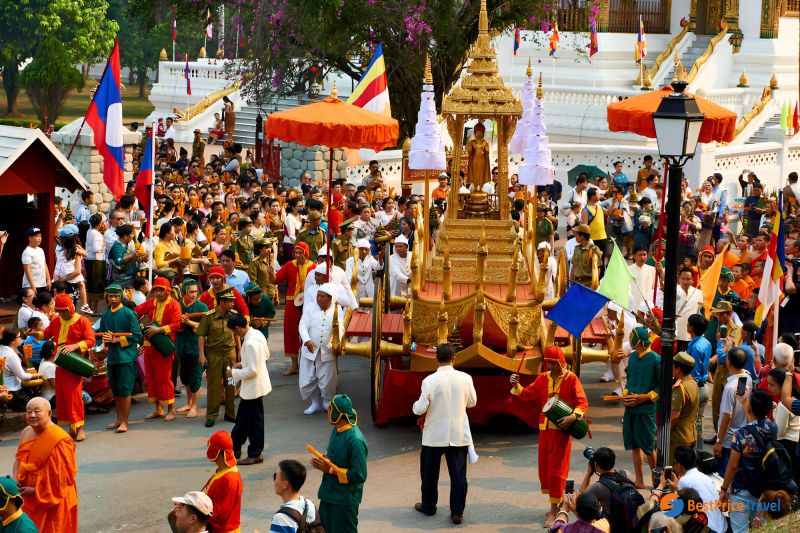
Indian travelers planning activities across Luang Prabang, Vientiane, and the Plain of Jars require an understanding of what each destination offers beyond weather timing. The things to do in Laos guide covers each destination’s strongest seasons for Indian travelers planning a multi-city itinerary.
Diwali and Dussehra (October to November)
Diwali 2026 falls on 20 October. The Dussehra to Diwali window (typically 7 to 10 days for Indian families) aligns with Laos’s transition from late monsoon to early dry season — one of the most underrated windows to visit Laos for Indian travelers seeking value and comfortable conditions.
October in Laos brings Kuang Si Falls to peak flow, temperatures in Luang Prabang cool to 24 to 28°C (75°F to 82°F), and hotel rates in Luang Prabang have not yet climbed to the December peak. November in Laos is fully dry and comfortable, with hotel prices still 15 to 25% below December levels. Indian travelers book flights from Delhi, Mumbai, or Bengaluru at least 8 to 10 weeks before Diwali — the Diwali Laos travel window fills quickly as Indian holiday travel peaks across Southeast Asia simultaneously.
Christmas and New Year (December to January)
December and January represent peak-of-peak demand for Laos, with hotel rates in Luang Prabang rising 40 to 60% above shoulder season pricing. A mid-range guesthouse in Luang Prabang that costs ₹4,500 (USD 47) per night in October reaches ₹7,000 to ₹8,000 (USD 74 to USD 84) per night in December.
Flights from Delhi, Mumbai, and Bengaluru to Vientiane (typically routed via Bangkok or Hanoi) see 35 to 50% fare increases from October onward. Indian travelers book Laos flights by September to secure fares before the increase takes effect. From December to January, the Laos travel window books out 10 to 12 weeks in advance — Indian travelers who prefer lower rates choose November or late January as shoulder alternatives.
Holi and Spring Break (March)
Holi 2026 falls on 2 March. March in Laos runs 33 to 38°C (91°F to 100°F) — heat comparable to Delhi in May, which most North Indian travelers are accustomed to. Budget and solo Indian travelers choose March in Laos for the combination of lower prices and manageable heat — but factor in the slash-and-burn smog warning (see Hot Season above) when planning a Northern Laos itinerary.
Hotel rates in Luang Prabang and Vientiane in March are 25 to 35% below December peak. A guesthouse in Luang Prabang at ₹6,500 (USD 68) per night in December costs ₹4,200 to ₹4,800 (USD 44 to USD 50) per night in March.
March in Laos sits just before Pi Mai Lao in April — Indian travelers who extend into early April catch the pre-festival energy building in Vientiane. Midday outdoor activity in Laos during March requires planning — Indian tourists schedule temple visits before 10:00 AM, rest during 12:00 PM to 3:00 PM, and resume outdoor activity after 4:00 PM.
Summer Holidays (April to June)
Indian school summer holidays run from late April through mid-June. The April to June window spans Laos’s hottest month (April at 38 to 40°C / 100°F to 104°F) and the beginning of the Laos rainy season (May to June).
April brings Pi Mai Lao — the Lao New Year water festival — directly comparable to Holi in energy and communal spirit. Pi Mai Lao is the most engaging cultural experience available in Laos for Indian families traveling with children.
May and June in Laos shift into early monsoon, with rain falling for 2 to 4 hours in the afternoon. Museums, temple complexes, and city walking in Laos remain fully accessible in the mornings during May and June.
Laos is more affordable than Thailand or Vietnam for Indian family travel — a family of 4 (2 adults, 2 children) budgets ₹12,000 to ₹18,000 (USD 126 to USD 190) per day in Laos, inclusive of mid-range accommodation, meals, and transport, compared to ₹18,000 to ₹25,000 (USD 190 to USD 263) for equivalent travel in Bangkok or Phu Quoc.
Laos Festivals by Month
Laos has 5 major festivals distributed across the year — each changes the ideal travel timing for experience-focused Indian tourists. Indian tourists who combine Laos with Vietnam align both countries’ weather windows within a single itinerary. The best time to visit Vietnam guide covers seasonal alignment for Indian travelers planning a combined Laos and Vietnam itinerary.
Pi Mai Lao
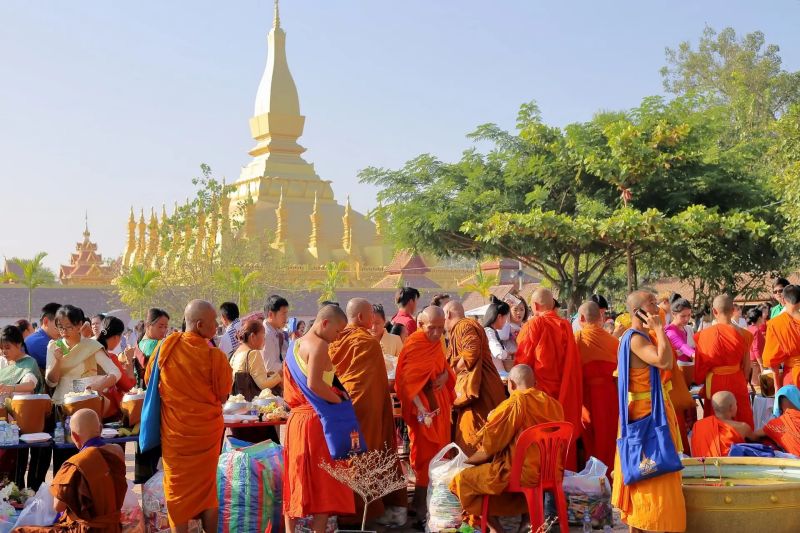
Pi Mai Lao takes place from 14 to 16 April in 2026, marking the Lao New Year according to the Buddhist solar calendar — Lao national public holidays surrounding the festival typically extend from 13 to 17 April. Pi Mai Lao centres on water — residents and visitors drench each other on the streets of Luang Prabang and Vientiane in a 3-day celebration that closely parallels Holi in its communal energy, colour, and joyful physicality.
Temple ceremonies, traditional Lao dance performances, and baci (blessing) rituals run alongside Pi Mai Lao street festivities. Temperatures in Laos during Pi Mai Lao reach 38 to 40°C (100°F to 104°F) — Indian tourists schedule water activities for the cooler morning hours before 10:00 AM.
That Luang Festival
The Boun That Luang festival takes place during the full moon of the 12th month of the Lao lunar calendar — typically the 3rd week of November. In 2026, the Boun That Luang full moon falls on 20 November.
200,000+ pilgrims, monks, and lay Buddhists converge on That Luang Stupa in Vientiane for 3 days of candlelit processions, alms-giving, and a surrounding temple market that fills the entire That Luang Stupa plaza.
For Indian Buddhist travelers, Boun That Luang carries a comparable spiritual weight to the Pushkar Fair — a mass gathering at a sacred site with centuries of pilgrimage history. Boun That Luang coincides with the start of Laos’s peak dry season, making November one of the strongest overall months to visit Laos.
Boun Bang Fai and Boat Racing Festival
Boun Bang Fai (the Rocket Festival) takes place in May, predominantly in rural Laos — particularly in Khammouane province and smaller towns in central Laos. Communities across rural Laos launch enormous handmade bamboo rockets into the sky during Boun Bang Fai to petition for seasonal rain, accompanied by music, processions, and local food markets. Boun Bang Fai is one of the most uniquely Lao experiences available for Indian travelers, with almost no international tourist presence.
The Boat Racing Festival takes place in October on the Mekong River at both Vientiane and Luang Prabang — marking the end of Buddhist Lent (Vassa). Long-boat crews race on the Mekong River in front of large local crowds during the Boat Racing Festival. Boun Bang Fai and the Boat Racing Festival both fall during off-peak months. Hotel rates in Luang Prabang and Vientiane are 25 to 35% below December levels during the Boun Bang Fai and Boat Racing festivals.
What to Pack for Laos Based on the Season You Travel
Packing for Laos depends entirely on the travel season — dry and wet seasons require completely different gear. Indian travelers hold an advantage: cotton fabrics widely used in India — lightweight kurtas, cotton shirts, and linen trousers — perform well in both Laos seasons due to their breathability and quick-drying properties.

Dry Season Packing List
The Laos dry season’s most important packing challenge is the daily temperature swing. In Luang Prabang during December and January, early mornings drop to 15 to 18°C (59°F to 64°F) while afternoons reach 30 to 35°C (86°F to 95°F) — a 15°C daily range that catches unprepared travelers off guard.
Essential items for dry season travel in Laos:
- 1 light jacket or fleece for early mornings — essential for Luang Prabang, optional for Vientiane
- Light cotton or linen clothing for daytime temperatures of 30 to 35°C
- Sunscreen SPF 50+ — UV index in Laos reaches 9 to 11 in the dry season
- Comfortable walking shoes with grip for temple stairs and riverbank paths
- Covered shoulders and knees for all temple visits in Laos
The temple dress code in Laos requires covered shoulders and knees at all Buddhist sites, including Wat Xieng Thong, That Luang Stupa, and Kuang Si’s shrine area. Indian travelers accustomed to temple dress codes in Rajasthan or South India will find Laos temple dress requirements familiar.
Rainy Season Packing List
A waterproof jacket with a hood is the single most important item for monsoon travel in Laos.
Thin ponchos available at local Laos markets are inadequate for sustained Laos monsoon rain. A structured waterproof jacket with a hood handles both the heavy afternoon downpours in Laos and the persistent drizzle of August and September.
Additional essentials for wet season travel in Laos:
- Waterproof sandals (Birkenstocks or similar) or waterproof trekking shoes
- Quick-dry fabrics only — denim is unsuitable for Laos monsoon conditions
- Insect repellent with at least 20% DEET concentration — dengue mosquito activity in Laos peaks from June to September
- Waterproof bag cover or dry bags for camera equipment
Indian travelers packing for the Laos rainy season carry all 4 categories above — waterproof outerwear, appropriate footwear, insect protection, and equipment covers — as standard preparation for the June to October monsoon window.
5 Things Indian Tourists Must Know Before Choosing When to Visit Laos
5 practical factors shape the best time to visit Laos, specifically for Indian travelers — beyond weather alone.
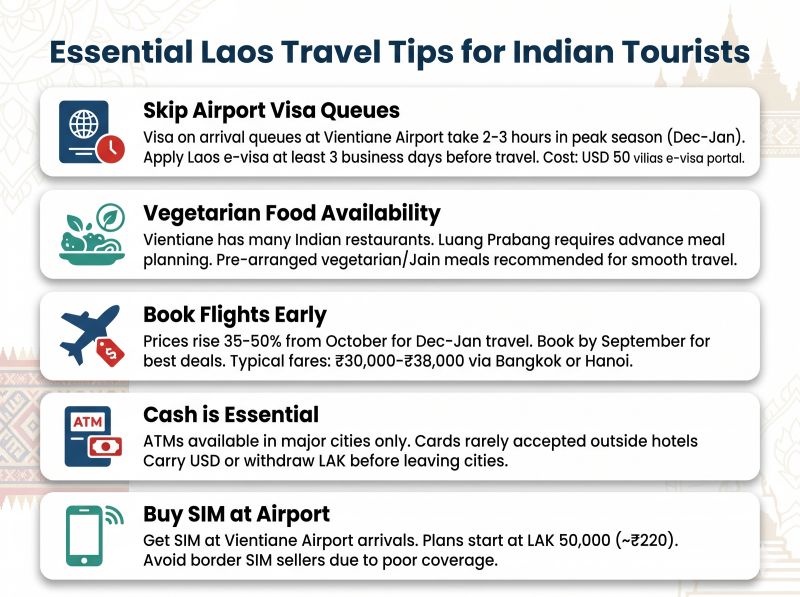
1. Apply for the Laos e-visa online before flying
Visa on arrival queues at Vientiane Wattay International Airport run 2 to 3 hours during peak season (December to January). Indian travelers apply for a Laos e-visa online at least 3 business days before travelling to bypass the Vientiane Wattay International Airport visa on arrival queue entirely. The Laos e-visa costs USD 50 (₹4,750) and is processed through the official Laos e-visa portal.
2. Pre-book vegetarian and Jain meals in Luang Prabang
Indian vegetarian and Jain food is significantly easier to source in Vientiane than in Luang Prabang. Vientiane has established Indian restaurants, while Luang Prabang requires advance coordination. Vietnamtour.in pre-arranges vegetarian and Jain-compliant meals for Indian travelers in Luang Prabang, removing the meal-coordination burden entirely.
3. Lock in flights from India by September
Flight prices from India to Laos (Vientiane Wattay International Airport) spike 35 to 50% from October onward for the December to January window. Indian travelers book Laos flights by September to secure return fares below ₹30,000 to ₹38,000 (USD 315 to USD 400) from Delhi or Mumbai via Bangkok or Hanoi.
4. Carry USD cash beyond Vientiane and Luang Prabang
ATM availability is reliable in Vientiane and Luang Prabang but sparse in all other Laos destinations. Indian travelers withdraw sufficient LAK or carry USD cash before departing Vientiane or Luang Prabang — cards are rarely accepted outside hotels and major restaurants in Laos. INR is not widely exchangeable in Laos — only BCEL Bank’s Vientiane main branch accepts INR currency notes. Indian travelers convert to USD before departing India.
5. Buy SIM cards at Vientiane Wattay Airport, not at land borders
Indian travelers purchase SIM cards at Vientiane Wattay International Airport arrivals hall, not at Laos border crossings. Unitel and Laotel offer tourist SIMs with data starting at LAK 50,000 (USD 2.30 / ₹220). Border SIM sellers at Laos border crossings overcharge and provide cards with unreliable data coverage.
FAQs Indian Tourists Ask Before Booking Laos
Is December the Best Month to Visit Laos?
Yes, December offers the best combination of weather, visibility, and post-festival atmosphere in Laos. December temperatures in Laos average 18 to 25°C (64°F to 77°F) in Luang Prabang and 22 to 28°C (72°F to 82°F) in Vientiane. Rainfall across Laos drops to 15 mm in December. The That Luang Festival has concluded by December, leaving a calm but active travel environment without overcrowding of the festival itself. Visibility for photography and outdoor exploration in Laos is at its annual peak in December.
December is the most expensive month to visit Laos — hotel rates in Luang Prabang reach their highest annual point, and flights from India to Laos book out fastest. Indian travelers plan and book Laos travel at least 10 to 12 weeks in advance for December.
Can Indian Tourists Visit Laos During the Rainy Season?
Yes, Indian tourists visit Laos during the rainy season with the right itinerary. Early monsoon (May to July) in Laos is accessible and comfortable for morning activity, with rainfall concentrated in the afternoon and evening hours. August to October in Laos requires routing away from flood-prone areas — southern Laos (Champasak, Savannakhet riverside zones) and rural trekking routes.
Indian travellers visiting Laos between May and July experience 25–35% lower hotel pricing and 30% fewer crowds compared with December–January, according to Vietnamtour.in operational data from 2023–2025 bookings, particularly in Luang Prabang boutique properties.
Which Month Has the Lowest Crowd and Best Prices in Laos?
Laos in May and June offers the lowest tourist density and the most competitive hotel pricing — averaging 25–35% below peak season rates. International arrivals drop after April’s Pi Mai Lao festival, while weather remains travel-friendly before heavier monsoon months. The May–June period in Laos is the clearest sweet spot for budget Indian travelers, especially for Luang Prabang boutique hotels and Mekong-view properties, which frequently discount unsold peak inventory.
Is Laos Hotter Than Vietnam in April?
Yes — Laos in April averages 38–40°C (100°F to 104°F), compared to 32–35°C (90°F to 95°F) in central and northern Vietnam (Da Nang, Hanoi) during the same period. Inland geography and lower coastal wind exposure make Vientiane, Luang Prabang, and Vang Vieng noticeably hotter. For Indian tourists combining both countries, Vietnam is the more comfortable April destination, while Laos suits travelers specifically visiting for Pi Mai Lao (Lao New Year), despite the heat.
How Many Days Are Needed to Visit Laos Properly in Peak Season?
7 to 10 days covers Vientiane, Luang Prabang, and one additional stop (Vang Vieng or Plain of Jars) comfortably in peak season. A typical structure is 2 days Vientiane + 3 days Luang Prabang + 2–3 days Vang Vieng or Plain of Jars. Solo travelers can do a 5-day minimum focused on Luang Prabang only, covering Kuang Si Falls, Pak Ou Caves, Mekong cruise, and Old Town temples without rushing.
Plan Your Laos Trip with Vietnamtour.in
Plan your Laos trip with Vietnamtour.in — request a 7- to 10-day Indochina itinerary tailored for Indian travelers, with vegetarian and Jain meal coordination, INR-priced packages, and Pi Mai Lao or Boun That Luang festival routing built into the trip plan.