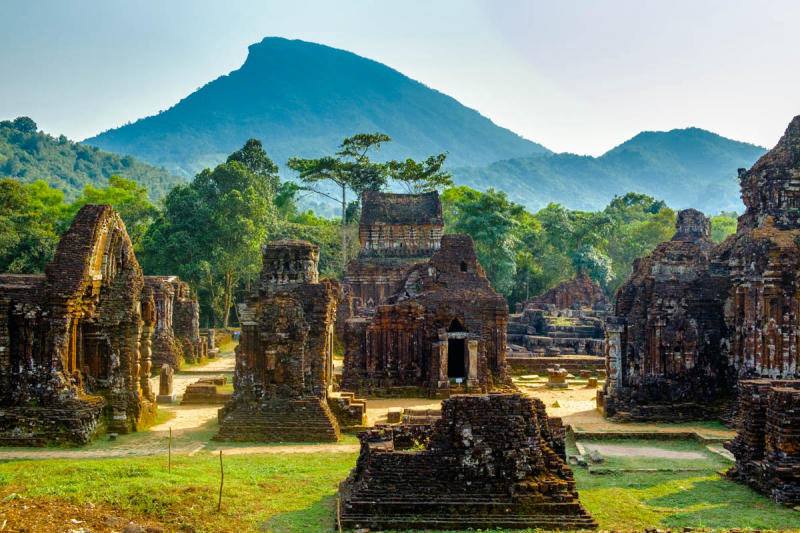
My Son Sanctuary is the largest surviving Cham Hindu temple complex in Vietnam, located 40 km southwest of Hoi An in Quang Nam province, with 71 surviving structures distributed across 14 temple groups. UNESCO inscribed My Son Sanctuary as a World Heritage Site in 1999 — the only UNESCO site in Vietnam built by the Cham civilisation rather than by Vietnamese or Chinese dynasties.
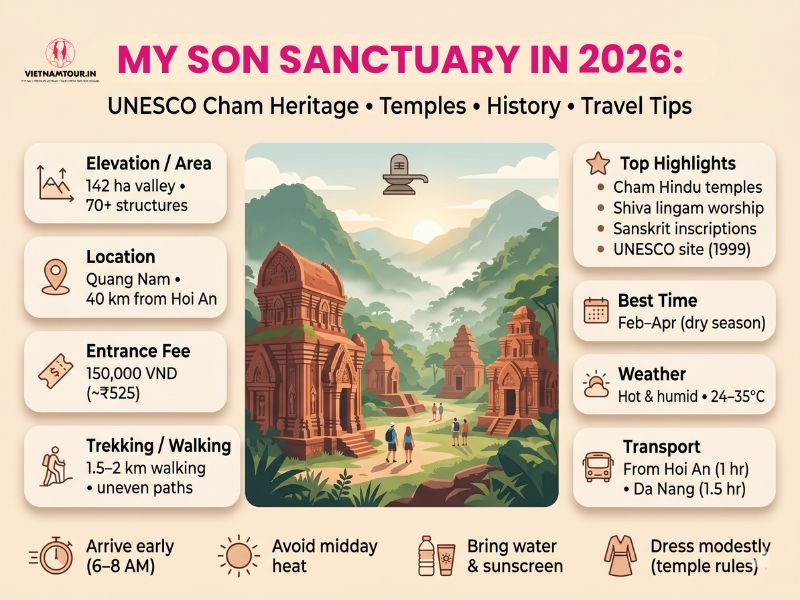
My Son Sanctuary entrance fee is 150,000 VND (₹535) per adult in 2026, with the site open daily from 6:00 AM to 5:30 PM. Half-day tours from Hoi An run ₹1,400–₹1,750 per person; private car tours from Da Nang cost ₹3,850–₹7,000 per vehicle. February to April is the best time to visit for Indian tourists. October and November carry active flood closure risk. The Da Nang Museum of Cham Sculpture is the essential companion visit for the full Cham sculptural collection.
My Son Sanctuary’s UNESCO significance, Cham ruins, Hindu architecture, entrance fees, opening hours, tour options from Hoi An and Da Nang, sunrise photography logistics, best months to visit, and 7 must-knows are covered in this guide for Indian tourists planning a central Vietnam itinerary in 2026.
My Son Sanctuary contains 32 Sanskrit steles, active Shiva lingam worship sites, and Dravidian-influenced tower architecture — 3 direct connections to Hindu religious traditions shared between the Cham kingdom and the Indian subcontinent between the 4th and 13th centuries.
My Son Sanctuary’s UNESCO World Heritage Status
UNESCO inscribed My Son Sanctuary as a World Heritage Site on 1 December 1999 under criteria (ii) and (iii), recognizing My Son as an outstanding example of cultural interchange between India and mainland Southeast Asia, and as exceptional testimony to the Cham civilization that built My Son from the 4th century AD and abandoned the sanctuary by the late 13th century AD.
The Cham civilization ruled central Vietnam’s coastal regions from the 2nd to the 19th century AD, with My Son Sanctuary functioning as the primary religious and ceremonial capital of the Champa Kingdom, while Simhapura (modern Tra Kieu) served as the royal political capital during Champa’s classical period. My Son Sanctuary’s 25 surviving structures represent the most concentrated cluster of Cham religious architecture still standing on original foundations among Vietnam’s surviving Cham sites at Po Nagar, Po Klong Garai, and Banh It.
The 14 Temple Groups Of My Son Sanctuary
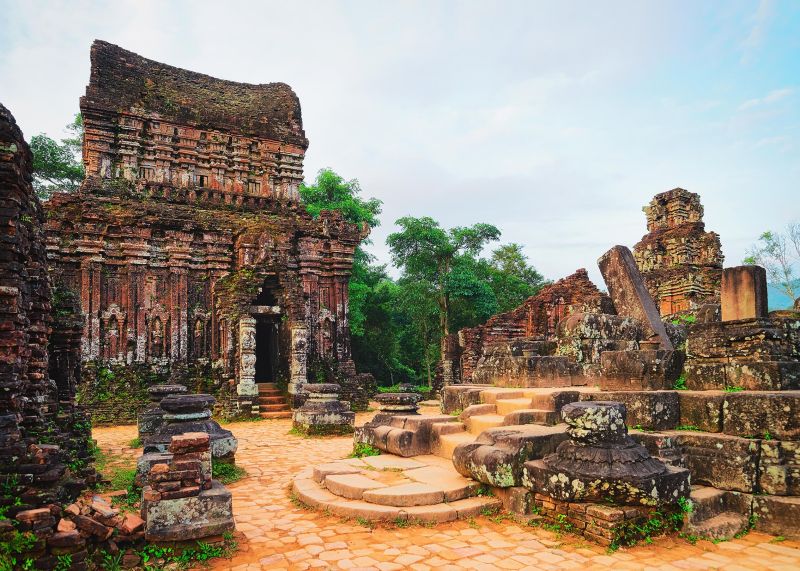
My Son Sanctuary’s 10 surviving temple groups are divided into a primary visitor zone (Groups B, C, and D) and restricted or damaged zones, with Group A — the most historically significant cluster — reduced to foundation rubble by US B-52 bombing in August 1969. The groups are labeled A, A’, B, C, D, E, F, G, H, and K across the 142-hectare valley in Quang Nam province.
Temple Group B1 serves as the main sanctuary kalan of My Son and houses the principal Shiva lingam altar dedicated to Bhadreshvara. Temple Group A1 originally stood 21 metres tall as the most ornate Cham temple structure ever built at My Son — now reduced to foundation rubble after the August 1969 US airstrike during the Vietnam War.
Hindu Architecture At My Son
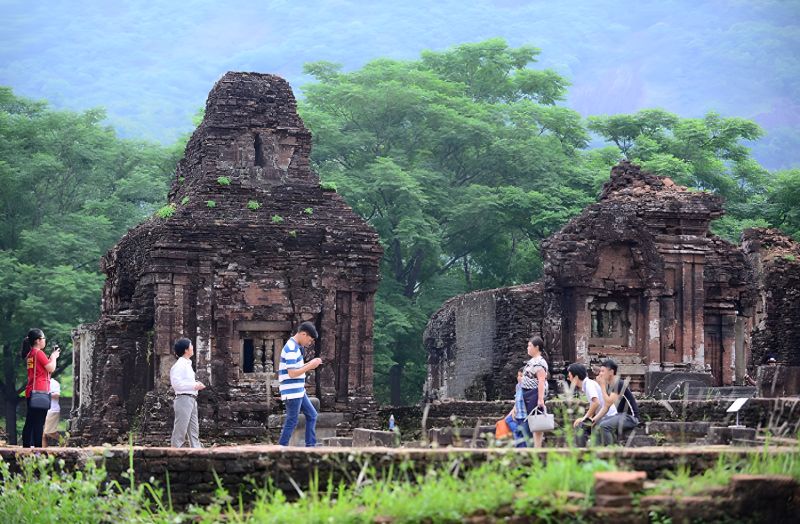
My Son Sanctuary was built as the primary religious capital of the Champa Kingdom dedicated to Bhadresvara — a fusion deity combining King Bhadravarman I with the Hindu god Shiva under the Hindu devarāja (god-king) tradition. Every kalan tower at My Son Sanctuary houses a Shiva lingam as its central altar, and Champa kings performed royal coronation and purification rituals at the B1 main sanctuary throughout the dynasty’s 900-year active religious period from the 4th to the 13th century AD.
Archaeologists have documented 32 surviving steles at My Son Sanctuary inscribed in Sanskrit and Old Cham script, recording Cham royal genealogies, temple dedication ceremonies, and Hindu religious verses. The My Son E1 pedestal dates to the 4th century AD as the earliest surviving inscribed monument from the Cham civilization, documenting King Bhadravarman I’s founding dedication to the original sanctuary.
My Son’s architectural vocabulary carries direct visual familiarity for Indian tourists from Hindu temple traditions back home. The kalan towers at My Son follow a North Indian Nagara-style curvilinear sikhara profile combined with Dravidian structural influences from the Pallava and Chalukya traditions — making My Son Sanctuary architecturally closer to Indian Hindu temple complexes than any other surviving heritage site in Vietnam.
The Tra Kieu altar (originally excavated from My Son Group D, now displayed at the Da Nang Museum of Cham Sculpture) depicts Lakshmi, Shiva, and apsara figures using iconographic conventions directly recognizable to Indian visitors familiar with Tamil Nadu and Karnataka temple carving traditions.
My Son Sanctuary Location
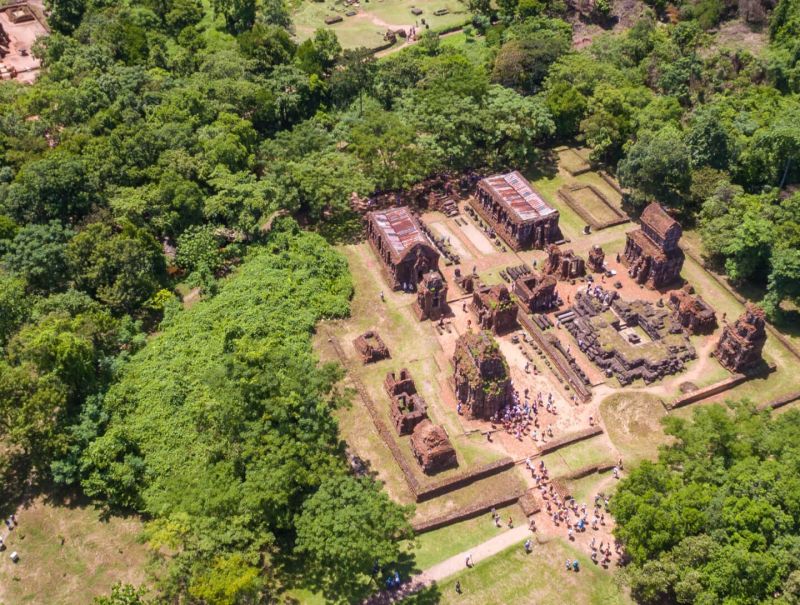
My Son Sanctuary is located at coordinates 15°46’N, 108°07’E in Duy Phu commune, Duy Xuyen district, Quang Nam province — 40 km southwest of Hoi An (55–70 minutes by road) and 60 km southwest of Da Nang (80–90 minutes by road) across National Highway 1A and provincial road DT610.
My Son Sanctuary sits within a circular valley approximately 2 km in diameter, surrounded by the Cat’s Tooth Mountain range (Hòn Quắp) to the west. The natural amphitheatre geography forms a visible barrier on approach and shapes the Champa Kingdom’s selection of My Son as a protected religious capital hidden from coastal invasion routes.
Distance From Hoi An To My Son Sanctuary
3 road options connect Hoi An to My Son Sanctuary across different distances and time trade-offs:
Provincial Road ĐT610 (direct route) — 40 km, 55 minutes. ĐT610 is the standard route for all day tours and private transfers between Hoi An and My Son Sanctuary.
National Highway QL1A via Tam Ky — 70 km, 90 minutes. QL1A via Tam Ky adds 35 minutes of driving time and runs 30 km longer than the direct route, with no additional sightseeing value for Indian tourists on day trips.
Scenic route via Thu Bon River valley — 55 km, 70 minutes. The Thu Bon River route passes through the Tra Kieu archaeological zone (ancient Simhapura, former Champa political capital), where the Tra Kieu altar and 30+ Cham sculptures now displayed at the Da Nang Museum of Cham Sculpture were originally excavated.
Provincial Road ĐT610 is the standard route for Indian tourists travelling from Hoi An to My Son Sanctuary on a day trip. ĐT610 is paved throughout the 40-km stretch, with the final 3 km before My Son Sanctuary narrowing to a single-lane approach through Quang Nam rice paddies.
Distance From Da Nang To My Son Sanctuary
Da Nang to My Son Sanctuary follows a single standard road route: south on National Highway QL1A from Da Nang city to the Duy Xuyen intersection, then west on Provincial Road ĐT610 to the My Son Sanctuary gate. The total driving distance from Da Nang to My Son covers 60 km in 80–90 minutes under normal traffic conditions.
Da Nang International Airport to My Son Sanctuary covers 65 km in 95 minutes, including airport exit and transfer-pickup time. Indian tourists arriving at Da Nang International Airport on flights that land before 9:00 AM reach My Son Sanctuary the same day as a half-day excursion, while Indian tourists arriving later overnight in Da Nang or Hoi An visit My Son the following morning.
My Son Sanctuary Entrance Fee 2026
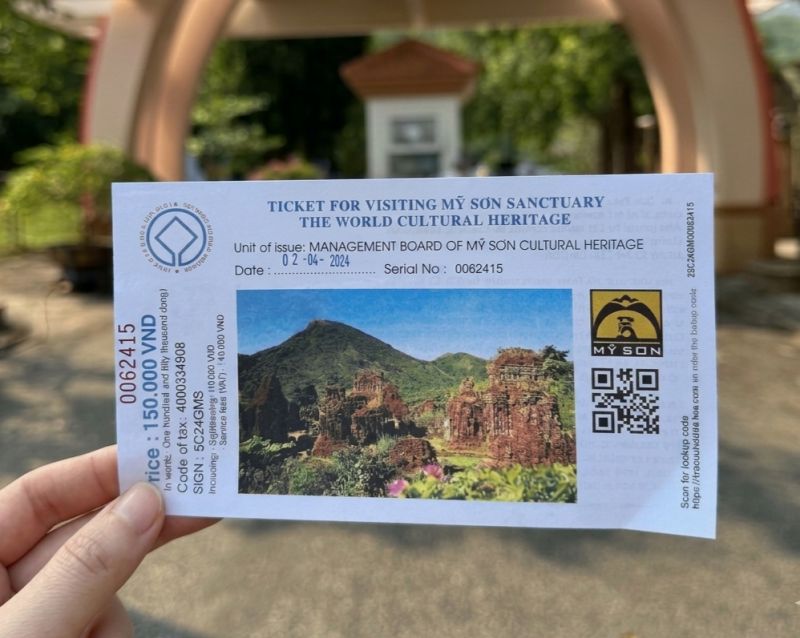
The standard My Son Sanctuary entrance fee for adult foreign visitors in 2026 is 150,000 VND (₹535) per person, with reduced rates for Vietnamese children and seniors with a valid ID. The My Son entrance ticket includes a complimentary electric buggy transfer from the main gate to the temple zone across 1.3 km of forest road, along with access to Cham traditional dance performances held daily at 9:30 AM and 10:30 AM inside the site.
All INR prices in this guide apply the 2026 standard rate of 1 INR = 280 VND. Cash in Vietnamese Dong is the primary payment method at My Son’s ticket gates — card acceptance remains limited at the site, and ATM machines do not operate within 10 km of My Son Sanctuary, so Indian tourists carry cash withdrawn earlier in Hoi An or Da Nang.
Additional Costs At My Son Sanctuary
2 additional cost categories apply for Indian tourists at My Son Sanctuary beyond the standard entrance ticket:
Licensed English-speaking site guide — 200,000–300,000 VND (₹714–₹1,071) for a 2-hour guided tour, with a maximum of 15 people per guide per Quang Nam tourism regulations.
Drone photography permit — requires prior written application to the Quang Nam Department of Culture, Sports and Tourism, with a minimum of 7 working days’ advance notice. Standard camera and smartphone photography at My Son Sanctuary carries no additional fee across all temple groups.
My Son Sanctuary Opening Hours
My Son Sanctuary opens daily at 6:00 AM and closes at 5:30 PM every day of the year, with the last entry ticket sold at 5:00 PM. My Son Sanctuary remains open on all Vietnamese national holidays, including Tết (Lunar New Year), Reunification Day (30 April), and Vietnamese Independence Day (2 September).
The optimal arrival window at My Son Sanctuary runs from 6:00 AM to 8:00 AM — early morning temperatures stay at the coolest daily range of 22–26°C year-round, and visitor density holds below 50 people across the full site before the first tour bus waves arrive at 8:30 AM.
Traditional Cham music and dance performances run at 9:30 AM and 10:30 AM daily inside the Group D covered pavilion, each performance lasting 20 minutes and included in the standard My Son entrance ticket. Indian tourists plan arrival to catch the 9:30 AM Cham dance performance, as the earlier time slot holds smaller audiences and offers better viewing angles from the central pavilion benches.
My Son Sanctuary Tours From Hoi An
My Son Sanctuary is 40 km from Hoi An, and 4 tour formats operate this Hoi An to My Son route daily: half-day group tours, full-day tours with lunch, Thu Bon River combination boat tours, and private car charters. Hoi An serves as the primary departure base for My Son visits, with the majority of Indian tourists selecting a half-day My Son tour format to pair with an afternoon Hoi An Ancient Town lantern exploration.
My Son Half-Day Tours From Hoi An
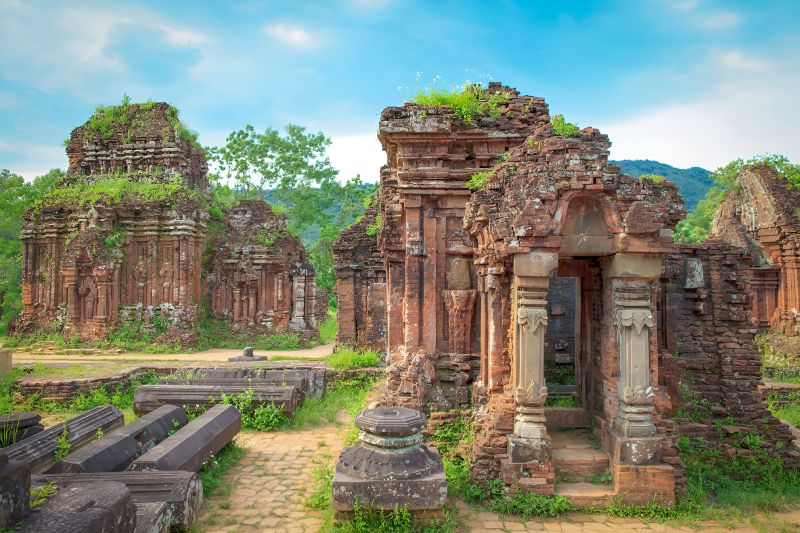
Half-day tours from Hoi An to My Son Sanctuary follow a standard 5-hour format: hotel pickup in Hoi An between 7:30 AM and 8:00 AM, arrival at My Son Sanctuary at 9:00 AM, 2 hours on-site including the 9:30 AM Cham dance performance, and return transfer to Hoi An by 1:00 PM.
Half-day Hoi An to My Son tour pricing ranges from 400,000–500,000 VND (₹1,428–₹1,785) per person in shared group tours. The half-day tour price includes round-trip transport, the My Son entrance ticket, and an English-speaking site guide — lunch and personal shopping are excluded. Half-day tours suit Indian tourists combining My Son Sanctuary with Hoi An Ancient Town lantern exploration within a single day.
My Son Full-Day Tours From Hoi An With Lunch
Full-day My Son tours from Hoi An depart at 7:00 AM and allocate 3 hours on-site at My Son Sanctuary, followed by lunch at a local restaurant near Tra Kieu village and an optional detour to the Tra Kieu Cham Museum (free entry). Full-day Hoi An to My Son tours return to Hoi An between 3:00 PM and 4:00 PM.
Full-day My Son tour pricing ranges from 700,000–1,100,000 VND (₹2,500–₹3,928) per person, including the My Son entrance ticket, round-trip transport, lunch at a Tra Kieu-area restaurant, and English-speaking site guide.
Vegetarian Indian tourists face a specific constraint on full-day tour lunches: restaurants near My Son Sanctuary primarily serve meat-based Vietnamese dishes, and purely vegetarian menus — particularly Jain-compliant meals prepared without onion or garlic — are not reliably available at standard tour-included lunch stops. Indian families travelling with strict Jain or vegetarian requirements carry dry snacks from Hoi An, because restaurants near My Son Sanctuary cannot be pre-confirmed for Jain compliance without direct kitchen coordination.
My Son Boat Tour From Hoi An Via Thu Bon River
The Thu Bon River boat tour is the scenic route variant for reaching My Son Sanctuary from Hoi An. Traditional wooden boats depart from Cam Kim Pier in Hoi An Ancient Town, travel 2 hours upstream through rural Quang Nam farmland and fishing villages, disembark near My Son for 2 hours of on-site temple exploration, and return to Hoi An by road on a shared shuttle bus. The total Thu Bon River boat tour duration runs 5 hours from Cam Kim Pier departure to Hoi An return.
Thu Bon River boat tour pricing ranges from 600,000–800,000 VND (₹2,142–₹2,857) per person, including traditional boat transfer, My Son Sanctuary entrance ticket, English-speaking site guide, and return road transport to Hoi An. The Thu Bon River route trades slower scenic pace with Quang Nam countryside views for reduced on-site temple exploration time compared to standard road-based tours. The Thu Bon River boat tour format suits Indian couples, honeymooning travelers, and photography-focused Indian tourists prioritising the river landscape experience alongside My Son Sanctuary.
My Son Sanctuary Guided Tours With Pickup From Da Nang
Da Nang serves as the second primary departure base for My Son Sanctuary tours, with 4 tour formats operating daily from Da Nang: private car tours, half-day shared group tours, full-day tours with lunch, and multi-stop combination tours pairing My Son with Ba Na Hills or Marble Mountains. Indian tourists staying in Da Nang beach resorts along My Khe Beach select Da Nang-based tours rather than transferring to Hoi An first for the My Son day trip.
Da Nang To My Son Sanctuary Private Car Tours
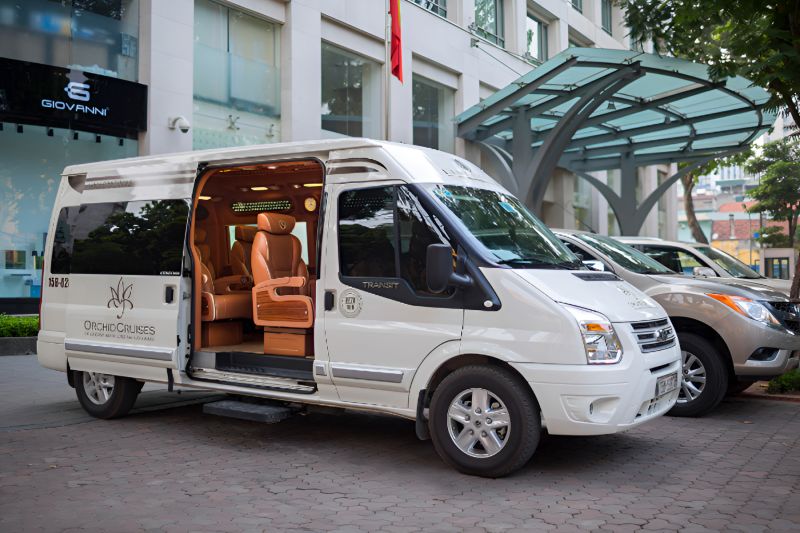
Private car tours from Da Nang to My Son Sanctuary provide a sedan (4 passengers) or SUV and minivan (6 passengers) with a dedicated driver for round-trip transport. Private car tour pricing by vehicle type:
Sedan up to 4 passengers — 1,100,000–1,500,000 VND (₹3,928–₹5,357) per vehicle, excluding My Son entrance ticket.
SUV or minivan for 5–6 passengers — 1,600,000–2,000,000 VND (₹5,714–₹7,142) per vehicle, excluding My Son entrance ticket.
Private car tours enable a 6:30 AM departure from Da Nang and arrival at the My Son gate before 8:00 AM — ahead of the group-tour wave that arrives from 9:00 AM onwards. The My Son entrance ticket (150,000 VND / ₹535 per adult) is purchased separately at the gate unless the private car tour operator pre-includes it in a bundled tour price.
Private car tours are the recommended format for Indian families travelling with elderly parents, young children, or mobility-limited members who require flexible on-site pacing between temple groups and air-conditioned transport between Da Nang hotels and My Son Sanctuary.
Da Nang Group Tours To My Son With Hoi An Combination
The budget-tier Da Nang to My Son tour format is the combined My Son + Hoi An shared minibus day trip. A 14–20 passenger minibus picks up Indian tourists from Da Nang hotels between 7:00 AM and 8:30 AM, spends 2 hours at My Son Sanctuary, then drops passengers at Hoi An Ancient Town for independent afternoon exploration — the Hoi An to Da Nang evening return transport is excluded from the standard tour price.
Da Nang to Hoi An combination tour pricing ranges from 400,000–600,000 VND (₹1,428–₹2,142) per person, covering round-trip Da Nang pickup, My Son entrance ticket, English-speaking site guide, and one-way transfer to Hoi An Ancient Town. Indian tourists arrange their own return transport from Hoi An to Da Nang in the evening, with Grab taxi rates running 300,000–400,000 VND (₹1,071–₹1,428) per car for the 30-km transfer.
The Da Nang combination tour delivers the lowest-cost itinerary covering both My Son Sanctuary and Hoi An Ancient Town in a single day, at the trade-off of separate return transport planning and a total travel day extending to 12 hours from Da Nang hotel pickup to Da Nang hotel return.
My Son Sanctuary Tour Packages for Indian Tourists
3 visit formats exist for Indian tourists planning a My Son Sanctuary trip. A fully guided My Son tour package delivers the highest support level; a local shared group tour offers the lowest price; and self-drive rental provides maximum flexibility.
| Format | Cost per Person | Guide | Flexibility | Vegetarian Support |
|---|---|---|---|---|
| Fully guided tour | ₹2,500–₹3,928 | Certified English | Fixed schedule | Pre-arranged possible |
| Local shared group tour | ₹700–₹1,071 | Basic guide | Group schedule | None |
| Self-drive motorbike | ₹250–₹357/day | None | Full flexibility | Self-managed |
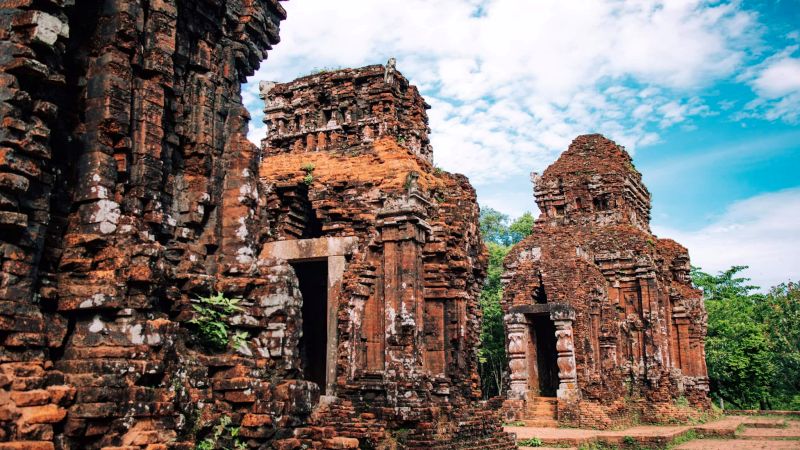
Indian tourists visiting My Son Sanctuary as part of a longer central Vietnam itinerary can reference the complete Hoi An attractions list in the places to visit in Hoi An guide, which covers the 9 key Hoi An heritage sites within 3 km of the Hoi An Ancient Town core — all reachable the same afternoon after returning from a My Son half-day tour.
My Son Sanctuary Sunrise Tour for Photography
My Son Sanctuary opens daily at 6:00 AM, and the first 90-minute window from 6:00 AM to 7:30 AM delivers the optimal photographic light conditions across the site. Low-angle eastern sunlight illuminates Group B and Group C tower façades, valley-floor morning mist rises off the Duy Xuyen stream network draining to the Thu Bon River, and on-site visitor density holds below 20 people across all temple groups before the first tour buses arrive.
My Son sunrise tour packages depart Hoi An at 4:30 AM at 200,000–400,000 VND (₹714–₹1,428) per person, excluding the My Son entrance ticket. My Son sunrise tours operate from September to March when the eastern sun clears the Cat’s Tooth Mountain range before the shadow line lifts from the valley floor. From April through August, monsoon cloud cover diffuses sunrise light across Quang Nam and the sunrise photography window loses reliability for dedicated Indian photography itineraries during these 5 months.
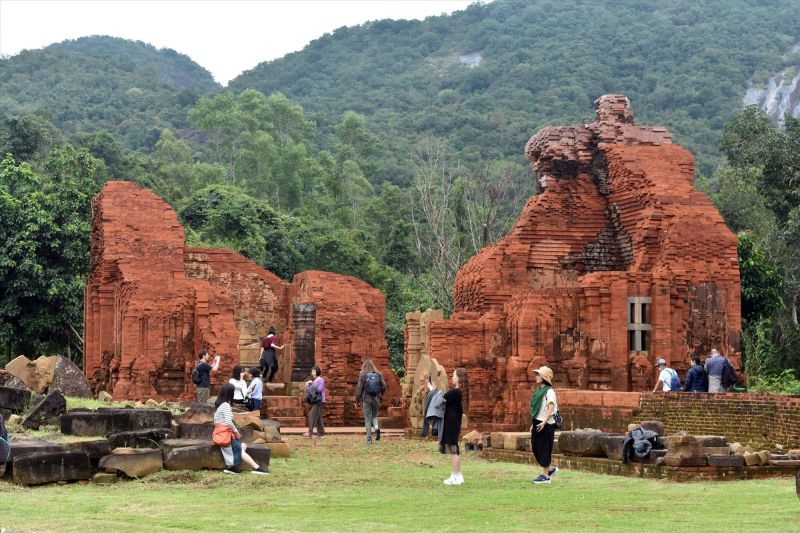
Best Camera Settings and Photography Spots at My Son Sanctuary
My Son Sanctuary delivers 4 photography positions that produce the strongest compositions across the archaeological site. The 4 positions cover Group B, Group D, the elevated embankment behind Group G, and the Group E/F cluster — each paired with a defined time window and starting camera settings calibrated to the specific light conditions at that position.
Position 1 — Group B main kalan, eastern face. Group B’s eastern face captures the strongest side-lit brick relief between 6:15 AM and 7:00 AM. Low morning sun at Group B rakes across the kalan surface at a shallow angle, which reveals the carved relief texture that flat overhead light flattens by 9:00 AM. Starting camera settings for Position 1 are f/8, ISO 400, and 1/200s — f/8 delivers sufficient depth of field for the full tower height, and 1/200s freezes any wind movement in the foreground vegetation.
Position 2 — Group D covered pavilion arch. The Group D arch composition frames the Group C towers through the arch opening, with the foreground arch in shade and the towers backlit behind it. This contrast remains consistent all day because the pavilion roof maintains foreground shadow regardless of sun angle. Starting camera settings for Position 2 are f/5.6 and ISO 800 — the wider aperture compensates for the shaded arch foreground while ISO 800 balances exposure between the dark arch and the bright sky behind Group C.
Position 3 — Elevated embankment behind Group G. The embankment overview delivers multiple tower groups visible in a single frame and runs from 7:30 AM to 9:00 AM, before overhead light flattens the tower relief across the valley. Starting camera settings for Position 3 are f/11, ISO 200, and 1/250s — f/11 holds depth of field across the full valley composition at this distance.
Position 4 — Group E/F cluster. The Group E/F cluster records partially collapsed towers with dense jungle encroachment and receives diffused light all day because the tree canopy scatters direct sunlight. This diffused light produces even illumination from opening to closing hours, making this position workable throughout the day without a specific arrival window. Starting camera settings for Position 4 are f/4, ISO 1600, and 1/125s — the wide aperture and elevated ISO compensate for the lower light level under the canopy.
My Son Sanctuary Drone Photography Rules
Drone photography at My Son Sanctuary requires a written permit from the Quang Nam Department of Culture, Sports and Tourism, issued a minimum of 7 working days before the flight date, per the department’s 2026 cultural heritage site regulations. My Son Sanctuary drone permit applications are processed only in-person at the Quang Nam Department office in Tam Ky city, and online application for My Son Sanctuary drone permits is unavailable as of 2026.
Drone use at My Son Sanctuary without a valid permit results in two enforcement actions: confiscation of the drone by My Son Sanctuary site security, and a fine of 500,000–1,500,000 VND (₹1,785–₹5,357) issued on site. The My Son Sanctuary permit timeline is incompatible with a 7- to 14-day Vietnam itinerary, which is the standard trip length for Indian tourists. The alternative for Indian tourists is hiring a licensed local videographer who holds an existing My Son Sanctuary drone permit — licensed videographer rates at My Son Sanctuary run 1,500,000–3,000,000 VND (₹5,357–₹10,714) for a half-day shoot with edited footage delivery included.
Best Time to Visit My Son Sanctuary for Indian Tourists
February to August is the best time to visit My Son Sanctuary for Indian tourists, with February to April as the peak window and May to August as the secondary window. My Son Sanctuary sits in Quang Nam province during the dry season from February to April, with temperatures ranging 24°C to 30°C, minimal rainfall, and stable sunrise photography conditions across the archaeological site. The February to April window at My Son Sanctuary aligns with the post-Holi Indian outbound travel peak, and Indian tourists booking a My Son Sanctuary visit in this window need to confirm bookings 3 to 4 weeks in advance.
4 seasonal windows define My Son Sanctuary visit conditions for Indian tourists across the calendar year:
February to April at My Son Sanctuary is the peak recommended window for Indian tourists. My Son Sanctuary in February to April delivers dry weather, comfortable temperatures of 24°C to 30°C, and clear sunrise visibility across the Cham tower groups.
May to August at My Son Sanctuary is the secondary acceptable window for Indian tourists, with an early-morning arrival requirement. My Son Sanctuary in May to August records high heat of 32°C to 38°C with high humidity, and Indian tourists visiting My Son Sanctuary in May to August need to enter the site between 6:00 AM and 8:00 AM and carry a minimum of 1.5 litres of drinking water per person to offset midday heat.
September to November at My Son Sanctuary is the non-recommended window for Indian tourists. My Son Sanctuary in September to November falls inside the Central Vietnam monsoon season, with active flood risk affecting access roads and site footpaths.
December to January at My Son Sanctuary is the moderate-condition window for Indian tourists. My Son Sanctuary in December to January records cool temperatures of 18°C to 22°C with occasional morning fog, and Indian tourists from Chennai, Bengaluru, and Hyderabad need to pack a light jacket for early-morning visits, while Indian tourists from Delhi, Jaipur, and Lucknow find the 18°C to 22°C range similar to North Indian winter mornings.
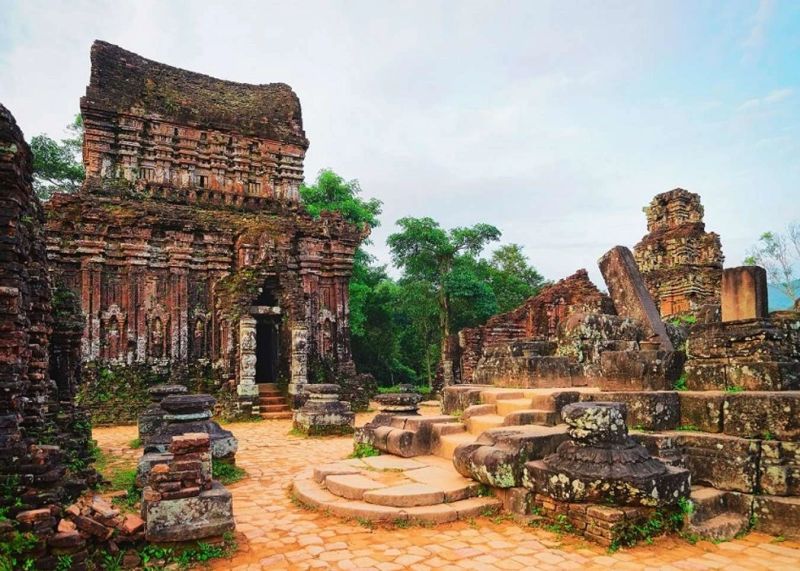
My Son Sanctuary in October and November
My Son Sanctuary floods 4 to 6 times annually in October and November, driven by 400–600 mm of monthly rainfall in the Thu Bon River basin. My Son Sanctuary closes when the Duy Xuyen gauge station records a Thu Bon River level above 4.5 metres — a threshold that crosses 4 to 6 hours before My Son Sanctuary closure takes effect.
My Son Sanctuary’s October 2024 flooding closed Groups B and C for 11 days — the longest single closure in the post-UNESCO period. Indian tourists booking a Diwali Hoi An itinerary from India in August or September often discover the October flood closure only after arriving in Vietnam, when the site is already shut and no tour refund applies to the My Son entrance ticket. Pre-booking the Da Nang Museum of Cham Sculpture as a confirmed backup for any Diwali central Vietnam package ensures Indian families have a Cham heritage visit confirmed regardless of My Son’s closure status on arrival day.
My Son Sanctuary Weather by Month: Temperature, Rainfall, and Visitor Crowd Data
| Month | Avg Temp | Avg Rainfall | Crowd Level | Recommended? |
|---|---|---|---|---|
| January | 20–24°C | 80 mm | Low | Yes (cool, dry) |
| February | 22–26°C | 30 mm | Medium | Yes (peak window) |
| March | 24–28°C | 20 mm | High | Yes (best) |
| April | 26–30°C | 40 mm | High | Yes (best) |
| May | 28–33°C | 90 mm | Medium | Yes (early AM only) |
| June | 30–35°C | 60 mm | Medium | Acceptable |
| July | 30–36°C | 60 mm | Medium | Acceptable |
| August | 29–35°C | 100 mm | Low–Medium | Acceptable |
| September | 26–30°C | 400 mm | Low | Not recommended |
| October | 23–27°C | 600 mm | Very Low | Avoid (flood risk) |
| November | 21–25°C | 500 mm | Very Low | Avoid (flood risk) |
| December | 19–23°C | 200 mm | Low | Moderate |
7 Things Indian Tourists Must Know Before Visiting My Son Sanctuary
7 site-specific conditions at My Son Sanctuary require advance preparation from Indian tourists: vegetarian food absence, uneven-ground walking distance, Vietnamese Dong cash-only entry, severe midday UV, enforced dress code, limited mobile coverage, and the Da Nang Museum of Cham Sculpture as the essential companion visit.
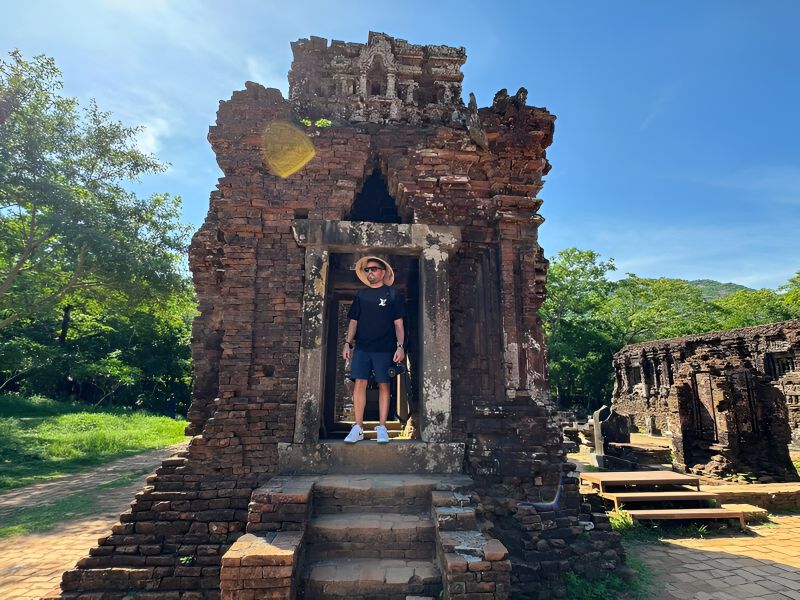
- Vegetarian food is not available at My Son Sanctuary. The My Son Sanctuary ticket gate food stall sells Vietnamese pho, grilled meat skewers, and soft drinks, with no vegetarian option on the menu as of 2026. Indian vegetarian tourists — including Indian tourists observing Jain dietary restrictions — carry dry snacks from Hoi An for the My Son Sanctuary visit. The nearest restaurant serving a limited vegetarian menu is 12 km from My Son Sanctuary at Duy Xuyen market.
- My Son Sanctuary walking distance is 1.5 to 2 km on uneven ground. My Son Sanctuary requires 1.5 to 2 km of walking on compacted gravel and uneven stone paths, with elevation changes of 2 to 3 metres between temple groups. My Son Sanctuary electric buggies cover only the 1.3 km gate-to-temple access road, and the buggies do not move visitors between Groups B, D, and G inside the temple zone. Flat-soled shoes with ankle support are mandatory for a My Son Sanctuary visit, and open sandals cause ankle injuries on the root-crossed paths between the temple groups.
- Indian Rupees are not accepted at the My Son Sanctuary ticket gate. The My Son Sanctuary ticket gate accepts Vietnamese Dong cash only — Indian Rupees, US Dollars, and international cards are not accepted at the counter. ATM machines are not installed within 10 km of My Son Sanctuary. Indian tourists on self-guided My Son Sanctuary trips withdraw Vietnamese Dong in Hoi An or Da Nang before departure to the site.
- UV exposure at My Son Sanctuary is extreme between 9:00 AM and 3:00 PM. UV exposure at My Son Sanctuary reaches index 11 to 12 (extreme) between 9:00 AM and 3:00 PM from March through September, driven by minimal shade between temple groups and the open orientation of the My Son valley. Required items for a My Son Sanctuary midday visit are SPF 50+ sunscreen, a wide-brim hat, UV-protective arm sleeves, and a minimum of 2 litres of drinking water per person.
- My Son Sanctuary dress code covers shoulders and knees in the active worship zones. My Son Sanctuary enforces a dress code covering shoulders and knees for entry into the active worship zones at Groups B and D. Indian tourists wearing standard Indian travel attire — including salwar kameez, kurta, and churidar — meet the My Son Sanctuary dress code without modification. Shorts and sleeveless tops trigger a sarong requirement at the My Son Sanctuary entrance, and My Son Sanctuary sarongs are available for rental at 20,000 VND (₹71) per piece.
- Mobile network coverage inside the My Son Sanctuary valley is partial. Mobile network coverage inside the My Son Sanctuary valley is limited to partial 3G from Viettel and Mobifone with intermittent 4G, and Vinaphone has no reliable signal on the My Son Sanctuary valley floor. Indian tourists visiting My Son Sanctuary download offline My Son Sanctuary maps through Maps.me before departure from Hoi An.
- The Da Nang Museum of Cham Sculpture is the essential companion visit to My Son Sanctuary. The Da Nang Museum of Cham Sculpture, located 60 km northeast of My Son Sanctuary, houses 400+ original Cham artefacts, including the 4th-century My Son E1 altar, the Tra Kieu altar, and goddess Devi sculptures removed from My Son Sanctuary for preservation after the 1969 US bombing. The Da Nang Museum of Cham Sculpture entry fee is 30,000 VND (₹107). Indian tourists who complete a My Son Sanctuary visit without the Da Nang Museum of Cham Sculpture see the architectural structures of the site only — the sculptural collection documenting Cham religion and its Indian-influenced iconography is located in Da Nang.
Plan Your My Son Sanctuary Visit With Vietnamtour.in
Vietnamtour.in arranges My Son Sanctuary visits as part of central Vietnam packages designed specifically for Indian travelers.
For Indian families travelling with elderly parents, young children, or mobility-limited members: private vehicle transfers from Da Nang or Hoi An hotels, guide pacing adjusted for multi-generational groups, and Jain-compliant lunches pre-confirmed through direct partnerships with Indian-chef restaurants in Hoi An are all arranged before the group departs India.
For Diwali and Dussehra travelers: the Da Nang Museum of Cham Sculpture is pre-scheduled as a confirmed backup for all October–November central Vietnam packages, so Indian families have a Cham heritage visit confirmed regardless of My Son’s flood closure status on arrival day.
Indian tourists planning a Vietnam itinerary beyond My Son Sanctuary can extend the UNESCO heritage experience across the country’s 8 inscribed sites — including Hoi An Ancient Town, Hue Imperial Citadel, and Phong Nha-Ke Bang caves — through the UNESCO World Heritage Sites in Vietnam guide.
Frequently Asked Questions: My Son Sanctuary for Indian Tourists
Is My Son Sanctuary Worth Visiting from Hoi An for a Half-Day Trip?
Yes — My Son Sanctuary is worth a half-day trip from Hoi An for Indian tourists interested in pre-Vietnamese history, Hindu architectural heritage, or UNESCO World Heritage sites. The My Son Sanctuary half-day trip from Hoi An covers a 40 km distance and a 2-hour on-site visit, and the trip fits inside a 6:00 AM to 1:00 PM window that leaves the afternoon free for Hoi An Ancient Town. Indian tourists focused on beaches, shopping, or Vietnamese cuisine receive lower value from a My Son Sanctuary visit, because My Son Sanctuary is an archaeological and religious heritage destination rather than a general sightseeing stop on a Hoi An itinerary.
Can Indian Tourists Visit My Son Sanctuary Without a Guide?
Yes — My Son Sanctuary is open to self-guided visits, and the 150,000 VND (₹535) entrance ticket grants full site access without a mandatory guide requirement. 3 limitations apply to a self-guided visit at My Son Sanctuary: My Son Sanctuary signage is written in Vietnamese with limited English translation across the site; My Son Sanctuary temple group historical context is not self-evident from the structures alone; and My Son Sanctuary Cham dance performance commentary runs in Vietnamese without English subtitles. Self-guided My Son Sanctuary visits work for Indian tourists with prior knowledge of Cham history, and for Indian tourists using the Quang Nam Heritage App, a free iOS and Android application that delivers English descriptions of all My Son Sanctuary temple groups.
How Many Hours Does a Visit to My Son Sanctuary Take?
A complete visit to My Son Sanctuary from ticket gate entry to ticket gate return takes 2.5 to 3 hours. The My Son Sanctuary visit breaks down into 5 time segments: 10 minutes on the electric buggy to the temple zone; 60 to 75 minutes exploring Groups B, C, and D; 20 minutes at the Cham dance performance; 30 minutes exploring Groups G, H, and K; and 10 minutes on the return buggy to the ticket gate. Indian tourists on a tight schedule who visit only Groups B, C, and D complete the My Son Sanctuary visit in 90 minutes. The on-site museum building at the My Son Sanctuary entrance requires an additional 30 minutes on top of the 2.5 to 3 hour visit duration.
What Is the Cheapest Way to Visit My Son Sanctuary from Hoi An?
The cheapest way to visit My Son Sanctuary from Hoi An is a local shared minibus tour departing Hoi An at 8:00 AM, priced at 200,000 to 300,000 VND (₹714 to ₹1,071) per person with the My Son Sanctuary entry ticket included. Shared minibus tours to My Son Sanctuary are booked at any hotel front desk or tour agency in Hoi An Ancient Town. Self-drive motorbike rental from Hoi An to My Son Sanctuary costs 70,000 to 100,000 VND (₹250 to ₹357) per day — but self-drive motorbike travel to My Son Sanctuary requires a valid international driving permit and prior driving experience on Vietnamese rural roads, and Indian tourists without prior Vietnam driving experience avoid the self-drive motorbike option for the Hoi An to My Son Sanctuary route.
Is My Son Sanctuary Accessible for Elderly or Mobility-Limited Indian Tourists?
My Son Sanctuary is partially accessible for elderly and mobility-limited Indian tourists: the My Son Sanctuary electric buggy covers the 1.3 km gate-to-temple access road and removes the hardest walking segment, and the paths between Groups B, C, D, and G inside My Son Sanctuary are compacted gravel with uneven root-raised sections that a standard wheelchair cannot navigate independently. Indian tourists travelling with elderly family members arrange a private My Son Sanctuary tour with a guide who controls pacing on the gravel paths, and the same Indian tourists skip the extended Group G, H, and K route, which adds 1.2 km of walking beyond the main temple concentration. The Cham dance pavilion at Group D is wheelchair-accessible and serves as the stationary viewing point at My Son Sanctuary for mobility-limited Indian tourists.