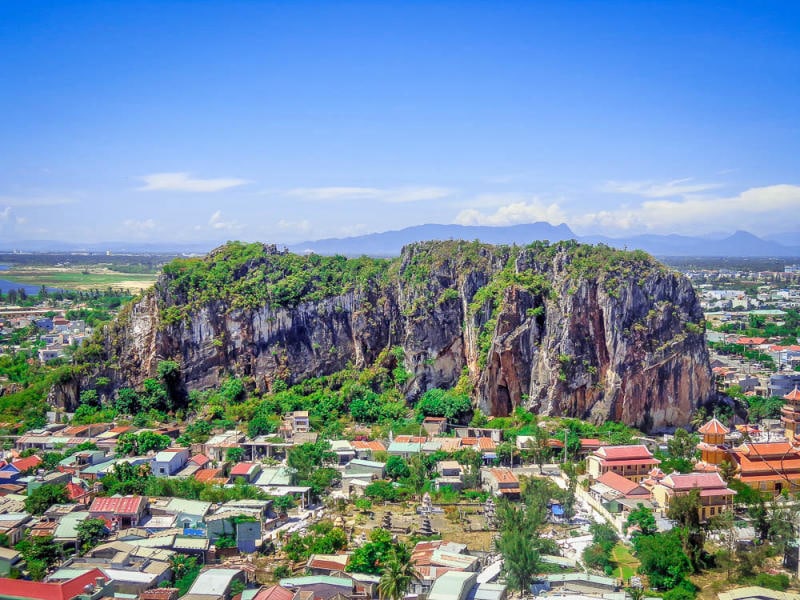

Marble Mountains (Ngũ Hành Sơn) is a cluster of 5 limestone and marble hills rising 108 metres (354 feet) from the coastal plain of Da Nang, located 7 km (4.3 miles) south of the city centre. Thuy Son (Water Mountain) is the one hill open to tourists — Thuy Son’s network of Buddhist pagodas, ancient caves, and a panoramic summit viewpoint makes Marble Mountains a half-day experience with no equivalent in India. The Marble Mountains entrance ticket costs ₹142 per person (40,000 VND), and the site is open every day from 7:00 AM to 5:30 PM. Indian tourists who visit Ajanta Caves for their spiritual atmosphere and carved interiors will find a comparable depth at Marble Mountains.
The site sits within a living landscape, with active worship, ocean views, and a craft village at the base. Vietnamtour.in recommends Marble Mountains as a half-day stop on every Da Nang and Hoi An itinerary.
Marble Mountains Ticket Price and Opening Hours for Indian Tourists
Marble Mountains entrance ticket costs ₹142 per adult (40,000 VND) and Marble Mountains is open daily from 7:00 AM to 5:30 PM — the 2 facts every Indian tourist needs before arrival, with no advance booking and no tour agent required.
Entrance Fee and Elevator Cost in INR
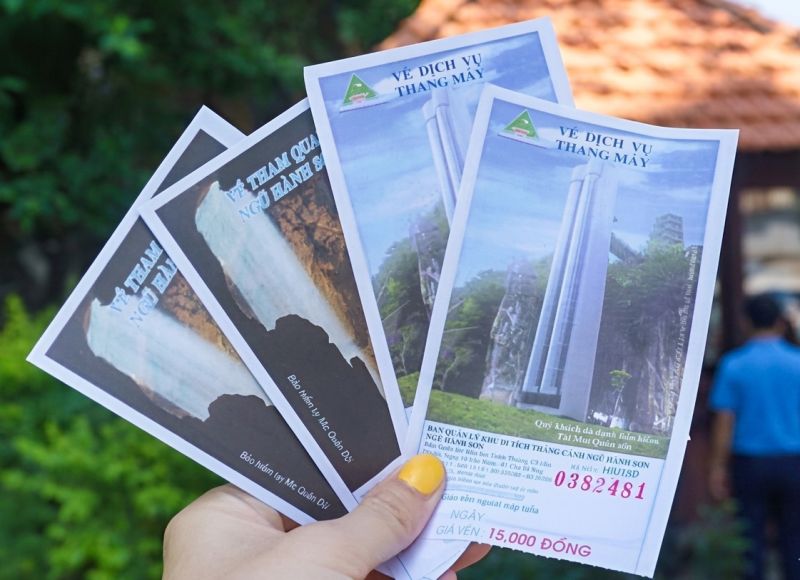
Marble Mountains (Ngũ Hành Sơn) entrance fee in 2026 is ₹142 per adult (40,000 VND) for the standard ticket to Thuy Son (Water Mountain). The elevator on the east side operates on a separate ticket: ₹53 one-way (15,000 VND) or ₹107 round-trip (30,000 VND), providing accessible transport for elderly visitors and families with young children. Children under 6 years enter Marble Mountains free of charge.
The Thuy Son elevator on the east side runs as a separate purchase — ₹53 per person one-way (15,000 VND) or ₹107 round-trip (30,000 VND). The nearest ATM is 1.5 km (0.9 miles) from the entrance — Indian tourists bring sufficient VND cash before arriving.
Opening Hours and Holiday Schedule
Marble Mountains is open every day of the week from 7:00 AM to 5:30 PM, including the 4 main Vietnamese public holidays — Tet (Lunar New Year), Reunification Day (April 30), Labour Day (May 1), and National Day (September 2). Last entry at 4:30 PM allows adequate time for exploring the caves, pagoda, and summit viewpoint before the 5:30 PM closing. Marble Mountains does not observe any seasonal closure and operates on the same daily schedule year-round.
Caves and Pagodas Inside the Marble Mountains
3 caves and pagodas sit inside Marble Mountains’ Thuy Son and are accessible on a single ₹142 ticket: Huyen Khong Cave, Am Phu Cave, and Linh Ung Pagoda. Each occupies a different section of Thuy Son and requires a separate short walk between them.
Huyen Khong Cave and Its Buddhist Shrines
Huyen Khong Cave is the largest and most visited cave on Thuy Son, distinguished by natural circular skylight openings in the cave ceiling that channel shafts of light directly onto the altar below. The cave houses a large Buddha statue at its centre and preserves Cham script inscriptions on the rock walls — a layered history of both Vietnamese Buddhist and ancient Cham civilisation on a single site.
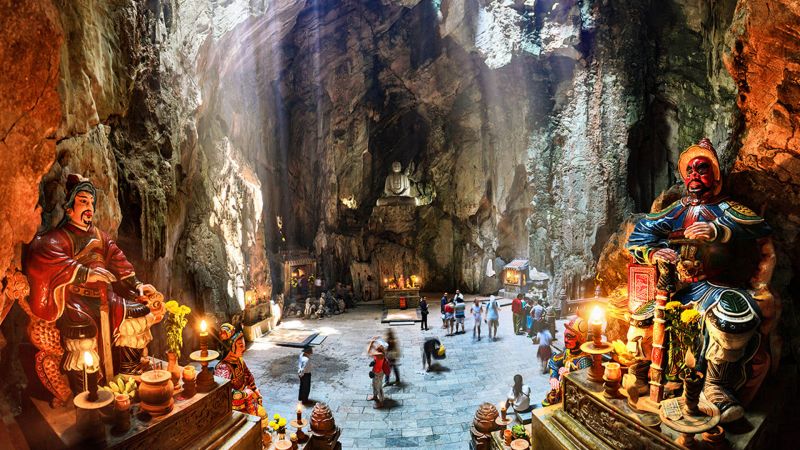
Steps descend into the cave from the Thuy Son mountain path, and handrails are available on both sides. Indian tourists familiar with Elephanta Caves near Mumbai will recognise a similar combination of sacred carvings and natural rock architecture, with the key difference that Huyen Khong is an active place of daily Buddhist worship.
Am Phu Cave
Am Phu Cave occupies the south face of Thuy Son and is accessed from a separate entrance distinct from the main Huyen Khong Cave route. “Am Phu” translates directly as “the underworld” in Vietnamese Buddhist cosmology, and the cave’s interior reflects that cosmology — stone carvings depicting scenes from Buddhist concepts of hell and heaven line the narrow passage walls on both sides.
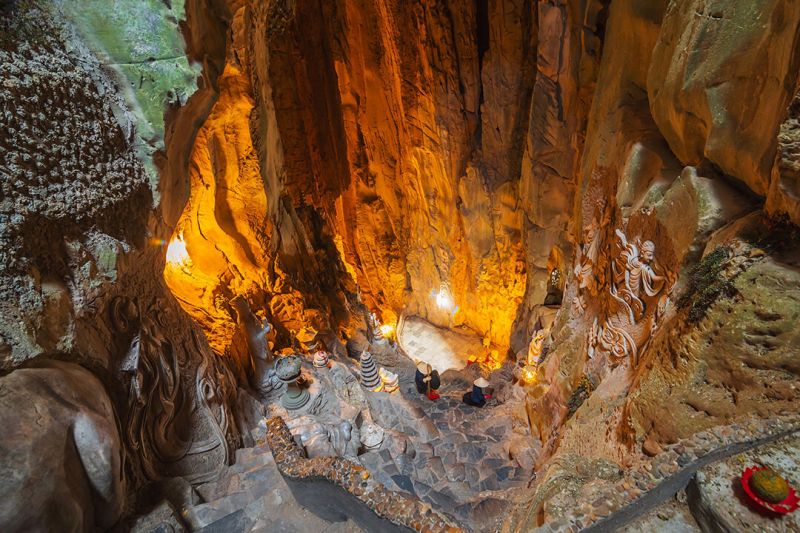
Am Phu Cave features low ceilings and tight passages throughout and is unsuitable for visitors with claustrophobia. Portions of the cave were under restoration as of 2026 — Indian tourists confirm current access status with the ticket counter on arrival before planning this section of the visit. The cave is unsuitable for children under 8 years old due to the confined passage dimensions.
Linh Ung Pagoda and the 5 Mountains Explained
A strict dress code applies at Marble Mountains’ pagodas, requiring visitors to cover both shoulders and knees before entering Linh Ung Pagoda grounds. While exploring the caves and stairs, Indian tourists wear closed-toe shoes with grip — the marble surfaces become as slippery as polished granite, particularly during the rainy season from September to November.
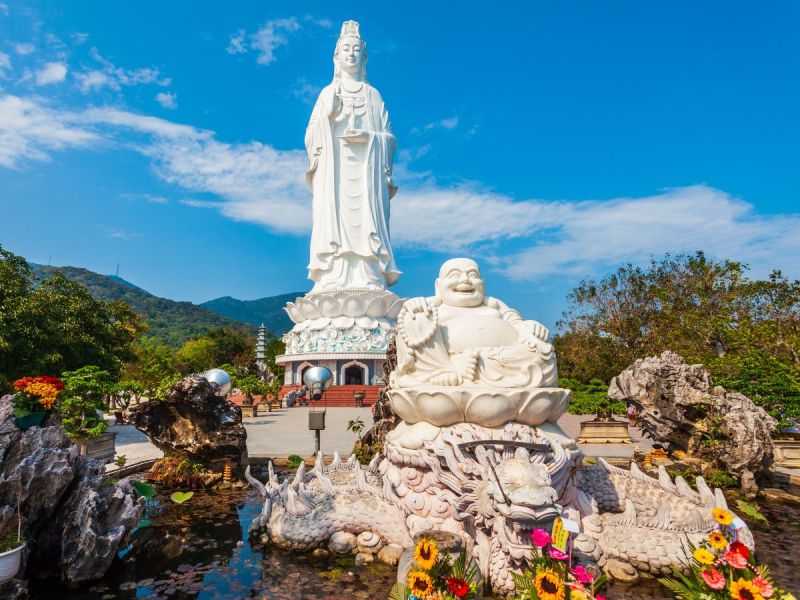
The site takes its name from the 5 hills that make up Ngũ Hành Sơn, each named after one of the five natural elements: Kim (Metal), Thuy (Water), Moc (Wood), Hoa (Fire), and Tho (Earth). Only Thuy Son (Water Mountain) is open to tourists — the remaining 4 hills (Kim Son, Moc Son, Hoa Son, and Tho Son) are not publicly accessible and cannot be entered. Indian tourists who have visited the Palitana temple complex in Gujarat — the 863-temple Jain pilgrimage site — will recognise a comparable layout of multiple shrines and active worship within a single elevated site.
Marble Mountains Elevator and Climbing Steps
Reaching the mid-mountain level at Thuy Son requires a choice between 2 routes: the elevator on the east face or the 156-step main staircase.
The Elevator
The Marble Mountains elevator is located on the east side of Thuy Son and operates on a separate ticket from the main entrance — ₹53 one-way (15,000 VND) or ₹107 round-trip (30,000 VND) per person. The elevator lifts visitors to mid-mountain level, and a short walk continues from the exit to the Linh Ung Pagoda and Huyen Khong Cave area.
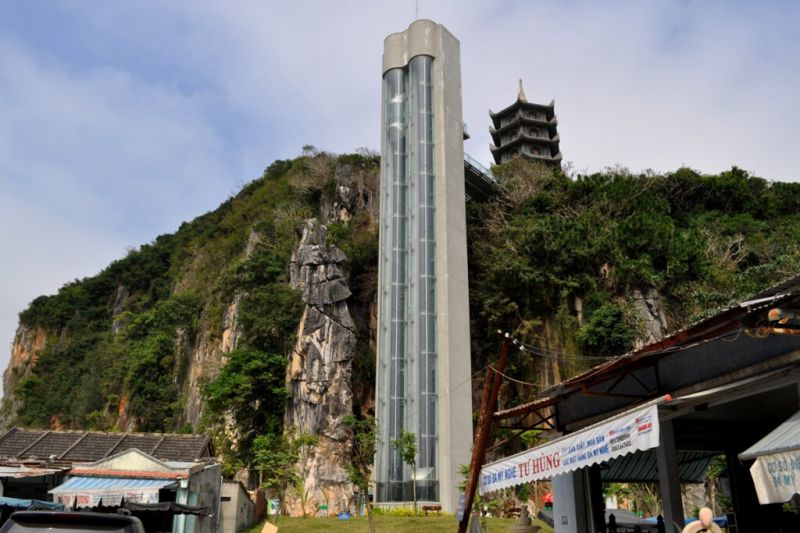
Some steps remain after the elevator exit — the path is significantly less demanding than the full staircase but is not entirely flat. The elevator suits families travelling with children under 10, elderly visitors, and travellers with knee or hip limitations. Like the Vaishno Devi helicopter service that lifts pilgrims from Katra to Sanjichhat, the Marble Mountains elevator removes the physical barrier of the ascent without reducing access to the religious and cultural experience.
Climbing the 156 Steps
The main staircase at Marble Mountains consists of 156 steps from the base to the mid-mountain gate, requiring 10 to 15 minutes at a moderate pace. The steepest section is the final 30 steps approaching the upper viewpoint, where no continuous handrail is present.
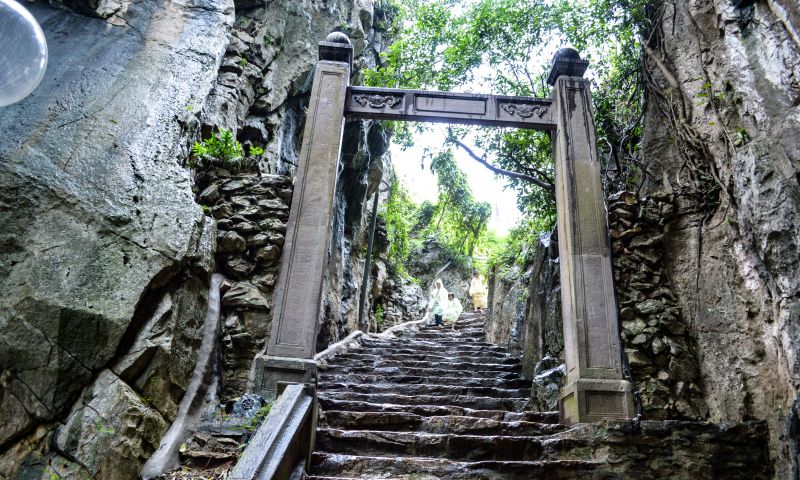
Stone steps become slippery when wet — closed-toe shoes are required for safe ascent, and sandals or flip-flops significantly increase the risk of slipping, particularly after rainfall. Indian tourists with moderate fitness levels complete the climb comfortably. The staircase route passes directly through Ong Chon Gate — an ancient Cham-era stone arch entrance that predates the current pagoda structures and is not accessible from the elevator route.
Marble Mountains Panoramic Viewpoint and Photography
The summit of Thuy Son delivers the single most photographed payoff of the entire Marble Mountains visit — a wide coastal panorama and 3 interior photography locations that each produce a different type of image.
The Summit View
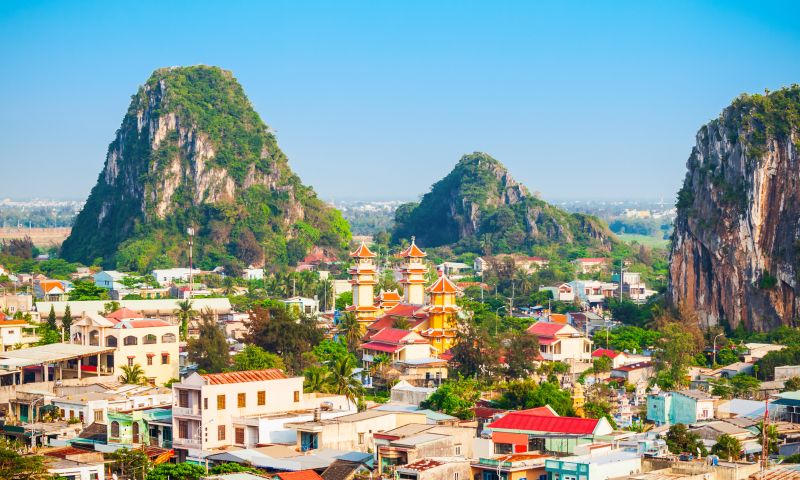
The Vong Giang Dai viewpoint at the summit of Thuy Son delivers a panoramic view extending north across My Khe Beach and Non Nuoc Beach, with the Han River and Da Nang city skyline visible to the northwest. At 108 metres (354 feet) above sea level, Vong Giang Dai places the entire Da Nang coastline in a single frame — ocean to the east, river delta and urban skyline to the north, and Non Nuoc Marble Village’s craft workshops directly below. Indian tourists familiar with the Kanheri Caves viewpoint near Mumbai will find a comparable elevated perspective at Vong Giang Dai, with the addition of an open ocean horizon. The clearest and least crowded conditions occur before 9:00 AM.
3 Best Photo Spots Inside the Mountains
Marble Mountains contains 3 distinct photography locations, each producing a different type of image from the same site. The first is the Huyen Khong Cave skylight — positioning the camera to shoot upward into the natural circular opening captures the strongest light shaft before 10:00 AM, when the morning sun angle aligns directly with the ceiling aperture. The second is Ong Chon Gate archway on the main staircase — framing the stone arch with the jungle canopy and descending steps visible below produces a composition unique to the staircase entrance route. The third is the Vong Giang Dai terrace at the summit — shooting the wide panorama with Da Nang’s beach to the left and the city skyline to the right, with portrait mode adding depth to the ocean-to-city span.
Non Nuoc Marble Village
Non Nuoc Stone Carving Village sits at the foot of Thuy Son, a 3-minute walk from the Marble Mountains main entrance, and operates as one of Vietnam’s largest active craft districts. The village contains over 400 workshops producing marble sculptures, Buddha statues, decorative carvings, and smaller tourist souvenirs — all hand-carved on site.
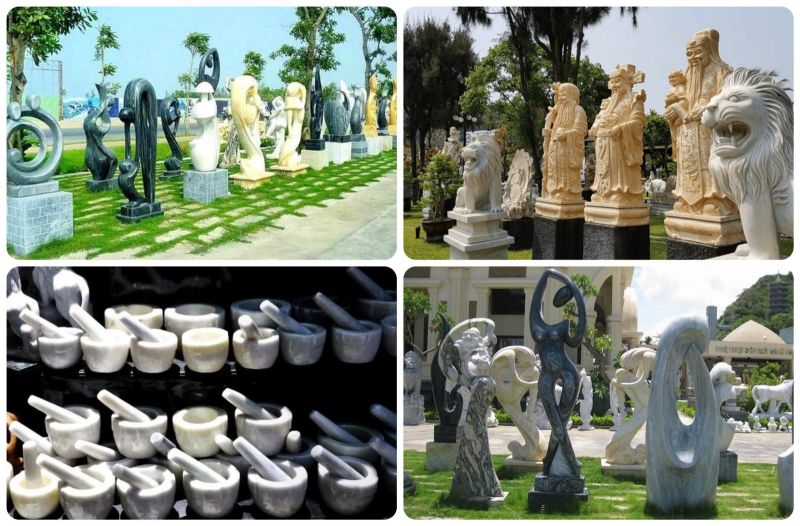
Prices at Non Nuoc range from ₹350 to ₹700 (100,000 to 200,000 VND) for small souvenirs, ₹1,400 to ₹2,800 (400,000 to 800,000 VND) for medium Buddha statues, and ₹7,000 (2,000,000 VND) and above for larger sculptural pieces. Bargaining is accepted across all workshops — a practical starting point is 60% of the initial asking price.
Indian tourists who have browsed Jaipur’s stone-carving bazaars will find a familiar atmosphere in Non Nuoc — the key difference is the subject matter, which is predominantly Vietnamese Buddhist iconography rather than Rajasthani decorative forms. Workshops throughout the village offer international freight and shipping services for larger purchases, handling the logistics of transporting pieces overseas.
Marble Mountains Day Trip from Hoi An for Indian Tourists
Marble Mountains day trip from Hoi An runs in 2 configurations: a 4-hour half-day to Marble Mountains alone, or an 8-hour full-day combining Marble Mountains with My Son Sanctuary — Hoi An is the most common departure base for Indian tourists.
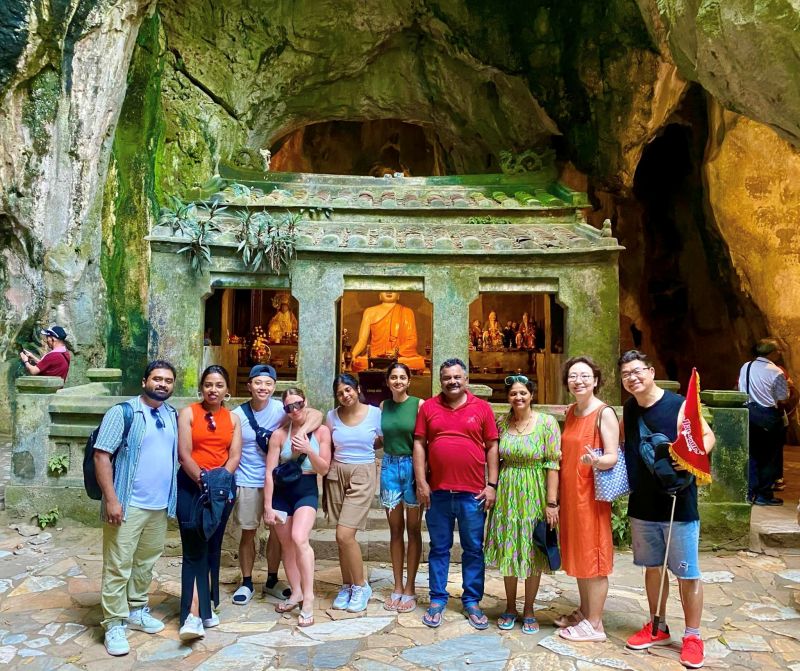
Distance, Travel Time and Transport Options from Hoi An
Marble Mountains is 30 km (18.6 miles) from Hoi An Ancient Town centre — a journey of 40 to 50 minutes by private car or taxi along the Da Nang coastal highway. No direct public bus connects Hoi An to Marble Mountains — private transport is the only practical option for this route.
4 transport options are available for Indian tourists travelling from Hoi An to Marble Mountains.
- A private taxi or car costs ₹700 to ₹1,050 (200,000 to 300,000 VND) one-way.
- A private taxi return with waiting time costs ₹1,400 to ₹1,750 (400,000 to 500,000 VND).
- A Grab motorbike taxi costs ₹350 to ₹490 (100,000 to 140,000 VND) one-way and is unsuitable for families or first-time travellers on Vietnamese roads.
- An organised day tour from Hoi An costs ₹2,100 to ₹3,500 (600,000 to 1,000,000 VND) per person, including private transport, a licensed guide, and lunch.
The organised day tour becomes cost-competitive for families of 3 or more when the per-head price is calculated against individual taxi fares plus guide fees.
Combining Marble Mountains with My Son Sanctuary in One Day
Marble Mountains and My Son Sanctuary can be visited in a single full day — My Son is located 45 km (28 miles) southwest of Marble Mountains, making the combined itinerary feasible with a private car. The optimal sequence starts with Marble Mountains arrival at 7:00 AM, completing the visit by 11:00 AM, then departing for My Son Sanctuary to arrive by 12:00 PM for the afternoon session. A private car covering both sites costs ₹3,500 to ₹4,900 (1,000,000 to 1,400,000 VND) for the full day, and the combined tour duration runs 7 to 8 hours.
My Son Sanctuary holds a position in Vietnamese history comparable to a smaller-scale Angkor: the brick towers are the ruins of a Hindu-origin Cham kingdom that predates the current Vietnamese state, making My Son a natural pairing with Marble Mountains’ Cham inscriptions. A licensed guide is necessary for My Son to contextualise the ruins; Marble Mountains requires no guide.
Best Time to Visit Marble Mountains for Indian Tourists
Vietnamtour.in operations teams in Da Nang confirm that early-morning visits produce the smoothest visitor flow for Indian groups, particularly families and senior travellers using the elevator route. Morning scheduling also aligns with typical Indian breakfast timing and avoids heat exposure during the staircase climb.
Best Time of Day
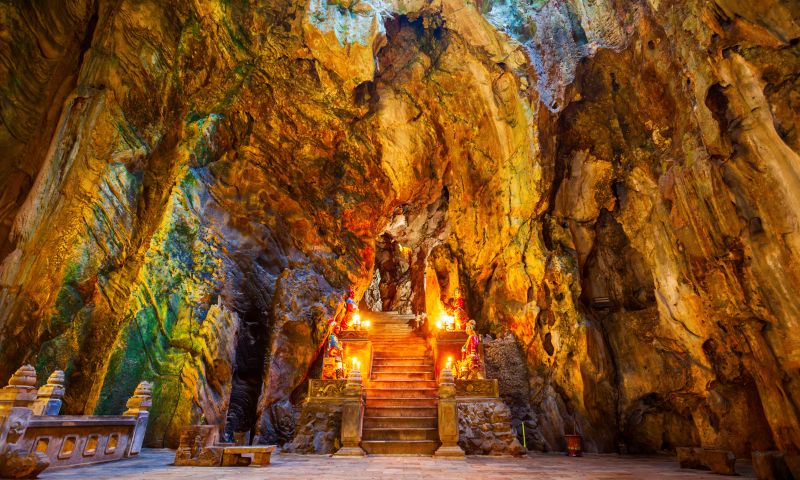
The best time to visit Marble Mountains is the 7:00–9:00 AM window — busyness score of 11 to 25 out of 100, per Google Popular Times. Arriving at 7:30 AM and completing the visit by 10:00 AM avoids the sharp crowd increase that begins at 10:00 to 11:00 AM, when scores rise to 60 to 83. Midday is the peak crowd period — scores reach 85 to 100 between 12:00 PM and 2:00 PM, with Saturday at 1:00 PM recording the maximum score of 100 out of 100. Crowd levels decline through the afternoon, dropping to 35 to 77 between 3:00 PM and 5:00 PM.
Vietnamtour.in timing analysis across Indian group departures shows that arrivals between 7:30 AM and 8:30 AM result in 35% shorter queue times at the entrance and elevator. Vietnamtour.in recommends completing the summit viewpoint before 9:30 AM to avoid tour bus arrivals from Da Nang city.
Saturday and Sunday midday are the busiest periods of the entire week — visiting between 11:00 AM and 3:00 PM on weekends produces the most congested cave and pagoda experience.
Best Season for Indian Tourists
February to May is the best season to visit Marble Mountains, covering Central Vietnam’s dry period when Da Nang temperatures hold between 24 and 30°C (75 to 86°F) — comfortable conditions for climbing. The rainy season runs from September through November — stone steps become significantly slippery during Da Nang’s rainy season, and some cave areas may have restricted access due to water accumulation.
3 Indian holiday windows align with the seasonal calendar in different ways: Holi (March) falls squarely in the dry season and represents the best timing of the year for a visit; summer school holidays (May to June) offer acceptable conditions as humidity increases but rainfall remains minimal; and Diwali (October to November) coincides with Da Nang’s rainy season — wet steps and reduced viewpoint visibility are standard during this period. A visit covering Huyen Khong Cave, Linh Ung Pagoda, and Vong Giang Dai viewpoint requires 1 to 1.5 hours regardless of season.
7 Things Indian Tourists Must Know Before Visiting Marble Mountains
Indian tourists visiting Marble Mountains need 7 practical pieces of information before arrival — covering dress, food, footwear, payment, access, photography, and timing.
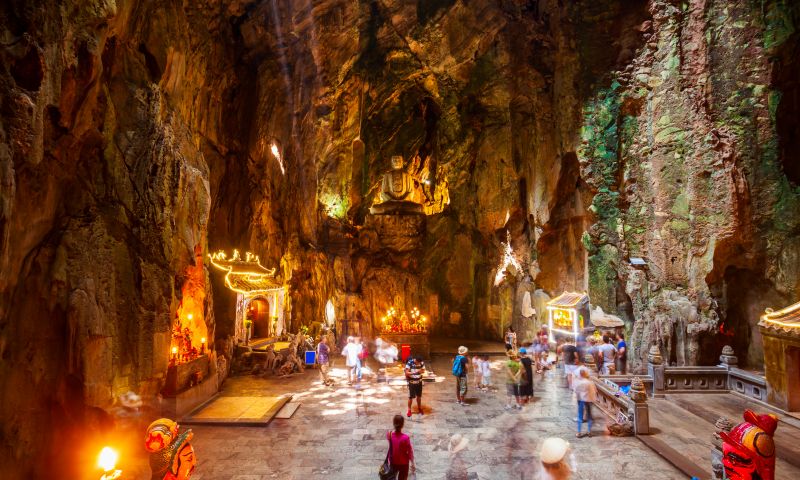
- Dress code applies to all pagodas — covered shoulders and knees are required inside Linh Ung Pagoda.
- No vegetarian restaurant operates inside Marble Mountains — the nearest vegetarian and Indian food options are in Non Nuoc Stone Carving Village, directly below, or a 10-minute drive toward Da Nang city; bring snacks for the visit.
- Footwear matters on marble surfaces — wet marble is as slippery as polished granite; closed-toe shoes with grip are essential, and sandals or flip-flops are a significant safety risk on the steps.
- The ticket counter accepts cash in VND only — no card payment is accepted at the entrance booth; the nearest ATM is 1.5 km (0.9 miles) away.
- Only Thuy Son (Water Mountain) is open to tourists — the entrance ticket covers Thuy Son only; the other 4 mountains (Kim Son, Moc Son, Hoa Son, and Tho Son) are not publicly accessible.
- Photography inside the caves is free — no additional charge applies; tripods are not permitted in the narrow passages of Am Phu Cave.
- The least congested window for Indian families is Tuesday to Thursday, 7:00–9:00 AM — empty pathways and the best light conditions for cave and viewpoint photography, per Google Popular Times.
Frequently Asked Questions — Marble Mountains for Indian Tourists
Is Marble Mountains Worth Visiting for Indian Tourists?
Marble Mountains is worth visiting for Indian tourists adding 1 to 1.5 hours to a Da Nang or Hoi An itinerary — a layered Buddhist pilgrimage site, with active worship, cave shrines, and a 108-metre coastal viewpoint comparable to Elephanta Caves and Ajanta in spiritual atmosphere. Indian tourists prioritising beach, food, or shopping over religious-cultural sites skip Marble Mountains in favour of My Khe Beach or Da Nang night markets.
What Should Indian Tourists Wear to Marble Mountains?
Indian tourists wear closed-toe shoes with grip and clothing covering both shoulders and knees at Marble Mountains. Closed-toe shoes are required because the marble steps become as slippery as polished granite when wet, and the shoulder-and-knee dress code is enforced inside Linh Ung Pagoda. Sandals, flip-flops, sleeveless tops, and shorts above the knee are unsuitable for the visit.
Is Marble Mountains Open Every Day of the Week?
Marble Mountains (Thuy Son) is open every day from 7:00 AM to 5:30 PM, including Vietnamese public holidays — Tet, Reunification Day, Labour Day, and National Day — and all weekends. No advance reservation is required — tickets are purchased at the entrance booth at the base of Thuy Son on the day of the visit.
Can Elderly Visitors and Young Children Use the Elevator at Marble Mountains?
The Marble Mountains elevator on the east side of Thuy Son operates daily and is fully accessible for elderly visitors and families with young children. The elevator lifts visitors to mid-mountain level, after which a short walk on a comparatively flat path leads to the Linh Ung Pagoda area. Some steps remain after the elevator exit, but the remaining steps are significantly fewer and less steep than the full 156-step main staircase. The elevator costs ₹53 one-way (15,000 VND) or ₹107 round-trip (30,000 VND) per person.
How Long Should Indian Tourists Spend at Marble Mountains?
1 to 1.5 hours is sufficient to visit Huyen Khong Cave, Linh Ung Pagoda, and the Vong Giang Dai summit viewpoint — a duration confirmed by Google’s Knowledge Graph for the site. Indian tourists including Am Phu Cave add 30 minutes to the visit. Visiting Non Nuoc Stone Carving Village at the foot of Thuy Son requires an additional 30 to 45 minutes and is best treated as a separate stop after descending from Marble Mountains.
What Is the Most Affordable Way to Visit Marble Mountains from Hoi An?
The most affordable individual transport option from Hoi An is a Grab car or shared taxi at ₹700 to ₹1,050 (200,000 to 300,000 VND) one-way. Organised day tours from Hoi An cost from ₹2,100 (600,000 VND) per person and include the guide, return transport, and lunch — making the day tour cost-competitive for families of 3 or more, where the per-head cost approaches the individual Grab car fare once guiding and meal costs are added.
Is Marble Mountains Suitable for Indian Families with Children Under 10?
Marble Mountains is suitable for Indian families with children under 10, provided the elevator is used in place of the 156-step main staircase. Children under 6 years enter free of charge. The cave interiors on the main Thuy Son route are wide enough for children to walk safely with adult supervision. Am Phu Cave is the exception — its narrow passages and low ceilings make it unsuitable for children under 8, and the section under restoration as of 2026 further limits access in affected areas — Indian tourists confirm the current Am Phu Cave access status at the ticket counter on arrival.
Plan the Wider Da Nang and Hoi An Itinerary
Indian tourists who include Marble Mountains as part of a broader Da Nang itinerary explore the places to visit in Da Nang guide for a complete overview of the city’s top attractions, beaches, and landmarks beyond the mountains. Travellers based in Hoi An reference the Hoi An guide covering the Ancient Town, the beach, lantern festivals, and day trip options including Marble Mountains and My Son Sanctuary in a single reference. For dietary planning around the visit, the Da Nang vegetarian restaurant guide covers vetted dining options within reach of Marble Mountains.