
The mysterious Bayon Temple, with its unique architecture, is a spiritual tourist destination in Cambodia that attracts countless visitors every year. Let’s explore this sacred temple and discover the fascinating stories behind this captivating attraction.
Introduction to Bayon Temple
For a long time, Bayon Temple has been renowned as one of the most unique and mysterious temples in Cambodia. The mystical beauty of Bayon Temple comes not only from its unique architecture, but also from the combination of history, culture, and religion.
Where is Bayon Temple
-
Address: inside Angkor Archaeological Park, 6 km from Siem Reap city Center, Cambodia
Located in the heart of the ancient city of Angkor Thom, Bayon Temple symbolizes the union of heaven and earth. This mountain temple was built to represent Mount Meru, a cosmic symbol in Hindu and Buddhist teachings. Bayon is also the most impressive temple in the Cambodian temple complex, thanks to its grandeur and the emotional impact it has on visitors.
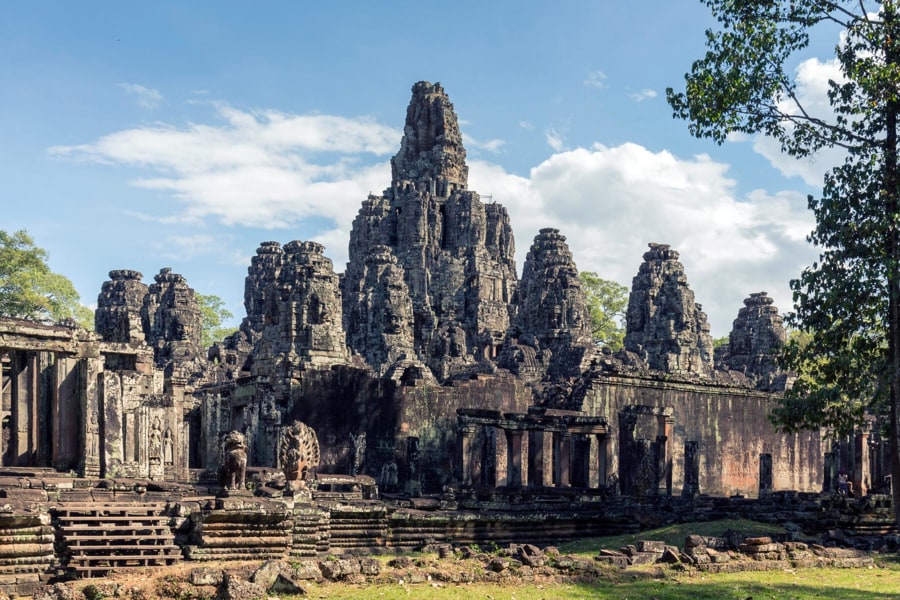
The temple faces east, with its structures extending westward along an east-west axis. Climbing to the summit offers breathtaking views of the surrounding ancient city.
Opening Hours & Entrance Fee
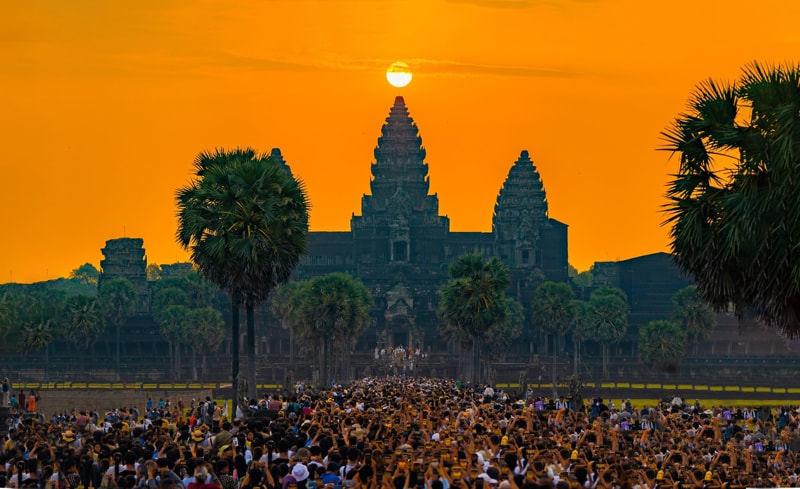
To visit Bayon Temple and other attractions inside the Angkor Complex, travellers need an official Angkor pass (ticket). With this ticket, Indian travellers can visit all the temples inside, including Bayon Temple, Angkor Wat, Angkor Thom, and all major attractions.
-
Here is the detailed ticket price:
|
Ticket Type
|
Price per person
|
Duration
|
Note
|
|
1-day
|
$37
|
1 day
|
Travellers who want a short visit to Bayon Temple or Angkor Wat with a tight schedule
|
|
3-day
|
$62
|
3 days (non-consecutive use allowed)
|
Most travellers choose to visit for 3 days to have a relaxed exploration. The ticket is valid for 10 days from the date of purchase. You can use the ticket to visit Bayon Temple and other attractions inside Angkor Archaeological Park for any 3 days within those 10 days.
|
|
7-day
|
$72
|
7 days (non-consecutive use allowed)
|
If you want to explore the Angkor Complex more deeply and more relaxed, you should choose to buy this 7-day ticket. The ticket is valid for 1 month from the date of purchase, allowing you to visit the Angkor Wat complex for any 7 days within that 1 month.
|
History of Bayon Temple
In the late 12th and early 13th centuries, King Jayavarman VII built the large city of Angkor Thom, the last capital of the Khmer Empire. The Bayon Temple, located in the center of Angkor Thom, is one of the temples built within this capital.
King Jayavarman VII erected the Bayon Temple with 54 towers, each sculpted with four-faced Lokesvara faces. Each tower has 216 faces in total, reflecting King Jayavarman VII’s Buddhist faith and a strong Buddhist architectural style.
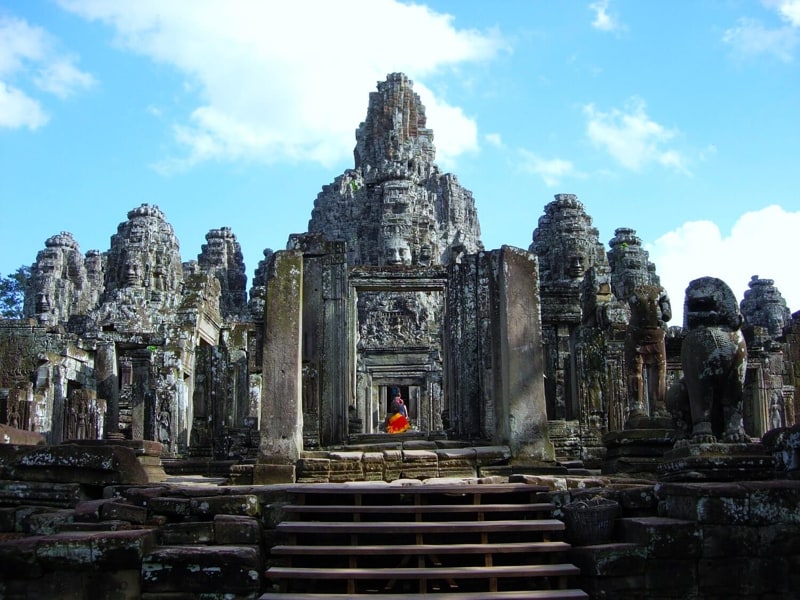
In the mid-13th century, after King Jayavarman VII’s death, the temple was altered by subsequent Hindu kings. Fortunately, the Bayon Temple was not destroyed because the smiling faces were mistaken by Hindus for the faces of the god Shiva, thus preventing its demolition.
Before 1609, when the Khmer Empire collapsed, the Angkor complexes were abandoned, and the Bayon temple was also left deserted in the jungle. After a long period of abandonment, in 1995, the Bayon temple was restored according to Anastylosis techniques.
To this day, the Bayon temple in Angkor Wat Complex is recognised as a World Heritage site, attracting many domestic and international tourists to visit and explore its mystical beauty.
Religious Meanings of Bayon Temple with the Cambodian People
The Bayon Temple is not only a unique architectural masterpiece but also a symbol of faith and love for the homeland of the Cambodian people. Cambodians believe that the faces on the towers of the Bayon Temple are either deities or King Jayavarman VII, who brought peace and prosperity to the country.
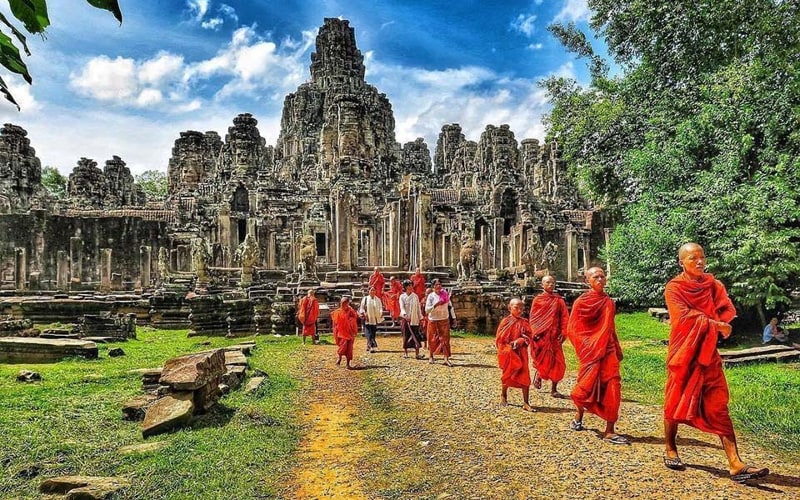
They also see the Bayon Temple as a place where nature and humanity, Buddhism and Hinduism, meet. That is why Cambodian people always respect, protect, and consider the temple as part of their cultural identity.
Bayon Temple vs Angkor Wat
Though both the Bayon Temple and Angkor Wat are located within the Angkor complex, they appeal to visitors in such different ways. Angkor Wat is the biggest and most well-known temple in Cambodia; it has a massive size, excellent symmetry, and a beautiful outline when seen from the east at sunrise. Angkor Wat epitomises the best aspects of Khmer classical architecture (or Classic Khmer Architecture) and was initially constructed as a Hindu religious site.
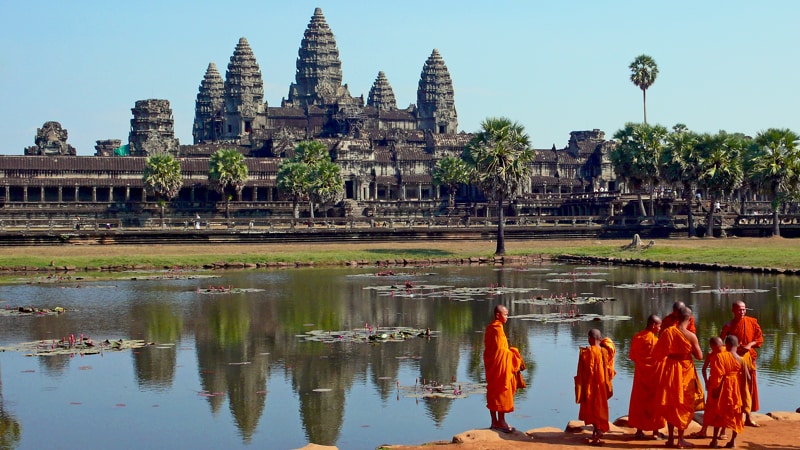
The appeal of Bayon Temple, on the other hand, comes from its odd, yet dramatic architecture. Whereas Angkor Wat emphasises open spaces and balance, Bayon Temple has numerous tall towers packed with hundreds of stone faces, creating a more intimate, spiritual environment that allows for greater inspection of the artistic features of the temple.
When it comes to storytelling, Angkor Wat’s bas-reliefs are based heavily on the mythology of the Hindu religion, while Bayon Temple’s carved images are more representative of mainstream life, major historical occurrences, and representations of characters that make up the Khmer Empire. For many visitors, the sheer size of Angkor Wat provides great majesty, while the deeper emotions that the Bayon Temple evokes provide visitors with greater cultural experiences.
Unique Architecture and Design of Bayon Temple
Bayon Temple has unique and distinctive architecture, different from other temples in Cambodia.
Structure of A Multi-Level Temple Maze
Bayon Temple was designed in an intricate and compact manner, with three principal supportive floors, including a primary floor at the base of the structure. Unlike Angkor Wat, which uses a moat and is enhanced by wide open spaces, the Bayon does not have rivers or a large empty area surrounding the structure, resulting in a very dense and enclosed space.
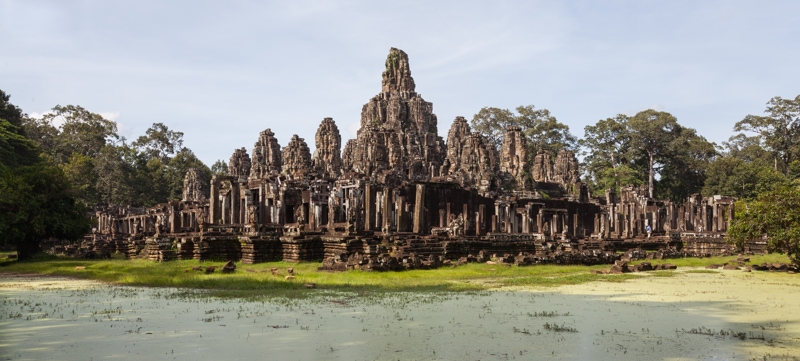
The central sanctum is positioned within the middle of the temple; stone towers surround the sanctum, forming a tiered design going upward toward the centre of the Bayon. This design is made up of dozens of towers, many of which are still present today and exhibit the vertical architectural feature of the Bayon.
Stone Towers and Iconic Smiling Faces
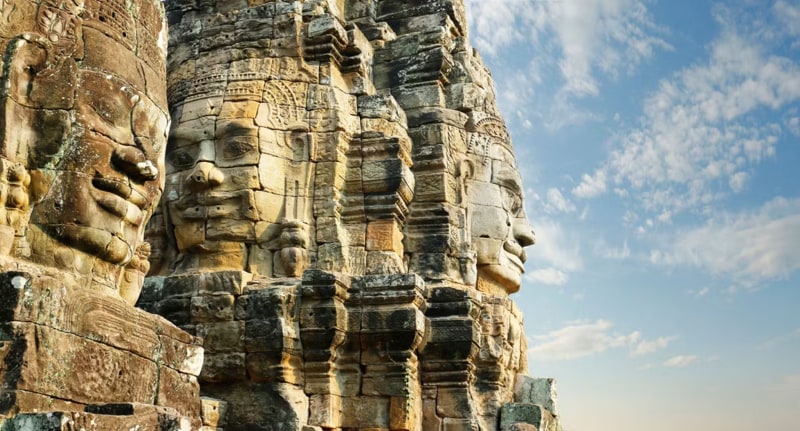
Bayon Temple is home to 54 towers adorned with enormous stone heads, all smiling broadly. There are approximately 216 large stone heads in total, each about 2 to 3m tall. The heads face in the four cardinal directions, representing omnipresence and the protection afforded by Avalokiteshvara, the bodhisattva of compassion, who is sometimes identified as an incarnation of King Jayavarman VII, the temple’s patron. Although they are spaced very far apart and are situated inside the highest point of the temple, the heads create a peaceful feel and bring a feeling of calmness, contrary to the intricacies of the temple’s building and its crowded layout.
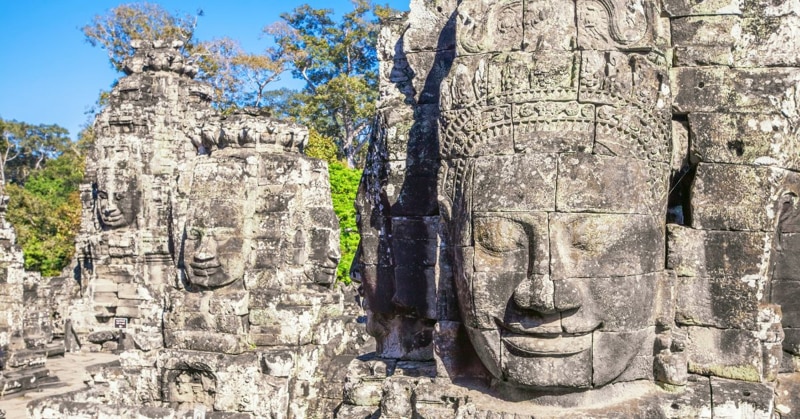
No one knows the exact meaning and name of each face, leaving many questions for researchers about the development of Khmer sculpture.
Bas-Reliefs of Bayon Temple
The Bayon Temple has Bas-Reliefs that are carved on the outer galleries of its second level and run a total length of over 1.2 kilometers. The Bas-Reliefs depict detailed and realistic representations of daily life in the Khmer Empire.
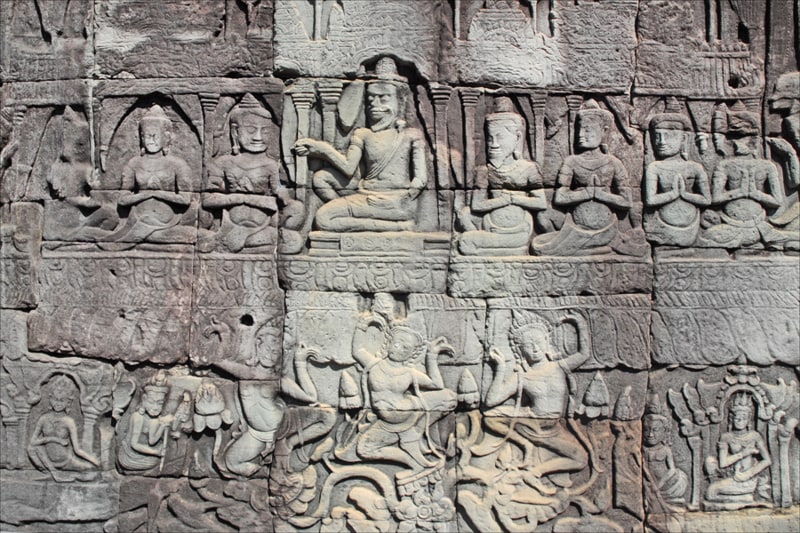
The scenes include market trading, preparing food, fishing, cock fighting, and events from large military campaigns, and in particular between the Khmer and Cham. Unlike other temples of Angkor, the Bas-Reliefs of Bayon are arranged with a chronological narrative style layout; therefore, the visitor can easily follow the narratives in the galleries.
Unmissable Experiences when Visiting Bayon Temple
While it is historically significant, Bayon Temple provides visitors with many immersive experiences that create a true memory of their visit to Bayon Temple. Therefore, these moments of visiting the Bayon Temple are unique and should not be missed.
Wander in the Presence of Mysteriously Smiling Stone Faces
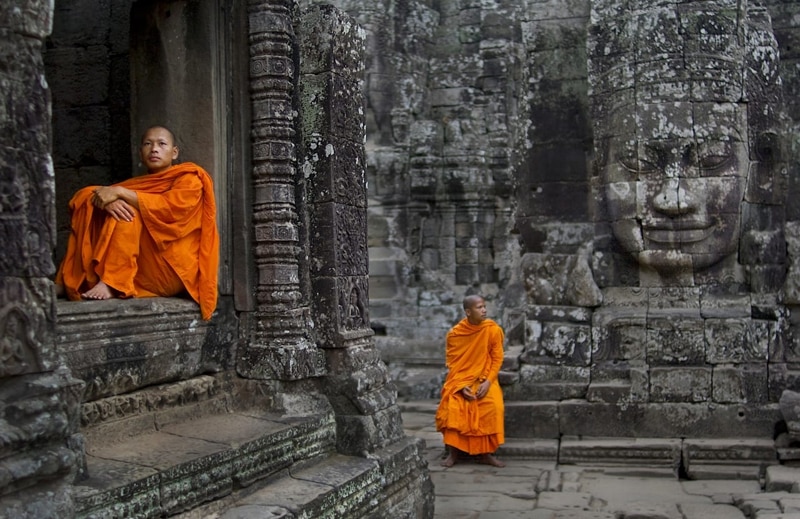
Among the things you will remember most about your visit to Bayon Temple is being able to walk underneath such majestic, larger-than-life stone faces as you roam the temple. The calmness and mystery of those majestic stone-carved faces surround you from every angle while you walk through the temple and create an almost surreal experience that is unlike any other temple in the world.

Capture Unique Photography Angles
Unlike Angkor Wat, there are so many opportunities for creative photography in Bayon. Narrow hallway spaces, layered tower structures, and unexpected views of the stone faces present an opportunity for dramatic and intimate framing of the stone faces in a way that is not easily replicated elsewhere in Angkor.
Get an Up-Close Look at the Upper Level
When you climb the upper level of Bayon Temple, you can get up close and personal with the famous stone faces and see all of the minute details that make them truly unique. In addition to viewing the intricate details of the famous stone faces, being able to view the entire city of Angkor Thom from a higher distance will give you an opportunity to enjoy a more peaceful and intimate experience away from the crowds.
Experience Bayon Temple Early in the Morning
One of the greatest ways to appreciate Bayon Temple is by going to see it first thing in the morning, when the stone carvings have an enhanced appearance due to the lower angle of sunlight. It’s cooler than it is later in the day, and there are not as many large tour groups visiting the site.
How to Get to Bayon Temple
Visitors traveling to the Bayon Temple can do so via a tuk-tuk, taxi, bicycle, or organized tour based on their own choice of budget or style of travel.
A tuk-tuk or taxi is the best means of transportation to reach Bayon Temple with an approximate travel time of 20 – 30 minutes from the city, and the average cost of transporting to Bayon Temple via a tuk-tuk or taxi will generally be between USD 10 – 15 one way or USD 25 – 35 USD if you wish to purchase a package day tour of Angkor including your entrance pass to all the Angkor temples.
Active travelers may consider cycling to Bayon Temple, which will take approximately 45 – 60 minutes using mostly flat roads.
For visitors wanting a hassle-free way to visit Bayon Temple, consider booking a guided tour from a reputable travel agency like Vietnamtour.in, which includes Bayon Temple along with other main temples in Angkor Thom.
Best Time to Visit Bayon Temple
If you’re considering when it is suitable to visit Bayon Temple, the best time would be between 7:30 AM and 9:00 AM (just before and after sunrise) – the temperatures tend to be cooler, and you’ll have a great opportunity for photos without too many other tourists around to obstruct your view of the stone faces.
If you’re deciding which months to visit, the months of November – March offer the driest weather, the best chance of pleasant temperatures, and therefore the best chance of having a comfortable experience. You also may want to consider visiting on weekdays and avoiding the late morning/early afternoon hours, as these times tend to attract most tourists to Bayon Temple.
Nearby Bayon Temple Attractions in the Angkor Complex
Bayon Temple is located in a convenient area of the Angkor Archaeological Park, allowing easy access to some of the most notable Angkor sites.
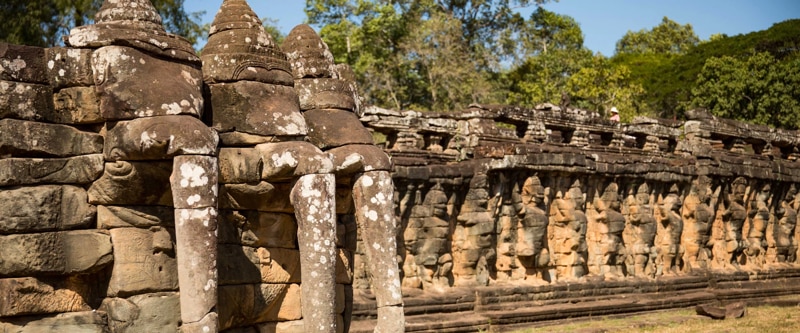
Bayon Temple is surrounded by Angkor Thom and is in proximity to the Baphuon, Terrace of the Elephants, and Terrace of the Leper King, all of which can be reached easily on foot from Bayon Temple. Visitors can gain an enhanced understanding of the Khmer Empire’s former royal capital while exploring the area surrounding Bayon Temple.
Angkor Wat is located just a short drive south of Angkor Thom, and is the largest and most famous temple in Cambodia. Even though it is not in Angkor Thom, Angkor Wat is located very close to Bayon Temple and can typically be included in the same itinerary.
In addition, Ta Prohm, which has giant tree roots and a jungle surrounding it, as well as Preah Khan, which is a large monastic complex located to the north of Angkor Thom, are other popular temples found in the area. Together, these landmarks comprise the primary attractions of Angkor and can usually be visited together with the Bayon Temple.
Things You Should Remember before Visiting the Bayon Temple
By following a few simple rules and developing good habits, you can create a smoother, safer, and ultimately more meaningful experience at Bayon Temple and other attractions inside the Angkor Complex:
- To visit Bayon Temple, which is part of the Angkor Complex, you need to have an Angkor Pass.
- For a more pleasant experience, visit the temple early in the morning. It can get extremely hot in the afternoon, and the site becomes crowded with other tourists during the day.
- Bayon Temple is an important religious site and a historical site, and as such, you must show a great deal of respect to the temple. Various places in the temple show carvings and stone faces, which you must not touch. Leaning, climbing, or performing any actions that can cause permanent damage to the temple is strictly forbidden. There are conservation zones that are protected, so be sure to follow the instructions of the signs and the staff.
- Dress appropriately while visiting the Temple of Bayon; wear clothing that covers the shoulders and knees. Comfortable shoes are also necessary, since many areas of the structure have worn, uneven stones or stairs.
- Take your time to explore the temple. The most famous parts of Bayon are its stone faces; however, many bas-reliefs depict the daily life, warfare, and religious activities of the Khmer Empire. Moving slowly, quietly, and respectfully will allow you to appreciate the artistic and cultural significance of the Temple as a whole.
- Bayon Temple is not only a tourist site; it is also an important part of the cultural heritage of Cambodia. Being considerate when it comes to noise, litter, and how we behave will help to ensure that this significant monument continues to be enjoyed by future generations.
FAQs about Visiting Bayon Temple
-
Does the Angkor Small Circuit include Bayon Temple?
Bayon Temple is one of the top attractions within the Angkor Small Circuit, making it very easy for visitors to add to their overall 1-day or 2-day Angkor itinerary.
-
Are there restrooms and food stalls at Bayon Temple?
Basic restroom facilities exist inside the Angkor complex. However, there are few food options available in proximity to Bayon Temple. It is highly recommended that visitors eat before they arrive at Bayon Temple, and also bring plenty of water and snacks.
-
Is Bayon Temple accessible for children and seniors?
Yes, Bayon Temple can accommodate visitors of all ages, but rough and uneven ground may present difficulty for older adults or very small children. Visitors should be sure to go slowly, stay on easier routes, and use caution when walking.
-
Should I go to Bayon Temple before Angkor Wat or after?
Most first-time tourists to Angkor Wat go there first, then go to Angkor Thom (which contains Bayon Temple) second. If you start your day early, then maybe you can visit Bayon first when it is less populated and quieter than after people start showing up at Angkor Wat.
-
Will someone need a guide when visiting the Bayon Temple?
You do not have to use a guide, but having one may help explain the significance of the stone faces and bas-reliefs located there and their cultural and historical relevance. In fact, many first-time visitors find their visit to the Bayon Temple more enjoyable when they are accompanied by a tour guide.
Conclusion
In conclusion, Bayon Temple is one of the most distinctive temples in the Angkor complex, famous for its serene stone faces and richly detailed bas-reliefs.
Whether you are visiting Angkor for the first time or returning for a deeper exploration, Bayon Temple is a stop you should not miss. With the right timing and a respectful approach, a visit to Bayon becomes more than sightseeing. It becomes a meaningful encounter with one of Cambodia’s most important cultural landmarks.
