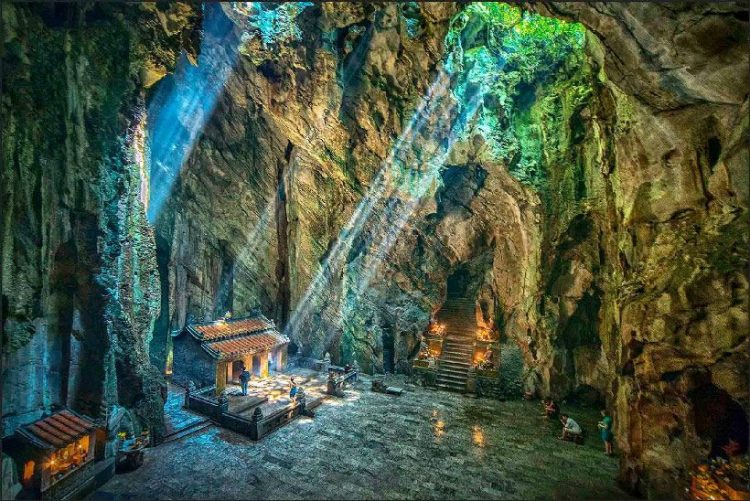
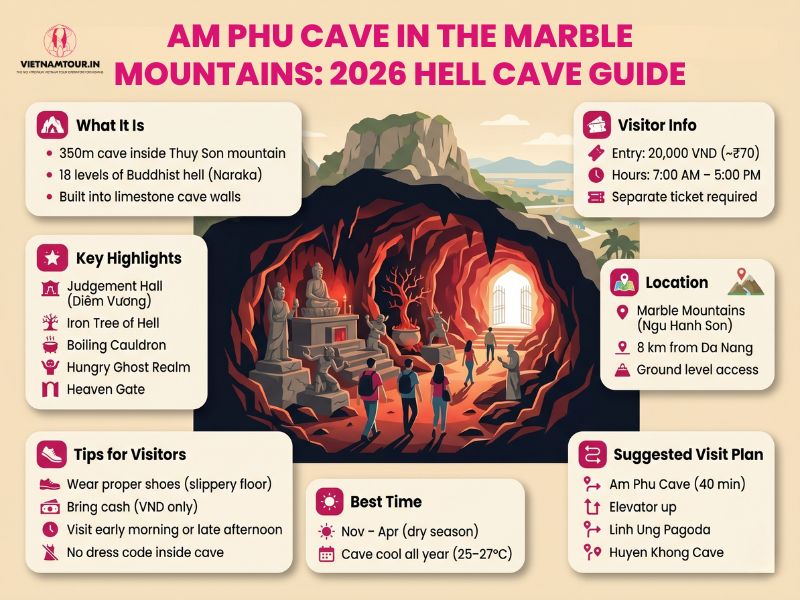
Am Phu Cave is a 350-metre subterranean passage carved into the base of Thuy Son mountain in Da Nang’s Marble Mountains complex, recreating all 18 levels of Buddhist hell (Naraka) through stone sculptures — the only cave attraction in Vietnam built entirely around the Buddhist afterlife narrative. Am Phu Cave sits at ground level on the western flank of Thuy Son (Water Mountain), the largest and most visited of the five Ngũ Hành Sơn peaks, 8 kilometres southeast of Da Nang city centre. Entry requires a separate ticket of 20,000 VND (~₹70) from the main Thuy Son admission, and Am Phu Cave is open daily from 7:00 AM to 5:00 PM.
Am Phu Cave coordinates: 16.0036° N, 108.2628° E. Google Maps pin: Am Phu Cave, Hòa Hải, Ngũ Hành Sơn, Đà Nẵng.
In this travel guide, Vietnamtour.in covers everything Indian travellers need to plan an Am Phu Cave visit in 2026:
- What it is: Am Phu Cave recreates all 18 levels of Buddhist hell (Thập Bát Địa Ngục) along a 350-metre corridor inside Thuy Son.
- History: Am Phu Cave has 400+ years of layered history — from a Cham sacred site to a Nguyen-dynasty Buddhist teaching tool to a Viet Cong shelter during the American War.
- Where it sits in Thuy Son: Am Phu Cave is one of five named caves on Thuy Son, and the only one that requires a separate ticket.
- Ticket and hours: 20,000 VND (~₹70) per adult, open daily 7:00 AM–5:00 PM, cash VND only.
- How to reach the upper caves: Take the elevator up (15,000 VND / ~₹52 one way) after Am Phu Cave, descend by the 150-step stairway.
- Itineraries: A half-day 3.5–4-hour Marble Mountains visit or a full-day Da Nang–Marble Mountains–Hoi An combination.
Am Phu Cave’s 18 Levels of Buddhist Hell
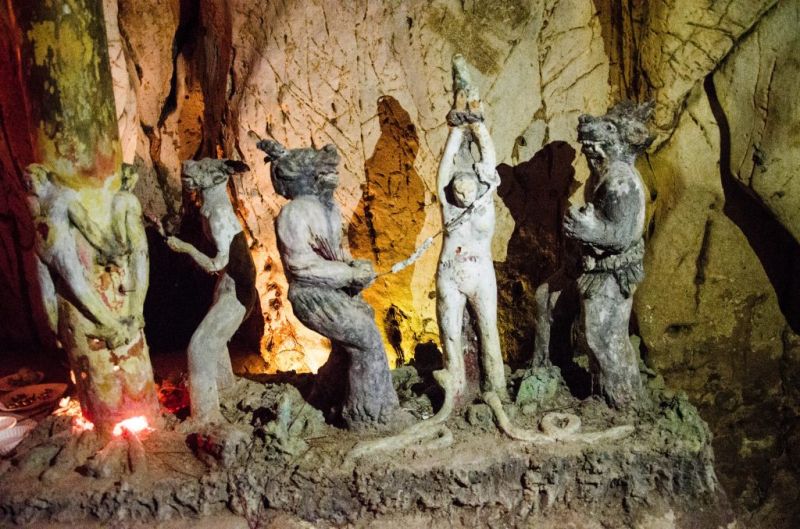
Am Phu Cave recreates all 18 levels of Buddhist hell — Thập Bát Địa Ngục — through stone and cement sculptures positioned sequentially along a 350-metre corridor inside Thuy Son mountain. Each of the 18 chambers depicts one category of karmic sin and one corresponding punishment, arranged in a fixed linear sequence, so the moral narrative progresses from judgement to release without ambiguity. The sculptures are built from stone and cement directly into the cave walls — not installed as separate exhibits — making Am Phu Cave function as a three-dimensional moral teaching tool rather than a geological attraction.
The Underworld Narrative
The visitor experience at Am Phu Cave follows the Buddhist afterlife sequence without deviation. The Am Phu Cave journey begins at the cave entrance, passes through the Diêm Vương Judgement Hall, descends through 18 chambers — each depicting the punishment for a specific sin — and exits through the Heaven Gate carved from white limestone at the far end.
Indian visitors familiar with Yamraj — the Hindu god of death and justice who presides over Naraka — will recognise the iconographic function of Diêm Vương immediately. In Vietnamese Buddhist tradition, the deceased faces Diêm Vương’s tribunal before being directed to one of the 18 punishment chambers. Each chamber corresponds to one category of sin and one form of retributive punishment. The sequence is linear, so disorientation is impossible even without a guide.
The 5 Most Distinctive Sculptures to Look For
Am Phu Cave contains more than 30 individual sculptural elements across 18 punishment chambers. The 5 most narratively significant sculptures — identified by their position in the sequence, physical scale, and frequency of visitor photography — are listed below in order of appearance along the corridor.
- Diêm Vương Judgement Hall — the opening chamber where the enthroned king of hell presides over the deceased; the widest point of the cave at approximately 15 metres across, lit with red and amber LEDs that create the most photogenic single frame in Am Phu Cave.
- Cây Đao Sơn (Iron Tree of Hell) — a tree with blade-edged branches reserved for those who committed acts of unfilial piety; the punishment of climbing blade-covered bark maps directly to karmic consequence frameworks familiar to Indian visitors.
- Vạc Dầu (Boiling Cauldron) — the punishment for greed, rendered with figures suspended above a vessel of boiling oil; the most visually confronting element in the cave for visitors under 10.
- Hungry Ghost Realm (Ngạ Quỷ) — the Vietnamese Buddhist rendering of Preta, the hungry ghost realm that appears identically in Hindu cosmology as one of the six realms of rebirth; Indian visitors recognise this tableau without translation.
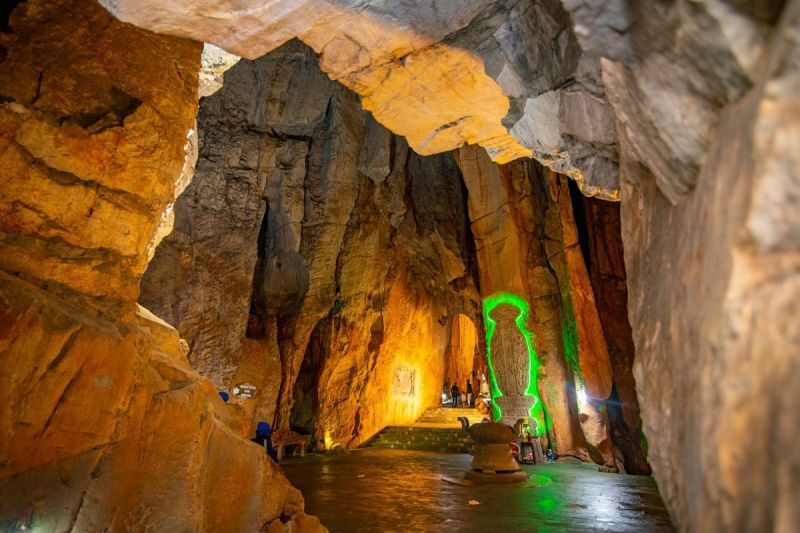
- Heaven Gate — the white stone arch at the corridor exit representing release from the punishment cycle, approximately 2.5 metres high and carved from white limestone with three steps leading up to it; the contrast between pale limestone and the darkened rock walls behind it makes it the most photographically distinct frame at the cave’s end.
History of Am Phu Cave
Am Phu Cave has more than 400 years of documented history, moving from a Cham sacred site to a Nguyen-dynasty Buddhist teaching tool to an American War shelter before becoming a tourist attraction in the 1990s. The 400-year layered history of Am Phu Cave — spanning from a Cham sacred site to a wartime shelter — gives the cave a cultural depth that purely geological caves cannot match.
Cham Origins and the Marble Mountains’ Sacred Status
The Cham people — whose Champa kingdom controlled central Vietnam from the 2nd to the 15th century, building the temple complexes of My Son, Po Nagar, and the early Marble Mountains shrines — regarded the limestone cluster of Ngũ Hành Sơn as sacred long before any Buddhist iconography was introduced. The five mountains — Kim (Metal), Mộc (Wood), Thủy (Water), Hỏa (Fire), and Thổ (Earth) — correspond directly to the five elements of Chinese and Vietnamese cosmological tradition. Indian visitors recognise an immediate parallel with the Panchabhutas framework: Prithvi (Earth), Jal (Water), Agni (Fire), Vayu (Air), and Akasha (Space) underpin Hindu cosmological thinking in precisely the same structural way.
When the Nguyen lords consolidated their control over central Vietnam in the 17th century, Lord Minh Khang re-consecrated the mountains with their current elemental names and commissioned Buddhist infrastructure across Thuy Son. Am Phu Cave’s hell tableau was constructed during this period, functioning not as entertainment but as a physical moral curriculum — a technique for teaching the consequences of karmic misdeeds to a largely illiterate population who could walk through the lesson literally.
Am Phu Cave as a Wartime Shelter During the American War
Am Phu Cave served as a Viet Cong shelter during the American War (1955–1975), shielding fighters and civilians from aerial bombardment because the limestone walls of Thuy Son are 5–15 metres thick at the cave perimeter and the cave entrance is invisible from the air. Am Phu Cave’s narrow entrance and winding corridor made the cave invisible from aircraft. Scarring on the stone near Am Phu Cave’s entrance is still visible, a residue of the cave’s dual identity as a sanctuary in both the spiritual and military senses of the word.
The dual identity of Am Phu Cave as both a sacred Buddhist tableau and a wartime refuge is essential to understanding the site’s historical resonance. It explains why Am Phu Cave feels more historically resonant than the geological caves higher up Thuy Son, where the drama is visual rather than narrative.
Am Phu Cave and the 5 Caves of Thuy Son
Am Phu Cave is one of five named caves within Thuy Son, the largest peak of the Marble Mountains, and the only one requiring a separate ticket from the main Thuy Son admission. Understanding where Am Phu sits within the full cave system determines both visit sequencing and total ticket cost.
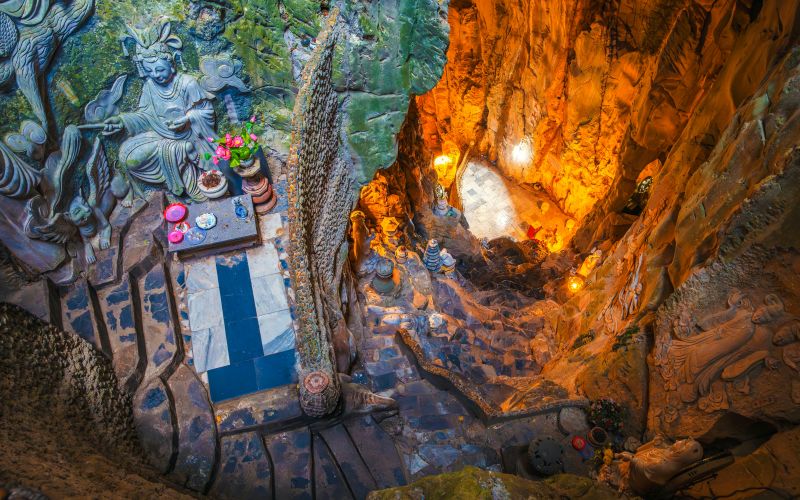
The 5 Caves of Thuy Son: Location, Access, and Key Feature
| Cave | Location on Thuy Son | Access | Key Feature | Ticket |
|---|---|---|---|---|
| Am Phu Cave | Ground level, west base | Walk in | 18 levels of Buddhist hell | Separate 20,000 VND (~₹70) |
| Huyen Khong Cave | Upper plateau | Stairway / elevator | Open-roof natural chamber with light shafts | Main ticket |
| Van Thong Cave | Upper plateau | Stairway | Squeeze-through passage with city viewpoint at the top | Main ticket |
| Tang Chon Cave | Upper plateau | Stairway | Cham-era stone altars | Main ticket |
| Linh Nham Cave | Upper plateau | Stairway | Smallest cave, single Buddhist shrine inside | Main ticket |
Am Phu Cave is visited before ascending Thuy Son. The recommended sequencing is to enter Am Phu Cave first — it is at ground level, next to the elevator base station — and then ascend either by elevator or stairway to access the four remaining caves, all of which are covered by the main Thuy Son ticket.
Am Phu Cave vs Huyen Khong Cave
Am Phu Cave and Huyen Khong Cave serve completely different visitor experiences and are not alternatives to each other. Am Phu Cave is a narrative sculpture walking through a dark, enclosed corridor; Huyen Khong Cave is a large natural chamber open to the sky through a roof aperture, with light shafts and a Buddhist shrine at its centre. First-time visitors to the Marble Mountains should visit both within a single half-day. Am Phu Cave and Huyen Khong Cave together cover the full range of experiences Thuy Son mountain offers: human religious narrative and natural geological spectacle.
Am Phu Cave Opening Hours and Entrance Fee in INR (2026)
Based on Vietnamtour.in’s latest 2026 travel audit, Am Phu Cave is open daily from 7:00 AM to 5:00 PM, including weekends and Vietnamese public holidays, with an entrance fee of 20,000 VND (~₹70) per adult — paid separately from the main Thuy Son ticket at a dedicated booth beside the elevator station. Per the Marble Mountains Management Board (Ngũ Hành Sơn), these operating hours apply year-round.
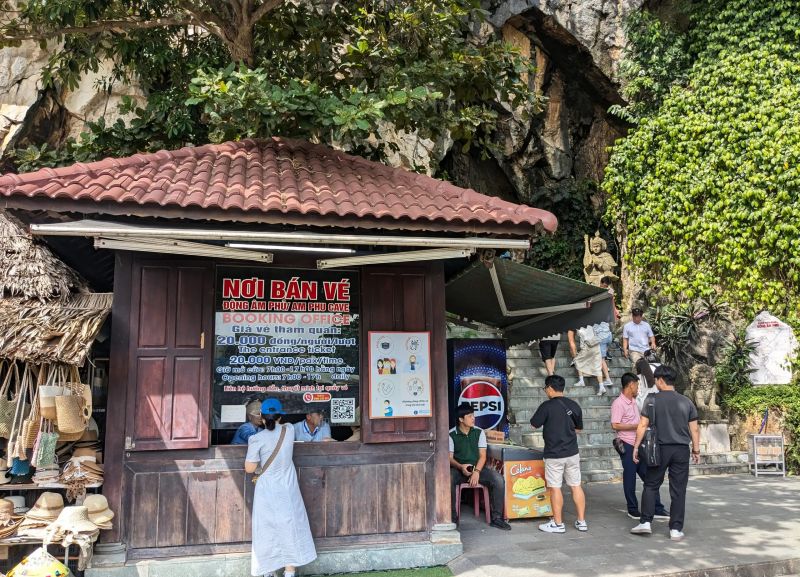
Am Phu Cave Entrance Fee
The ticket structure at the Marble Mountains has two components that Indian visitors frequently conflate. The main Thuy Son ticket (40,000 VND / ~₹140 per adult) covers Huyen Khong Cave, Van Thong Cave, Tang Chon Cave, Linh Nham Cave, Linh Ung Pagoda, and all access routes on the upper mountain. The main ticket does not cover Am Phu Cave. A second ticket — 20,000 VND (~₹70) — must be purchased at the Am Phu Cave booth, located to the left of the elevator base station at the mountain’s base.
Total cost for an Indian family of four (2 adults + 2 children aged 8–12) visiting both the main complex and Am Phu Cave:
| Item | Adults × 2 | Children × 2 (age 8–12) | Total |
|---|---|---|---|
| Main Thuy Son ticket | 80,000 VND (~₹280) | 80,000 VND (~₹280) | 160,000 VND (~₹560) |
| Am Phu Cave ticket | 40,000 VND (~₹140) | 40,000 VND (~₹140) | 80,000 VND (~₹280) |
| Elevator one-way (optional) | 30,000 VND (~₹104) | 30,000 VND (~₹104) | 60,000 VND (~₹208) |
| Family total | 300,000 VND (~₹1,048) |
Children under 6 years old enter both the main complex and Am Phu Cave free of charge. Students with a valid ID pay reduced rates: 10,000 VND (~₹35) for the main ticket and 7,000 VND (~₹25) for Am Phu Cave.
All payments are cash VND only. There is no card or UPI facility at either ticket booth. The nearest ATM is on Huyen Tran Cong Chua Street, approximately 200 metres from the main gate of the Marble Mountains (Ngu Hanh Son).
Best Time to Visit Am Phu Cave
Am Phu Cave maintains an interior temperature of approximately 25–27°C year-round, making the cave comfortable even during Da Nang’s peak summer months of June to August when outdoor temperatures reach 36–38°C. The cave’s enclosed corridor provides natural climate control regardless of the season.
The two quietest visitor windows are 7:00–9:00 AM (before tour coaches arrive from Da Nang and Hoi An) and 3:00–5:00 PM (after morning tour groups departing Hoi An have completed their visit and returned). The 11:00 AM–1:00 PM window is the busiest, concentrated by group tours that leave Hoi An at approximately 8:30 AM and reach the Marble Mountains by mid-morning.
For outdoor conditions on the mountain above Am Phu Cave, the November–April dry season offers the best weather. Am Phu Cave itself is comfortable in any month.
Marble Mountains Elevator vs Hiking Trail
Am Phu Cave requires no climbing — Am Phu Cave sits at ground level at the base of Thuy Son — but reaching the upper caves after Am Phu requires choosing between the mountain’s elevator (thang máy) and the stone stairway. The Marble Mountains have an elevator, not a cable car. This distinction matters: the elevator is a standard vertical lift inside the mountain, while the stairway is an outdoor stone climb.
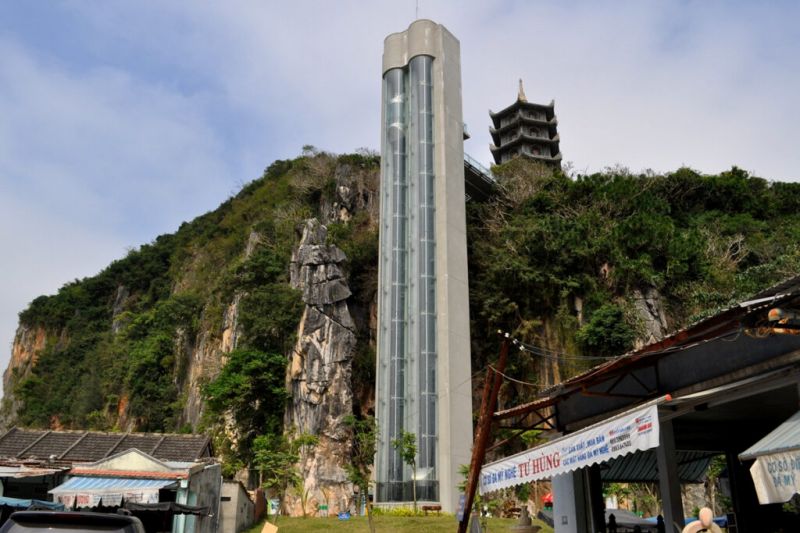
Marble Mountains Elevator
| Detail | Value |
|---|---|
| One-way fee | 15,000 VND (~₹52) |
| Return fee | 30,000 VND (~₹104) |
| Operating hours | 7:00 AM – 5:00 PM daily |
| Capacity | 8–10 persons per cabin |
| Travel time | 30 seconds to the upper plateau |
| Best for | Elderly visitors, children under 5, mobility issues, hot days |
The elevator is appropriate for visitors with elderly family members, children under 5, or mobility difficulties — including knee conditions, hip problems, or recovery from injury — that make the 150-step stone stairway impractical. The elevator deposits passengers directly onto the upper plateau of Thuy Son, adjacent to the entrance of Linh Ung Pagoda. The most efficient approach for a full-day visit is to enter Am Phu Cave first at ground level, then take the elevator up and descend by the stairway — this preserves energy for the cave circuit above.
The Marble Mountains Stairway
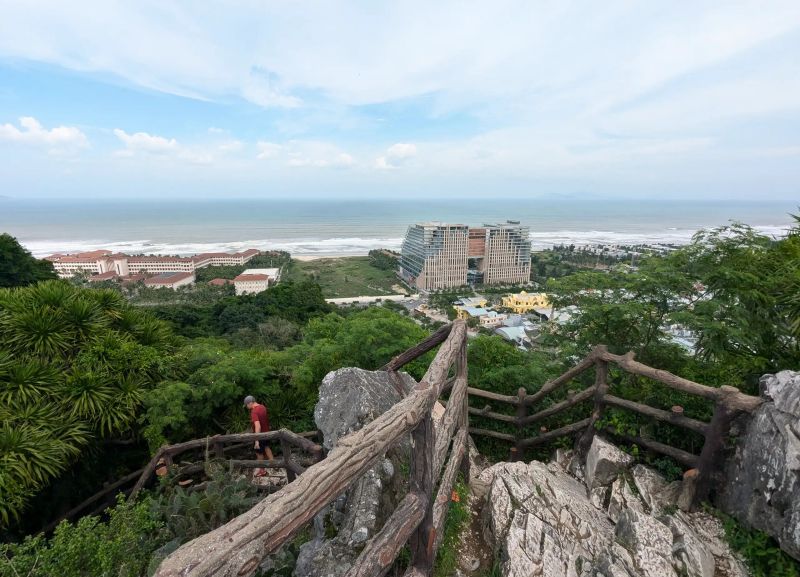
The Marble Mountains Stairway begins at the main gate and climbs to Ong Chon Gate on the upper plateau, taking 15–20 minutes at a moderate pace. The route passes two open viewpoints looking east over the Da Nang coastline and the East Sea. The stairway has more than 150 stone steps. The stairway is manageable for healthy adults, but is steep in sections and becomes slippery when wet during the October–November rainy season.
The practical recommendation for most Indian family groups is to use the elevator for the ascent and descend by stairway. Am Phu Cave’s entrance is immediately to the left of the elevator base station, so the visit sequence flows naturally: buy tickets at ground level → enter Am Phu Cave → return to base station → take elevator up → visit upper caves → descend by stairway.
Linh Ung Pagoda and the Other Marble Mountains Caves
After Am Phu Cave, the natural continuation is the upper Thuy Son complex — Linh Ung Pagoda, Huyen Khong Cave, Van Thong Cave, and Tang Chon Cave — all accessible on a single main ticket. The complete Marble Mountains experience covers both the ground-level hell cave and the Buddhist temple and cave network above it.
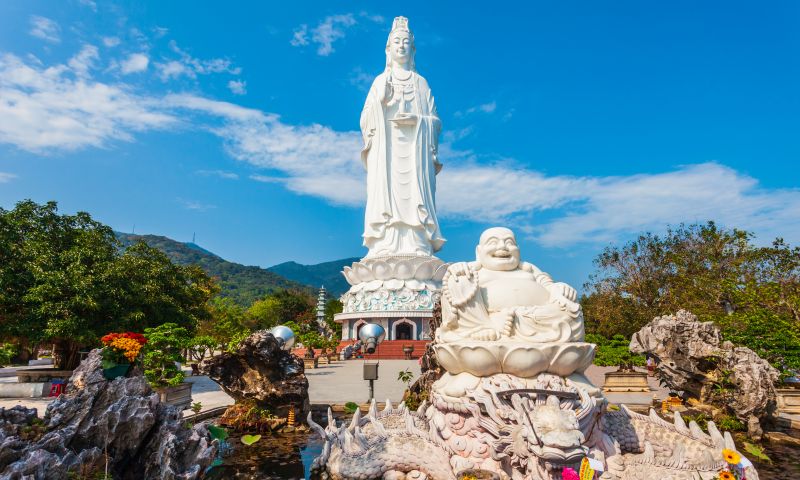
Linh Ung Pagoda on Thuy Son
Linh Ung Pagoda on Thuy Son is an active Buddhist temple located immediately above Am Phu Cave on the mountain’s upper plateau. Indian visitors — whether Buddhist, Hindu, or simply familiar with South and Southeast Asian religious iconography — will recognise the bodhisattva mudras at Linh Ung Pagoda — Abhaya (fearlessness), Varada (granting wishes), and Dhyana (meditation) — and the incense rituals without any explanation. Entry to Linh Ung Pagoda is free. The dress code applies: covered shoulders and knees are required. Note that Linh Ung Pagoda on Thuy Son is entirely distinct from the more widely photographed Linh Ung Pagoda on Son Tra Peninsula, which houses the 67-metre Lady Buddha statue visible from Da Nang city.
Recommended Visit Order for Am Phu Cave + Full Marble Mountains Circuit
The full circuit covering Am Phu Cave and all the major upper-mountain attractions takes 2.5–3 hours:
- Am Phu Cave (ground level, ~40 minutes)
- Take the elevator up (15,000 VND / ~₹52 one way)
- Linh Ung Pagoda (~20 minutes)
- Huyen Khong Cave (~30 minutes)
- Van Thong Cave and city viewpoint (~20 minutes)
- Tang Chon Cave — optional (~15 minutes)
- Descend by the stairway
Non Nuoc Marble Village
Non Nuoc Marble Village — the 400-year-old stone carving district immediately adjacent to the Marble Mountains — is 3 minutes on foot from the Am Phu Cave exit along Huyen Tran Cong Chua street. Non Nuoc Marble Village is one of the few places in Vietnam where Indian tourists can purchase iconographically familiar religious objects — Ganesha, Buddha, and Shiva sculptures — carved from the same marble extracted from the Ngũ Hành Sơn peaks.
Top Purchases for Indian Tourists
Non Nuoc Village sells 3 categories of marble products most relevant to Indian buyers: religious sculptures, incense holders, and animal figurines — all available as shelf stock or made-to-order, with no fixed retail pricing across any workshop on the street.
- Marble Ganesha, Buddha, and Shiva sculptures cost approximately ₹700–₹2,100 (200,000–600,000 VND) for pieces under 20cm in standard marble. Larger pieces and custom Hindu iconography — Ganesha and Shiva, specifically — are priced on request, as workshops produce these to order rather than keeping them in stock.
- Marble incense holders range from approximately ₹350 to ₹700 (100,000–200,000 VND). No workshop on Huyen Tran Cong Chua street displays fixed prices; compare across at least 3 stalls before committing.
- Marble elephants — the most consistently available item for Indian tourists — start from approximately ₹170 (48,000 VND) for small figurines under 10cm, rising to ₹1,400–₹3,500 (400,000–1,000,000 VND) for mid-size paired pieces at 15–25cm. All figures above are post-bargaining estimates; initial asking prices across Non Nuoc typically run 40–60% above the achievable final price.
Bargaining is expected and is not considered impolite. The critical logistical constraint for Indian buyers is size: sculptures larger than 30cm will not fit in Indian airline carry-on allowances and require cargo shipping arrangements that only certain workshops can facilitate. Confirm shipping capability before purchasing anything over that size.
Non Nuoc Village Hours and How to Navigate the Street
Non Nuoc Village is open 7:00 AM–6:00 PM daily, with no entry fee. The main commercial street runs approximately 800 metres. The meaningful distinction is between workshop-front showrooms — where an artisan is visibly working at the front of the space — and retail-only stalls. The sound of chiselling and grinding identifies a working workshop. Prices at working workshops are consistently lower than at retail-only stalls because the margin layer is removed.
7 Things Indian Tourists Must Know Before Visiting Am Phu Cave in 2026
- Cash VND only. Neither the ticket booth at Am Phu Cave nor the main Thuy Son gate accepts cards or UPI. The nearest ATM is on Huyen Tran Cong Chua street, approximately 200 metres from the main entrance.
- Separate ticket required. The main Thuy Son ticket (40,000 VND / ~₹140) does not include Am Phu Cave. The Am Phu Cave ticket (20,000 VND / ~₹70) is purchased at a separate booth to the left of the elevator base station.
- Footwear matters. The cave floor is uneven limestone with occasional wet sections. Flip-flops are inadvisable. Closed shoes or sandals with heel straps are the minimum appropriate footwear.
- Photography is unrestricted. There are no photography restrictions inside Am Phu Cave. Phone flash is useful in the deeper sections where the LED lighting is dim. The three most photographed frames are Diêm Vương’s enthroned figure at the entrance hall, the spiral stairwell descending to the underworld, and the white limestone Heaven Gate at the exit.
- No dress code in the cave, but one applies above it. Am Phu Cave is not an active place of worship; no covering is required inside. Linh Ung Pagoda on the upper mountain is active and requires covered shoulders and knees.
- The exit is not the entrance. Am Phu Cave is a one-way 350-metre corridor; the exit emerges approximately 80 metres from the entrance along the base of the mountain. The cave is not a loop. Groups should agree on a meeting point before entering.
- Best season for outdoor conditions is November–April. Da Nang’s dry season runs November through April, offering the lowest humidity and least rainfall for the open-air stairway and viewpoints. Am Phu Cave itself is comfortable in any month due to a stable interior temperature of approximately 25–27°C.
Children under 6 years old enter both Am Phu Cave and the main Thuy Son complex free of charge. The age threshold — not a height threshold — is the official policy of the Marble Mountains Management Board.
Frequently Asked Questions About Am Phu Cave
Is Am Phu Cave Suitable for Children?
Am Phu Cave is suitable for children aged 8 and above. Children aged 5–7 may find the sculptures disturbing because the interior is dark and depicts graphic punishments; children under 5 are not recommended. Children under 6 enter free, the cave walk takes 30–45 minutes at a relaxed pace with no climbing required, and strollers and wheelchairs cannot navigate the uneven 350-metre limestone corridor.
Is There Vegetarian Food Near Am Phu Cave for Indian Tourists?
Yes. A cluster of vegetarian street food stalls is located approximately 800 metres north of the main Marble Mountains entrance on Le Van Hien Street. Additionally, the Buddhist vegetarian kitchen at Linh Ung Pagoda on Thuy Son serves donation-based meals on the 1st and 15th days of the lunar calendar.
How Long Does a Visit to Am Phu Cave Take?
Am Phu Cave alone requires 30–45 minutes at a relaxed pace. The full Thuy Son circuit — Am Phu Cave plus elevator, Linh Ung Pagoda, Huyen Khong Cave, and Van Thong Cave — extends total time to 2.5–3 hours. Adding Non Nuoc Marble Village as a post-visit shopping stop brings the complete Marble Mountains experience to 3.5–4 hours from arrival to departure.
Can Am Phu Cave Be Visited Without a Guide?
Yes — Am Phu Cave is fully self-guided. Every chamber has bilingual signage in Vietnamese and English identifying the sin depicted and the punishment assigned. An optional local guide costs approximately ₹700–₹1,400 (200,000–400,000 VND) for a 2-hour session covering the full Marble Mountains circuit. Indian visitors interested in the Hindu-Buddhist parallels in the iconography — Yamraj versus Diêm Vương, Naraka versus Thập Bát Địa Ngục, Preta versus Ngạ Quỷ — typically find a guide adds meaningful depth.
How Much Does Am Phu Cave Cost to Visit in 2026?
Am Phu Cave costs approximately ₹70 per adult (20,000 VND), paid as a separate ticket from the main Thuy Son admission of approximately ₹140 (40,000 VND). Children under 6 years old enter for free. The full family-of-four breakdown is in the ticket section above, with a verified total of approximately ₹1,048 (300,000 VND) including elevator one-way fares.