
Behind the famous temples of Angkor lies Angkor Thom, the final capital of the Khmer Empire. This once-thriving city, filled with kings, monks, and royal rituals, is nowadays a stunning maze of magnificent gates, ancient palaces, and countless stone faces. Walking through Angkor Thom is like experiencing the heartland of Political and Spiritual Cambodia.
Introduction to Angkor Thom
Angkor Thom is considered one of the most significant and fascinating locations within the Angkor Archaeological Park, symbolising the centre of the Khmer Empire, both politically and spiritually. It was not designed as a temple but rather as a grand capital city, where the kingdom’s kings, monks, and various citizens would hold rituals within its temple infrastructure.
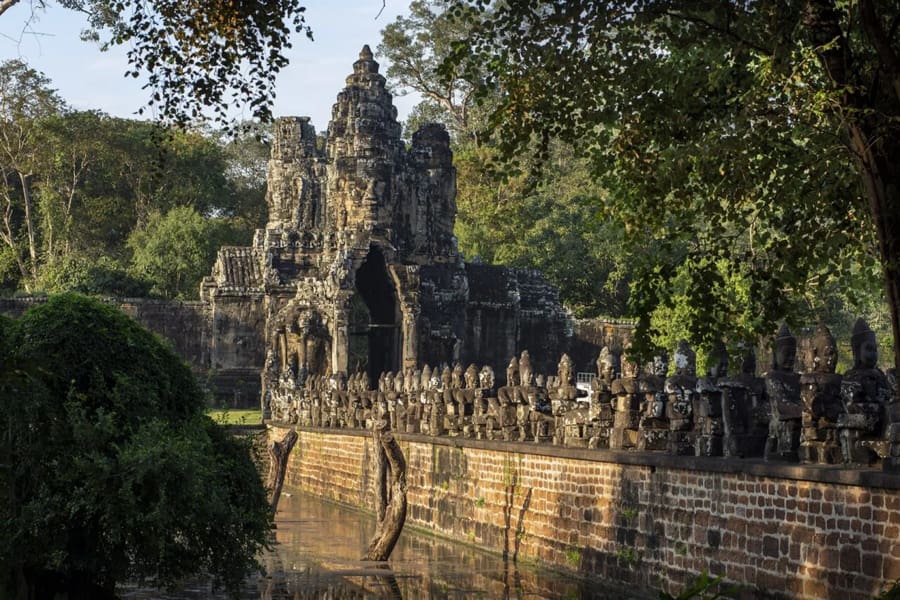
Where is Angkor Thom
-
Address: inside Angkor Archaeological Park, 6 km from Siem Reap city Center, Cambodia
Angkor Thom is located in Northwestern Cambodia, just a couple of kilometres north of Siem Reap at the centre of the Angkor temple complex. It sits immediately north of Angkor Wat and is encircled by a square perimeter with an enormous moat, thus covering about 9 square kilometres total.
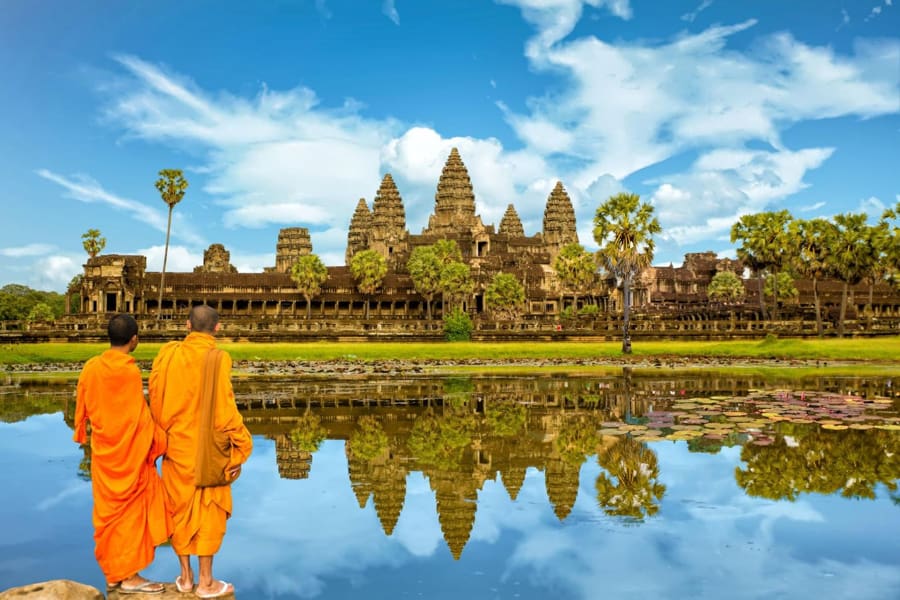
Because of its location, many tourists will visit Angkor Thom via the Small Circuit route, allowing them to see Angkor Wat, Ta Prohm and other temples in one day. Most tourists approach Angkor Thom through the famous South Gate, one of five monumental gates that once regulated access into this ancient city.
Opening Hours & Entrance Fee
- Angkor Thom is generally open daily from 7:30 AM to 5:30 PM.
To visit Angkor Thom and other attractions within the Angkor Complex, tourists need a ticket. The ticket is called the “Angkor pass”. Indian tourists have the right to visit any temple within this complex using this ticket, including Angkor Thom.
Here is the detailed information about tickets and prices:
|
Ticket Type
|
Price per person
|
Duration
|
Note
|
|
1-day
|
$37
|
1 day
|
Travellers who want a short visit to Bayon Temple or Angkor Wat with a tight schedule
|
|
3-day
|
$62
|
3 days (non-consecutive use allowed)
|
Most travellers choose to visit for 3 days to have a relaxed exploration. The ticket is valid for 10 days from the date of purchase.
|
|
7-day
|
$72
|
7 days (non-consecutive use allowed)
|
If you want to explore the Angkor Complex more deeply and more relaxed, you should choose to buy this 7-day ticket. The ticket is valid for 1 month from the date of purchase, allowing you to visit the Angkor Wat complex for any 7 days within that 1 month.
|
History of Angkor Thom
The construction of Angkor Thom began in the late 12th century under the leadership of King Jayavarman VII. King Jayavarman VII was one of the most powerful and influential leaders in the history of Khmer civilisation. After several periods of war and conquest by foreigners, King Jayavarman VII built Angkor Thom as a fortified capital that reflected and represented power, unity, and divinity. It was in Angkor Thom that many ceremonies and rituals took place.
However, as the Khmer civilisation declined and disintegrated into history, Angkor Thom slowly became deserted and was eventually reclaimed by the jungle. Angkor Thom is now a remarkable archaeological site and a true testament to the history and civilisation of ancient Khmer civilisation.
Religious Meanings of Angkor Thom with the Cambodian People
In addition to serving as a capital city, Angkor Thom is considered to be of ceremonial significance to the people of Cambodia. Angkor Thom is planned to resemble the Buddhist cosmology of the Hindu concept of Mount Meru, which is considered the centre of the universe. The Bayon Temple inside the Angkor Thom represents a shift to Buddhism from Hinduism during the reign of King Jayavarman VII.
Angkor Thom is not just of historical significance to the people of Cambodia, but to them, the city holds a great deal of religious sanctity as a symbol of their national identity. The city remains a symbol of the spirituality of the people of Cambodia today.
5 Main Gates of Angkor Thom
Angkor Thom’s Gates are not just gates to enter, but were designed to show the power of the Khmer Empire, to keep out intruders and to showcase the Khmer Empire’s great divine power. They represent the four cardinal directions and give visitors their first glimpse of the magnificence of Angkor Thom by being placed at the cardinal points of east, west, north, and south.
These are the South Gate, North Gate, East Gate, West Gate, and Victory Gate, which were constructed to face key roads. All of these five gates were constructed with the same design, which features the faces of towering stones comparable to those found at the Bayon Temple. It is assumed that these faces belong to Avalokiteshvara or the deity of King Jayavarman VII.
South Gate: The Most Popular Angkor Wat Entrance
The South Gate, situated closest to Angkor Wat, is the most popular gate among the five, visited by more tourists, and the most photographed. It also happens to be the main entry point for most visitors entering Angkor Thom today.
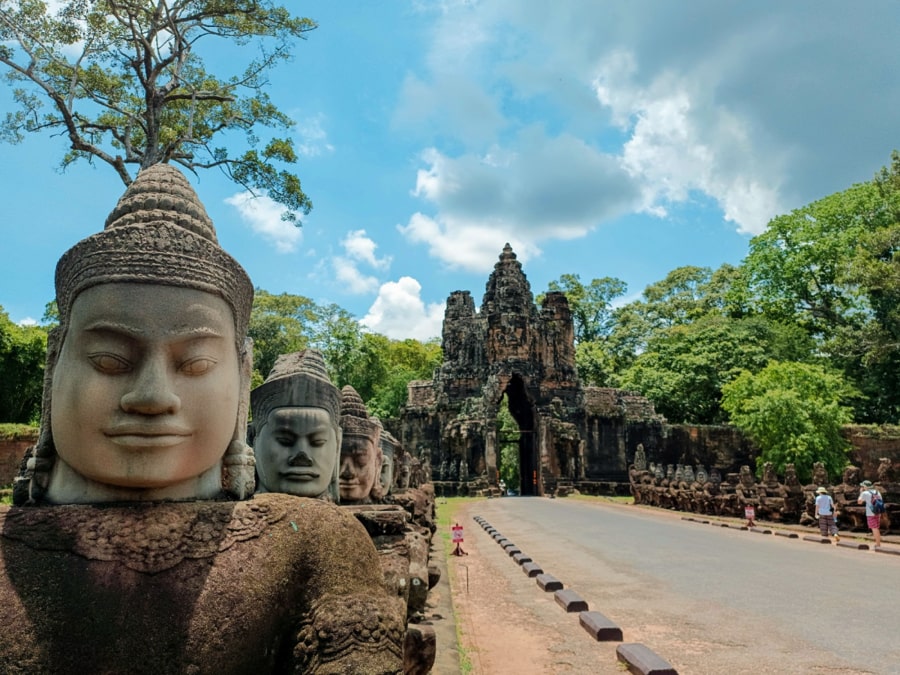
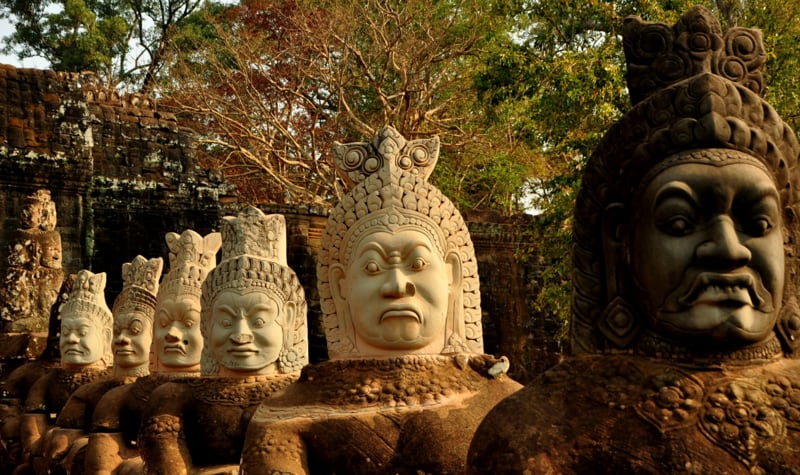
The pathway, or causeway, leading to the South Gate, is flanked by statues of gods and demons pulling a gigantic Naga serpent, giving some of the most photographed scenes in the Angkor complex. Crossing the South Gate is like entering another era, with the massive stone faces and walls giving the impression of the old era right from the beginning.
North Gate, East Gate, West Gate, and Victory Gate
Of the five gates, the South Gate is the most frequented, while the other four are somewhat less crowded but equally interesting. The North and West Gates are the most tranquil of all and serve as an ideal spot for visitors wanting to avoid crowds.
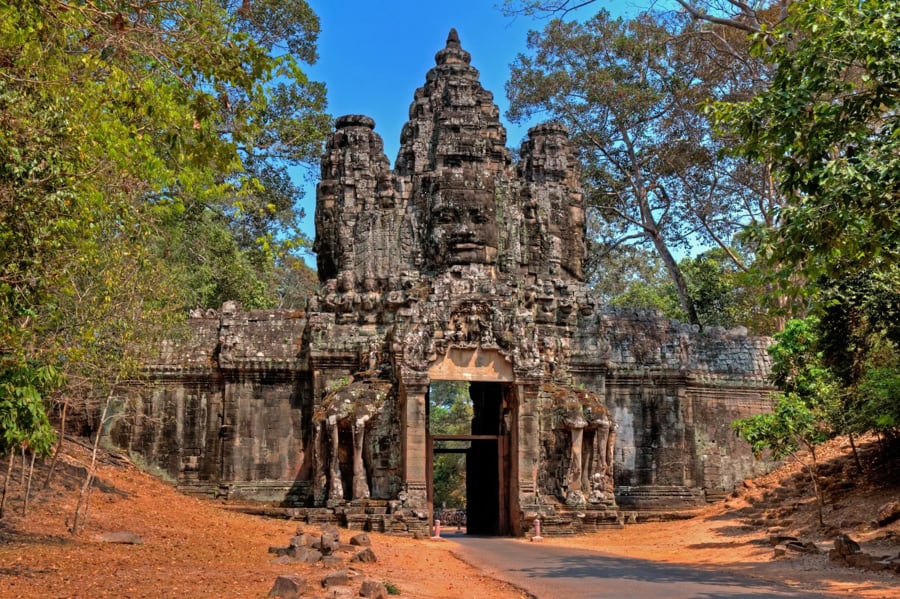
The East Gate has also been called the Gate of the Dead, as it was once a link between Angkor Thom and ancient ceremonial routes. Of the remaining gates, the Victory Gate is perhaps the most historic, since this was the gate that kings and their armies used upon their return from victorious military campaigns, a sign of their triumph and royal authority.
Symbolism of the Gods and Demons Pulling the Naga
One of the most striking things to see in the gates of Angkor Thom is the array of statues displaying gods (Devas) and demons (Asuras) pulling the body of a multi-headed Naga serpent. This signifies the widely known Hindu myth involving the Churning of the Ocean of Milk and describes the never-ending battle between good and evil to achieve balance and everlasting life. In the case of Angkor Thom, these statues signified the balance between good and evil to achieve harmony in life.
Top Attractions Inside Angkor Thom
Angkor Thom is not a single monument but a vast royal city filled with some of the most significant temples and ceremonial spaces of the Khmer Empire. Within its walls, visitors can explore state temples, royal sanctuaries, and grand terraces that once formed the political and spiritual core of ancient Cambodia.
Bayon Temple (Prasat Bayon)
The most iconic landmark inside Angkor Thom is the Bayon Temple. The structure is highly recognised by the many faces looking in all directions. The many smiling faces create a very powerful atmosphere and a somewhat surreal experience. It is as if one is being watched from any direction.
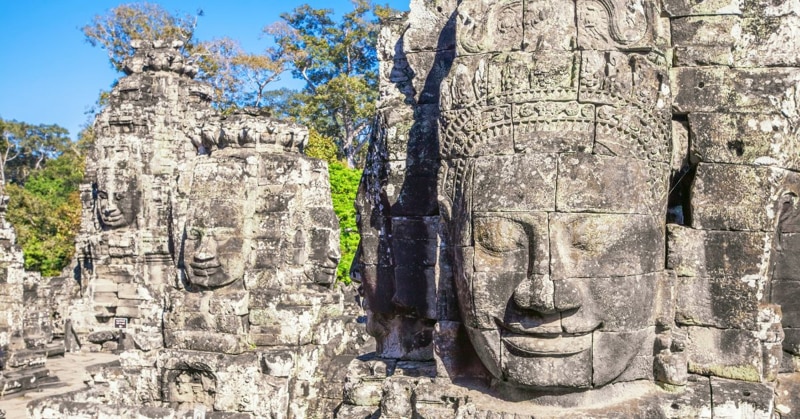
Unlike Angkor Wat, which was constructed as a state temple at the periphery of the capital city, Bayon was constructed at the very heart of the capital.
Baphuon Temple (Prasat Baphuon)
Baphuon is a massive temple mountain consisting of three levels, located to the northwest of the Bayon temple. While initially a Hindu temple in honour of the Hindu deity Shiva, it was eventually transformed into a Buddhist temple, reflecting the religious shifts of the Khmer Empire. The sheer size of Baphuon makes this temple an important place to visit, although sometimes it is not noticed for its sheer scale, a characteristic of Angkor Thom.
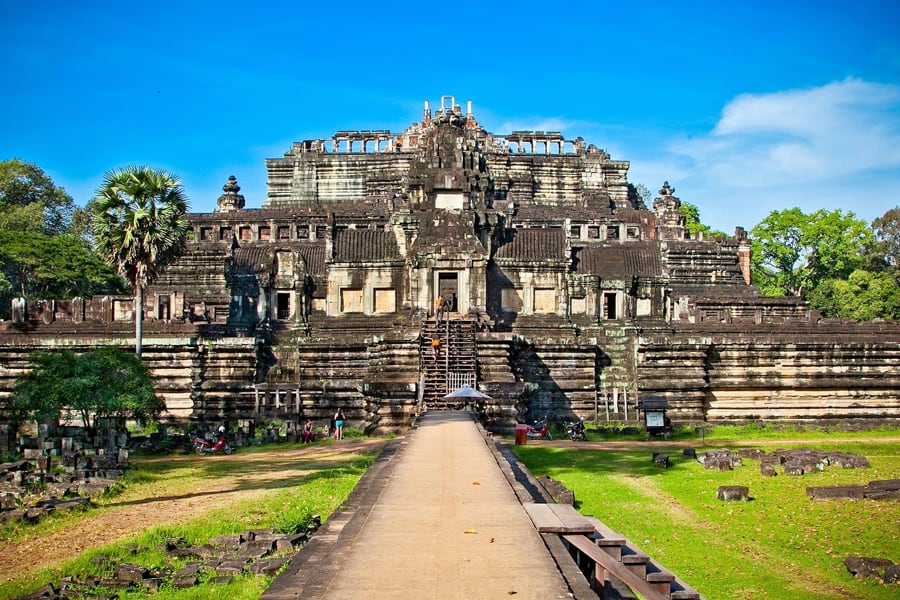
The temple was dismantled stone by stone in the 20th century; however, years of war resulted in the loss of the original plans to rebuild the temple, making its reconstruction a monumental jigsaw puzzle. At present, the structure is restored to its former glory, including the giant statue of Buddha donated to the western façade by the Buddhists.
Phimeanakas
Phimeanakas is a smaller temple but an important historical site, built inside the Royal Palace site. It is built in the form of a stepped pyramid and used to be a royal sanctuary, reserved only for the king and royal family.
In the mythological tradition, the Khmer king was said to be obliged to spend a night in Phimeanakas with a sacred serpent spirit in the guise of the mythical Naga. This ritual was considered to be a guarantee for the prosperity and protection of the kingdom. Originally, the temple was a symbol of the power and divine right of the king to rule, connecting the two realms of the sacred and the secular.
Royal Palace of Angkor Thom (Preah Barom Reach Veang)
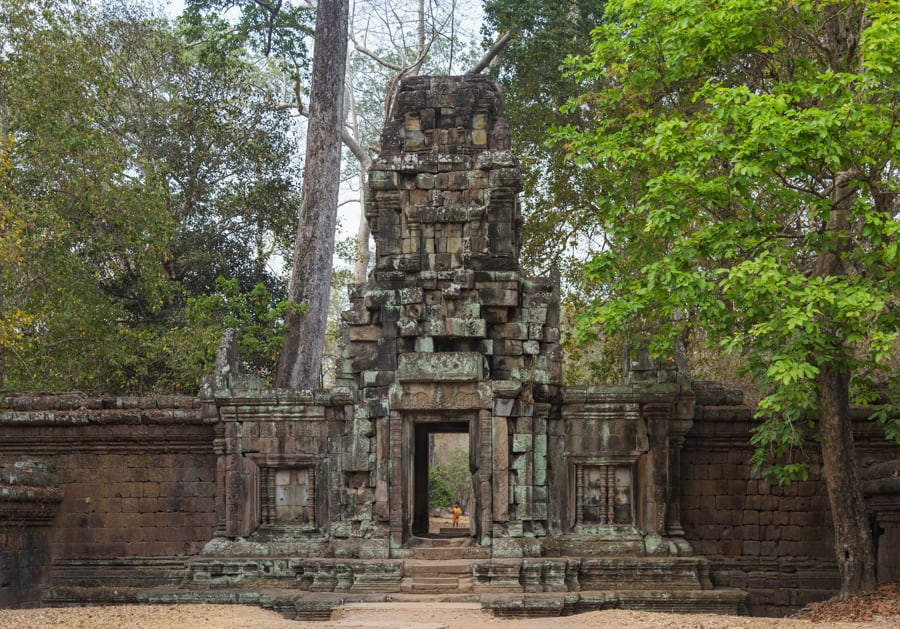
This part of the city, the Royal Palace Area, was the central administrative and residential area of Angkor Thom. While the original wooden structures no longer exist, the layout of the grounds displays the dimensions and functions of the past. This area was where the ceremony, royal audience, and other activities took place.
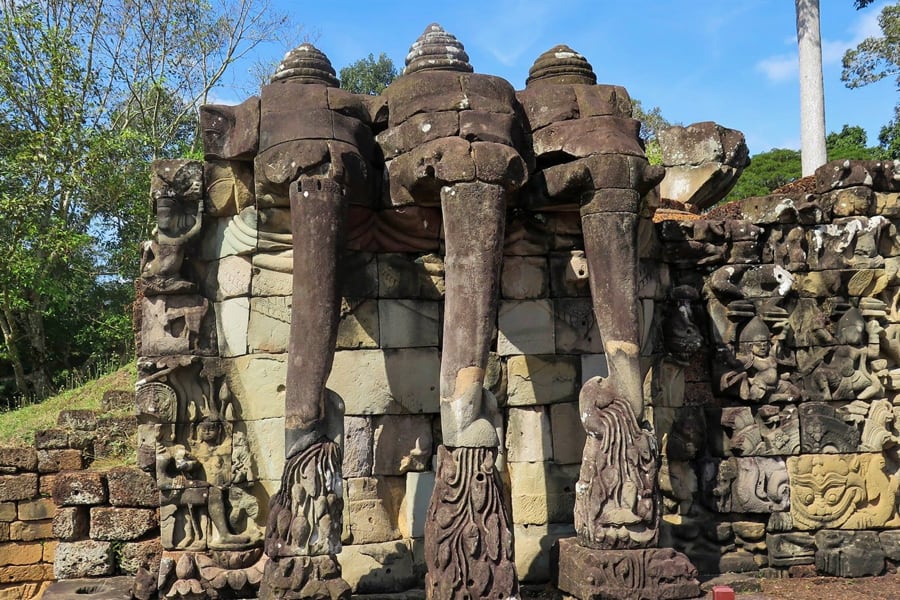
Terrace of the Elephants (Sala Damrei)
The Terrace of the Elephants is a long elevated platform that features rich elephant sculptures. This platform was used by monarchs to observe military parades, public events, and other important functions. Such a strategic position on the terrace enabled the king to speak to a large gathering of people at the royal square.
Terrace of the Leper King (Preah Bat Damrong Kroung)
Located near this spot, the Terrace of the Leper King has intricate carvings of various mythological characters and deities. Contrary to its name, there is no clear evidence linking the area with the disease, but researchers believe that it might have been related to afterlife judgment or funerary rites. The area is, therefore, a fascinating piece of art within Angkor Thom.
How to Get to Bayon Temple
Bayon Temple is located inside the area of Angkor Thom, 10-12 km to the north of the city centre of Siem Reap. There are several easy methods to reach Bayon Temple, and it largely depends on your travel preferences and budget.
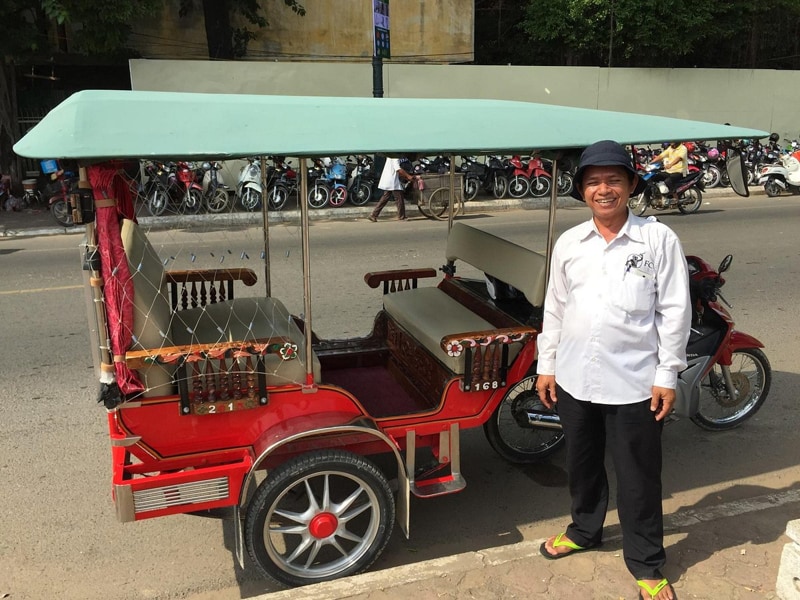
By Tuk Tuk
The most popular and accessible mode of transport for travellers residing in Siem Reap is through tuk-tuks. The time it takes to ride a tuk-tuk from the city centre to Bayon Temple is approximately 30-40 minutes.
-
Estimated Cost: $15 to $25
By Taxi
For people who want to relax, especially during hot or rainy weather, taking a private car or taxi is a good option. Air-conditioned cars will offer people a more relaxed experience, especially for families or small groups.
-
Estimated cost: $25 to $40
By Bicycle
The option to cycle to Bayon Temple is the best for physically fit travellers who enjoy exploring at a leisurely pace. The travel time is about 30 to 50 minutes from the city centre in Siem Reap.
-
Bike rental charges: $2 to $5/day.
By Guided Tour
The easiest way to visit the Bayon Temple is by joining a guided tour through a reliable tour operator like Vietnamtour.in. This is especially useful when you are a first-time visitor. The tours are conducted through a reliable tour operator, and a guide is provided. The route is planned efficiently so that major temples in Angkor Thom are included.
Best Time to Visit Angkor Thom
The best months to visit Angkor Thom are from November to March, when the dry season falls in Cambodia. During this time, it is quite cool to visit it. However, in the rainy season, which falls between May and October, it is also a good time to visit since there are fewer tourists around and the place is lush and verdant. There may be some rain showers, mostly in the afternoon, but many tourists enjoy this peace.
In one day, you should visit Angkor Thom in the early morning (from 7 AM to 10 AM) to enjoy the cool and fresh air. In addition, at that time, popular places like the Bayon temple will be less crowded, so that you can freely take photos and admire the Khmer architecture. In contrast, you should avoid visiting from 11 AM to 2 PM because it will be very hot and crowded.
Angkor Thom for First-Time Angkor Visitors
When exploring Angkor Thom as a first-time visitor, it can be intimidating. By following these few helpful hints, you can prepare for your visit and have an enjoyable adventure without stress.
-
Entering through the South Gate is the most beautiful and scenic way to enter Angkor Thom; continue from here after entering to see the Bayon Temple and the corresponding temples around it, so you don’t have to double-back unnecessarily.
-
For first-time visitors, hiring a tuk-tuk or using a guided tour is the easiest way to see Angkor Thom, as there is a lot of distance between the various attractions within Angkor Thom. This will also save you time and energy because you will have someone else to drive you through the temple complex.
-
Biking is also a fun way to explore Angkor Thom; however, you may find the heat, as well as the long distances, exhausting.
-
It is very important to wear clothes that cover your shoulders and knees when entering any of the temples (i.e., the Bayon Temple, etc).
-
Also, it is essential to wear sandals or shoes you can walk in because you will be walking on uneven stone surfaces and stairs within the temple complex.
-
Do not hurry through Angkor Thom, as your focus is on the Bayon Temple. Slow down, walk around, and take time to explore the temple at different levels; take time to view the bas-reliefs and stone faces from different angles.
-
Ensure you have enough water, wear a hat and sunblock, and bring sunglasses, as there is a lot of limited shade at certain times of day, and the heat can be extreme (particularly around midday).
-
Do not climb into restricted areas or touch the delicate relief carvings; Angkor Thom is still considered a pilgrimage for thousands of people, as well as being a protected site with lots of history behind it.
-
On your first trip to Angkor Thom, we recommend concentrating on the major highlights of your visit: Bayon Temple, Baphuon Temple, Phimeanakas Temple, and the Royal Palace Complex to maximise your enjoyment of the area; you can revisit to explore other areas once you have time.
FAQs about Visiting Angkor Thom
-
Is Angkor Thom the same as Angkor Wat?
No. Angkor Thom and Angkor Wat are separate temples within the complex. Angkor Wat is a single temple structure, whereas Angkor Thom is a historical city and houses many significant buildings and structures in the region, including the Bayon Temple, Baphuon Temple, and Royal Palace.
-
How much time do I need to visit Angkor Thom?
Mostly, it takes the visitor between 2 and 4 hours to tour around the site. If you wish to see the major landmarks within the site, half a day is needed.
-
Can I walk around Angkor Thom?
Yes, but Angkor Thom is a big place. It’s easy to walk around individual temples, but getting from one place to another is easier by tuk-tuk, bicycle, or car.
-
Is a guide necessary to visit Angkor Thom?
A guide is not required, but hiring a guide can greatly enhance your visit by learning about history and understanding what you are looking at and reading.
Conclusion
In conclusion, Angkor Thom is not only an ancient temple, but the heart and soul of the Khmer Empire, including all the history, culture, and religion. From the gates and the enigmatic faces of Bayon, to the terraces of the king, and the secrets within the complex, Angkor Thom is an alternative and much richer way to experience the magic of Angkor, which is only surpassed by Angkor Wat.
If you have the chance to travel to Cambodia, don’t miss this amazing experience. Come and admire the masterful architectural works firsthand, and immerse yourself in the rich history and culture of the Land of Temples!
