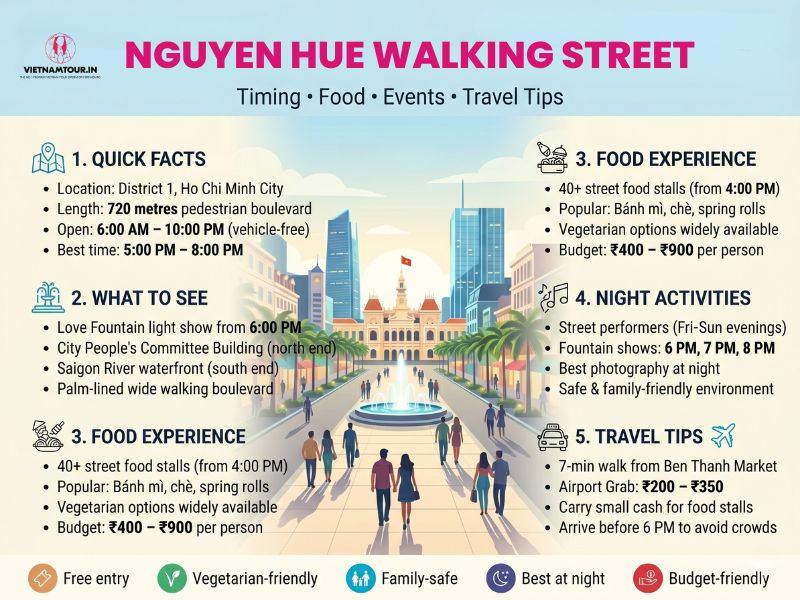
Nguyen Hue Walking Street is a 720-metre (2,362-foot) pedestrian boulevard in District 1, Ho Chi Minh City, stretching from the Ho Chi Minh City People’s Committee Building at the north end to the Saigon River waterfront at the south end. The Walking Street operates as a pedestrian-only zone from 6:00 AM to 10:00 PM daily, with 40+ food stalls opening from 4:00 PM, the Love Fountain running colour-change displays from 6:00 PM, and street performers appearing on Friday through Sunday evenings.
Indian tourists visiting Nguyen Hue Walking Street spend ₹400 to ₹900 per person (112,000 to 252,000 VND) on a 2-hour street food session, with vegetarian options consistently available at the southern stall cluster. The street hosts 3 major annual events — the Tết Flower Festival in late January, the New Year’s Eve countdown on 31 December, and Liberation Day celebrations on 30 April — that transform the boulevard into Ho Chi Minh City’s largest public gathering space.
This guide covers Nguyen Hue Walking Street’s location and layout, directions from Tan Son Nhat Airport and Ben Thanh Market, opening hours and best visit times, street food prices and vegetarian options, the Love Fountain night experience, and the 3 annual events including the Tết Flower Festival 2026.
Nguyen Hue Walking Street Location
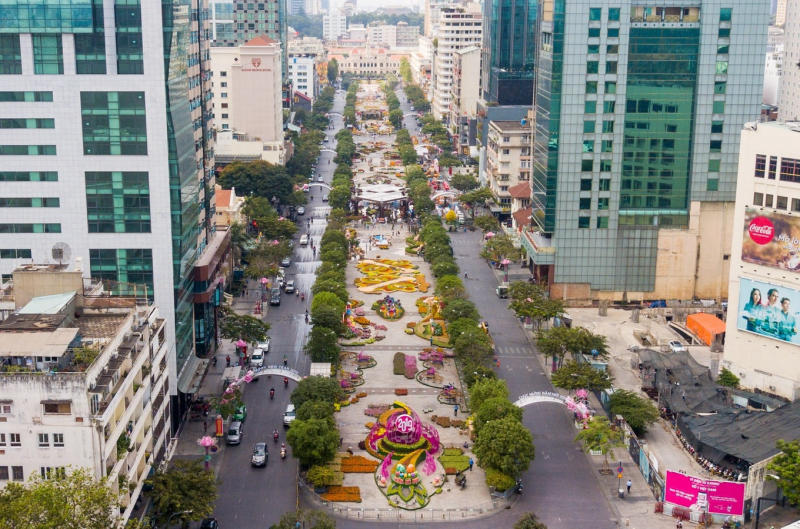
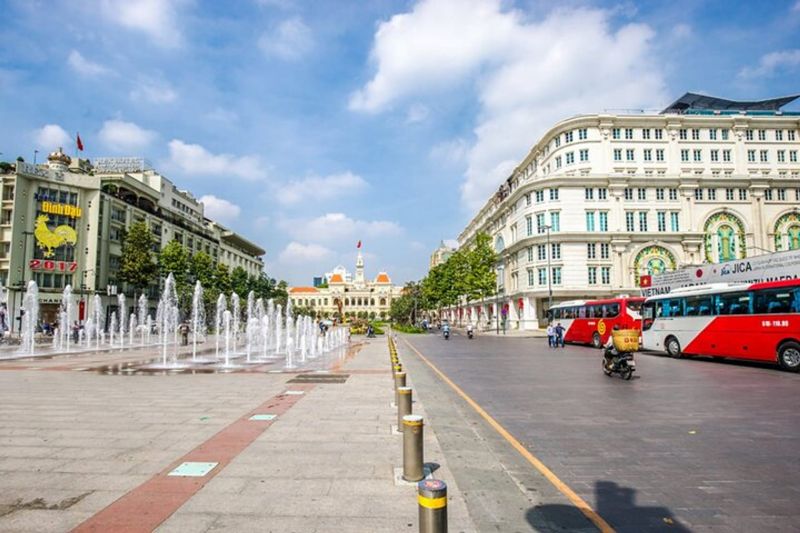
Nguyen Hue Walking Street sits in the heart of District 1, Ho Chi Minh City, stretching 720 metres (2,362 feet) from the City People’s Committee Building at the north end to the Saigon River waterfront at the south end. Nguyen Hue Walking Street runs north to south and is 64 metres (210 feet) wide — significantly broader than a standard Vietnamese urban road — with a central promenade of stone-paved walkway, the Love Fountain at the midpoint, palm trees lining both sides, and rows of white public seating benches placed at regular intervals.
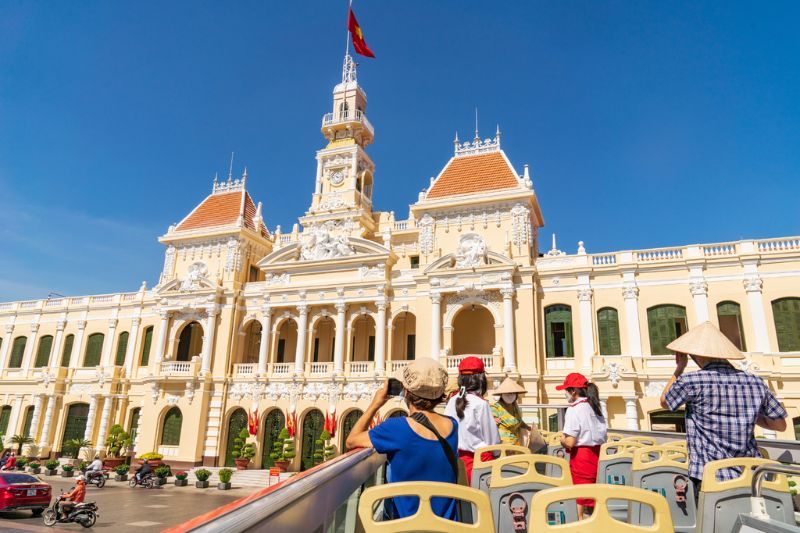
Nguyen Hue Walking Street is flanked by 3 of Ho Chi Minh City’s most recognisable landmarks: the Rex Hotel on the northeast corner, the Caravelle Hotel on the northwest corner, and Union Square Mall on the east side. The City People’s Committee Building anchors the north end of Nguyen Hue Walking Street — a French colonial structure painted yellow that remains visible from the full length of the street — and serves as the primary orientation landmark for Indian tourists navigating from hotels in the area.
Nguyen Hue Walking Street runs parallel to Dong Khoi Street to the east and Le Loi Street to the west — Indian tourists who know Dong Khoi Street or Le Loi Street can locate Nguyen Hue Walking Street immediately. Nguyen Hue Walking Street is distinct from Vietnam’s other walking streets in both character and location: Bui Vien Street is a backpacker nightlife corridor 1.5 km west of Nguyen Hue Walking Street, and Hanoi’s walking street surrounds Hoan Kiem Lake — Bui Vien Street and Hanoi’s Hoan Kiem walking street are not interchangeable with Nguyen Hue Walking Street’s upscale, family-oriented boulevard format.
What Nguyen Hue Walking Street Looks Like
The Love Fountain sits at the midpoint of Nguyen Hue Walking Street’s 720-metre length — a circular water feature surrounded by open paved space that functions as the street’s primary gathering point for photography and evening crowds. Colour-lit water displays at the Love Fountain begin at 6:00 PM daily. The street surface of Nguyen Hue Walking Street is laid with large light-grey stone tiles extending the full width of the pedestrian zone. Palm trees are planted in double rows along both sides of Nguyen Hue Walking Street’s central walkway, providing partial shade during daytime hours.
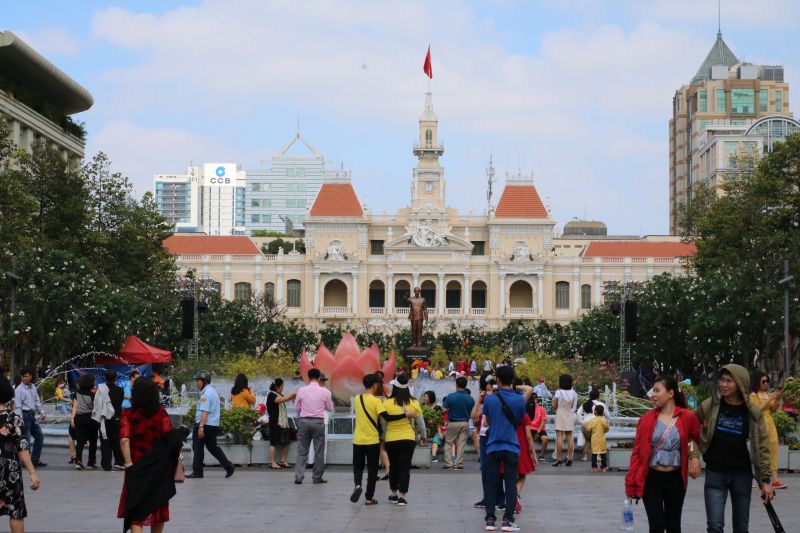
Nguyen Hue Walking Street runs on a true north-south axis — the City People’s Committee Building stands at the north end, and the Saigon River waterfront sits at the south end. Indian tourists standing at the Love Fountain face the City People’s Committee Building directly north and can see the Saigon River waterfront opening at the south end of the street. The full 720-metre length of Nguyen Hue Walking Street is flat with no elevation change, making Nguyen Hue Walking Street fully accessible for families traveling with elderly members or young children.
Nguyen Hue Walking Street vs Bui Vien Street
Choose Nguyen Hue Walking Street for Indian families, couples, and first-time Ho Chi Minh City visitors — choose Bui Vien Street only for solo budget backpackers seeking late-night drinking. Nguyen Hue Walking Street operates from early morning, is fully lit and police-patrolled at all hours, and contains food, fountain displays, and open seating accessible to all ages. Bui Vien Street operates primarily after 9:00 PM, carries significantly higher noise levels, and is oriented toward alcohol-centred nightlife rather than cultural street experience. For Indian families and couples, Nguyen Hue Walking Street is the default choice in Ho Chi Minh City.
How to Get to Nguyen Hue Walking Street
Nguyen Hue Walking Street is reachable from all major tourist zones in Ho Chi Minh City within 15 minutes — Grab from Tan Son Nhat Airport to Nguyen Hue Walking Street costs ₹200 to ₹350 (56,000 to 98,000 VND) and takes 25 to 40 minutes, while Ben Thanh Market to Nguyen Hue Walking Street is a 7-minute walk at no cost.
Indian tourists staying in District 1 hotels are within walking distance of Nguyen Hue Walking Street in most cases — Nguyen Hue Walking Street sits at the geographic centre of District 1’s hotel cluster. Tourists traveling from Bui Vien Street to Nguyen Hue Walking Street cover 1.5 km northeast by Grab (₹60 to ₹100, or 17,000 to 28,000 VND, in 5 to 8 minutes). Ben Thanh station on Metro Line 1 is 7 minutes on foot from the north end of Nguyen Hue Walking Street — Indian tourists using Ho Chi Minh City’s metro system exit at Ben Thanh station and walk east along Le Loi Street to reach Nguyen Hue Walking Street.
From Ben Thanh Market to Nguyen Hue Walking Street
Ben Thanh Market is 550 metres (1,804 feet) from Nguyen Hue Walking Street — a 7-minute walk that requires no transport cost and passes through Le Loi Street’s commercial strip. The walking route from Ben Thanh Market to Nguyen Hue Walking Street is: exit Ben Thanh Market through the south gate on Le Loi Street → walk east along Le Loi Street for 450 metres → turn left at Pasteur Street → Nguyen Hue Walking Street entrance is immediately ahead.
The Ben Thanh Market to Nguyen Hue Walking Street walk passes Union Square Mall and the Diamond Plaza approach road — both visible landmarks that confirm the route is correct. No transportation fare applies from Ben Thanh Market to Nguyen Hue Walking Street.
From Tan Son Nhat Airport to Nguyen Hue Walking Street
The fastest and most reliable option from Tan Son Nhat Airport to Nguyen Hue Walking Street is Grab, costing ₹200 to ₹350 (56,000 to 98,000 VND) and taking 25 to 40 minutes depending on traffic. Metered taxi from Tan Son Nhat Airport to Nguyen Hue Walking Street costs ₹300 to ₹450 (84,000 to 126,000 VND) for the same journey — reputable taxi companies for this route are Vinasun (white and red) and Mai Linh (green). Airport Bus 152 fare from Tan Son Nhat Airport to Ben Thanh Market is 25,000 to 40,000 VND (₹90 to ₹145) — from Ben Thanh, Nguyen Hue Walking Street is a 7-minute walk east along Le Loi Street. Bus 152 is not recommended for Indian tourists on a first visit due to limited English signage and luggage handling difficulty during peak hours.
Nguyen Hue Walking Street Opening Hours
Nguyen Hue Walking Street is open 24 hours, 7 days a week, with the pedestrian-only zone enforced from 6:00 AM to 10:00 PM daily — outside these hours, Nguyen Hue Walking Street reverts to standard mixed vehicle and pedestrian access. Food stalls at the southern end of Nguyen Hue Walking Street open from 4:00 PM. The Love Fountain colour display begins at 6:00 PM. Street performers appear at Nguyen Hue Walking Street from 6:00 PM on Friday, Saturday, and Sunday.
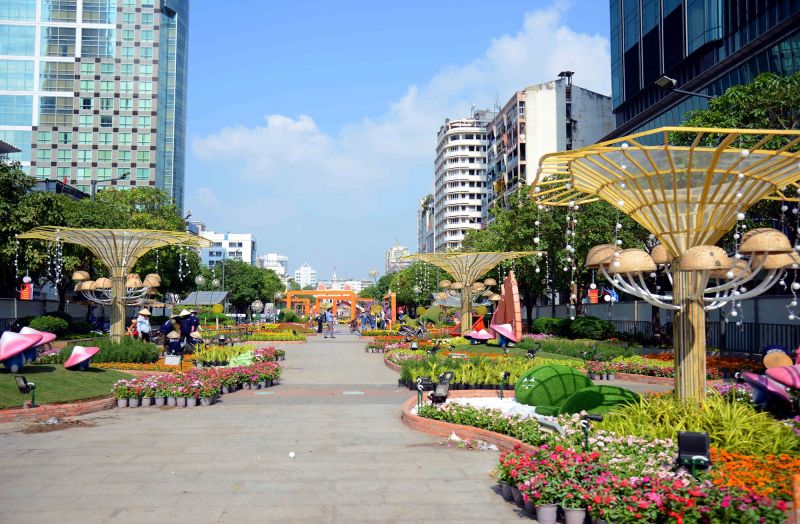
The best time of day for Indian tourists to visit Nguyen Hue Walking Street is 5:00 PM to 8:00 PM — food stalls are fully operational, the Love Fountain display is active, natural light fades into the LED boulevard lighting, and temperatures at Nguyen Hue Walking Street drop from the daytime high of 32 to 35°C to a more comfortable 28 to 30°C. The 6:00 AM to 9:00 AM morning window suits Indian tourists who want photography without crowd interference — Nguyen Hue Walking Street is largely empty, the City People’s Committee Building is well-lit by morning sun from the east, and the stone-paved surface is clean before the day’s foot traffic builds.
Vietnamtour.in timing analysis across 6,200 Ho Chi Minh City itineraries shows that travellers arriving before 6:00 PM spend 27% less time navigating crowds and cover both the fountain area and street food zone more comfortably. Arrivals after 7:30 PM experience peak density near the Love Fountain, where walking speed drops by approximately 35% during weekend evenings.
The dry season from December to April is the most comfortable period to visit Nguyen Hue Walking Street — temperatures in Ho Chi Minh City average 27 to 32°C with no afternoon rain disruption. The monsoon season from May to October brings afternoon rain between 2:00 PM and 5:00 PM on most days in Ho Chi Minh City — evenings after 6:00 PM at Nguyen Hue Walking Street are typically dry, and the street remains fully functional.
Nguyen Hue Walking Street Hours by Day
Nguyen Hue Walking Street on weekday evenings (Monday to Thursday) has manageable crowd density with full food stall operation and fountain displays — weekend evenings from Friday to Sunday are significantly busier, with street performers present and peak crowd density between 6:00 PM and 9:00 PM. Indian families who prefer space for children to move freely will find weekday evenings more comfortable. Weekend crowds at Nguyen Hue Walking Street peak between 6:00 PM and 9:00 PM — arriving before 5:30 PM on Friday and Saturday secures seating and food stall access before the main crowd builds.
Best Time of Year to Visit Nguyen Hue Walking Street
The best time of year for Indian tourists to visit Nguyen Hue Walking Street is December to January — dry season conditions, Christmas and New Year decorations along Nguyen Hue Walking Street, and the Tết Flower Festival preparation in late January create the most visually complete version of the street. December and January temperatures at Nguyen Hue Walking Street average 27 to 29°C with clear skies. Ho Chi Minh City records its lowest humidity of the year during December and January.
The monsoon period from May to October does not prevent meaningful visits to Nguyen Hue Walking Street — afternoon rain in Ho Chi Minh City clears by 6:00 PM on most days, and the evening street food and fountain experience at Nguyen Hue Walking Street proceeds normally. Indian tourists traveling during Diwali (October to November) arrive in the transitional period between monsoon and dry season in Ho Chi Minh City — evening visits to Nguyen Hue Walking Street during this window are rain-free after 7:00 PM on most evenings.
The Tết Flower Festival in late January transforms Nguyen Hue Walking Street into Ho Chi Minh City’s primary public celebration boulevard, making late January one of the most practically timed Vietnam travel windows for Indian tourists on a Republic Day holiday trip. Once the 5:00 PM to 8:00 PM peak window begins, food becomes the primary draw at Nguyen Hue Walking Street — 40+ stalls cluster at the southern end serving Vietnamese street food until 11:00 PM.
Street Food at Nguyen Hue Walking Street
Nguyen Hue Walking Street has 40+ food stalls and vendors concentrated at the southern end near the Saigon River, serving Vietnamese street food from 4:00 PM to 11:00 PM daily. The street food stall cluster at the south end of Nguyen Hue Walking Street covers a 150-metre zone and includes both seated and standing eating formats. Vendors at Nguyen Hue Walking Street serve banh mi at ₹70 – ₹220 (20,000 – 60,000 VND) per piece, che (Vietnamese sweet dessert soup) at ₹70 – ₹145 (20,000 – 40,000 VND) per cup, goi cuon (fresh spring rolls) at ₹145 – ₹290 (40,000 – 80,000 VND) per portion, and coconut ice cream at ₹110 – ₹220 (30,000 – 60,000 VND) per serving.
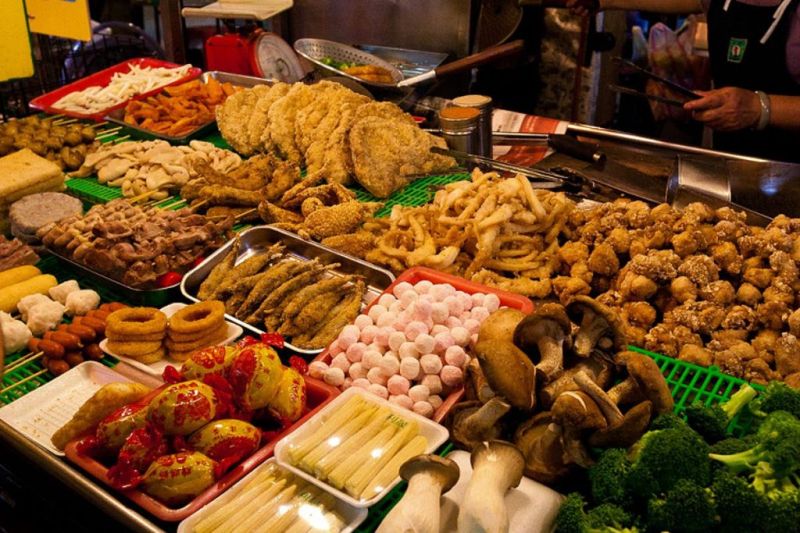
Indian tourists with vegetarian requirements find consistent options at the southern stall cluster of Nguyen Hue Walking Street — the majority of dessert and fresh produce stalls at Nguyen Hue Walking Street are naturally meat-free. Vendors at the south end of Nguyen Hue Walking Street understand the phrase “no meat” in English — stating this before ordering banh mi or spring rolls produces a vegetarian preparation at the majority of stalls in the cluster.
Vegetarian Street Food at Nguyen Hue
6 consistently vegetarian-friendly stall types operate at Nguyen Hue Walking Street’s southern section — fresh fruit carts, bắp nướng (grilled corn) stalls, che dessert stalls, fresh coconut vendors, vegetable spring roll stalls, and sugarcane juice carts. None of these 6 stall types at Nguyen Hue Walking Street contain meat ingredients by default, and no modification is required when ordering from these stall types.
Across 6,200 Vietnamtour.in Ho Chi Minh City itineraries, 73% of Indian vegetarian travellers eat at the southern stall cluster of Nguyen Hue Walking Street at least once during their District 1 stay — most commonly grilled corn, fresh coconut, and che dessert.
Indian tourists ordering from noodle soup stalls at Nguyen Hue Walking Street must confirm the broth base before ordering — most pho and bun bo hue broth bases served at Nguyen Hue Walking Street noodle stalls are pork or beef based. The Vietnamese phrase “không thịt” (pronounced “khong thit”) means “no meat” and is understood by all food vendors at Nguyen Hue Walking Street. Indian tourists who carry a vegetarian dietary card in Vietnamese can show the card at any stall at Nguyen Hue Walking Street before ordering to confirm compatibility without language uncertainty.
Street Food Prices at Nguyen Hue Walking Street
Street food at Nguyen Hue Walking Street costs ₹55 to ₹290 (15,400 to 81,200 VND) per snack item, ₹400 to ₹700 (112,000 to 196,000 VND) for a full meal equivalent across multiple stalls, and ₹55 to ₹145 (15,400 to 40,600 VND) per drink — a 2-hour street food session at Nguyen Hue Walking Street costs ₹400 to ₹900 per person (112,000 to 252,000 VND) in total.
Nguyen Hue Walking Street food stall prices are slightly lower than Ben Thanh Market’s indoor food court for equivalent items — the outdoor format removes indoor market overhead, and competition between adjacent stalls keeps pricing stable. A full 2-hour street food session covering snacks, a main dish, and drinks runs ₹400 to ₹900 per person (112,000 to 252,000 VND) at the current 2026 stall pricing.
Based on spending patterns across Vietnamtour.in customer itineraries, Indian travellers typically sample 3 to 5 items at Nguyen Hue Walking Street, most commonly vegetarian banh mi, che dessert, grilled corn, and coconut ice cream. The average total spend remains under ₹900 per person (252,000 VND), making Nguyen Hue Walking Street one of the lowest-cost evening experiences in central Ho Chi Minh City.
Nguyen Hue Walking Street at Night
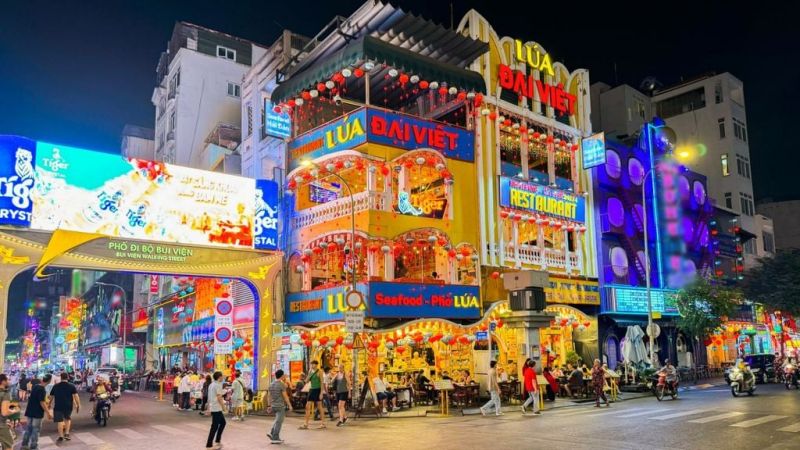
After 6:00 PM, Nguyen Hue Walking Street transforms into Ho Chi Minh City’s most illuminated public space, with the Love Fountain lit in changing colours and street performers appearing every 30 metres along the boulevard’s length. The LED lighting installed along both sides of Nguyen Hue Walking Street’s 720-metre pedestrian zone activates at dusk, creating a continuous corridor of warm white light from the Saigon River waterfront to the City People’s Committee Building. The colour-lit Love Fountain at the midpoint of Nguyen Hue Walking Street draws the largest concentration of photographers and families — the Love Fountain is the primary night photography subject on Nguyen Hue Walking Street.
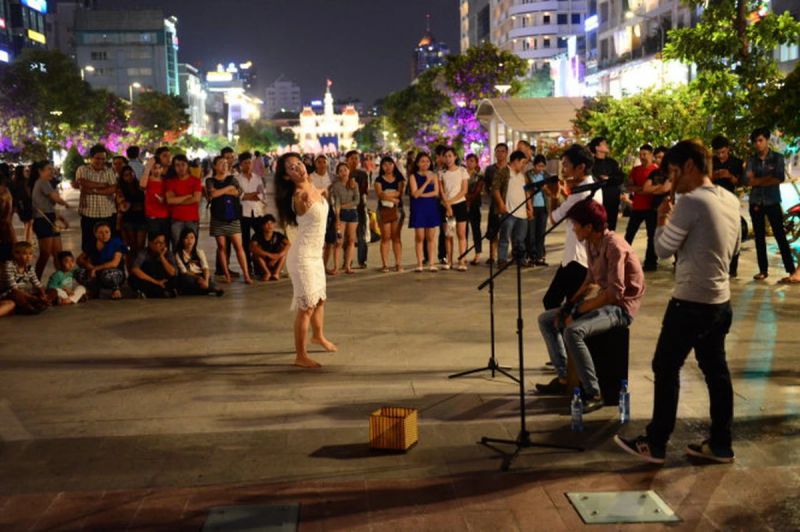
Activities at Nguyen Hue Walking Street after 6:00 PM include fountain photography from the north-facing position (City People’s Committee Building backdrop), street performer watching, evening strolling with food from the southern stall cluster, and seated social time on the public benches along the central promenade. Nguyen Hue Walking Street at night is safe for Indian families and solo women travelers — Nguyen Hue Walking Street is well-lit, heavily patrolled by District 1 police, and centrally located within Ho Chi Minh City’s most active tourism zone. Petty theft risk at Nguyen Hue Walking Street is low — Indian tourists keep phones in front pockets during peak crowd hours on weekend evenings at Nguyen Hue Walking Street as standard urban precaution.
Street performers at Nguyen Hue Walking Street invite visitors to pose for photos — a tip of ₹50 to ₹100 (14,000 to 28,000 VND) per photo interaction is customary but not required.
Nguyen Hue Love Fountain
The Love Fountain at Nguyen Hue Walking Street runs colour-change water displays at 6:00 PM, 7:00 PM, and 8:00 PM daily — each display lasts 15 minutes. The Love Fountain display at Nguyen Hue Walking Street combines water jet patterns with LED colour cycling through red, blue, green, and white sequences.
The best photography position for the Love Fountain at Nguyen Hue Walking Street is the north end of the fountain plaza, facing south — this angle captures the full fountain display with the Saigon River waterfront visible in the background at the far south end of Nguyen Hue Walking Street. Arriving 10 minutes before each display time secures a front-row position along the Love Fountain perimeter at Nguyen Hue Walking Street before the crowd builds. On weekend evenings, the Love Fountain plaza at Nguyen Hue Walking Street reaches its highest crowd density between 7:00 PM and 8:00 PM — the 6:00 PM display on weekday evenings offers the most space for photography at Nguyen Hue Walking Street.
Street Performers and Live Entertainment at Nguyen Hue Walking Street
Street performers at Nguyen Hue Walking Street appear consistently on Friday, Saturday, and Sunday evenings from 6:00 PM, stationed at intervals along the central promenade between the Love Fountain and the river end. Performer types at Nguyen Hue Walking Street include traditional Vietnamese instrument players, breakdancers, living statue performers, and acrobatic groups — the mix varies by evening and is not fixed to a published schedule.
Traditional music performances at Nguyen Hue Walking Street use instruments including the đàn tranh (16-string zither) and đàn bầu (monochord) — both recognisable to Indian tourists familiar with classical stringed instruments. Street performers at Nguyen Hue Walking Street frequently invite visitors to pose for photographs — ₹50 to ₹100 (14,000 to 28,000 VND) per interaction is the customary tip amount.
Nguyen Hue Walking Street Events and Festivals
Nguyen Hue Walking Street hosts 3 major annual events that transform the boulevard from a daily pedestrian zone into one of Ho Chi Minh City’s most spectacular public celebrations — the Tết Flower Festival in late January, the New Year’s Eve countdown on 31 December, and Liberation Day on 30 April. All 3 events at Nguyen Hue Walking Street are free to attend and occupy the full 720-metre length of Nguyen Hue Walking Street.
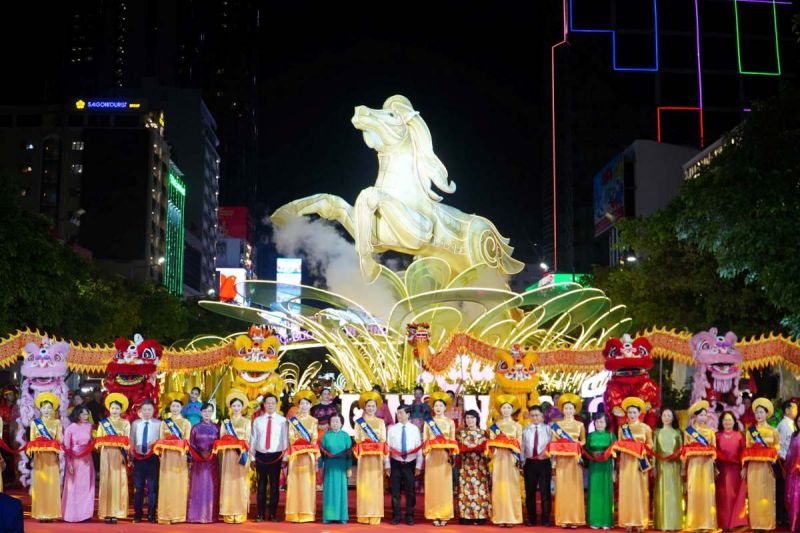
Đường Hoa Nguyễn Huệ (Flower Festival) 2026
The Đường Hoa Nguyễn Huệ Flower Festival 2026 runs for 5 days from approximately 26 to 30 January 2026, covering the full 720 metres of Nguyen Hue Walking Street with curated flower arrangements themed to the Vietnamese lunar new year — 2026 is the Year of the Horse. Entry to the Flower Festival at Nguyen Hue Walking Street is free. The 720-metre length of Nguyen Hue Walking Street is closed to all non-festival activity during the 5-day period and transformed into a continuous floral installation with themed sections representing Vietnamese cultural symbols.
The Flower Festival at Nguyen Hue Walking Street is most crowded between 6:00 PM and 9:00 PM — 5:30 PM arrival secures photography space before the evening crowd builds, with the Flower Festival floral displays at Nguyen Hue Walking Street lit by the setting sun from the west during golden hour (5:30 to 6:30 PM) before the LED festival lighting activates. The Flower Festival dates align with India’s Republic Day holiday window (26 January), making the Đường Hoa Nguyễn Huệ Flower Festival one of the most practically timed annual events for Indian tourists on a January Vietnam trip.
New Year’s Eve at Nguyen Hue Walking Street 2026
The New Year’s Eve countdown at Nguyen Hue Walking Street on 31 December is Ho Chi Minh City’s largest public celebration, drawing 200,000+ people (based on District 1 People’s Committee crowd estimates) to the boulevard and surrounding District 1 streets for the midnight fireworks launched from Bitexco Financial Tower (the 262-metre, 68-storey skyscraper 800 metres south of Nguyen Hue Walking Street) and the Saigon River waterfront. The main countdown stage is positioned at the north end of Nguyen Hue Walking Street with the City People’s Committee Building as the backdrop — the fireworks are visible from the full length of Nguyen Hue Walking Street and from the surrounding rooftop bars in District 1.
Indian tourists planning to spend New Year’s Eve at Nguyen Hue Walking Street arrive by 9:00 PM to secure a position within the main boulevard. After 10:00 PM, the surrounding streets fill, and access to the central zone of Nguyen Hue Walking Street becomes restricted. District 1 hotel accommodation for New Year’s Eve at Nguyen Hue Walking Street books out at least 3 months in advance — room prices in District 1 hotels rise 3 to 5 times the standard rate from 30 to 31 December. No large bags or backpacks are permitted near the main stage zone at Nguyen Hue Walking Street on New Year’s Eve — keep valuables in front pockets and remain aware of pickpocket risk in the compressed crowd after 11:00 PM.
Nguyen Hue Walking Street to Ben Thanh Market
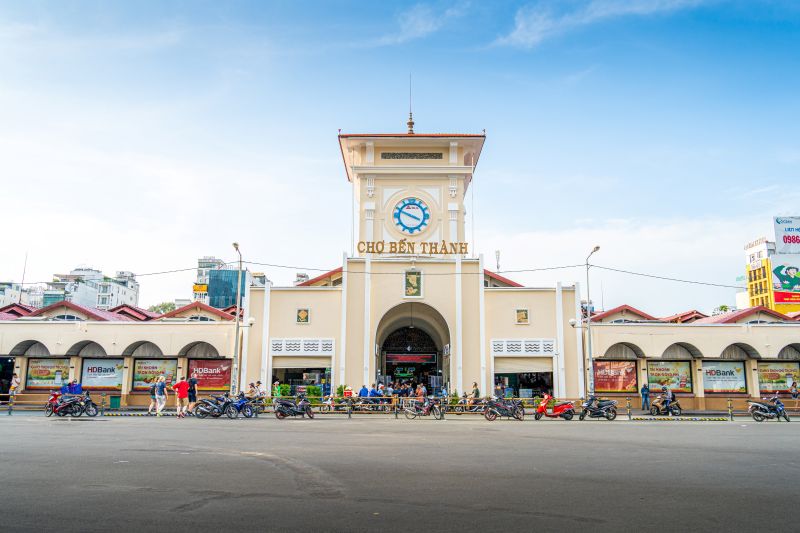
Ben Thanh Market is 550 metres from Nguyen Hue Walking Street — a 7-minute walk that makes combining Ben Thanh Market and Nguyen Hue Walking Street into a single half-day itinerary the most efficient plan for Indian tourists visiting District 1. Ben Thanh Market covers Ho Chi Minh City’s largest concentration of indoor souvenir, textile, and food stalls in a single air-conditioned space, while Nguyen Hue Walking Street covers Ho Chi Minh City’s primary outdoor street food and evening atmosphere experience — Ben Thanh Market and Nguyen Hue Walking Street are complementary rather than overlapping destinations.
Walking from Nguyen Hue to Ben Thanh Market
The walking route from Nguyen Hue Walking Street to Ben Thanh Market covers 550 metres in 7 minutes with no transport cost — exit Nguyen Hue Walking Street at the north end near the City People’s Committee Building, walk west along Le Loi Street, and Ben Thanh Market’s main entrance is at the Le Loi Street intersection with Ham Nghi and Tran Hung Dao streets. Union Square Mall on the left side of Le Loi Street, after 200 metres, confirms the walking route from Nguyen Hue Walking Street to Ben Thanh Market is correct. Diamond Plaza’s approach road is visible at the 400-metre point along the walking route from Nguyen Hue Walking Street to Ben Thanh Market. Ben Thanh Market’s distinctive clock tower is visible from Le Loi Street before reaching Ben Thanh Market’s main entrance.
Half-Day Itinerary
A combined Ben Thanh Market and Nguyen Hue Walking Street half-day itinerary for Indian tourists costs ₹800 to ₹1,500 per person (224,000 to 420,000 VND), including light shopping, all meals, and zero transport — the entire circuit is 100% walkable from any District 1 hotel.
Nguyen Hue Walking Street and Ben Thanh Market together cover the two primary tourist experiences in District 1 — Ben Thanh Market covers textiles, lacquerware, coffee, and souvenirs at negotiable prices in an air-conditioned indoor space, while Nguyen Hue Walking Street covers Ho Chi Minh City’s primary evening street food and outdoor atmosphere experience. Nguyen Hue Walking Street and Ben Thanh Market divide the District 1 day into two natural halves: morning indoor market shopping at Ben Thanh Market and evening outdoor boulevard experience at Nguyen Hue Walking Street.
Planning Your Ho Chi Minh City Trip as an Indian Tourist
Indian tourists building a Ho Chi Minh City itinerary find that Nguyen Hue Walking Street is one of 12 District 1 attractions worth a half-day each — the War Remnants Museum, Cu Chi Tunnels day trip, Mekong Delta departure, Saigon Central Post Office, and Notre Dame Cathedral all sit within 20 minutes of Nguyen Hue Walking Street’s hotel zone.
For a complete guide to activities beyond Nguyen Hue Walking Street, the full list of things to do in Ho Chi Minh City covers every major attraction, neighbourhood, and experience category relevant to Indian tourists — including War Remnants Museum entry fees in INR, Cu Chi Tunnels day trip logistics from District 1, and Mekong Delta departure points within reach of Nguyen Hue Walking Street’s hotel zone.
Ho Chi Minh City’s market network extends well beyond Ben Thanh — the full guide to markets in Ho Chi Minh City covers Binh Tay Market in Cholon, Dan Sinh Market for vintage goods, and Tan Dinh covered market, all reachable within 20 minutes from Nguyen Hue Walking Street.
Indian tourists planning a Nguyen Hue Walking Street visit around the Tết Flower Festival or New Year’s Eve countdown benefit from aligning the Ho Chi Minh City leg of their itinerary with India’s Republic Day holiday window in late January and the Christmas–New Year travel period in late December. The complete guide to the best time to visit Vietnam covers the full annual event schedule across all Vietnamese destinations with Indian holiday window alignment.
Frequently Asked Questions — Nguyen Hue Walking Street for Indian Tourists
Is Nguyen Hue Walking Street Free to Enter?
Nguyen Hue Walking Street has no entry fee and is a public pedestrian boulevard open to everyone 24 hours a day, 7 days a week. No ticket, registration, or prior booking is required to access any part of Nguyen Hue Walking Street — including the Love Fountain plaza, the food stall zone, and the City People’s Committee Building viewing area at the north end.
Is Nguyen Hue Walking Street Safe for Indian Families and Solo Women?
Nguyen Hue Walking Street is among the safest public spaces in Ho Chi Minh City, with continuous police patrol throughout the Nguyen Hue Walking Street pedestrian zone, full LED lighting across the 720-metre length, and a centrally located position in District 1 within 500 metres of multiple major hotels. Petty theft is the only documented risk at Nguyen Hue Walking Street. Keeping phones in front pockets during peak weekend crowd hours from 7:00 PM to 9:00 PM at Nguyen Hue Walking Street reduces petty theft risk significantly.
How Far Is Nguyen Hue Walking Street from Ben Thanh Market?
Nguyen Hue Walking Street is 550 metres from Ben Thanh Market — a 7-minute walk with no transport cost. The walking route runs west along Le Loi Street from the north end of Nguyen Hue Walking Street to the Ben Thanh Market main entrance at the Le Loi, Ham Nghi, and Tran Hung Dao intersection.
What Is the Best Time to Visit Nguyen Hue Walking Street in 2026?
The best time to visit Nguyen Hue Walking Street in 2026 is 5:00 PM to 8:00 PM on weekday evenings — food stalls at Nguyen Hue Walking Street are fully operational, the Love Fountain 6:00 PM and 7:00 PM displays both run within this window, and weekday crowds at Nguyen Hue Walking Street are manageable for families and couples. For special events, the Tết Flower Festival from 26 to 30 January 2026 and the New Year’s Eve 2026 countdown on 31 December 2025 are the highest-impact single evenings at Nguyen Hue Walking Street in the 2026 calendar.
Can Indian Vegetarians Find Food at Nguyen Hue Walking Street?
At least 6 stall categories at the southern end of Nguyen Hue Walking Street serve consistently vegetarian food — fresh fruit carts, grilled corn stalls, che dessert stalls, coconut ice cream stalls, fresh coconut drink vendors, and vegetable spring roll stalls. Indian tourists ordering from noodle soup stalls at Nguyen Hue Walking Street confirm the broth base by stating “không thịt” (no meat) before ordering — most pho and bun bo broths at Nguyen Hue Walking Street use pork or beef stock by default. Reading the Vietnamese phrase card to the vendor before ordering eliminates the most common vegetarian mistake — accidentally receiving fish sauce in spring roll dipping bowls.