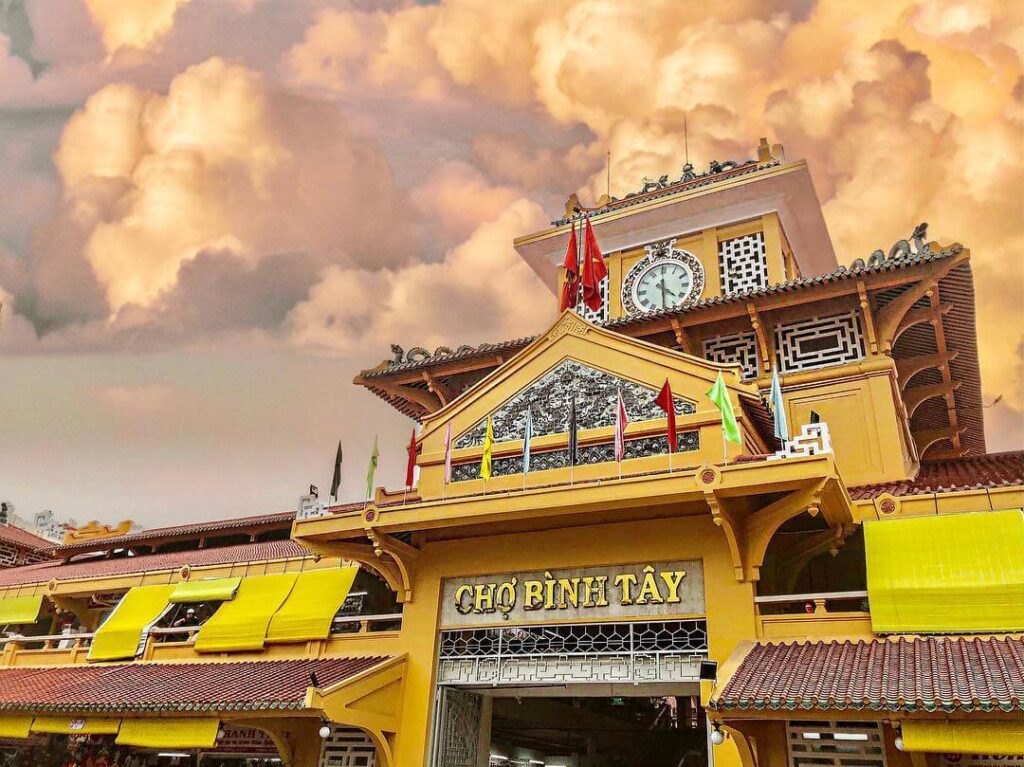
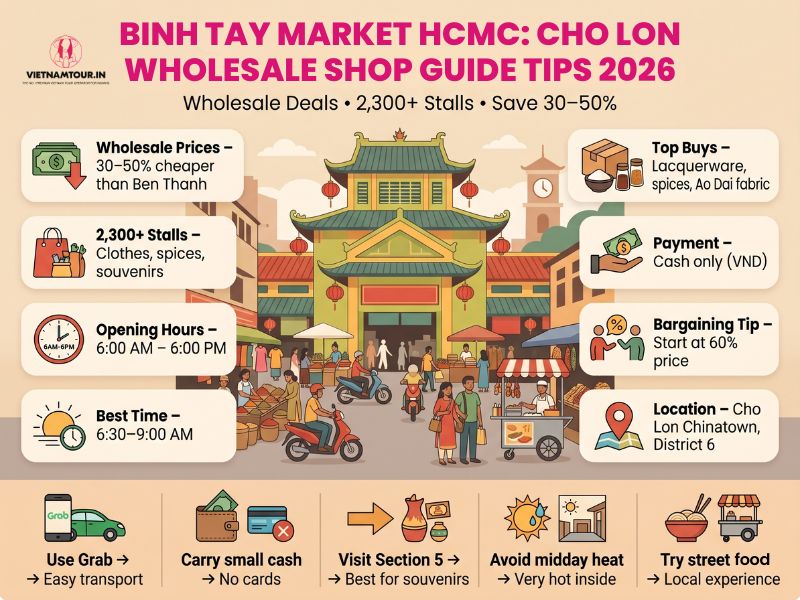
Binh Tay Market (Chợ Bình Tây) is Ho Chi Minh City’s largest wholesale market, located in Cho Lon — Vietnam’s historic Chinatown district — in District 6 at Thap Muoi Street. Binh Tay Market covers 2.5 hectares and houses 2,300+ stalls selling wholesale goods at prices 30–50% below Ben Thanh Market retail rates — with wholesale clothing from ₹105 (30,000 VND) per piece, dried goods from ₹70 (20,000 VND) per pack, and lacquerware from ₹140 (40,000 VND) per item. Binh Tay Market was built in 1928 under French colonial administration and operates daily from 6:00 AM to 6:00 PM, serving wholesale traders, local buyers, and individual visitors with no minimum purchase requirement.
This guide covers Binh Tay Market’s location and transport from District 1, shopping sections and wholesale pricing, the 1928 heritage building’s architecture, and practical tips for Indian tourists — including best visiting hours, food options near Cho Lon, and how to compare Binh Tay Market with Ben Thanh Market.
Binh Tay Market Location
Binh Tay Market is located in Cho Lon — Ho Chi Minh City’s historic Chinatown district — in District 6 at Thap Muoi Street, GPS coordinates 10.7528° N, 106.6490° E, 5 km west of Ben Thanh Market in District 1 and reachable by Grab in 15–20 minutes at ₹105–₹175 (30,000–50,000 VND). “Cho Lon” translates as “Big Market” in Vietnamese — Binh Tay Market is the commercial anchor of Cho Lon, operating as a wholesale trading hub for Ho Chi Minh City’s Vietnamese-Chinese community since 1928.
Binh Tay Market’s wholesale character, Chinese-influenced goods, and Cantonese vendor culture distinguish Binh Tay Market from tourist-facing markets in District 1. Binh Tay Market’s 2,300+ stalls serve Vietnamese wholesale traders as their primary customer base, not international tourists.
Cho Lon: The Urban Context of Binh Tay Market
Cho Lon is Ho Chi Minh City’s oldest continuously inhabited commercial district, originally settled by Chinese migrants from Guangdong and Fujian provinces in the 18th century, spanning Districts 5 and 6 with a population of 500,000+ residents of ethnic Chinese descent. Binh Tay Market is the commercial centre of Cho Lon — the majority of Binh Tay Market’s 2,300+ vendors are ethnic Hoa (Vietnamese-Chinese), and Cantonese and Teochew dialects are actively spoken across the market stalls.
Cho Lon’s street-level environment includes Chinese temple architecture, active incense burning at 12+ registered temples within 500 metres of Binh Tay Market, and Cantonese-language signage on the majority of shopfronts — a commercial and architectural environment distinct from the French colonial streetscapes of District 1.
Distance from District 1 to Binh Tay Market and Transport Options
Binh Tay Market is 6 km from Ben Thanh Market in District 1, reachable in 20–30 minutes by Grab, depending on traffic — 3 transport options connect District 1 to Binh Tay Market:
- Grab taxi or car: ₹123–₹175 (35,000–50,000 VND) one way, 20–30 minutes — door-to-door drop-off at Binh Tay Market’s Thap Muoi Street entrance; Grab operates identically to Ola and Uber
- GrabBike (motorbike taxi): ₹63–₹88 (18,000–25,000 VND) one way, 15–20 minutes — faster in peak traffic, not suited for carrying bulk purchases
- Public bus Route 1 from Ben Thanh Bus Station: ₹7 (2,000 VND) one way, 40–50 minutes — lowest cost option; no luggage storage on board
The Grab app — equivalent to Ola or Uber for Indian tourists — is the most practical option for reaching Binh Tay Market from central HCM. Walking from District 1 to Binh Tay Market is not advisable: the 6 km route crosses busy arterial roads with no tourist-grade pedestrian infrastructure.
Binh Tay Market History and Architecture
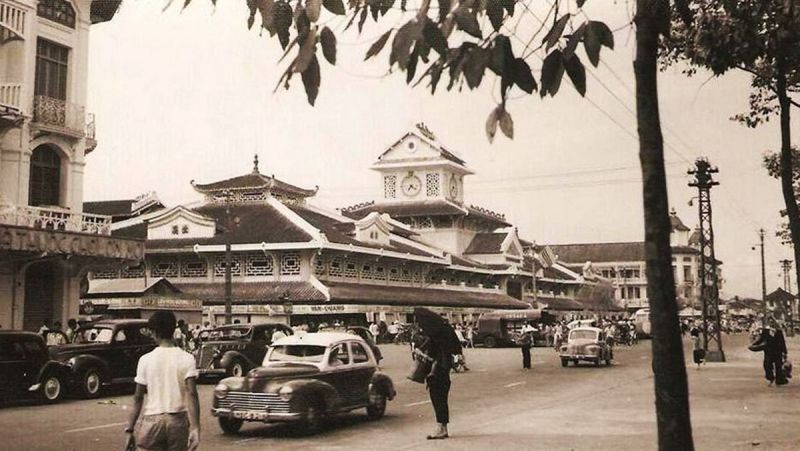
Binh Tay Market was built in 1928 by Quach Dam (郭琰), a Teochew Chinese merchant who personally funded the entire construction and donated the completed structure to the city of Saigon — replacing the original Cho Lon Market established on the same site in 1864. Binh Tay Market’s construction took 3 years to complete from 1925 to 1928, producing the heritage building that still stands at Thap Muoi Street today.
Quach Dam and the Founding Story of Binh Tay Market
Quach Dam was one of Saigon’s wealthiest traders in the early 20th century, with a fortune accumulated through rice trading and shipping operations across the Mekong Delta. Quach Dam funded and donated Binh Tay Market to the city of Saigon in 1928 to establish a permanent commercial centre for Cho Lon’s ethnic Chinese trading community — a civic donation with no recorded commercial return to Quach Dam or his family. Quach Dam’s bronze statue was removed from Binh Tay Market’s central courtyard during the post-1975 period and later restored to its original position facing the main gate on Thap Muoi Street, where Quach Dam’s bronze statue stands today.
Chettiar merchants from Tamil Nadu and Sindhi traders from Sindh province built comparable civic-commercial infrastructure across Southeast Asia during the same colonial period — Chettiar-funded temples in Singapore and Penang and Sindhi trading houses in Hong Kong and Manila represent the same pattern of minority merchant communities establishing permanent institutional anchors in adopted commercial cities.
Binh Tay Market Architecture
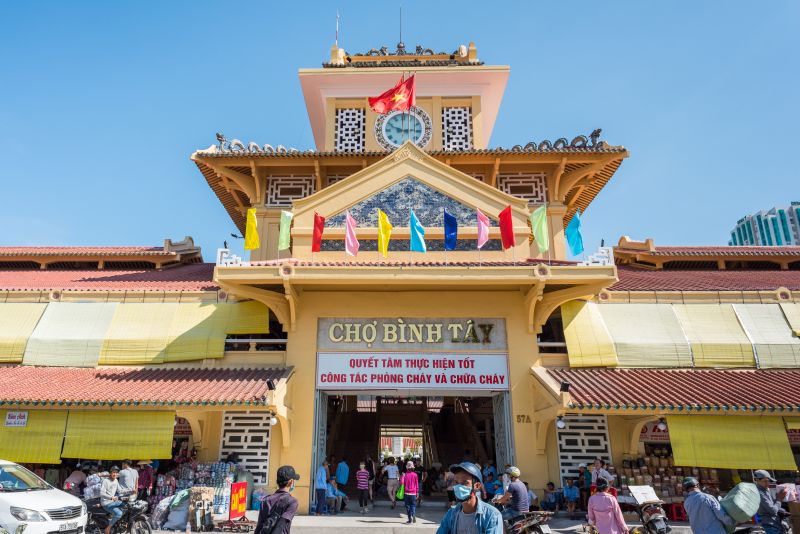
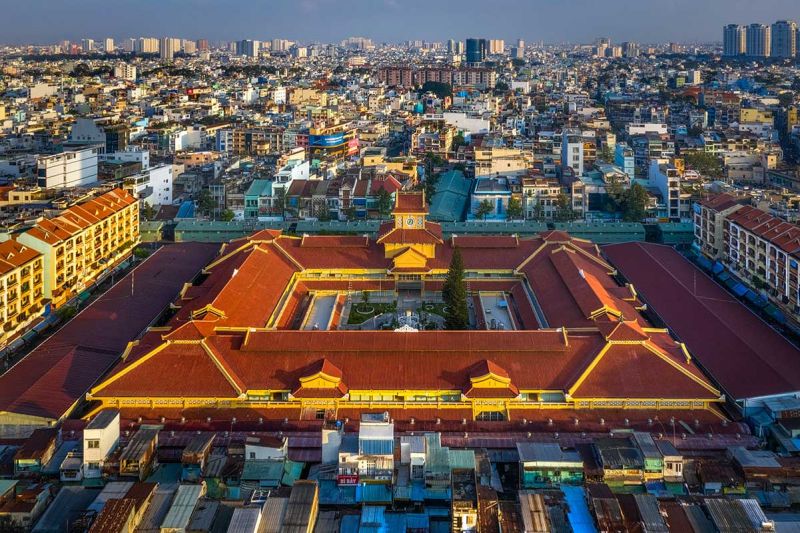
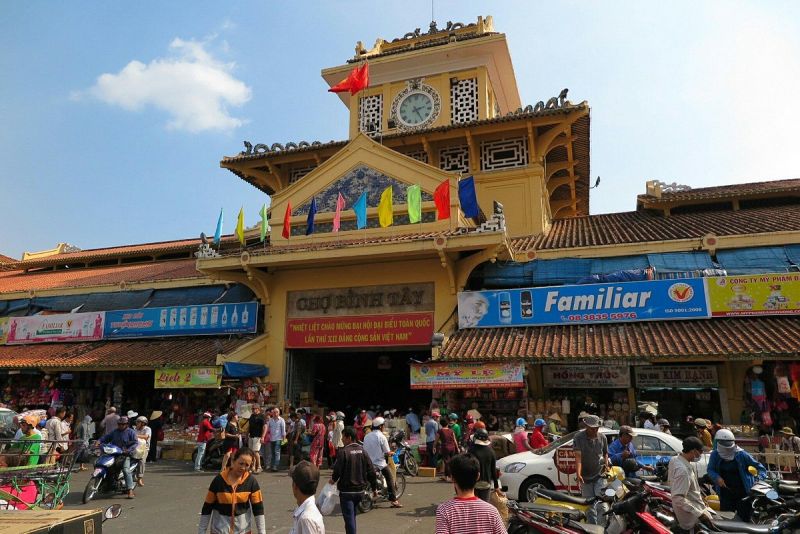
Binh Tay Market combines southern Chinese temple architecture with French colonial structural engineering — built in 1928 with 4 entrance gates, a double-tiered roof with upturned eaves in the Guangdong regional style, and green and yellow ceramic tile work across the full facade. Binh Tay Market’s central open-air courtyard houses a clock tower and Quach Dam’s bronze statue within a 2,500 m² open space at the building’s geometric centre. Binh Tay Market covers a total area of 25,000 m² and is listed as a Grade 2 architectural heritage site by the Ho Chi Minh City Department of Culture, Sports and Tourism.
The Binh Tay Market roofline’s upturned eaves, ceramic ridge decorations, and 4 gate towers follow the same Guangdong temple construction vocabulary as Crawford Market in Mumbai — designed by British architect William Emerson in 1871 — and Hogg Market (New Market) in Kolkata, both of which combine European structural frames with Asian decorative systems in colonial-period market buildings.
Binh Tay Market Opening Hours, Entrance, and Section Map
Binh Tay Market opens at 6:00 AM and closes at 6:00 PM seven days a week, including Vietnamese public holidays, with no entrance fee. Binh Tay Market has 4 main entrances: Thap Muoi Street (main entrance and most recognisable gate), Phan Van Khoe Street, Lao Tu Street, and Hau Giang Street.
Binh Tay Market Layout
Binh Tay Market divides into 6 trading sections organised around the central courtyard, each specialising in a distinct product category:
- Section 1 (Main Hall, nearest Thap Muoi gate): Dry goods, spices, and dried seafood — from ₹70 (20,000 VND) per pack
- Section 2: Textiles, fabric rolls, and wholesale clothing — fabric from ₹105 (30,000 VND) per metre
- Section 3: Household goods, kitchenware, and plastic goods — from ₹35 (10,000 VND) per item
- Section 4: Confectionery, Vietnamese sweets, and dried fruits — from ₹70 (20,000 VND) per pack
- Section 5: Souvenirs, lacquerware, and handicrafts — from ₹140 (40,000 VND) per item; primary zone for individual tourist purchases
- Section 6: Fresh produce and Chinese medicinal herbs — from ₹35 (10,000 VND) per unit
Section 5 holds the highest concentration of souvenir and lacquerware stalls in Binh Tay Market, with additional souvenir stalls in the corridor between Sections 4 and 5. Visitors entering via the Thap Muoi main gate reach Section 5 by crossing the central courtyard and turning right at the clock tower — a walking distance of 80–100 metres from the main gate.
Shopping at Binh Tay Market
Binh Tay Market operates as a wholesale market with minimum order quantities of 6–12 units at wholesale stalls — individual tourist purchases without minimum quantities are available at Section 5 souvenir stalls and courtyard-adjacent stalls, where vendors sell to retail buyers. Binh Tay Market souvenir prices run 30–50% below equivalent items at Ben Thanh Market across all 8 product categories below.
8 Best Items to Buy at Binh Tay Market with Price Benchmarks in INR
The 8 best purchases at Binh Tay Market for Indian tourists in 2026, with wholesale and retail price benchmarks:
- Lacquerware bowls and trays — hand-painted pieces from Cho Lon workshops: ₹350–₹700 (100,000–200,000 VND) per piece at Section 5 retail; ₹210–₹420 (60,000–120,000 VND) per piece at wholesale minimum of 6 pieces
- Vietnamese conical hats (Nón Lá) — wholesale-grade palm-leaf construction: ₹70–₹140 (20,000–40,000 VND) each; minimum 10 pieces at wholesale pricing
- Áo Dài fabric (silk and cotton blends, unstitched bolt fabric from Section 2): ₹700–₹1,400 (200,000–400,000 VND) per metre for cotton blend; ₹1,400–₹2,100 (400,000–600,000 VND) per metre for silk blend
- Dried Vietnamese cinnamon (Quế Quảng Nam) — Quang Nam province cinnamon from Cho Lon spice stalls, the same Cinnamomum loureiroi species as Indian dalchini: ₹140–₹350 (40,000–100,000 VND) per 200g pack
- Chinese tea sets — ceramic 6-piece sets with Cantonese designs: ₹525–₹1,050 (150,000–300,000 VND) per set
- Vietnamese embroidered tablecloths and cushion covers (Section 2 textiles): ₹280–₹700 (80,000–200,000 VND) per piece
- Hand-painted silk fans (Section 5): ₹175–₹525 (50,000–150,000 VND) each
- Dried longan, lotus seeds, and red dates (Section 6 herb stalls): ₹210–₹420 (60,000–120,000 VND) per 500g — all 3 items are shelf-stable and meet Indian customs requirements for sealed dried food imports
Bargaining at Binh Tay Market
Binh Tay Market operates on a dual-price system: wholesale price for bulk buyers purchasing 12+ units and tourist retail price for individual visitors — vendors quote tourist retail as the opening price, and the negotiated retail price is 20–35% below the first quoted figure. Wholesale price for orders of 12 or more units is a further 30–40% below negotiated retail price at Binh Tay Market. Open bargaining at 60% of the vendor’s first quote and settle between 70–80% for individual tourist purchases at Binh Tay Market Section 5 stalls.
Cash in VND is the only accepted payment at all Binh Tay Market stalls. ATMs are located 200 metres from Binh Tay Market’s main gate on Thap Muoi Street. Carry small denomination notes of ₹70 (20,000 VND) and ₹175 (50,000 VND) for Section 5 souvenir purchases — exact-denomination payment reduces change errors at high-volume wholesale stalls.
The dual-price system at Binh Tay Market — tourist retail versus wholesale — operates entirely in Vietnamese and Cantonese, with no Hindi-speaking vendor presence across Sections 1 to 4. Indian tourists without local guidance consistently pay tourist retail rates even when purchasing at wholesale minimum quantities, because the threshold for wholesale pricing activation is communicated verbally by vendors rather than displayed on price cards.
Wholesale Buying at Binh Tay Market
Binh Tay Market wholesale stalls set minimum order quantities of 12–24 units for small goods and 6 metres minimum for fabric. Wholesale pricing activates automatically at these thresholds, with no registration or advance arrangement required. Wholesale section vendors at Binh Tay Market carry English and Vietnamese price cards; Hindi price cards are available at lacquerware and ceramic stalls in Section 5 that regularly serve Indian wholesale buyers.
3 product categories with confirmed wholesale availability at Binh Tay Market for Indian buyers: lacquerware (MOQ 12 pieces, ₹210–₹420 / 60,000–120,000 VND per piece at wholesale), Vietnamese cinnamon and dried herbs (MOQ 1 kg, ₹350–₹700 / 100,000–200,000 VND per kg), and embroidered textiles (MOQ 6 pieces, ₹280–₹560 / 80,000–160,000 VND per piece). Freight consolidation and shipping services to India are available through Cho Lon freight operators — Binh Tay Market’s ground floor office near the Lao Tu entrance provides referrals to licensed consolidators operating in District 6.
Food Stalls and Street Food Near Binh Tay Market
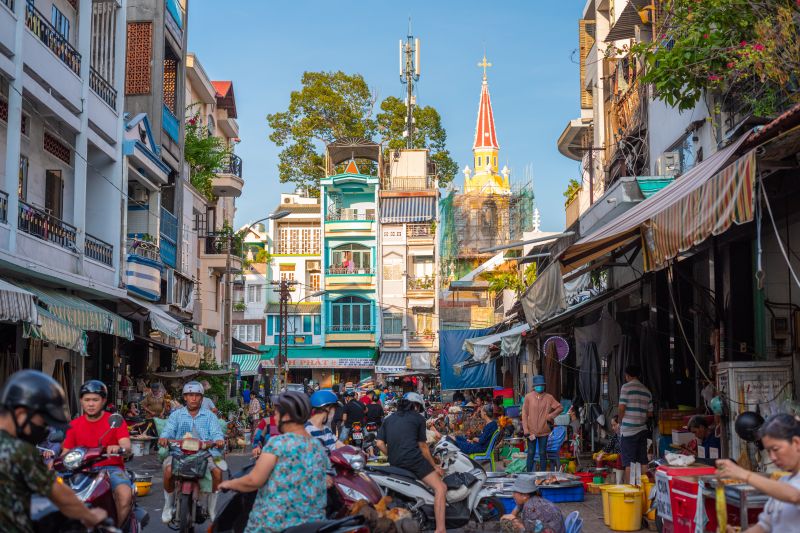
Binh Tay Market has no sit-down restaurant inside the building — the streets of Cho Lon surrounding Binh Tay Market on Thap Muoi Street, Lao Tu Street, and Hau Giang Street form one of Ho Chi Minh City’s most concentrated Chinese-Vietnamese (Hoa) street food zones, with morning stalls operating from 6:00 AM to 11:00 AM and evening stalls operating independently from 5:00 PM to 10:00 PM.
5 Cho Lon Dishes to Eat Near Binh Tay Market
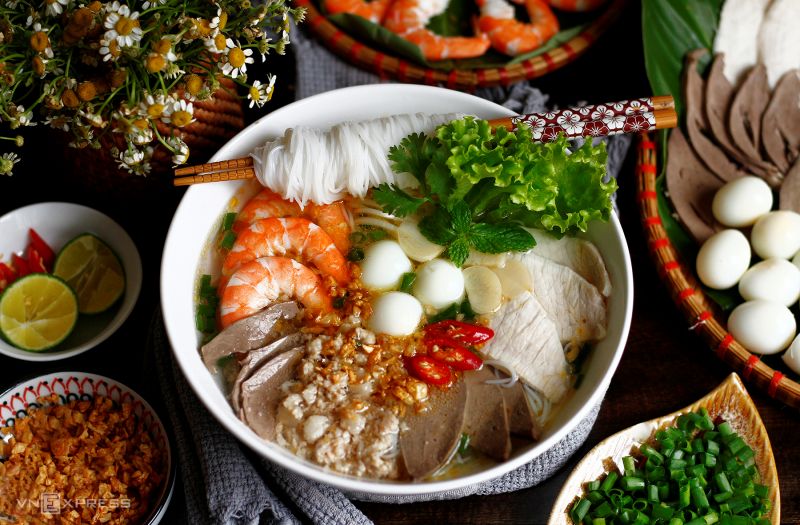
The 5 signature dishes of Cho Lon’s street food zone near Binh Tay Market:
- Hu Tieu Nam Vang (Phnom Penh-style noodle soup) — clear pork broth with rice noodles, pork slices, and dried shrimp: ₹70–₹105 (20,000–30,000 VND) per bowl. Morning stalls on Thap Muoi Street open from 6:00 AM. Not vegetarian.
- Banh Cuon (steamed rice rolls) — filled with minced pork and wood ear mushroom, topped with fried shallots: ₹53–₹88 (15,000–25,000 VND) per portion. Stalls on Lao Tu Street open from 6:30 AM. Not vegetarian.
- Che Ba Mau (three-colour bean dessert) — chilled dessert with mung beans, red beans, and pandan jelly in coconut milk: ₹35–₹53 (10,000–15,000 VND) per cup. Fully vegetarian. Available throughout the day at Hau Giang Street stalls.
- Dim Sum / Yum Cha (Cantonese steamed dumplings) — pork-based baskets: ₹175–₹351 (50,000–100,000 VND) per basket. 3 dedicated dim sum restaurants operate within 300 metres of Binh Tay Market’s Thap Muoi main gate, open 7:00 AM–11:00 AM only. Not vegetarian.
- Banh Tieu (hollow sesame doughnuts) — Chinese-Vietnamese fried sesame bread, often paired with Xoi sticky rice: ₹18–₹35 (5,000–10,000 VND) each. Fully vegetarian. Cart vendors operate at Binh Tay Market’s Thap Muoi main gate from 6:30 AM daily.
Vegetarian and Indian-Friendly Food Options Near Binh Tay Market
Indian tourists requiring vegetarian, beef-free, or pork-free food near Binh Tay Market have 3 confirmed options within 600 metres of the Thap Muoi main gate:
- Banh Tieu (sesame doughnuts, fully vegetarian): ₹18–₹35 (5,000–10,000 VND) each — cart vendors at Binh Tay Market’s Thap Muoi main gate from 6:30 AM daily
- Che Ba Mau (three-colour bean dessert, fully vegetarian): ₹35–₹53 (10,000–15,000 VND) per cup — Hau Giang Street stalls, available throughout the day
- Chay Buddhist vegetarian restaurants: 2 dedicated Chay restaurants on Nguyen Trai Street, 400 metres from Binh Tay Market’s main gate, serving mock-meat Vietnamese-Chinese dishes at ₹105–₹210 (30,000–60,000 VND) per main course
Indian restaurants are absent from the Binh Tay Market and Cho Lon area — the nearest Indian restaurant cluster is in District 1, 6 km from Binh Tay Market, reachable via Grab in 20–25 minutes at ₹105–₹175 (30,000–50,000 VND). For halal food: 1 halal Chinese-Muslim restaurant operates on Nguyen Trai Street, 600 metres from Binh Tay Market’s Thap Muoi main gate — confirm halal certification directly with the restaurant before ordering.
Binh Tay Market Tour from Ho Chi Minh City
Indian tourists visiting Binh Tay Market from Ho Chi Minh City face one practical planning decision: explore Cho Lon independently on a self-guided basis, or join a guided half-day tour that combines Binh Tay Market with other Cho Lon landmarks.
A standalone self-guided visit to Binh Tay Market takes 1.5–2 hours. A guided Cho Lon half-day tour from District 1 covers Binh Tay Market, Thien Hau Temple (400m from the main gate), Nghia An Hoi Quan Pagoda, and a Cho Lon street food walk — total duration 3.5–4.5 hours.
For Indian tourists combining Binh Tay Market with Thien Hau Temple and Cho Lon’s street food zone, the practical challenge is not distance — all three stops sit within 400 metres of each other — but sequencing: the Binh Tay Market wholesale peak ends by 10:30 AM, Thien Hau Temple is least crowded before 9:30 AM, and the Cho Lon street food stalls on Thap Muoi Street close by 11:00 AM. Arriving 30 minutes late at any one stop collapses the entire half-day sequence.
Binh Tay Market is one of three major markets that define the HCM shopping experience for Indian tourists, the others being Ben Thanh Market and An Dong Market. For a full overview of all three and how to plan a multi-market day in HCM, see the guide to markets in Ho Chi Minh City.
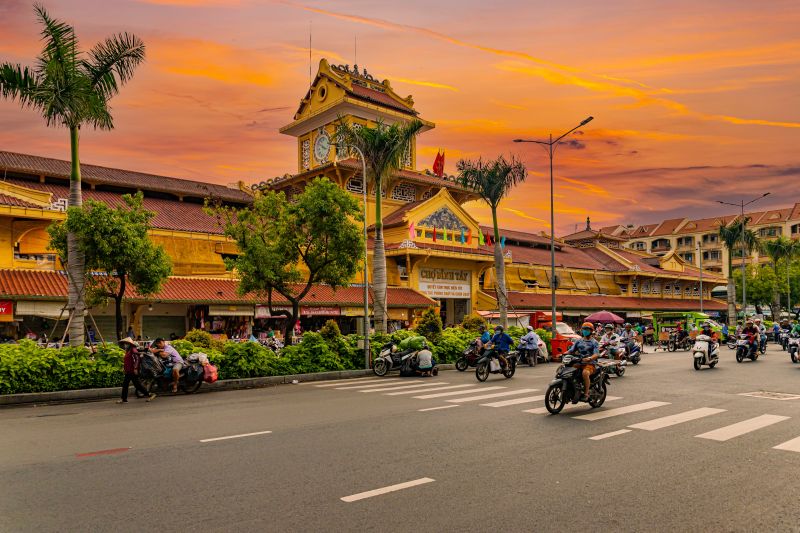
Half-Day Cho Lon Tour Including Binh Tay Market: 4-Stop Itinerary
A half-day Cho Lon guided tour from District 1 covers 4 stops in 4 hours, with private car tour pricing at ₹1,750–₹3,500 (500,000–1,000,000 VND) per person excluding lunch.
The 4-stop Cho Lon half-day itinerary including Binh Tay Market:
- Thien Hau Temple (9:00 AM, 30 minutes) — Chinese Taoist temple built in 1760, 300 metres from Binh Tay Market’s Thap Muoi main gate; free entry
- Binh Tay Market (9:30 AM, 90 minutes) — Section 5 souvenir shopping from ₹140 (40,000 VND) per item and central courtyard photography of the 1928 heritage facade
- Cho Lon street food break (11:00 AM, 45 minutes) — Hu Tieu Nam Vang at Thap Muoi Street stalls from ₹70 (20,000 VND) per bowl
- An Dong Market (12:00 PM, 60 minutes) — retail fashion and fabric, 1.2 km from Binh Tay Market’s main gate; no entry fee
Why Use a Guide for Binh Tay Market
English-speaking guide support at Binh Tay Market’s wholesale stalls (Sections 1–4) can reduce wholesale bargaining time by 30–40% compared to self-guided navigation across Binh Tay Market’s 2,300 stalls. Vendors in Sections 1–4 operate in Vietnamese and Cantonese only, with no Hindi-speaking presence. Guide assistance helps Indian buyers activate wholesale pricing thresholds that vendors communicate verbally rather than display on price cards.
Self-Guided Visit to Binh Tay Market
A self-guided visit to Binh Tay Market requires no guide and no advance booking — arrive via Grab before 9:00 AM, allow 90 minutes inside Binh Tay Market, and depart before 11:00 AM when Thap Muoi Street and Hau Giang Street reach peak vehicle congestion.
5-step self-guided sequence for Binh Tay Market (90 minutes total):
- Enter via the Thap Muoi main gate (0–5 minutes) — photograph the full 1928 heritage facade from the pavement opposite the Thap Muoi Street entrance, 15–20 metres back from the gate for the full 4-tower frame
- Walk to Binh Tay Market’s central courtyard (5–15 minutes) — locate Quach Dam’s bronze statue at the courtyard centre and the clock tower on the north wall before entering the trading halls
- Proceed to Section 5 souvenir zone (15–55 minutes) — Section 5 is accessed by turning right at the clock tower; lacquerware from ₹140 (40,000 VND), conical hats from ₹70 (20,000 VND); negotiate in cash VND only, open at 60% of the quoted price
- Cross to Section 4 confectionery (55–75 minutes) — Vietnamese sweets and dried fruits from ₹70 (20,000 VND) per pack; Section 4 packaging is factory-sealed and meets IATA carry-on standards for dry food
- Exit via Lao Tu Street entrance (75–90 minutes) — turn left onto Lao Tu Street for Cho Lon morning street food stalls serving Banh Tieu from ₹18 (5,000 VND) and Hu Tieu Nam Vang from ₹70 (20,000 VND) per bowl
Best Time to Visit Binh Tay Market for Indian Tourists
November to April is the best period to visit Binh Tay Market, when Ho Chi Minh City’s dry season delivers temperatures of 28–34°C and monthly rainfall below 50mm — conditions that keep Cho Lon’s surrounding street food stalls and open-air market sections fully operational throughout the day.
The wet season (May–October) brings afternoon rainfall averaging 150–300mm per month in Ho Chi Minh City, with daily downpours between 3:00–5:00 PM that flood Thap Muoi Street and Hau Giang Street to 5–15 cm depth — making the street food stalls and open-air lanes surrounding Binh Tay Market inaccessible on foot during rain events. Binh Tay Market’s covered trading halls remain accessible year-round regardless of rainfall.
December–January and March–April align with both Ho Chi Minh City’s dry season and India’s major school holiday windows — Indian tourists visiting Binh Tay Market during these periods access the market under optimal weather conditions. Ho Chi Minh City’s month-by-month rainfall, temperature ranges, and festival calendar — including Tết Nguyên Đán dates that affect Binh Tay Market’s operating hours — are covered in the best time to visit Ho Chi Minh City guide.
Best Hours to Visit Binh Tay Market
The optimal visiting window at Binh Tay Market is 6:30–9:00 AM on weekdays, when vendors are fully stocked, natural light enters the central courtyard directly, and wholesale trading activity is at peak density across all 6 sections. Binh Tay Market wholesale activity drops by 50–60% after 11:00 AM — interior hall lighting becomes artificial, and stall owners in Sections 1–4 begin consolidating stock for the day.
Binh Tay Market operates at the highest trading volume Monday through Saturday. Sunday wholesale activity at Binh Tay Market runs at 30–40% of weekday volume — Section 5 souvenir stalls remain open on Sundays, while Sections 1–4 wholesale operations reduce significantly. The 4:00–5:30 PM window at Binh Tay Market offers low crowd density and direct western light on the Thap Muoi gate facade — suited for architectural photography of the heritage building exterior.
6 Things Indian Tourists Must Know Before Visiting Binh Tay Market
6 things Indian tourists must know before visiting Binh Tay Market cover cash requirements, photography, minimum orders, heat, navigation, and language.
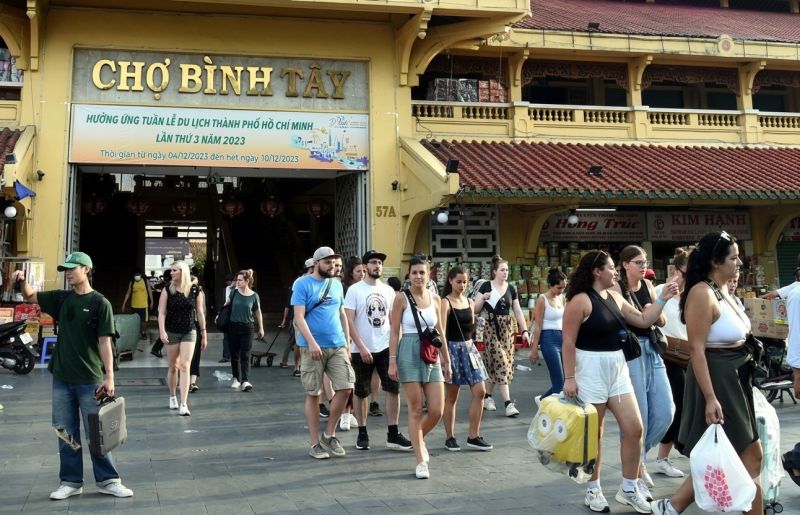
- Tip 1: Cash is mandatory at Binh Tay Market — no card payment is accepted at any stall. Carry VND in small denominations of ₹351 (100,000 VND) and ₹175 (50,000 VND); the nearest ATM is 200 metres from Binh Tay Market’s main gate on Thap Muoi Street.
- Tip 2: Photography is permitted in Binh Tay Market’s central courtyard and all 6 trading sections. Make eye contact and nod before photographing individual vendors — Cantonese vendors at Binh Tay Market accept photography at active trading stalls without objection in most cases.
- Tip 3: Minimum order quantities apply at wholesale stalls — Section 5 and the Thap Muoi-facing corridor are the designated retail zones where individual-item purchases apply with no minimum quantity. Stalls outside Section 5 quote wholesale minimums of 6–24 units per design.
- Tip 4: No air conditioning — internal temperature at Binh Tay Market reaches 35–38°C between 10:00 AM and 2:00 PM. Carry 500ml of water per person and arrive before 9:00 AM to complete Section 5 shopping before the peak heat window.
- Tip 5: Use the Vietnamese name in Grab — search “Chợ Bình Tây” in Google Maps for the correct Binh Tay Market entrance pin; share the Vietnamese name “Chợ Bình Tây” with Grab drivers directly to avoid misdirection to Ben Thanh Market 6 km away in District 1.
- Tip 6: Hindi is not spoken at Binh Tay Market — vendor communication is in Vietnamese, Cantonese, or basic English. The Vietnamese phrase “Tôi muốn mua…” (I want to buy…) followed by pointing at the item and showing a calculator price on your phone is the standard negotiation method at Binh Tay Market’s Sections 4 and 5 stalls.
For further questions Indian tourists commonly ask before visiting Binh Tay Market — including comparisons with Ben Thanh Market and same-day logistics — the answers are below.
Frequently Asked Questions: Binh Tay Market for Indian Tourists
Is Binh Tay Market Worth Visiting for Indian Tourists Who Are Not Shoppers?
Yes — Binh Tay Market’s 1928 Chinese-French colonial heritage building, Quach Dam bronze statue, and Cho Lon district cultural context make Binh Tay Market worth visiting independently of shopping. The 4-entrance gate facade and double-tiered Guangdong-style roof structure are documented as Grade 2 heritage architecture by the Ho Chi Minh City Department of Culture, Sports and Tourism — the only wholesale market in Ho Chi Minh City with this heritage classification.
A photography and architecture visit at Binh Tay Market requires 45 minutes and covers the Thap Muoi gate facade, central courtyard clock tower, and Quach Dam bronze statue. Combining Binh Tay Market with Thien Hau Temple (300 metres from the Thap Muoi main gate) and Nghia An Hoi Quan Pagoda (500 metres) creates a 2-hour Cho Lon heritage walk covering 3 buildings from the 18th–20th century Chinese-Vietnamese architectural period.
Is Binh Tay Market Better Than Ben Thanh Market for Shopping?
Binh Tay Market prices run 30–50% below Ben Thanh Market on comparable souvenir items, with a wholesale-oriented trading floor of 2,300+ stalls versus Ben Thanh Market’s tourist-retail floor of 1,400+ stalls. Ben Thanh Market has air-conditioned sections, a tourist-facing retail floor of 1,400+ stalls, and fixed-price stalls suited to individual souvenir buyers — conditions that differ from Binh Tay Market’s open-hall, wholesale-minimum trading environment. Binh Tay Market provides wholesale pricing, bulk availability, Áo Dài fabric from ₹700 (200,000 VND) per metre, and Cho Lon spice stalls unavailable at Ben Thanh Market.
What Are Binh Tay Market’s Opening Hours in 2026?
Binh Tay Market opens at 6:00 AM and closes at 6:00 PM seven days a week in 2026, with no closure on Vietnamese public holidays and no entry fee. Wholesale stall peak activity at Binh Tay Market ends by 10:30 AM. Section 5 souvenir stalls operate from 8:00 AM to 5:30 PM. No reservation or entry ticket is required to enter Binh Tay Market at any entrance.
How Much Should Indian Tourists Budget for Binh Tay Market?
A standard shopping visit to Binh Tay Market costs ₹1,400–₹2,800 (400,000–800,000 VND) per person, broken down across 4 spending categories:
- Grab transport (return from District 1): ₹250–₹350 (71,000–100,000 VND)
- Section 5 souvenirs (3–5 items): ₹700–₹1,750 (200,000–500,000 VND)
- Cho Lon street food (breakfast and snacks): ₹140–₹350 (40,000–100,000 VND)
- Wholesale purchases (optional, Sections 1–4): ₹350–₹700 (100,000–200,000 VND) per category at minimum order quantities
A photography-only visit to Binh Tay Market with no purchases costs ₹250–₹350 (71,000–100,000 VND) in total — Grab transport from District 1 only.
Can Indian Tourists Visit Binh Tay Market and Ben Thanh Market on the Same Day?
Yes — Binh Tay Market and Ben Thanh Market are visitable in a single morning, starting at Binh Tay Market before 9:00 AM and arriving at Ben Thanh Market by 11:30 AM. The 6 km distance between Binh Tay Market and Ben Thanh Market takes 20–25 minutes by Grab at ₹105–₹175 (30,000–50,000 VND). Allow 90 minutes at Binh Tay Market for Section 5 shopping and courtyard photography, followed by 60–90 minutes at Ben Thanh Market — a combined 4-hour morning block covering both markets before Ben Thanh Market’s peak tourist crowd arrives after 12:00 PM.