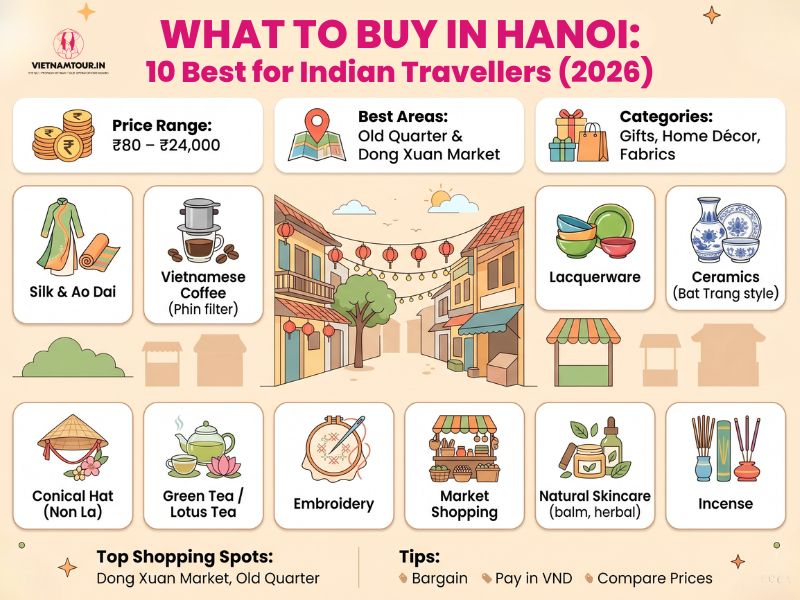
The 10 best souvenirs to buy in Hanoi are Vietnamese silk and Ao Dai, Vietnamese coffee, lacquerware, ceramics, conical hats, green tea, hand-embroidered products, Dong Xuan Market finds, natural skincare products, and incense. Prices start from ₹80 (23,000 VND) for everyday items such as Cao Sao Vàng balm and reach up to ₹24,000 (6,840,000 VND) for premium lacquerware wall panels, depending on type and quality.
Gifting, home décor, and fabric — 3 categories, where Hanoi delivers the highest value for Indian travellers — align directly with the top souvenir categories available in the city. Dong Xuan Market and Hanoi’s Old Quarter are the 2 primary shopping destinations for Hanoi souvenirs — Dong Xuan Market offers wholesale pricing and the Old Quarter provides curated speciality stores.
This Hanoi shopping guide from Vietnamtour.in — the No.1 premium Vietnam tour operator for Indian travellers, serving 428,000+ Indians since 2015 — lists the 10 best souvenirs in Hanoi with INR pricing, where to buy them, and practical shopping tips for Indian travellers in 2026.
#1 — Vietnamese Silk and Ao Dai
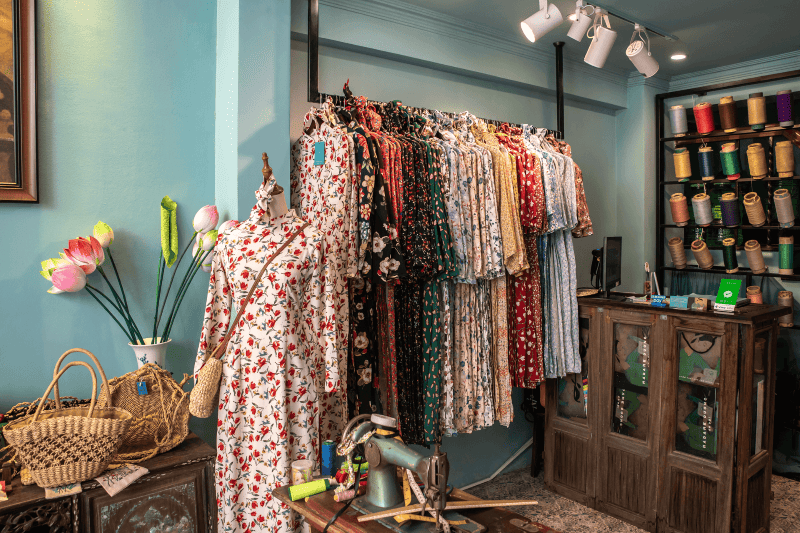
Vietnamese silk is the most popular souvenir for Indian tourists in Hanoi because Hanoi’s silk offers high quality, competitive pricing, and the option of custom tailoring within 24 hours. Vietnamese silk resonates immediately with Indian shoppers who have a lifelong familiarity with silk in daily dress, religious wear, and gifting culture. Vietnamese silk differs from Indian silk varieties in 3 specific ways: thread weight, weave density, and finishing technique.
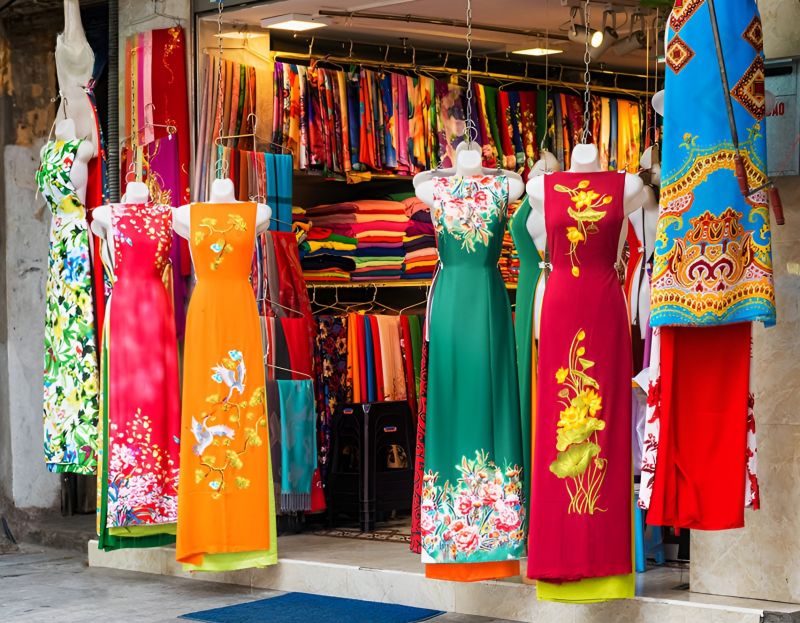
What Is Vietnamese Silk and How Does It Compare to Indian Silk?
Vietnamese silk is woven from silkworm cocoons at weaving villages such as Van Phuc, located 35 km from central Hanoi, with a thread density of 50 to 80 threads per cm².
Vietnamese silk is lighter and thinner than both Kanjivaram and Banarasi silk, making Vietnamese silk the preferred choice for saree blouse lining, dupattas, and custom Ao Dai tailoring among Indian shoppers. Indian women purchase Vietnamese silk in Hanoi specifically for saree blouses and dupattas — a functional use pattern unique to the Indian traveller segment at Hanoi’s silk shops.
How Much Does Vietnamese Silk Cost in Hanoi? (INR Price Guide)
Vietnamese silk fabric in Hanoi costs ₹360 (100,000 VND) per metre wholesale at Dong Xuan Market, ₹800–₹2,400 (225,000–680,000 VND) per metre at Van Phuc Silk Village, and ₹1,200–₹3,500 (335,000–980,000 VND) per metre at Hang Gai Old Quarter shops — a 3–10x price spread between wholesale and retail.
| Location | Price per metre (INR) | Price per metre (VND) | Bargaining? |
|---|---|---|---|
| Dong Xuan Market (2nd floor) | ₹360–₹700 | 100,000–195,000 | Yes |
| Van Phuc Silk Village | ₹800–₹2,400 | 225,000–680,000 | No (fixed) |
| Hang Gai Street | ₹1,200–₹3,500 | 335,000–980,000 | Yes |
Where to Buy Silk in Hanoi: 3 Best Locations
The 3 best locations to buy silk in Hanoi are Van Phuc Silk Village, Hang Gai Street in the Old Quarter, and Dong Xuan Market’s second floor.
Van Phuc Silk Village offers the highest quality Vietnamese silk at fixed prices starting from ₹1,440 (400,000 VND) per metre, with no bargaining required — making Van Phuc Silk Village the most straightforward option for first-time Indian buyers who want authenticity without negotiation stress.
Hang Gai Street, known locally as Silk Street, has 35+ shops selling Vietnamese silk from ₹900 (250,000 VND) per metre, permits bargaining, and employs tailors experienced in stitching Indian dress styles, including saree blouses and salwar kameez. Hang Gai Street is the preferred destination for bulk purchases and custom tailoring orders.
Dong Xuan Market’s second floor sells Vietnamese silk at wholesale prices from ₹360 (100,000 VND) per metre, with no minimum order requirement, and suits Indian families buying fabric for multiple people in a single visit.
#2 — Vietnamese Coffee (Cà Phê)
Vietnamese coffee is the most popular edible souvenir to bring home from Hanoi, with a bolder, denser flavour than Indian filter coffee and prices starting from ₹320 (90,000 VND) per 500g. Vietnamese coffee is brewed using a Phin filter — a slow-drip aluminium device sold alongside the coffee for ₹180 to ₹360 (50,000–100,000 VND) — which produces a concentrated extract that Indian filter coffee makers do not replicate in strength or texture.
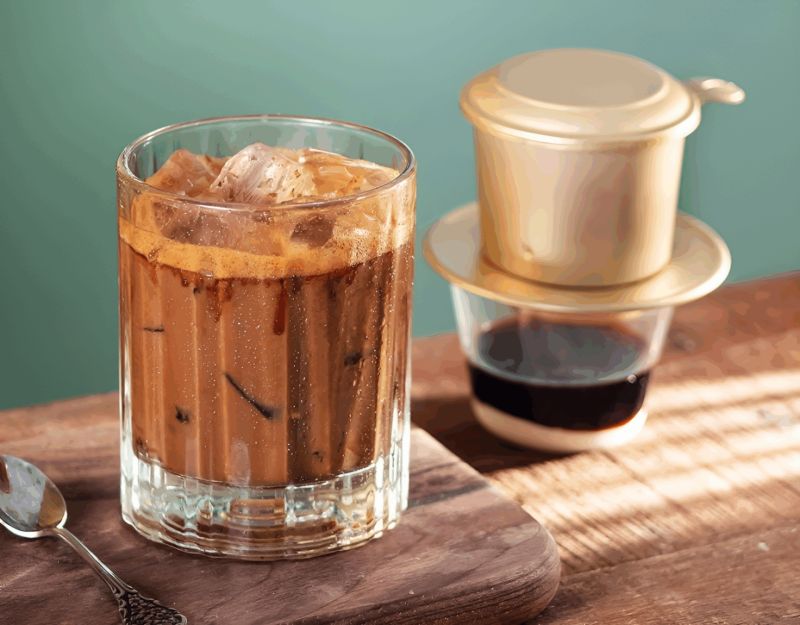
According to Vietnamtour.in tour booking statistics from 46,000+ Vietnam trips by Indian travellers, Vietnamese coffee is the most frequently declared edible souvenir departing from Hanoi, with 3 out of 5 travellers purchasing at least one 500g pack. Coffee combined with a Phin filter forms the most common bundled purchase, priced between ₹500 and ₹900 total.
What Makes Vietnamese Coffee Different from Indian Filter Coffee?
Vietnamese coffee differs from Indian filter coffee in its Robusta-to-Arabica ratio: 65–80% Robusta in Vietnamese blends versus the Arabica-dominant composition of most Indian filter coffee, producing a stronger, bitter flavour and a caffeine content of 200–300 mg per cup compared to 80–120 mg per cup in Indian filter coffee.
The Phin filter — a 4-minute slow-drip metal brewer — extracts Vietnamese coffee concentrate through a gravity-fed drip process, producing a darker and more concentrated result than the decoction method used in South Indian filter coffee, despite operating on a similar slow-extraction principle.
Egg coffee (Cà Phê Trứng) is a Hanoi-exclusive invention from 1946, made by whisking egg yolk into a creamy foam that replaces dairy cream, and sells for ₹180 to ₹360 (50,000–100,000 VND) per cup at specialist cafés in Hanoi’s Old Quarter — a flavour profile unavailable in the Indian market and among the most purchased Hanoi food souvenirs by Indian travellers.
How Much Does Vietnamese Coffee Cost in Hanoi?
Vietnamese coffee in Hanoi costs ₹320–₹640 (90,000–180,000 VND) for 500g of premium ground roast at Dong Xuan Market — equivalent to ₹64–₹128 per 100g — with bundled Phin filter sets adding ₹180–₹360 (50,000–100,000 VND) for a complete brewing kit.
| Coffee Product | Price (INR) | Price (VND) | Best Format For |
|---|---|---|---|
| Ground roast 500g pack | ₹320–₹640 | 90,000–180,000 | Daily home brewing |
| Whole bean 500g pack | ₹400–₹800 | 115,000–230,000 | Grinder owners |
| Phin filter (single) | ₹180–₹360 | 50,000–100,000 | Bundled gifting |
| Coffee + Phin combo | ₹500–₹900 | 145,000–260,000 | Most popular gift bundle |
| Premium Weasel coffee 100g | ₹2,400–₹4,800 | 680,000–1,360,000 | High-value gifting |
Is Vietnamese Coffee Allowed on Flights to India?
Yes, vacuum-sealed packaged coffee under 2 kg is permitted in both checked baggage and carry-on luggage on all flights to India.
Indian customs do not restrict Vietnamese coffee imports for personal use. Indian travellers choose vacuum-sealed bags for packing Vietnamese coffee to prevent aroma transfer to other luggage items. Liquid cold brew coffee exceeding 100 ml is not permitted in carry-on bags under standard IATA liquid restrictions.
#3 — Lacquerware and Traditional Crafts
Lacquerware (Sơn Mài) is Hanoi’s most distinctive decorative souvenir, produced by hand through 7 to 20 layers of tree resin applied over bamboo or wood, with premium pieces taking 3 to 6 months to complete. The 3 to 6 month production time of premium Vietnamese lacquerware is visible in the finished surface — a depth and warmth that mass-produced home décor cannot replicate.
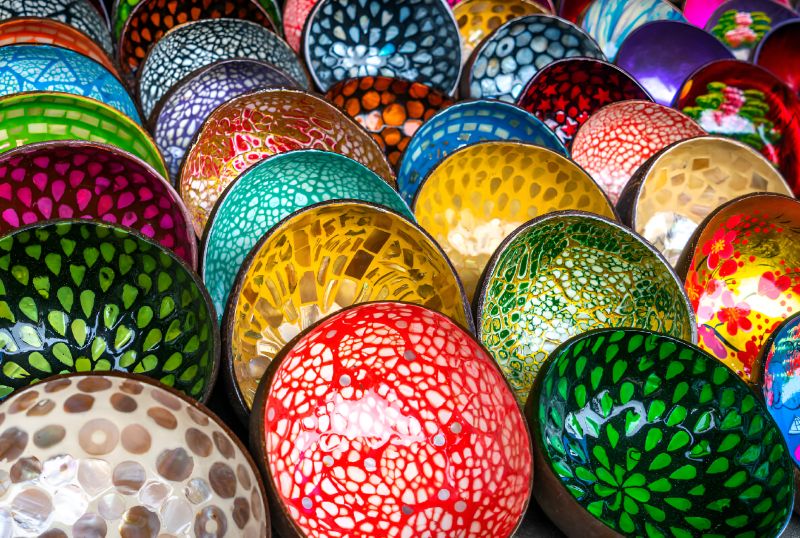
What Is Vietnamese Lacquerware (Sơn Mài) and How Is It Made?
Vietnamese lacquerware is a craft technique that applies resin from the Rhus verniciflua tree over bamboo or wooden bases in multiple layers, creating a durable, high-gloss surface.
Each of the 7 to 20 lacquer layers requires 24 to 48 hours of drying time. Premium large-format Vietnamese lacquerware pieces take 3 to 6 months from base preparation to finished product. For Indian buyers, the closest comparable craft is Rajasthan’s lac-work — but Vietnamese Sơn Mài uses genuine tree resin rather than shellac (lac resin), which is the key distinction when explaining the value difference to family in India.
Surface designs on Vietnamese lacquerware are hand-painted, not printed — featuring Vietnamese countryside scenes, lotus flowers, or egrets. No two Vietnamese lacquerware pieces are identical.
How Much Does Lacquerware Cost in Hanoi?
Vietnamese lacquerware in Hanoi costs ₹640 (180,000 VND) for a small jewellery box, ₹2,400–₹6,400 (680,000–1,820,000 VND) for a medium tray or bowl, and ₹16,000–₹24,000 (4,560,000–6,840,000 VND) for a large hand-painted wall panel — with the 3–6 month production time directly visible in the surface depth and finish.
| Lacquerware Item | Price (INR) | Price (VND) | Production Time |
|---|---|---|---|
| Small jewellery box | ₹640–₹1,200 | 180,000–340,000 | 7–10 days |
| Coaster set (6 pieces) | ₹800–₹2,000 | 225,000–570,000 | 14–21 days |
| Medium decorative bowl | ₹2,400–₹6,400 | 680,000–1,820,000 | 1–2 months |
| Lacquer photo frame | ₹1,200–₹3,200 | 340,000–910,000 | 3 weeks |
| Large wall panel | ₹16,000–₹24,000 | 4,560,000–6,840,000 | 3–6 months |
The best locations to buy lacquerware are Hang Khay Street, which has 7+ specialist shops, and the ground floor of Dong Xuan Market.
How to Identify Authentic Lacquerware vs Plastic Imitations
Authentic lacquerware is heavier, cool to the touch, and has a slightly uneven surface from hand production — plastic imitations are lighter, warm to the touch, and perfectly uniform in the finish.
Three tests confirm authentic lacquerware before purchase: first, check the weight — genuine lacquerware weighs 30–50% more than a plastic piece of identical size; second, place a palm on the surface for 10 seconds — authentic lacquerware stays cool while plastic imitations reach room temperature immediately; third, examine the surface under light — hand-applied lacquer leaves visible texture variation across the finish that plastic imitations cannot replicate.
Signs of a plastic imitation include a perfectly glossy and uniform surface throughout, a hollow sound when tapped, and a price below ₹400 (115,000 VND) for a medium-sized piece — genuine lacquerware of the same size starts from ₹700 (200,000 VND) at reputable Hanoi shops.
#4 — Hanoi Ceramics and Pottery
Bat Trang ceramics are Hanoi’s signature handmade pottery, produced continuously for over 500 years in Bat Trang Village, 14 km from Hanoi city centre. Bat Trang Village is the single source of a distinctive ash glaze that no other Vietnamese ceramic region replicates.
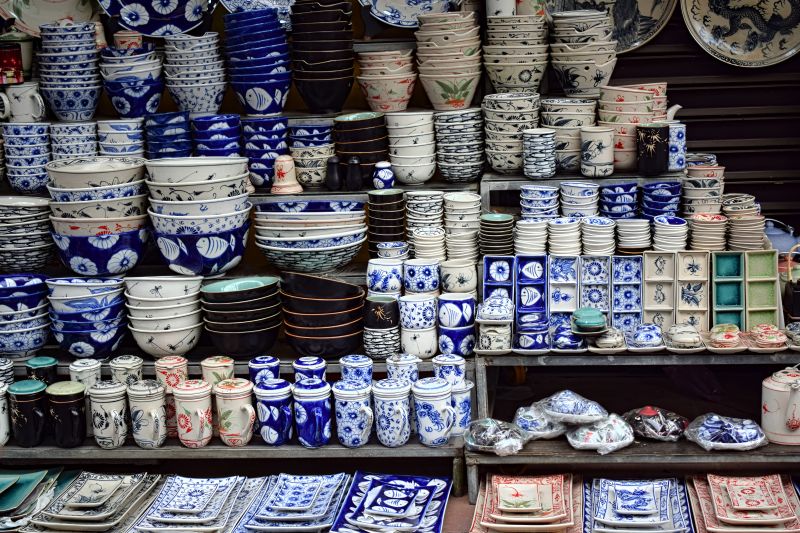
What Makes Bat Trang Pottery Different from Other Vietnamese Ceramics?
Bat Trang pottery is distinguished by its ash glaze technique, which produces a characteristic blue-grey tone exclusive to Bat Trang Village and absent from all other Vietnamese ceramic regions.
Bat Trang Village has over 500 years of production history and began exporting ceramics to Japan and South Korea as early as the 15th century — a heritage standard equivalent to Khurja pottery from Uttar Pradesh for Indian buyers who prioritise provenance when purchasing handmade goods. The Bat Trang ash glaze is a completely separate technique from Indian pottery traditions and has no direct parallel in Indian ceramic production.
Bat Trang potters accept custom name and logo engraving orders on ceramic pieces priced from ₹360 (100,000 VND), completed within 24 hours — a turnaround that makes Bat Trang ceramics a functional choice for Indian families purchasing wedding favours or commemorative gifts during Hanoi visits.
How Much Does Bat Trang Pottery Cost?
Bat Trang pottery costs ₹160 (45,000 VND) for a small tea cup at Bat Trang Village and ₹2,400–₹6,400 (680,000–1,820,000 VND) for a large hand-painted vase — with Bat Trang Village prices running 40–60% below identical pieces sold at Hanoi’s Old Quarter retailers due to absence of middleman margin.
| Bat Trang Item | Price at Village (INR) | Price at Old Quarter (INR) | Saving |
|---|---|---|---|
| Tea cup (small) | ₹160–₹320 | ₹280–₹560 | 40–55% |
| Bowl set (4 pieces) | ₹640–₹1,600 | ₹1,200–₹2,800 | 40–50% |
| Decorative plate | ₹400–₹1,200 | ₹720–₹2,000 | 40–55% |
| Custom-engraved cup | ₹360–₹800 | ₹600–₹1,400 | 35–50% |
| Large hand-painted vase | ₹2,400–₹6,400 | ₹4,000–₹10,000 | 35–55% |
Can You Carry Ceramics on Flights to India?
Yes, ceramic pieces are permitted on flights to India in checked baggage when each ceramic piece is wrapped in a minimum of 3 layers of bubble wrap, with an additional layer of clothing or soft fabric between ceramic pieces. Foam-lined boxes for ceramic transport are available at Bat Trang Village shops for ₹80–₹160 (23,000–45,000 VND) each, and Bat Trang Village shops provide foam-lined boxes free of charge with purchases above ₹3,200 (910,000 VND).
For Indian customs, declare the combined total value of all ceramic pieces if the combined total exceeds ₹5,000 — the ₹5,000 threshold applies to the combined purchase total, not to each individual ceramic piece.
#5 — Conical Hats (Nón Lá)
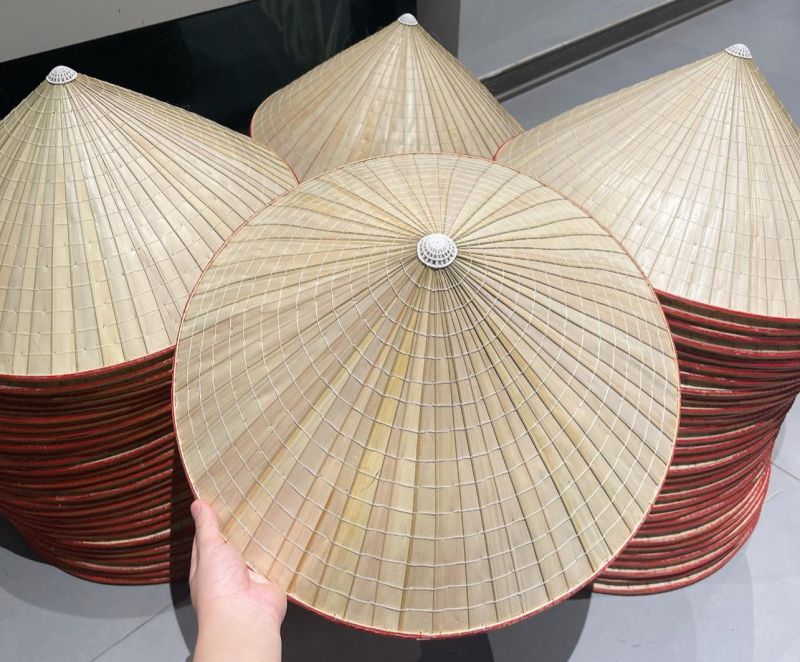
The Nón Lá is the lightest and most iconic Vietnamese souvenir, constructed from 10–15 layers of Latania palm leaves over a bamboo frame, available from ₹160 (45,000 VND), and weighing between 100–180g — light enough to pack flat inside standard cabin luggage without occupying a separate compartment.
What Is the Nón Lá and What Does It Symbolise?
The Nón Lá is a conical palm-leaf hat documented in Vietnamese cultural records dating back 3,000 years, symbolising graceful femininity and rural Vietnamese identity across all regions of Vietnam.
Each Nón Lá is constructed with 10–15 Latania leaf layers stitched over a bamboo frame, producing a finished weight of 100–180g. The Huế Poem Hat (Nón Bài Thơ) is a premium regional variant from Central Vietnam distinguished by embedded poetry visible when held against light, and sells for ₹360–₹720 (100,000–200,000 VND) compared to ₹160–₹320 (45,000–90,000 VND) for standard Nón Lá. Indian buyers familiar with handwoven palm-leaf craft traditions from Kerala and Tamil Nadu recognise the Nón Lá construction method as equivalent in material and labour intensity, though the Nón Lá conical form and Vietnamese symbolic meaning have no direct parallel in Indian hat-making traditions.
How Much Do Conical Hats Cost in Hanoi?
The Nón Lá in Hanoi costs ₹160 (45,000 VND) for a standard tourist piece at Dong Xuan Market and ₹2,400 (680,000 VND) for a premium Huế Poem Hat at Old Quarter speciality shops — a 15x price spread driven by leaf quality, stitch density, and embedded poetry detailing.
| Nón Lá Type | Price (INR) | Price (VND) | Where to Buy |
|---|---|---|---|
| Standard tourist Nón Lá | ₹160–₹320 | 45,000–90,000 | Dong Xuan Market |
| Decorated/painted Nón Lá | ₹400–₹720 | 115,000–200,000 | Hang Bong Street |
| Huế Poem Hat (premium) | ₹720–₹2,400 | 200,000–680,000 | Old Quarter speciality |
| Children’s mini Nón Lá | ₹120–₹240 | 35,000–70,000 | Dong Xuan Market |
Luggage tip: Place the Nón Lá brim-up in the overhead cabin compartment to hold the Nón Lá’s shape without collapsing as long as no heavy item presses directly on it.
#6 — Vietnamese Green Tea and Herbal Products
Vietnamese green tea is the most popular health-oriented souvenir from Hanoi, with Hanoi Lotus Tea (Trà Sen Hà Nội) standing as the most premium variety — Hanoi Lotus Tea requires 1,400 lotus blossoms to produce a single kilogram and sells for ₹1,800–₹5,400 (500,000–1,500,000 VND) per 100g, making Hanoi Lotus Tea unavailable at equivalent quality outside Vietnam.
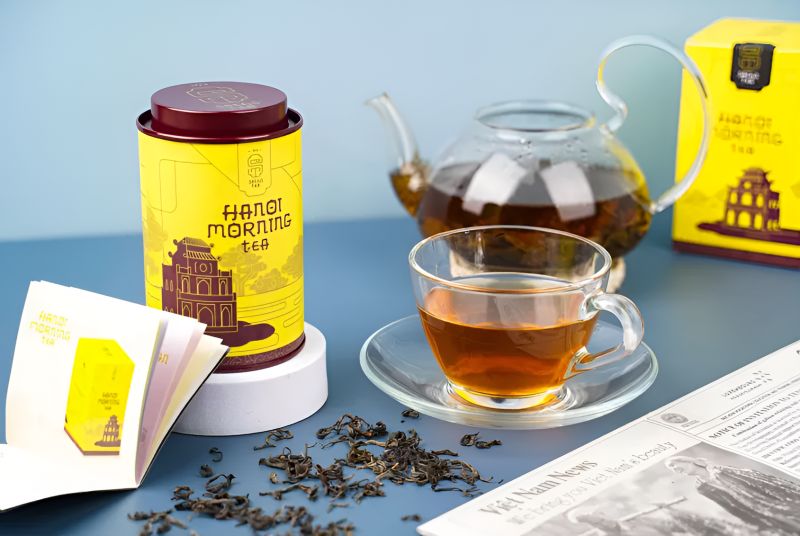
According to Vietnamtour.in traveller feedback, Vietnamese tea is primarily purchased as a gifting souvenir for family members in India, with Lotus Tea and Thai Nguyen green tea forming the most common combination. Vietnamtour.in recommends vacuum-packed tea boxes for Indian travellers carrying multiple gift items.
What Are the Best Vietnamese Teas to Buy in Hanoi?
The 3 best teas to buy in Hanoi are Lotus Tea (Trà Sen), Thai Nguyen Green Tea (Trà Thái Nguyên), and Artichoke Tea (Trà Atiso) from Da Lat, priced from ₹320 (90,000 VND), ₹160 (45,000 VND), and ₹280 (80,000 VND) per 100g, respectively.
Lotus Tea (Trà Sen) is hand-infused by placing green tea leaves inside lotus blossoms overnight to absorb the flower’s natural fragrance — a process requiring 1,400 blossoms per kilogram that places Lotus Tea at ₹1,800–₹5,400 (500,000–1,500,000 VND) per 100g price range and establishes Lotus Tea as the highest-value tea gift category available in Hanoi.
Thai Nguyen Green Tea (Trà Thái Nguyên) is the most widely consumed green tea in Vietnam, grown in plantations 80 km north of Hanoi, and sells for ₹160–₹360 (45,000–100,000 VND) per 100g at Hanoi tea shops — the most affordable premium tea option for Indian buyers purchasing multiple gift portions.
Artichoke Tea (Trà Atiso) is cultivated in Da Lat, 1,500 km south of Hanoi, sells for ₹280–₹560 (80,000–160,000 VND) per 100g, and is purchased by Indian travellers specifically for its documented artichoke-based digestive and liver-support properties — a functional wellness category with established demand among Indian health-conscious consumers.
How Much Does Vietnamese Tea Cost in Hanoi?
Vietnamese tea in Hanoi costs ₹160 (45,000 VND) per 100g for Thai Nguyen green tea and ₹1,800–₹5,400 (500,000–1,500,000 VND) per 100g for premium Lotus Tea — a 10–30x price spread driven by production labour and lotus blossom volume per kilogram of finished tea.
| Tea Type | Price (INR / 100g) | Price (VND / 100g) | Best Buyer Profile |
|---|---|---|---|
| Thai Nguyen Green Tea | ₹160–₹360 | 45,000–100,000 | Bulk gifting, 5+ portions |
| Artichoke Tea (Da Lat) | ₹280–₹560 | 80,000–160,000 | Health-conscious buyers |
| Standard Lotus Tea | ₹320–₹800 | 90,000–225,000 | Mid-range gifting |
| Premium Hanoi Lotus Tea | ₹1,800–₹5,400 | 500,000–1,500,000 | Single high-value gift |
| Vacuum gift box (3 teas) | ₹1,200–₹2,800 | 340,000–795,000 | Multi-recipient gifting |
#7 — Hand-Embroidered Products
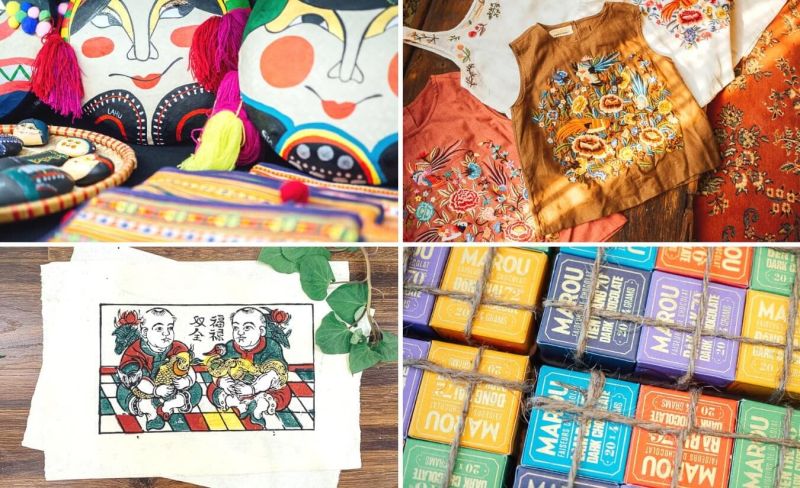
Hanoi hand-embroidered products are the most labour-intensive traditional textile souvenir, completed entirely by hand using cross-stitch technique, with prices starting from ₹160 (45,000 VND) for a bookmark and reaching ₹16,000 (4,560,000 VND) for a large wall panel — a price range that reflects 30–60 hours of skilled hand labour per large piece.
What Types of Embroidered Products Are Popular in Hanoi?
The 6 most popular hand-embroidered products in Hanoi are tablecloths (₹2,400–₹8,000 / 680,000–2,280,000 VND), pillowcases (₹800–₹2,400 / 225,000–680,000 VND), wall art panels (₹4,000–₹16,000 / 1,135,000–4,560,000 VND), handbags (₹1,600–₹4,800 / 455,000–1,360,000 VND), fabric patches (₹160–₹480 / 45,000–135,000 VND), and bookmarks (₹160–₹360 / 45,000–100,000 VND).
Hanoi cross-stitch embroidery requires 30–60 hours of hand labour per large piece, a production standard comparable to Lucknow’s Chikankari — both Hanoi cross-stitch embroidery and Chikankari are traditional hand-embroidery crafts with documented histories dating to the 17th century and equivalent levels of artisanal skill. Hanoi cross-stitch embroidery and Chikankari differ in technique: Chikankari uses shadow-work and pulled-thread methods on white fabric, while Hanoi cross-stitch uses counted coloured threads on natural linen or silk.
Hanoi hand embroidery is identified by a thread density of 25–40 stitches per cm² and slight irregularity visible on the reverse side of the fabric — both characteristics are absent in machine-made embroidery imitations, which show a perfectly uniform stitch pattern and a straight-line mechanical repeat on the reverse side.
How Much Do Embroidered Products Cost in Hanoi?
Hanoi hand-embroidered products cost 3–5 times more than machine-embroidered equivalents, with prices ranging from ₹160 (45,000 VND) for a bookmark to ₹16,000 (4,560,000 VND) for a large wall panel — reflecting 30–60 hours of skilled hand labour per large piece.
| Product | Price (INR) | Price (VND) | Hand Labour Time |
|---|---|---|---|
| Bookmark | ₹160–₹360 | 45,000–100,000 | 2–4 hours |
| Fabric patch | ₹160–₹480 | 45,000–135,000 | 3–6 hours |
| Pillowcase | ₹800–₹2,400 | 225,000–680,000 | 8–15 hours |
| Handbag | ₹1,600–₹4,800 | 455,000–1,360,000 | 15–25 hours |
| Tablecloth | ₹2,400–₹8,000 | 680,000–2,280,000 | 20–40 hours |
| Wall art panel | ₹4,000–₹16,000 | 1,135,000–4,560,000 | 30–60 hours |
#8 — Natural Skincare and Beauty Products
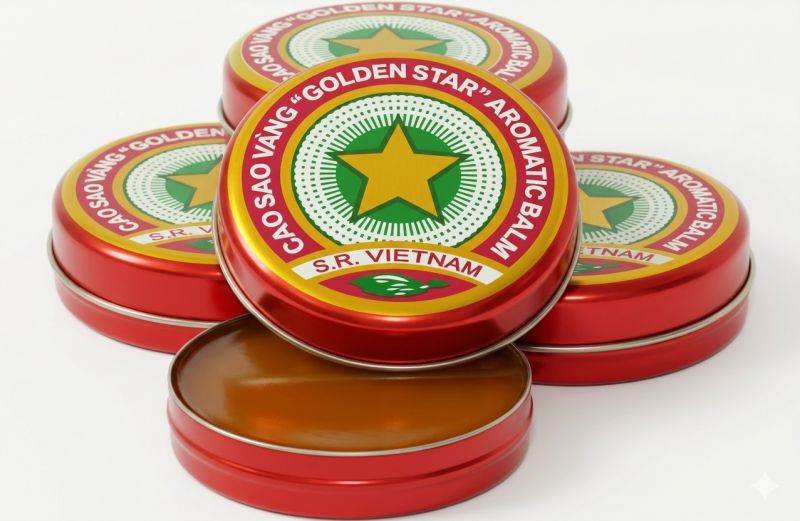
Vietnamese herbal skincare is the fastest-growing souvenir category among Indian travellers in Hanoi, with prices starting from ₹80 (23,000 VND) for Cao Sao Vàng (Golden Star Balm) — the best-selling single skincare product in Hanoi. Vietnamese herbal skincare appeals directly to Indian buyers because 3 of its core active ingredients — rice water, turmeric, and green tea — are established ingredients in Indian Ayurvedic and home beauty traditions.
What Skincare Products Is Vietnam Famous For?
Vietnam is internationally recognised for 4 herbal skincare products: green tea face masks, fermented rice water serums, activated bamboo charcoal cleansers, and Cao Sao Vàng (Golden Star Balm) — all available at Hanoi pharmacies and souvenir shops from ₹80 (23,000 VND) per unit.
Cao Sao Vàng (Golden Star Balm) is a herbal topical balm equivalent in function to Tiger Balm, priced at ₹80–₹160 (23,000–45,000 VND) per tin, and exported to 15+ countries. Cao Sao Vàng is the single most purchased skincare souvenir by Indian tourists in Hanoi — a position driven by its ₹80 entry price, multipurpose pain-relief and decongestant function, and tin size of 3g–20g that fits within standard airline carry-on limits.
Fermented rice water serum sells for ₹360–₹720 (100,000–200,000 VND) per 100ml bottle at Hanoi pharmacies and uses the same active principle as Indian besan and turmeric skincare: fermented grain extract applied topically for skin brightening and conditioning. Vietnamese green tea face masks sell for ₹160–₹480 (45,000–135,000 VND) per pack of 5 in Hanoi — 40–60% below the import price of identical Vietnamese-brand products sold on Indian e-commerce platforms.
How Much Does Vietnamese Skincare Cost in Hanoi?
Vietnamese herbal skincare in Hanoi costs ₹80 (23,000 VND) for an entry-level Cao Sao Vàng tin and ₹720 (200,000 VND) for a premium fermented rice water serum — with most products priced 40–60% below equivalent Vietnamese-brand items sold on Indian e-commerce platforms.
| Skincare Product | Price (INR) | Price (VND) | Carry-on Allowed? |
|---|---|---|---|
| Cao Sao Vàng balm (3g–20g) | ₹80–₹160 | 23,000–45,000 | Yes (solid) |
| Green tea face mask (5 pack) | ₹160–₹480 | 45,000–135,000 | Yes (dry sheet) |
| Bamboo charcoal cleanser bar | ₹120–₹320 | 35,000–90,000 | Yes (solid) |
| Fermented rice water serum 100ml | ₹360–₹720 | 100,000–200,000 | No (liquid >100ml) |
| Vietnamese essential oil set | ₹560–₹1,200 | 160,000–340,000 | No (liquid) |
Are Vietnamese Skincare Products Safe to Bring to India?
Yes, Vietnamese skincare products are permitted for import into India and are not listed in any restricted category under Indian Central Board of Indirect Taxes and Customs regulations.
IATA carry-on liquid rules apply to Vietnamese skincare products on flights to India: all liquid, gel, and cream skincare products above 100 ml — including serums, toners, and moisturisers — must travel in checked baggage, not carry-on. Vietnamese skincare products under 100 ml that bypass liquid carry-on restrictions include sheet masks (dry format), solid balms such as Cao Sao Vàng, and bar soaps — all 3 product types are available at Hanoi pharmacies from ₹80 (23,000 VND) per unit.
Indian customs classifies purchases of 10 or more units of the same skincare product as a commercial import rather than personal-use — buyers who purchase 10+ identical units face declaration requirements and potential duty assessment at Indian ports of entry.
#9 — Incense and Spiritual Products
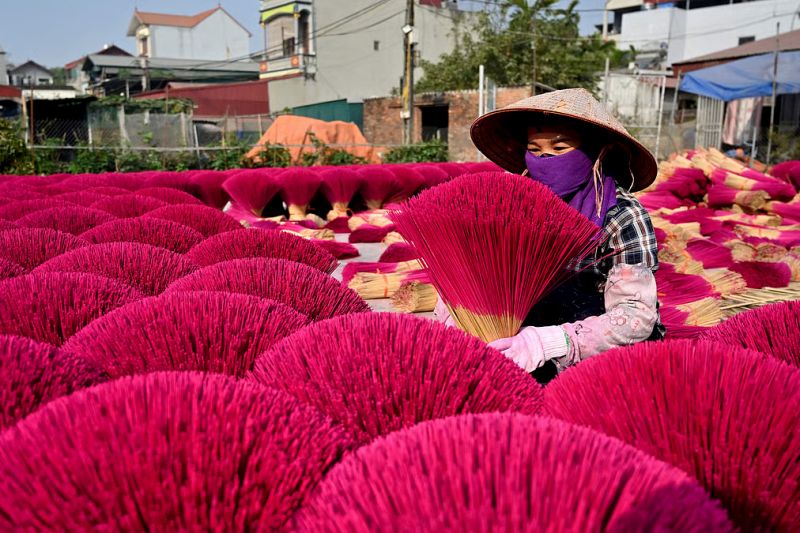
Vietnamese incense is the most spiritually meaningful souvenir for Indian families in Hanoi, available in 4 fragrance types immediately recognisable to Indian incense users — agarwood, sandalwood, lotus, and cinnamon — produced at traditional craft villages within 30 km of Hanoi city centre, with prices starting from ₹120 (35,000 VND) per bundle.
What Types of Vietnamese Incense Are Available in Hanoi?
The 4 main incense types available in Hanoi are agarwood (nhang trầm hương) from ₹360 (100,000 VND) per bundle, sandalwood (nhang gỗ đàn hương) from ₹200 (55,000 VND) per bundle, lotus from ₹120 (35,000 VND) per bundle, and cinnamon from ₹120 (35,000 VND) per bundle — all produced at incense craft villages within 30 km of Hanoi.
Quang Phu Cau Village, located 10 km south of Hanoi, produces 60% of northern Vietnam’s incense supply. Indian tourists who visit Quang Phu Cau Village purchase incense directly from producers at prices 30–40% below Hanoi Old Quarter retail rates — a bundle priced at ₹200 (55,000 VND) in the Old Quarter costs ₹120–₹140 (35,000–40,000 VND) at Quang Phu Cau Village.
Vietnamese coil incense (nhang cuộn) burns for 12 continuous hours compared to the 30-minute burn time of a standard Indian agarbatti stick — Vietnamese coil incense is the most practical format for extended Hindu puja, meditation, or home ceremonial use among Indian buyers. Vietnamese coil incense sells for ₹280–₹560 (80,000–160,000 VND) per coil pack of 10 at Hanoi incense shops.
Vietnamese agarwood incense (nhang trầm hương) is produced from Aquilaria tree resin — the same botanical source as Oud used in Indian incense and perfume traditions. Vietnamese agarwood incense sells for ₹360–₹1,800 (100,000–500,000 VND) per bundle, depending on resin concentration, making Vietnamese agarwood incense the highest-value incense souvenir category available in Hanoi for Indian buyers who use Oud-based fragrance in religious or home settings.
How Much Does Vietnamese Incense Cost in Hanoi?
Vietnamese incense in Hanoi costs ₹120 (35,000 VND) per bundle for lotus or cinnamon stick incense and ₹1,800 (500,000 VND) per bundle for premium agarwood — running 60–70% less than equivalent Oud or agarwood incense products sold in the Indian market.
| Incense Type | Price (INR / bundle) | Price (VND / bundle) | Burn Time |
|---|---|---|---|
| Lotus stick incense | ₹120–₹240 | 35,000–70,000 | 30 min/stick |
| Cinnamon stick incense | ₹120–₹240 | 35,000–70,000 | 30 min/stick |
| Sandalwood stick incense | ₹200–₹400 | 55,000–115,000 | 30 min/stick |
| Standard agarwood incense | ₹360–₹720 | 100,000–200,000 | 45 min/stick |
| Premium agarwood incense | ₹720–₹1,800 | 200,000–500,000 | 45 min/stick |
| Coil incense (10 pack) | ₹280–₹560 | 80,000–160,000 | 12 hr/coil |
#10 — Dó Paper and Propaganda Posters
Two additional Hanoi souvenirs popular among Indian art collectors and home décor buyers are Dó paper handicrafts (₹240–₹1,600 / 70,000–460,000 VND) and Vietnamese propaganda posters (₹400–₹2,000 / 115,000–570,000 VND), both produced in Hanoi craft districts and unavailable at equivalent quality outside Vietnam.
What Is Dó Paper and Why Indian Buyers Choose It?
Dó paper (giấy dó) is a traditional handmade paper produced from Rhamnoneuron balansae bark at Yen Thai Village, 25 km from Hanoi, with a 700-year production history and natural anti-insect properties that preserve writing and painting for 500+ years — a longevity record that places Dó paper in the same archival category as Indian palm-leaf manuscripts and Khadi paper used in Madhubani painting traditions.
Dó paper handicrafts available in Hanoi include calligraphy paper sheets (₹240–₹480 / 70,000–135,000 VND per pack of 10), Dó paper notebooks (₹400–₹800 / 115,000–225,000 VND), and framed Dó paper artwork (₹800–₹1,600 / 225,000–460,000 VND) — sold at Hang Gai Street and Yen Thai Village direct producer outlets.
Propaganda Posters: Hanoi’s Most Recognisable Modern Souvenir
Vietnamese propaganda posters from the 1950s–1980s are reprinted from original silkscreens at Hanoi Propaganda Poster Shop on Hang Gai Street and at independent design studios on Hang Bong Street, sold for ₹400–₹2,000 (115,000–570,000 VND) per A3-size print, and represent the most photographed and gifted modern Vietnamese souvenir among Indian art collectors.
Đông Hồ folk paintings (Tranh Đông Hồ) are traditional woodblock prints produced at Đông Hồ Village in Bắc Ninh province, 35 km from Hanoi, with themes of prosperity, harvest, and family — themes that overlap directly with Indian Madhubani and Warli folk painting traditions. Đông Hồ paintings sell for ₹320–₹1,200 (90,000–340,000 VND) per print at Hanoi art galleries on Hang Trong Street.
| Paper / Art Item | Price (INR) | Price (VND) | Where to Buy |
|---|---|---|---|
| Dó paper sheets (10 pack) | ₹240–₹480 | 70,000–135,000 | Yen Thai Village |
| Dó paper notebook | ₹400–₹800 | 115,000–225,000 | Hang Gai Street |
| Framed Dó artwork | ₹800–₹1,600 | 225,000–460,000 | Old Quarter galleries |
| Propaganda poster (A3) | ₹400–₹2,000 | 115,000–570,000 | Hang Gai Propaganda Shop |
| Đông Hồ folk painting | ₹320–₹1,200 | 90,000–340,000 | Hang Trong Street galleries |
What Should Indian Tourists Know Before Shopping in Hanoi?
Indian tourists shopping in Hanoi need to know 5 essentials: (1) bargaining is expected at open markets but not at fixed-price shops, (2) opening prices run 200–400% above transaction value, (3) VND cash beats card payment by 3% surcharge, (4) Bat Trang Village offers 40–60% lower prices than Old Quarter retailers, and (5) ATM withdrawal at malls is 50–100% cheaper than Old Quarter street ATMs.
Indian tourists shopping in Hanoi operate across two distinct pricing environments: negotiation-based open markets where opening prices run 200–400% above the final transaction price, and fixed-price branded shops and galleries where the listed price is the sale price.
Hanoi’s 10 souvenir categories are divided across these two environments by product type: edible souvenirs (coffee, tea, herbal products) are available at both fixed-price pharmacies and negotiable market stalls, while handicraft souvenirs (lacquerware, embroidery, ceramics) are available at Bat Trang Village at fixed producer prices and at Dong Xuan Market at negotiable wholesale prices. Indian buyers who visit one fixed-price shop before entering an open market establish a price reference point that reduces overpayment by 30–50% on comparable items.
Dong Xuan Market Shopping Guide
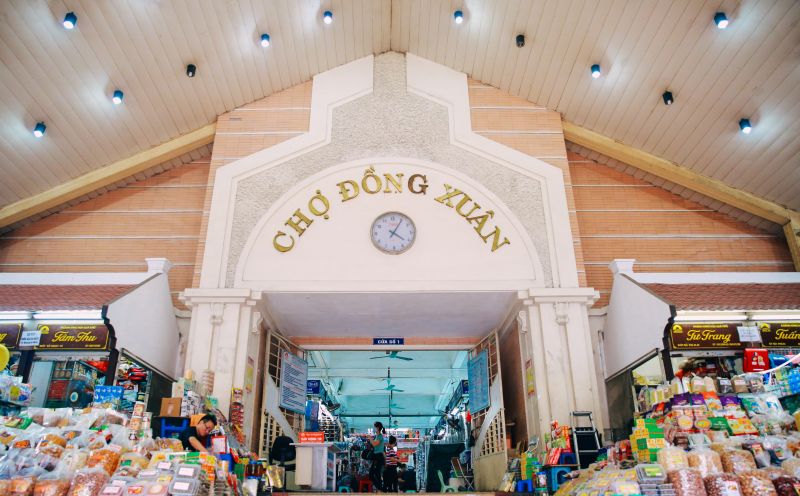
Dong Xuan Market is Vietnam’s largest indoor market, with 2,000+ stalls across 3 floors and daily operating hours from 6:00 AM to 6:00 PM, with wholesale prices starting from ₹35 (10,000 VND) per item on the souvenir floor — the lowest baseline prices for souvenirs among all Hanoi shopping destinations.
What Is Dong Xuan Market and How Is It Organised?
Dong Xuan Market is organised across 3 floors: the ground floor sells fresh food and wet market produce; the first floor sells fabric, clothing, and textile wholesale from ₹180 (50,000 VND) per metre; the second floor sells souvenirs, electronics, and decorative goods from ₹35 (10,000 VND) per piece.
Dong Xuan Market is located on Dong Xuan Street, Hoan Kiem District, a 10-minute walk from Hoan Kiem Lake. Peak shopping hours at Dong Xuan Market are 9:00 AM to 12:00 PM, when stall density and vendor availability are highest. The Hang Dao Weekend Night Market runs every Friday, Saturday, and Sunday from 7:00 PM to midnight, directly adjacent to Dong Xuan Market — a location that combines Dong Xuan Market and the Hang Dao Weekend Night Market into a single evening visit, practical for Indian tourists staying in the Old Quarter.
7 Bargaining Tips for Indian Shoppers at Dong Xuan Market
Opening prices at Dong Xuan Market for tourist souvenirs run 200–400% above the final transaction price — Indian shoppers who apply the 7 bargaining techniques below consistently close purchases at 25–35% of the opening quote.
- Start your counter-offer at 25–30% of the first quoted price — the first quoted price at Dong Xuan Market is 200–400% above the actual transaction value.
- Walk away from the stall — Dong Xuan Market sellers call buyers back within 5 metres and offer a 40–60% price reduction to close the sale.
- Buy 3 or more items from one stall — purchasing 3 or more items from a single Dong Xuan Market stall reduces the per-item price by 20–40% through informal wholesale pricing.
- Pay in Vietnamese Dong (VND) — card payments at Dong Xuan Market attract a 3% surcharge at most stalls, and USD transactions return less favourable rates than VND cash.
- Shop between 7:00 AM and 9:00 AM — Dong Xuan Market sellers accept lower opening counter-offers in the first 2 hours of trading before peak foot traffic begins.
- Compare prices across 3 stalls on the same floor before committing — prices for identical items at Dong Xuan Market vary by 20–30% within a single floor.
- Carry small denomination VND notes (10,000–50,000 VND) — small denomination notes eliminate incorrect change disputes, which occur at an estimated 1 in 5 high-volume souvenir transactions at Dong Xuan Market.
What Is the INR to Vietnamese Dong Exchange Rate? (2026)
The INR to VND exchange rate in 2026 is approximately ₹1 = 280–300 VND, with a mid-rate of ₹1 = 290 VND used as the standard working rate for Hanoi shopping calculations. To convert VND prices to INR, remove 3 zeros from the VND price and divide by 0.29 — 300,000 VND ÷ 290 = ₹1,000.
For ATM withdrawals in Hanoi, ATMs inside large shopping malls charge 20,000–40,000 VND (₹65–₹130) per transaction. Street ATMs in Hanoi’s Old Quarter charge up to 60,000 VND (₹195) per transaction — a fee 50–100% higher than mall ATMs for identical withdrawal amounts. Check the live INR to VND rate on Google or XE.com on the day of travel, as the rate moves within a ±5% band monthly.
Hanoi Shopping FAQs for Indian Travellers
Is Bargaining Expected at All Markets in Hanoi?
Yes, bargaining is standard at Hanoi’s open markets and Dong Xuan Market; bargaining is not practised at Hanoi shops with printed price tags, commercial malls, or art galleries.
Fixed pricing at Hanoi shops is confirmed by 3 signs: clearly printed price boards, staff in uniforms, and shops that issue printed receipts. Indian buyers who bargain at Hanoi open markets achieve a 20–40% reduction on souvenir prices and a 10–20% reduction on textile prices when purchasing 3 or more items per transaction.
What Is the Best Market in Hanoi for Souvenirs?
Dong Xuan Market is the best market in Hanoi for souvenirs overall, with wholesale prices starting from ₹35 (10,000 VND) per item and the widest product variety across 2,000+ stalls; the Hang Dao Weekend Night Market is the best option for curated handmade crafts.
Dong Xuan Market suits bulk buying — the market’s 2,000+ stalls cover souvenirs, textiles, and electronics across 3 floors with no minimum purchase requirement. The Hang Dao Weekend Night Market, held every Friday, Saturday, and Sunday from 7:00 PM to midnight, stocks handmade crafts from independent artisans at prices averaging ₹360–₹1,800 (100,000–500,000 VND) per piece — 30–50% above Dong Xuan Market prices but with verified handmade provenance. Hom Market, located on Hue Street in Hai Ba Trung District, specialises in fabric and silk tailoring with minimum fabric purchases from ₹540 (150,000 VND) per metre, and suits Indian buyers ordering silk in volumes above 5 metres for saree or ethnic wear tailoring.
What Is the Most Popular Souvenir in Hanoi for Indian Tourists?
The most popular souvenir in Hanoi for Indian tourists is Vietnamese silk fabric, purchased by 60% of Indian travellers booking through Vietnamtour.in for use in saree blouses, dupattas, and custom Ao Dai tailoring — a functional textile use pattern unique to the Indian traveller segment that drives silk to the top of the souvenir spend distribution.
Vietnamese coffee ranks second by purchase frequency among Indian travellers, with 3 out of 5 travellers buying at least one 500g pack from Hanoi as recorded across 46,000+ Vietnamtour.in tour bookings since 2015.
What Is the Cheapest Souvenir to Buy in Hanoi?
The cheapest souvenir to buy in Hanoi is Cao Sao Vàng (Golden Star Balm), priced at ₹80 (23,000 VND) per tin, followed by lotus and cinnamon incense bundles at ₹120 (35,000 VND) and Nón Lá conical hats at ₹160 (45,000 VND) — all 3 fit within a ₹500 souvenir budget for 5 family members.
Indian families travelling on a combined ₹3,200 souvenir budget can buy 1 of each item from 8 of the 10 souvenir categories listed above by mixing entry-level pricing from Dong Xuan Market and Bat Trang Village.
How Much Shopping Budget Should Indians Set Aside for Hanoi?
Indian travellers should budget ₹3,200–₹32,000 for Hanoi shopping, depending on spending style — entry budget at ₹3,200 covers one item from each major souvenir category, mid-range at ₹12,000 covers premium silk fabric plus full Bat Trang dinner set, and upper budget at ₹32,000 covers a custom-tailored Ao Dai plus large lacquerware wall panel and premium Hanoi Lotus Tea gift box.
| Budget Tier | Total Budget | What It Covers |
|---|---|---|
| Entry | ₹3,200–₹6,400 | 1 item per major category |
| Mid-range | ₹6,400–₹16,000 | Premium silk + ceramic dinner set |
| Upper | ₹16,000–₹32,000 | Custom Ao Dai + lacquerware panel + premium tea |
Complete Hanoi Shopping Guides
Hanoi’s shopping zones extend across 7 districts, from modern malls in Ba Dinh and Tay Ho to boutique design stores in the Hanoi Old Quarter and wholesale markets in Hoan Kiem — with price ranges spanning ₹35 (10,000 VND) at Dong Xuan Market stalls to ₹160,000 (45,000,000 VND) at premium silk galleries. Indian tourists who plan shopping across multiple Hanoi districts reduce the average spend per souvenir by 25–40% compared to buying exclusively from Old Quarter retail shops. The shopping in Hanoi guide covers all major malls, boutiques, and street shopping zones with transport directions and 2026 opening hours for each venue.
Hanoi’s major markets — Dong Xuan Market, the Hang Dao Weekend Night Market, and Quang Ba Flower Market — each operate on different schedules and serve distinct product categories. The shopping malls in Hanoi guide provides venue-specific profiles including product specialisations, opening hours, and price benchmarks for Indian buyers planning a multi-market shopping itinerary.
For craft village visits beyond the Old Quarter, the Bat Trang Pottery Village guide, Van Phuc Silk Village guide, and Quang Phu Cau Incense Village guide provide transport directions, half-day itineraries, and producer-direct pricing benchmarks.
What NOT to Buy in Hanoi
The 4 product categories to avoid buying in Hanoi are counterfeit branded goods, mass-produced items sold as handmade, wildlife-derived products, and unsealed food items — all 4 categories carry legal consequences at Indian customs entry.
Counterfeit branded goods (Louis Vuitton, Nike, and replica luxury brands) are subject to seizure at Indian customs and prosecution under India’s Trade Marks Act 1999 (Section 103, see indiacode.nic.in), which carries penalties of 6 months to 3 years imprisonment and fines of ₹50,000 to ₹200,000 — applicable regardless of purchase price or country of origin.
Mass-produced items sold as handmade are identified by one measurable sign: 50 or more identical products stacked or displayed together confirm industrial manufacturing. Genuine handmade items at Hanoi markets show visible variation between individual pieces and are sold in quantities of 5 or fewer identical units per stall display.
Wildlife-derived products — including coral decorations, tortoiseshell items, and snakeskin goods — are prohibited under the CITES Convention (cites.org) and India’s Wildlife Protection Act 1972, with penalties of 3 to 7 years imprisonment for import into India. The CITES prohibition and India’s Wildlife Protection Act 1972 apply to wildlife-derived decorative items sold openly in Hanoi tourist markets, not only to items labelled as wildlife products.
Unsealed food items are confiscated at Indian customs entry under restrictions on unprocessed agricultural produce — factory-sealed, commercially packaged food products with printed batch numbers and expiry dates pass Indian customs inspection without confiscation risk.